

Season 1, Episode 1947 · All Things Policy
You Can Have a Rocket and Still Lose Access to Space | Space Launch 2
3 Sep 2026 · 29 min
Season 1, Episode 1947 · All Things Policy
3 Sep 2026 · 29 min
A rocket is only useful if it has somewhere reliable to launch from. Lokendra Sharma and Ashwin Prasad Rao discuss how geography, launch ranges, sea launch and access to foreign spaceports shape national launch capacity. They also examine India’s dependence on Sriharikota, the role of Kulasekarapattinam, and whether Technology Safeguards Agreements and overseas launch sites could give India more resilient access to orbit. The discussion draws on this recent newsletter edition discussing global space launch: https://orrery.ashwinprasadrao.com/p/still-on-the-umbilical For those interested in…
by Takshashila Institution · English · News
Ever wondered how automation will change the world? Maybe you puzzle over what India could do to ease traffic congestion, or how China's aircraft carriers will transform Indian Ocean geopolitics?
S1 · E1950 · 8 Sep 2026 · 38 min
A Chinese shipping company – Sea Legend- announced that it will be starting container shipping services between China’s east coast and the UK through the 'Ice Silk Road'. In this episode, Bhumika Sevkani and Anushka Saxena talk about the potential of the alternative route, the China-Russia partnership in the Arctic and the leverage that the Ice Silk Road could provide going ahead. Tune in to understand the global implications of exploring this trade route as well as the interests and actions of various geopolitical actors in the Arctic. All Things Policy is a daily podcast on public policy…
S1 · E1949 · 7 Sep 2026 · 31 min
What does the emerging Mecca Pact mean for regional security and, more crucially, for India? In this episode of All Things Policy, Research Analysts Aishwaria Sonavane and Adya Madhavan deliberate on the trilateral defence arrangement between Saudi Arabia, Turkiye and Pakistan, analysing its capabilities, strategic asymmetries, and the gap between collective-defence commitments on paper and immediate operational realities. From the perspective of a Pakistan-Saudi nuclear umbrella to questions of military interoperability and Pakistan's long-term capability development, they examine what…

S3 · E1948 · 4 Sep 2026 · 50 min
On 31 August 2026, the Ministry of Electronics & Information Technology (MeitY) notified Semicon 2.0 – Scheme for the development of Semiconductor Design and Manufacturing Ecosystem in India. To discuss the hits and misses of this new architecture, Pranay Kotasthane speaks to Sunil Acharya, Management Director of the Semiconductor Future Accelerator Lab Foundation (SFAL). Sunil breaks down the incentives for chip design firms and explains how investors and entrepreneurs might perceive these changes. Read more: https://egazette.gov.in/WriteReadData/2026/275860.pdf All Things Policy is a daily…
S1 · E1946 · 2 Sep 2026 · 29 min
Private rockets may be built by companies, but who gives them enough demand to survive and scale? Lokendra Sharma and Ashwin Prasad Rao discuss how government procurement has shaped launch capacity in the United States and China, why India has largely supported the supply of rockets rather than buying launches, and how anchor contracts could help build a stronger domestic launch industry. The discussion draws on this recent newsletter edition discussing global space launch: https://orrery.ashwinprasadrao.com/p/still-on-the-umbilical For those interested in exploring these questions further,…
S1 · E1945 · 1 Sep 2026 · 28 min
A 15-minute city is an urban planning concept where all daily essential services are accessible within a 15-minute walk or bike ride from any resident's front door. Developed by Franco-Colombian scholar Carlos Moreno and popularised in Paris, the model aims to reduce car dependency, lower carbon emissions, and boost local quality of life. But would this concept play out well in the average Indian city? To unpack this question and more, Kripa Koshy (Staff Programme Manager) is joined by Sarthak Pradhan (Assistant Professor, Economics) and Suman Joshi (Staff Programme Manager) in this latest…
S1 · E1944 · 31 Aug 2026 · 38 min
In this episode of All Things Policy, Vanshika Saraf and Abhishek Kadiyala examine what the war on Iran means for the November 2026 midterm elections in the U.S. The joint U.S. and Israeli strikes that began on 28 February 2026 have not become a campaign issue in their own right, with only 4 per cent of Americans naming foreign policy as their top concern by July. The conversation applies a test drawn from Iraq in 2002 and Afghanistan in 2010, which is that American wars seldom rank as voter priorities yet often worsen the issues that do. The episode works through the evidence, including…
S1 · E1972 · 12 Oct 2026 · 31 minNew
How does a young officer’s “Why not?” become a senior officer’s “Better not”? In this episode of All Things Policy, Dr Y. Nithiyanandam, Professor at the Takshashila Institution, speaks with Cmde (Dr) Arun Pratap Golaya (Retd) about The Inverse Law of Innovation: the idea that openness to new ideas in government declines with years of service. Drawing on his experience in naval innovation, Golaya explores how career risks, rigid procedures and the “frozen middle” can stall promising ideas. Together, they discuss small experiments, leadership support and rewarding outcomes, asking a vital…

S1 · E1971 · 9 Oct 2026 · 35 minNew
China is often seen as a highly centralised system where policy is decided at the top and simply implemented by the bureaucracy. But is Chinese policymaking really that straightforward? In this episode, Shreya Ramakrishnan speaks with Shobhankita Reddy about how policymaking actually works in China. They explore the iterative nature of the policymaking process, the different stakeholders who shape it, and how these dynamics are reflected in China’s approach to AI. The conversation then looks at the broader domestic economic trends shaping China’s technology ecosystem, and what these could…
S1 · E1970 · 8 Oct 2026 · 31 min
In this episode of All Things Policy, Aditi Palo speaks with Abhishek Kadiyala about the impacts of an altered US Congress composition on India-US ties. In the past, the US Congress has proven to be a relatively consistent element in India-US ties and a reliable institution in times of political uncertainty. But early trends in the midterm elections indicate a shift towards a more ideologically divided composition of Congress, which could potentially erode this very reliability. Aditi and Abhishek unpack the uncertainties a fragmented Congress would bring in, and delve into the measures…
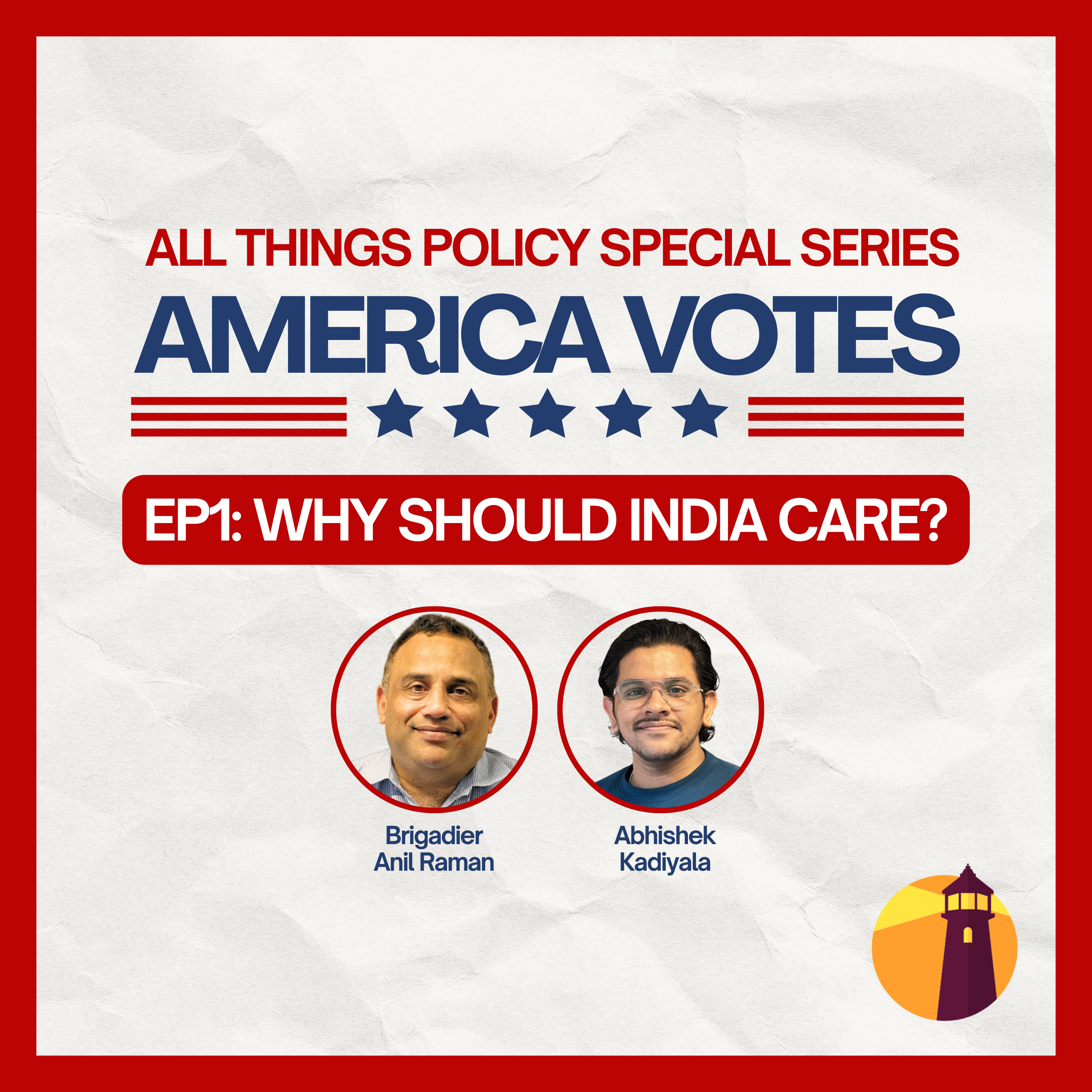
S1 · E1969 · 7 Oct 2026 · 35 min
In this inaugural episode of 'America Votes', All Things Policy's series covering the US mid-terms, Brigadier Anil Raman and Abhishek Kadiyala cover the early trends in November elections. They discuss the process, the politics and its relevance for India. It frames the midterms as a contest for Congress, whose powers over war, tariffs and aid outlast any executive action. Tracing the President's record-low approval and Republican fears, the episode shows how American domestic politics now sets the cost and tone of ties with India. It argues that India remains strategically essential but…

The Melo app keeps playing with the screen off, works in the car and on your watch, wakes you to your station, and browses the whole catalogue offline. Free, no ads, no account.


