Episode notes
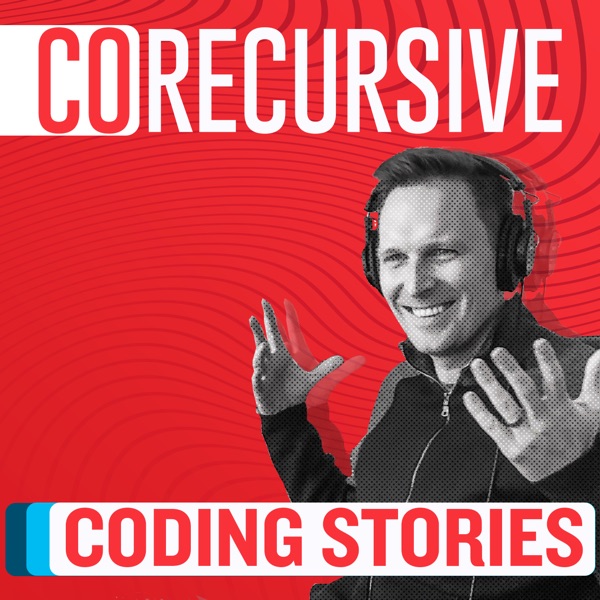
What do we risk when we let AI do the heavy lifting in our coding? Are we giving up the thinking that makes us good at what we do? And as expectations keep rising to match productivy gains, is all this speed really helping, or just making us busier? Today, let's look at the tradeoffs of coding with AI and why the hardest part might be deciding what to hold onto, and what to let go. Episode Page Support The Show Subscribe To The Podcast Join The Newsletter
CoRecursive: Coding Stories
by Adam Gordon Bell - Software Developer · English · Tech & Science
The stories and people behind the code. Hear stories of software development from interesting people.
More from CoRecursive: Coding Stories
-
E116 · 4 Nov 2025 · 44 min
Story: Godbolt's Rule - When Abstractions Fail
What do you do when your code breaks and the only fix is to dig into the runtime below? Matt Godbolt lives for that. Tile-based renderers, color-coded scanlines, zero-copy NICs—each story is a clue that leads past the abstraction to the real machine. He shares the rule that guides him: master your layer, learn the one below, and know the outline of the layer under that. Matt Godbolt's journey proves the real breakthroughs are hideen behind the abstrations where you are comfortable and familiar. Episode Page Support The Show Subscribe To The Podcast Join The Newsletter
-
E115 · 2 Oct 2025 · 55 min
Story: Risk Rolls Downhill - The Software Bug That Sent People to Prison
What if a software bug drained your savings, ruined your reputation, and nobody believed it wasn't your fault? Scott Darlington took over a village post office, hoping to give his family a steady life. But the software system kept showing cash shortfalls he couldn't explain. Each time, the Post Office told him the numbers were right and made him pay the difference out of his own pocket. Eventually it became too much and actions Scott took to protect himself lead to his arrest and public shaming. How do you build trust in systems when the people behind them refuse to admit they're broken?
-
2 Sep 2025 · 9 min
Quick Update
A quick update from Adam about the podcast's current state, consistency challenges, and what's coming next. Episode Page Support The Show Subscribe To The Podcast Join The Newsletter
-
S113 · E113 · 2 Jul 2025 · 40 min
When AI Codes, What's Left for me?
I've always found meaning—and a lot of strength—in building things. Now, with AI coding agents changing the way we work, it's easy to feel threatened, like something essential might get taken away. But honestly, that creative urge can't be replaced by any tool. In this episode, I talk about what it's like when your identity is tied to making things, and the tools suddenly change. Episode Page Support The Show Subscribe To The Podcast Join The Newsletter
-
E112 · 3 Jun 2025 · 48 min
Story: Coding Through Chaos : Addiction, Recovery and Acceptance
What if your search for connection took you somewhere you never meant to go—almost costing you everything? John Walker grew up building computers and exploring early internet forums, always looking for a place to fit in. As a teenager, he hacked his school network and spent hours on IRC, but loneliness crept in. Drugs became a fun exploration and a social experiment. But soon, addiction pulled him into homelessness and jail. Even at his lowest, John turned to online communities. He ran IRC bots to keep recovery chatrooms safe from trolls and built scrapers to solve tough data problems at…
-
E111 · 2 May 2025 · 45 min
Story: The Power of Context: Reimagining Learning
Have you ever found yourself in a situation where learning felt like an uphill battle? Like no matter how hard you tried, the pieces just wouldn't fall into place? Steve Krouse's story shows the power of the right learning environment. As a child, Steve felt he wasn't good at math. But everything changed with an afterschool program called IMACS. Initially skeptical, he soon embraced its creative approach, which encouraged self-paced learning. At IMACS, Steve learned to think on paper, grasping math concepts through programming languages like Logo and Scheme. This confidence moved him from…
-
E123 · 4 Aug 2026 · 53 min
The Hutter Prize: Compression, prediction, and the limits of intelligence
I texted Don about a side gig: €5,000 for every 1% you shave off a zip file. It's a real contest. For 20 years, Marcus Hutter has offered €500,000 to anyone who can losslessly compress a gigabyte of Wikipedia below 110 megabytes. Gzip gets you to 322. After that you're on your own. So we tried. Run-length encoding. Pointing back instead of repeating yourself. Huffman coding worked out by hand. Arithmetic coding, which spends less than one bit per character. Then Claude Shannon's 1951 guessing game, and a paper where an LLM beats every record and still wins nothing, because the model counts…
-
E122 · 13 Jun 2026 · 1 hr
The Bitter Lesson: The history of reinforcement learning
I've been trying to understand how machine learning actually works. Not use it, understand it, down to the ifs and loops. How does a program built out of plain conditionals get better on its own? So late one night I sent Don a paper. Three words in the title: reward is enough. The claim is that all of intelligence, the whole thing, comes down to a system maximizing a reward. Don thought that was far too reductive. I wanted to pull it apart and see if it held up. We backed up through the history to find out how far "reward is enough" really goes: B.F. Skinner training pigeons, a backgammon…
-
E121 · 9 May 2026 · 56 min
The Pre-Training Wall and the Treadmill After It
I've been confusing Don with frontier-lab links late at night for a bit. Ilya Sutskever told a NeurIPS audience that pre-training as we know it would unquestionably end. There's only one internet, and the data isn't growing. The frontier labs call this the pre-training wall. A leaked Google memo from 2023 argued they had no moat. R1 is on GitHub. Llama is on Hugging Face. OpenAI's secondary-market valuation has climbed past $850 billion. Don was confused. So he came over and we made an episode about it. Episode Page Support The Show Subscribe To The Podcast Join The Newsletter
-
E120 · 2 Apr 2026 · 42 min
Story: The Aging Programmer
Kate Gregory has been writing C++ for over forty years. Books, keynotes, a consulting firm she built from the ground up. At sixty-three, she's one of the most experienced programmers alive. She surveyed hundreds of software engineers about getting older. What scares you? What's changed? What have you lost? The things people feared most — memory, stamina, keeping up — weren't the real threats. The stuff that was actually breaking down was mostly fixable. A bad knee wasn't aging, it was a torn cartilage. Wrist pain disappeared when she changed how she slept. But buried in the research was…

Take it with you
The Melo app keeps playing with the screen off, works in the car and on your watch, wakes you to your station, and browses the whole catalogue offline. Free, no ads, no account.