Episode notes
Homicide squad detectives rush from Melbourne to Bendigo. They hit the ground running, questioning Donna and Ray within days of one another. Detectives identify contradictions in their accounts, including when Ray denies kissing Donna before Ros's death. Ray suggests that his neighbour Vin, who found Ros's body, might have been the source of the strychnine that killed Ros. Ros's mother pleads with her daughter's best friend, Wendy, to tell the police everything she knows. Subscribers hear new episodes of The Poisoned Wife first. Listen at thepoisonedwife.com , in The Australian’s app…
Transcript
Read the transcript · about 8,440 words, follows along as you listen
Speaker 1:Listeners are advised that this podcast contains coarse language and adult themes. The Poisoned Wife is a podcast investigation brought to you by me, Hedley Thomas.
Speaker 2:And The Australian.
Speaker 1:Subscribers to The Australian hear episodes first on The Australian's app at thepoisonedwife.com and Apple Podcasts.
Speaker 3:Every single piece of paper I got about this case, you have now got.
Speaker 4:He would have known that she would have died a really painful death. She always wanted to be a mother.
Speaker 5:Always.
Speaker 4:I didn't do it. I had nothing to do with Rosalind's death. I was a 16-year-old girl who had a crush.
Speaker 6:On an older married man.
Speaker 4:I just think it's all so cruel.
Speaker 2:How would you have been trying to protect him?
Speaker 1:Joy Craig had not known what to think since her daughter's death. The claims about Roz supposedly having cancer made absolutely no sense. Joy did know that her daughter was angry over Ray's infatuation with Donna. After her daughter's funeral, and with all the obvious attention that Ray was still paying to Donna, the older woman must have wondered about foul play. But on June 26, a Thursday, the scenario became all too real. Joy wrote to her daughter's close friend, Wendy, again.
Speaker 7:I have just come back from the phone box, but I couldn't get through to you. I'm afraid I have some very upsetting results to tell you.
Speaker 1:Queensland police went to Joy's Rainbow Bay flat. Detectives in Bendigo needed to talk to her urgently.
Speaker 7:I had a message to ring Bendigo CIB, which I did from the CIB here, only to be told the dreadful news that strychnine had been found in Rosalind's stomach. What I am wanting to tell you is that I was asked about Rosalind's close contacts and of course your name came up and I told them of your regular phone calls. So I rather expect you to be contacted... and asked for a statement. They know all about Ray and Donna, and could even tell me more. In fact, I don't think I could state anything that somebody else hadn't already said. I got the feeling that many people have already been interviewed. Please don't be frightened, and just tell it all as you know it, no matter what.
Speaker 7:They asked me if Roz was depressed. But of course she wasn't when I was there, only angry, Ray and Donna, which I told them, and she was so elated about the baby. I know what this is doing to me, and I realise how you will be affected also. I haven't heard from anyone down there since this happened, and I wonder if I will.
Speaker 2:One day earlier.
Speaker 1:Ray had been asked by the same detectives in Bendigo to go with them for an interview at the police station.
Speaker 7:They, CIB Bendigo, assured me close watch was being kept on Jodie. But even that is so worrying to me, being so far away. How tragic it all is. No matter which way it goes, I am so sick inside. You just can't imagine. Our Ros must one day rest in peace.
Speaker 4:Love you.
Speaker 7:Joy.
Speaker 1:The two crime scene specialists from Victoria Police turned up at the McQueen home half an hour after sundown. Sergeant John Moushel was looking for strychnine, a trace of the deadly poison, or whatever might have held or administered it. In the laundry on the western wall were seven overhead cupboards. Inside, there were jars, their contents unknown. Samples were taken. Samples from the food in the freezer were taken too.
Speaker 8:I searched a shed at the rear of the property, which contained a fowl coop. There was a barrel on the southern wall of the shed.
Speaker 1:The holder of a degree in applied science, Sergeant Marshall had been with the State Forensic Science Laboratory for five and a half years before this assignment in Bendigo. He found a plastic container of white powder on top of the barrel and a bottle containing white emulsion inside the barrel. He collected both of these and they are listed as items four and five respectively in his formal statement. A bush with blackberries hanging from it attracted the scientific officer's attention.
Speaker 2:He took this plant. Yvonne Dixon remembered the day well. As she wrote that day.
Speaker 9:Two cars of detectives spent the day searching Ray's house and sheds. I saw one carrying a tripod for taking photos. Forensic detectives were among them, one wearing a familiar bone-coloured dust coat.
Speaker 1:On June 27, Yvonne wrote, Vin McKenzie arrived home.
Speaker 9:And two cars of detectives, including forensic detectives, interviewed him and questioned him regarding details of crime and position of how he found Roz on the chair. The detective was photographed in as near the position as possible, sitting sideways on a kitchen chair with feet on floor and head leaning back.
Speaker 1:Ray McQueen visited his friend Evan Doherty. It was June 28. Ray's first statement to police had been made three days earlier, shortly after the search. The search hadn't found anything incriminating. But the skilled homicide detective senior sergeant, Ron Blackshaw, was yet to come to town. The evidence now is from Evan Doherty's signed police statement.
Speaker 5:Ray came to our house for dinner. He was visibly upset. He asked me, had we heard anything on the news about Roslyn? I said, no. He said, Ros died of a lethal dose of strychnine. I just about fell off the chair with shock. I asked him about strychnine, if it was a liquid or a powder. He said that he didn't know anything about it either. He said that the only thing he knew was that Vinnie McKenzie, his neighbour, had threatened his other neighbour, the Dixons, that he would wipe them out with a dose of strychnine. He related an incident over the Dixons borrowing McKenzie's tractor and causing damage to it. Dixon had put it back in McKenzie's shed in the damaged condition whilst he tried to get a part for it, but McKenzie found it and got upset because he hadn't been told.
Speaker 1:Evan Doherty added that Ray had said something about a shed and a tin.
Speaker 2:He recalled that Ray was.
Speaker 5:Conveying to me that Mackenzie had a tin of strychnine in his shed.
Speaker 1:He remembered a time when he was told by Ray about a friend known as Wart, and he lived on a farm neighbouring the McQueen family farm at Beulah.
Speaker 5:This story was related to me by Ray McQueen probably 10 years ago. I believe Wart to be Paul Boehm, but I only knew him as Wart. Watt had pigs on the property and they were dying mysteriously. They searched the sty and located a tin of strychnine, or an empty tin, and it was established that the pigs had been at the residue of the strychnine. Rosalind was looking forward to the birth of her child. She was a loving mother to Jodie. I cannot accept that Rosalind would take her own life.
Speaker 1:On the day the homicide squad detectives arrived in Bendigo, Donna told them Ray kissed her twice before Roz's death. She described it as a peck on the lips each time. She suggested in her police interview that those kisses happened before the Christmas of 1985. The first time was after a water fight Ray and Donna had with a bucket and fire extinguisher at Roz and Ray's place. Donna was soaking wet and she wanted to go for a walk.
Speaker 2:To dry off. Ray joined her.
Speaker 1:They walked to a dam on Vin McKenzie's day ring property and then out onto the road, which ran past Roz and Ray's place.
Speaker 4:When we were about.
Speaker 10:Halfway between Mackenzie's and Ray's place, in full view of Ray's house, we started joking and mucking around, tickling each other. I couldn't remember exactly. He was holding my hands at chest height. He then pushed my hands and arms out, which brought me closer, and then he kissed me on the lips.
Speaker 2:Donna said she was surprised.
Speaker 4:It was all over in a moment.
Speaker 10:I did not lead him on or do anything that would give him any reason to think that I wanted to be kissed.
Speaker 1:The second kiss happened inside Ray and Roz's home one evening, when Roz was at home in the next room. Donna said that she went into the kitchen to make a cup of coffee.
Speaker 2:Ray soon joined her.
Speaker 1:He jabbed her in the ribs, causing her to spill some coffee on the floor. She cleaned it up with a dishcloth and in what must have seemed like cheeky payback, She wiped the dishcloth in his face.
Speaker 10:He then grabbed me by the wrist and then he kissed me on the lips.
Speaker 2:Afterwards, Donna took.
Speaker 1:the coffee into the lounge room and sat down in a beanbag as if nothing had happened. Ray sat down behind her in a chair.
Speaker 2:That was Donna's version.
Speaker 1:It was distinctly different from Ray's account in the same interview room three days later.
Speaker 2:It was weeks before.
Speaker 1:Rosalind's death, according to Donna, when Ray had said that his wife might not be around for very long and the detectives regarded that as significant.
Speaker 10:I asked Ros if she didn't want me coming around anymore because of Ray's attention towards me. Ros said she did not mind me coming around, it's just when I'm around he pays no attention to her. I also spoke to Ray about it and he said he used to joke around with her, the same way he did with me and she would get angry and snotty and tell him to get away. Ray told me he was scared he was going to lose Roz. With the cancer, she was going to die.
Speaker 1:Donna was probably asked by the homicide detectives whether there had been collusion with Ray at an early stage of the murder probe, because in her 1986 statement, Donna adds.
Speaker 10:On the day following his interview by the police, he came to my place of work. He told me he'd been interviewed by the police the night before. He read out the statement he'd made to the police. He wanted me to speak to his mother because Roz had spoken to her about a lot of things that troubled her. Also, things that had happened to her prior to them getting married. I would not have a clue what he expected of me by this request. I said to him that it was not good to find she died of strychnine. I then told him of some of the questions they'd asked me.
Speaker 10:After we talked, all he would say was, all you can say is the truth.
Speaker 1:Sergeant John Marshall would return to the house at Lockwood on July 4.
Speaker 8:I took carpet fibre samples from the dining room carpet, a sheepskin rug on the dining room floor, a sample of the carpet fibres from the lounge room, a carpet sample from the main bedroom and a carpet fibre sample from the rear bedroom.
Speaker 1:My conversations with Karina usually feature Rex Bakes, the retired private investigator.
Speaker 2:Rex is a maverick.
Speaker 1:The first time I spoke to him four years ago, shortly after his suitcase of documents had arrived at my office in Brisbane, he told me.
Speaker 3:You certainly can't be a saint if you're an investigator because you get nowhere.
Speaker 2:I didn't know what Rex had meant.
Speaker 1:What did private investigators like him do to get the job done?
Speaker 2:On the phone, I said to Karina.
Speaker 1:Managing Rex is going to be a bit of a challenge from time to time because he is so passionate about this case.
Speaker 2:I doubt he thinks of much else.
Speaker 11:That's probably right.
Speaker 10:We have to just lay down the ground rules and you can't share everything.
Speaker 6:Problem to arise and then at that point we jump in and say to him, actually let's have a chat about how this is going to work or whether we need to have some pre-emptive conversation.
Speaker 1:The apartment we've taken as a base for the best part of a week looks north across View Street in the heart of Bendigo. A short walk around the corner and down Palmel are the old Bendigo law courts including the Supreme Court. Carina wants to take the guided tour of the 130-year-old building connected across its three levels by lavish staircases. It is grand and it boasts a secret basement in which gold-filled prisoners would be locked up pending their hearings. There is a local legend that a tunnel in the late 1800s went under the road connecting the Hotel Shamrock and the law courts. and that after a long day of weighing the alleged crimes of accused prisoners, thirsty judges and magistrates would walk the tunnel to refresh themselves with drink. We didn't find the tunnel, and Rex had little interest in the tour. He'd prefer to reminisce in one of the comfortable chairs of the Hotel Shamrock, that old gin joint he haunted as a younger P.I., Since Rex's treatment for cancer, alcohol has rarely passed his lips.
Speaker 1:On the View Street apartment's long kitchen table, my laptop displays the names of witnesses that we're going to approach.
Speaker 3:I don't care if I've got to go there six times, even though it's 30 k's out of town.
Speaker 1:See, Karina's colour-coded witnesses, and there's quite a few on there.
Speaker 2:We tried one by phone.
Speaker 4:Please leave a message after the tone.
Speaker 11:Rex Bakes here. I hope you remember me.
Speaker 3:I was thinking about dropping in for a cup of tea tomorrow.
Speaker 11:Bye for now. Forewarned is forearmed.
Speaker 2:You're in favour of just turning up?
Speaker 12:Yes.
Speaker 3:The Queen now thinks that this is dead and buried. I've just gone along waiting for someone to open up rather than aggravate them.
Speaker 2:Ray McQueen would beg to differ.
Speaker 1:Rex, there are going to be some interviews that we do where it won't be a good idea for you to be there.
Speaker 2:Yes.
Speaker 11:Donna's a problem.
Speaker 1:When Rex said this to us in Bendigo, Karina and I were planning to drop by the nearby home of Donna's parents, Glenys and Alf Manalik.
Speaker 3:When you go to Manalik's, Mr and Mrs Manalik Senior are going to talk about me. Because I've been to see Donna on two consecutive days and I used my other name until I was required to.
Speaker 2:Prove who I was. What's your other name?
Speaker 11:Rob Taylor.
Speaker 2:But why didn't you just say, I'm Rex Bakes?
Speaker 11:Because I don't go around putting my hand in rabbit traps.
Speaker 2:That's a private investigator technique, is it?
Speaker 11:Yes.
Speaker 1:Well, we'll be using our name and not leaving anything out.
Speaker 3:They now know my proper name because I had to prove to Donna what my name was. On my driver's licence is the name that I was born with.
Speaker 1:But do you believe that Donna would have told her parents that she'd been visited.
Speaker 2:By a man with two names.
Speaker 1:and that he may be visiting her parents as well.
Speaker 11:That may have happened, so it might have completed a circle.
Speaker 1:And what is your advice to us, ahead of us going to talk to Donna's parents?
Speaker 3:Don't say anything about the other name. You're not privy to what I did years ago.
Speaker 2:Right. Yeah, well, we weren't there. We didn't know you then.
Speaker 3:I think it'll be all right as long as I don't go. That house over there I'm pointing to, that's where Donna grew up.
Speaker 2:Is that where she lived when she knew Ray?
Speaker 10:Yes.
Speaker 11:She lived there with her parents.
Speaker 2:But they're not there now.
Speaker 1:Karina Berger and I drove the hire car to the current home of Alf and Glennis Manalik. Rex was parked a few kilometres away in his four-wheel drive.
Speaker 2:Hello?
Speaker 1:If their current property is any indication, the Manalik family home that greeted Ray McQueen when he knocked on the door all those years ago would have been a picture of suburban pride, immaculately presented with a well-maintained garden and a collection of homely knick-knacks neatly arranged on the porch. We stood on one side of the closed cream security screen door, We explained to Alf and Glenis who we were and what we were doing and what we wanted to speak with them about. The circumstances surrounding Roz's death 40 years ago.
Speaker 2:Glenis and Alf seemed taken aback.
Speaker 1:They weren't forewarned, but they told us they were happy for us to report what they explained.
Speaker 2:Alf and Glenis told.
Speaker 1:Us that they didn't realise anything was going on between Ray and Donna until after Roz died. Glenys, however, said she knew Roz was upset. Roz had spoken to Glenys about Ray and Donna, but Glenys had been dismissive of those concerns. She'd told Roz that they were just friends. Sadly, she hasn't had contact with her daughter for years, and afterwards we wondered why. Was it anything to do with the case? But in those 12 minutes or so chatting on the doorstep, we didn't pry into that argument. We didn't ask why they don't see their daughter and her children, Alf and Glenys' grandchildren. Glenys described Donna as having been innocent and naive in 1986. She spoke about Ray playing on Donna's innocence and using his position as a friend of the family. These are Glenys' words that day.
Speaker 2:It's not her voice.
Speaker 13:She wasn't very old. She was too innocent, didn't she?
Speaker 2:Know anything.
Speaker 13:He took advantage. We just trusted him. We're trustful people. We were friends of Roz too, and we were all very close. And he did that. He's not worth even thinking about.
Speaker 14:It's something that should never have happened, I don't think.
Speaker 1:The home phone rang and the ringtone was Fur Elise by Beethoven. While Glenna spoke on the phone, Alf kept talking with us. He clearly raised some things we'd also been thinking about. That's if, of course, the coroner's finding was right and that Ray in fact killed Roz. Something Ray has always emphatically denied.
Speaker 14:What I never understood is why they didn't ever find out where that poison came from. How he got it. How he got it administered to Roz, nobody knows. How did he do it? Or how did she do it? They never found any evidence of where it came from.
Speaker 1:Glenys told us that she was visited by Ray McQueen soon after his wife Roz died. Glenys was shocked by what Ray said to her and Alf. She told us that as Ray sat in their lounge room, he casually revealed that Donna was going to move in with him. Ray wanted Donna in his Lockwood home as his partner, his lover, and as a stepmother and carer for his toddler, Jodie.
Speaker 2:Not in a year, but straight away.
Speaker 3:So while you're away at Manelix, I just made a few notes in my little book here about when we all arrived in Bendigo and what we've been up to.
Speaker 1:Rex takes his little book everywhere. It's a diary for his thoughts and ideas and a repository for many serious articles and funny cartoons he collects. In the four years since his suitcase full of paper turned up in the newsroom in Brisbane, Rex has mailed many articles about murders to me. They are enclosed with his handwritten letters.
Speaker 3:Various interesting newspaper clippings about someone poisoned the wash cuppa.
Speaker 11:Different cases about poisonings. References to Strickland. Here we go, a few pages about the McQueen case.
Speaker 1:I told Rex that our earlier visit that day to see Glenys and Alf Manalik went smoothly. Corinna and I had not mentioned Rex's use of his made-up name, Rob Taylor. Rex drove to Ros and Ray's old house in Lockwood again. He's drawn to this place. He thinks about its former occupants a lot.
Speaker 3:Ray cultivated vegetables and that there. Ray was very much a country boy and wanted to grow a few fruit trees and a couple of spuds or something or other. So you can imagine this piece of land was cultivated and probably quite neat.
Speaker 2:You sound like you've got to know Ray, but he can't stand you.
Speaker 15:It's only through having spoken to these people and reading notes and things, I only know him through what I've heard and read. We've never shared a cup of coffee or a donut.
Speaker 3:It's just something that's been on my mind for many years and it won't leave my mind until hopefully there can be some closure.
Speaker 16:At midday on Monday, June 30, Ray went to see Alida Robinson.
Speaker 1:A young real estate agent working for the agency Dungy and Carter. It was five days after police had gone to the McQueen house to escort Ray back to the Bendigo CIB's interview room to take his signed statement. Most of the items taken from the McQueen house later that day were still being tested. Ray told a leader he needed the house sold.
Speaker 17:He discussed the property with me and told me the reason he wanted to sell was that his wife had died in April this year. He didn't like going back to the house. He was living at his mother's house.
Speaker 1:Alida met Ray at the house the next day. It presented to her as neat and tidy inside. There were still toys in Jodie's bedroom. The master bedroom didn't look like it was being used. There were some obvious clean-up jobs outside which would make the place more presentable.
Speaker 17:He wanted me to put the property on the market then and he would do the jobs as he went along. I prepared all the paperwork. I rang Ray McQueen the same day to advise him of the price we had arrived at.
Speaker 1:But just 24 hours later, Ray told the agent that he would have to withdraw the property from sale. It was July 2 and news of the sudden visit by detectives had broken across Bendigo. Ray had not mentioned to Alita that two detectives had come a week earlier. taken items of potential evidence and questioned him closely.
Speaker 17:He actually said, I suppose you have heard the news on the radio.
Speaker 1:Local detectives from the Bendigo CIB got the ball rolling with the interview of Ray McQueen on June 25, resulting in his initial signed statement later that day. Several days later, the arrival in Bendigo of Detective Senior Sergeant Ron Blackshaw from the Homicide Squad in Melbourne signalled that Roz's death was being taken very seriously. But Blackshaw faced significant hurdles. The failure of Bendigo's uniformed police to follow procedures back on April 1 meant that a lot of evidence could have been destroyed or compromised in the three months since Roz's death. Now that police finally knew how she died, Ron Blackshaw needed to reach as many people as possible, quickly.
Speaker 1:He spoke to local reporters. Here's how the Bendigo Advertiser newspaper reported it.
Speaker 12:A 30-year-old Lockwood woman and her unborn child were killed by poisoning during Easter, police believe. Mrs Rosling McQueen died an agonising death on Easter Tuesday after consuming a lethal quantity of strychnine, they said. Detective Senior Sergeant Ron Blackshaw yesterday released the first details of the probe. Police are calling for public help on supplies of the restricted poison generally used for destruction of vermin.
Speaker 6:He said, We want information from anyone who may have been approached about where they could get strychnine or anyone who saw or heard anything suspicious in the area of McQueen's house at the old Lockwood Post Office in Lockwood Road on April 1. There are two ways she could have ingested the poison. She could have taken it herself or it could have been given to her. Someone may have been approached by another person with questions about it or where they could get it.
Speaker 12:Detective Senior Sergeant Blackshaw said the circumstances of Mrs McQueen's death were extremely suspicious.
Speaker 1:We can see all these years later that the police brief of evidence which he compiled is pretty comprehensive and compelling. Ron Blackshaw's version of finding Ray McQueen at home while moving furnishings is in the police brief. It was 1pm on Friday, July 4.
Speaker 6:Hello Mr McQueen, my name's Blackshaw. I met you the other day at your mother's house.
Speaker 4:Yes, I know.
Speaker 6:I'd like you to come to Bendigo CIB office with us. I want to talk to you about the circumstances surrounding your wife's death.
Speaker 4:What do you want to know?
Speaker 6:I actually have a lot of questions to ask you. I'll talk about it when we get to the office.
Speaker 1:There was apparently no banter on the drive back to the interview room, according to the records. At 2pm when the interview started, Detective Senior Sergeant Ron Blackshaw didn't mince words.
Speaker 6:I'm obliged to tell you there are certain circumstances surrounding the death of your wife which concern me. You're not obligated to answer any questions unless you wish. Anything that you do say will be written down and may be given in evidence at a later court hearing. Do you understand this?
Speaker 4:Yes, I understand. I have seen my solicitor. I'm also concerned about Rosalind's death and how it happened. I can't believe that she was poisoned. I'm more than willing to help you in any way that I can.
Speaker 1:The seasoned detective asked a question that was wide open without putting any timing.
Speaker 2:Parameters around it.
Speaker 1:He asked Ray McQueen to give his version of the circumstances leading up to his wife's death and after her death. For some witnesses, it is an invitation to talk and talk. And for the guilty, that's inherently risky. The more they talk, the more likely it is that they'll volunteer something incriminating or contradict something they've said to someone else or tell a bald-faced lie. That's why lawyers tell most witnesses with something to be concerned about that they should not do a police interview. They should maintain their right to silence.
Speaker 1:But if the client really believes or insists that he or she must do a police interview then they should confine their story and their answers tightly yes and no and i can't recall responses are much safer than long-winded explanations to a detective hanging on every word Ray McQueen asked the homicide cop where he wanted Ray to start.
Speaker 6:Wherever you want to start.
Speaker 4:I don't know how far back I should go. The day of or the day before? I could go back a year before I knew her. But I don't know anything about her childhood years before I met her.
Speaker 1:Without spelling out what he was talking about, Ray strongly hinted at something dark in his dead wife's childhood.
Speaker 4:But just through some things that she has said to me over the years that I've known her. She had a pretty rough childhood and she never used to socialise very much. You know, she loathed going to hotels and that sort of thing, but she would go along just so that she would have company. I never asked about her childhood, but every now and then she would say that some of the things that happened in her childhood were bad. Obviously, that is something that she lived with for the rest of her life.
Speaker 2:He then described Ros as someone riven with worry.
Speaker 4:From the time that I knew her, she always worried about things, little things, things that seemed totally irrelevant to me. Little things used to concern her that I wouldn't have thought of.
Speaker 1:He cited her work in the bank for a decade full-time and two years part-time. Most of this was before Ray knew her.
Speaker 4:If she was one or two cents over or under in her money, it was of great concern to her. She was dedicated to doing her work properly. She was a very dedicated mother and a dedicated wife. I sort of didn't care if she wanted to give up work at any time, but she wasn't the person who would just sit at home and do housework and just find jobs to do around the house.
Speaker 6:I'd like you to go back a bit further. For instance, when you first met your wife, What were the circumstances of that meeting?
Speaker 4:I'd separated from my previous wife, from my previous marriage.
Speaker 6:You're quite sure of that, are you?
Speaker 18:Yeah.
Speaker 6:What were the circumstances of the separation from your first wife?
Speaker 4:Incompatibility. There were money problems involved.
Speaker 6:How were you incompatible with your first wife?
Speaker 4:When we first come over to Bendigo, I was married to Jeanette and I lived with her. We had sold the farm that I started paying for when I was 17 years old. I had been away shearing, trying to get extra money to pay off the farm as soon as I could.
Speaker 1:Ray told the detective that he and Jeanette had come to Bendigo with.
Speaker 2:Quite a.
Speaker 4:Lot of money in our pockets after selling the farm.
Speaker 1:And because it was a wheat farm, Ray explained, there were back payments for the wheat harvest over previous years which would come in and replenish their funds. But Ray was concerned about paying too much in income tax, so he said he put the wheat payments into his then-wife Jeanette's name.
Speaker 4:And any wheat payments that came in went straight into her account. Well, I had no reason to believe that any money in that account would be used for anything but us.
Speaker 2:After some time.
Speaker 4:I said, right, we better have a count-up of what resources we have got. We went through the value of the house that we had, what it would be worth, and the cash that we had, that I thought I had accumulated in her bank account. And when that was brought up, she said, oh no, I haven't got that anymore. I asked her why, how come? She said, I've given that to dad to look after. That was her father she meant, and she had given it to her father to invest for her in some way. That was emphasised, that the investment was for her, not me. And I couldn't handle that. I said, well, why didn't you tell me?
Speaker 4:I said, it was given to you for both of us to use. She said, well, you have given me the money to do with it what I thought was best and what I wanted to do with it. The marriage just fell apart from there. It was just finished from there on. I broke up the marriage. Jeanette didn't want me to go in the early stages.
Speaker 6:Was the incompatibility confined to financial matters?
Speaker 4:Yes, it was all money. That's for sure.
Speaker 6:When did Rosslyn come on the scene? Was it after this conflict with Jeanette or before?
Speaker 4:No, it was after the conflict with Jeanette. It had been going on and building up for some time before we separated. When we did eventually separate, well, then it was a matter of months after that. before I met Roslyn. It was several months after I separated with Jeanette that I even spoke to Roslyn.
Speaker 2:Those were lies. Why utter them?
Speaker 1:Ray had tried to present as a faithful husband while.
Speaker 2:Married to Jeanette.
Speaker 1:He was, he claimed, only intimate with Ros when Ray and his first wife had separated.
Speaker 4:Rosalind had been an acquaintance as a bus passenger when I was working on the buses. She used to travel on my bus out to Eagle Hawk.
Speaker 1:The detective quizzed Ray McQueen on timings, but the widower was suddenly vague.
Speaker 4:I don't really remember.
Speaker 6:You don't recall the first time you went out together?
Speaker 16:No.
Speaker 4:Rosalind and I used to talk on the bus. We just developed a friendship. She used to come and ride on the bus with me when I was on night shift.
Speaker 6:Where else would you go?
Speaker 4:We never socialised. Occasionally we went for a countertea at a hotel. We never went to restaurants unless it's a Christmas break-up. Look, I think you're trying to tie me up or something.
Speaker 1:Detective Senior Sergeant Blackshaw didn't blink at Ray's appeal. He just kept grinding forward with more questions. questions about Ray's newly expressed worry about the previous questions.
Speaker 2:Do you?
Speaker 6:What makes you think that?
Speaker 4:I don't know if there is any way I can help you. I'm trying to help you.
Speaker 6:We're giving you the opportunity to tell the story. You do not seem to understand that all I'm interested in doing in this conversation is to put certain points that have arisen from my investigation to you and record your comment and to give you an opportunity to convey your views in connection with the death of your wife. Yes, I know, but I'm not sure of what I should do. Mr McQueen, I've already told you of your right to remain silent. Do you understand your rights?
Speaker 4:Yes, I understand.
Speaker 6:And you have been advised by a solicitor?
Speaker 4:Yes, I think I should speak to a solicitor. I don't know what is best for me.
Speaker 6:Please yourself, Mr McQueen. You can use the phone to call your solicitor if you wish.
Speaker 4:What is the purpose of all this?
Speaker 1:Ron Blackshaw was highly regarded for the thoroughness of his investigations. Blackshaw again repeated that he was simply trying to establish facts about Ros's sudden death.
Speaker 4:Yes, all right. I will go on. I'm happy to help in any way I can.
Speaker 6:Is what you've told me of the circumstances of your meeting Roslyn correct?
Speaker 2:Yes.
Speaker 6:What you've told me is totally correct.
Speaker 4:Yes, the suspicion lies with me. I know.
Speaker 6:I'm not saying that at all. All you've been asked to do is come here and attempt to fluently explain the background of your relationship with your deceased wife. I'm here to take down anything that you may want to tell me about the circumstances surrounding your wife's death. Do you understand this?
Speaker 4:Yes, I certainly do. I met Rosalind as a bus passenger.
Speaker 6:Were you still with your wife then? That is Jeanette, your first wife.
Speaker 4:Yes, I was still with Jeanette then. but I had nothing to do with Rosalind sexually before I separated from Jeanette.
Speaker 1:The detective had held his nerve and his line of questioning to extract at least some of the truth from Ray McQueen. He had misled the police investigation at an early stage. We know that at the time of the interview, Ron Blackshaw already knew much about Donna, the teenager who had become close to Ray McQueen in the months leading up to Ros's death. It was open to Blackshaw to strongly suspect that Ray wanted to dispel any suspicion of a pattern of conduct. Ray wanted the police to believe that his relationship with Donna was perfectly innocent. Ray's perilous situation could worsen if Detective Senior Sergeant Blackshaw suspected that a costly divorce, an unhappy second marriage with Roz and then infatuation with the teenager Donna amounted to powerful motives, and that those prompted Ray to kill Roz, avoid a second divorce, deliver the property and funds from the second marriage to Ray, and save the costs of rearing another child.
Speaker 1:And afterwards, when the dust had settled, Donna could become his live-in lover and the unpaid carer of his daughter, Jodie.
Speaker 6:You say you left your wife because of the financial problems?
Speaker 4:Financial and incompatible.
Speaker 6:Not because of Rosslyn.
Speaker 4:No. That is the truth. That had nothing to do with it at all. There was nothing. between us except a bus driver and a passenger relationship. She used to ride around on the bus. That's all she did.
Speaker 6:Did you ever go into Roslyn's flat prior to your separation with your first wife?
Speaker 8:No.
Speaker 4:Never.
Speaker 6:What did you do when you separated from Jeanette? Where did you go to?
Speaker 4:I shifted all my gear around to my parents' place. I talked to people I could talk to on the bus and Rosalind was one of the people I could talk to more than others. We just developed a friendship from there. I saw more and more of her. Then there was a sexual relationship.
Speaker 1:There had to be alarms going off for Ray McQueen around this time. His inquisitor hadn't begun to question him yet about his marriage with Roz. For the first dozen transcript pages of the interview, Ray's perfectly healthy first wife, Jeanette, was the primary focus. How much more closely would he be questioned about his second wife, who had suddenly died? Perhaps Ron Blackshaw wanted Ray McQueen to worry, to sweat about this.
Speaker 4:Jeanette filed for divorce. I agreed to it. The property settlement was very bitter.
Speaker 6:What was your financial position prior to your marriage breakup?
Speaker 4:I suppose you could say it was good.
Speaker 6:And what was the position following the property settlement with Jeanette?
Speaker 4:Not good. She almost destroyed me. She took me to the cleaners.
Speaker 6:How much do you think it cost you in round figures?
Speaker 4:Probably $ 100, 000. It was pretty tough to get started again.
Speaker 6:So you were very bitter about the property settlement, were you?
Speaker 4:Yes, I was. I thought it was unfair.
Speaker 6:Was your wife Jeanette bitter about the property settlement?
Speaker 1:No.
Speaker 4:Why should she be? She got the best of it.
Speaker 1:Ray disclosed that there was what he called a reasonably short time between the divorce and his.
Speaker 2:Marriage to Roz.
Speaker 1:They started married life at a home in Bendigo and after a couple of years they moved out to Lockwood.
Speaker 4:We were very happy out there. Had very few arguments. There was nothing we could not sit down and talk about and work out.
Speaker 6:Was there ever anything or any other problem between you and Roslyn that you could not sit down and talk about?
Speaker 4:Yep.
Speaker 6:What was that?
Speaker 4:I know what you're trying to get around to. My friendship with Donna Manalik.
Speaker 6:Tell me about it.
Speaker 1:Detective Senior Sergeant Ron Blackshaw wanted the newly widowed murder suspect to disclose things about the teenager, Donna, how Ray felt about her, how pregnant Roz felt about her husband apparently favouring the 16-year-old, giving Donna time and attention that Roz needed. 40 years later, the interview notes bear out the back and forth between the homicide detective and Ray McQueen.
Speaker 4:Donna was a friend of the family. She was friendly with Ros too. She was one of the other bus driver's daughters, as you probably know. She had a lot of trouble at home talking to her parents. She used to talk to Rosalind by the hour about her problems at home. She talked to me. She talked to Roz and I together. After talking to her parents, they thought it would be a good idea if she could get in and play some sport. And I offered to help her.
Speaker 6:Who suggested that?
Speaker 4:Well, I don't know who suggested it.
Speaker 6:Well, who agreed it would be a good idea?
Speaker 4:Alf and Glenis Manalik. I said I would be more than willing to teach Donna how to play tennis. And Donna's not the only young person I've tried to teach how to play tennis. Over home on the farm, I used to.
Speaker 1:Ray said that he would pick Donna up on Wednesday nights and take her to the tennis court, teach her strokes and then take her home.
Speaker 6:Would Rosalind come with you on most occasions?
Speaker 4:Not very often because she had Jodie to look after.
Speaker 6:What other activities did you involve yourself in with Donna?
Speaker 4:Just taking her straight home.
Speaker 1:Ron Blackshaw rephrased the question. And Ray replied that Donna would also accompany him on country outings and social events such as going to speedboat races.
Speaker 6:Did your activities with Donna create problems in your relationship with your wife, Rosalind?
Speaker 18:Yes.
Speaker 4:Rosalind asked me if there was anything going on between Donna and I. And there was absolutely nothing going on. Rosalind spoke to my parents and she spoke to Donna's parents. and asked what they thought, and she had even asked Donna if she was having an affair with me. They all said there was nothing between Donna and I. Did you ever kiss Donna Manalik? Never. Only for her birthday. New Year's Eve. On something like that. Never before Rosalind died.
Speaker 1:The detective knew someone was lying. Donna had been interviewed three days earlier. Ray acknowledged that things between him and Donna changed after the strychnine poisoning of his wife.
Speaker 4:I have kissed Donna passionately since Rosalind died.
Speaker 2:Often?
Speaker 4:Three or four times. Where did this happen? Outside the town hall. We were going in to see her cousin do some ballroom dancing. The indoor cricket one night.
Speaker 6:Did she respond to your passionate kissing?
Speaker 4:Yes, we sat in the car and talked.
Speaker 6:What did you talk about?
Speaker 4:About us and how much we wanted to be together all the time.
Speaker 6:How old are you?
Speaker 4:33.
Speaker 6:How old is Donna Manalik?
Speaker 4:17 years.
Speaker 1:The detective 100% knew their respective ages. His questions were well aimed.
Speaker 6:And she's your friend's daughter, isn't she?
Speaker 2:Yes.
Speaker 6:And did you see her romantic involvement with this girl as a reasonable proposition?
Speaker 4:Yes. What's age got to do with the way people feel about each other?
Speaker 6:So are you saying that this helping hand situation of an older person helping a younger person developed into a romantic involvement? Is that right?
Speaker 4:You could call it that.
Speaker 6:And were Donna's parents aware of how the situation had changed?
Speaker 4:I think they guessed.
Speaker 1:The detective prompted Ray to explain more about his involvement with Donna.
Speaker 4:Donna continued to go to indoor cricket with me and look after Jodie. We used to sit and talk in the car between indoor cricket and going home. We'd talk about her problems and how.
Speaker 2:I was going.
Speaker 4:She was having problems at home and I said, well, if you can't hack it, you know, you've always been welcome at our home. And when she said she had just had enough at home, I said, would you come out and live with me? She said she would.
Speaker 6:What happened then?
Speaker 4:I went out and talked to her parents about it. They didn't seem to think it was a good idea.
Speaker 6:But what did Donna have to say about all that?
Speaker 4:Well, her mother had made it quite clear to me. I don't know when, but when Donna turns 18 years old, she can go and do what she likes.
Speaker 6:Are you aware that Donna has made a statement to police in relation to her situation involving... I know you have had her in. You would know exactly what Donna Manalik has told us, wouldn't you?
Speaker 4:I wouldn't know. I rang her at work after she had been in talking to you. I was concerned about her, but there was no corroboration of stories.
Speaker 6:But you did discuss with Donna what you had said and what she had said, didn't you?
Speaker 4:Yes, but I didn't tell her what to say.
Speaker 1:The detective asked Ray McQueen to elaborate on his relationship plans with Donna.
Speaker 6:To start with, was it to be a full heterosexual relationship?
Speaker 4:A de facto relationship, as husband and wife.
Speaker 6:And that was the proposition that was put to Donna's mother, was it? Yes.
Speaker 1:When Ray was asked to describe the family's activities over Easter in the days before Roz died, he gave a version very similar to the one given the previous week to the Bendigo CIB detectives. He said they'd got home on Sunday night after the two days visiting friends in Redcliffs and that at the Monday procession in Bendigo for Easter.
Speaker 4:Ros had a couple of dizzy spells. It was fairly hot. We went home. Donna and I had arranged to play tennis that afternoon. Ros didn't come in the finish. She would rather stay home.
Speaker 6:What was the conversation?
Speaker 4:A tennis?
Speaker 12:Yes.
Speaker 4:I don't know what the conversation was about. We just played tennis. There was nothing out of the ordinary.
Speaker 6:Are you saying that there was no notable conversation that would stand out in your mind?
Speaker 4:Yes, there was no notable conversation. I can't recall anything that would stand out in my mind.
Speaker 1:The detective closed in. He was about to play a significant card. He had been aware of it since the police interview with Donna a few days earlier.
Speaker 6:All right then, let me put it to you this way. Did Donna say to you at tennis on this day, Easter Monday, 1986, something along these lines? Roz is unhappy. she thinks that you don't love her, that you'll probably want to divorce her, or words to that effect.
Speaker 2:Ray said that he didn't recall anything like that.
Speaker 6:If Donna had said this to you, would you consider this to be a notable conversation?
Speaker 4:Yes, certainly.
Speaker 1:You were going to hear what Donna had already told police and had put in her statement. It is the notable conversation that Donna recalled having had with Ray McQueen at tennis on the Monday night, March 31, 1986, just.
Speaker 2:Hours before Ray's wife, Roz, was fatally poisoned.
Speaker 10:About two weeks before Roz died, I went to a barbecue at Ray's place with my mum and dad. While I was there, Roz said to me, I don't know what to do. I found it very hard to talk to him and it seems like he doesn't want to listen. I'm scared that he's going to want to divorce me. I then said to her, don't be stupid. You're the only thing he's got and he loves you. She then said, yes, I suppose so. I then played tennis with Ray on the Monday afternoon before Roz died. I told him what Roz had said and that she was upset. He was very shocked at what I'd told him. He then asked who had told me. I told him that I'd spoken to Roz. I then said he should sit her down, talk to her about it and tell her how much he loved her.
Speaker 4:He replied, yes, I shall talk to her when I go home.
Speaker 1:A fortnight later, Donna made a second statement. In it, she elaborated on Ray's reaction at the tennis courts on being told by Donna that Roz had mentioned the possibility of a divorce.
Speaker 10:I mentioned previously my conversation with Ray at the tennis on the day before, Easter Monday. During that conversation, he told me he could not afford to divorce Roz because the first divorce cost him $ 94, 000. He could not afford it anyway.
Speaker 1:When my colleague at The Australian, Liam Mendez, spoke to the 73-year-old Ray McQueen shortly before the launch of this podcast series, Ray expressed a fear that he would be harmed by police if he gave us his side of the story now. Here's how part of that conversation between Liam and Ray McQueen unfolded at a public car wash in Melbourne.
Speaker 4:I just want to talk about it, Ray. I'm just trying to tell your side of the story. Why did she say that you kissed?
Speaker 1:I don't trust the media.
Speaker 18:There's no such thing as a true thing, a good story.
Speaker 4:Well, I'm just trying to get what you have to say.
Speaker 18:I've got lots to say, but I'm not saying that to anybody.
Speaker 4:Why is that the case?
Speaker 6:Because I've been told if I.
Speaker 15:Do talk to the media, I will be dead meat.
Speaker 1:There are pages of autopsy evidence and the results of toxicology tests showing that Ros McQueen died as a result of strychnine poisoning. But when speaking to Liam Mendez, Ray McQueen suggested something very different.
Speaker 2:What do you believe killed Rosalind?
Speaker 18:Well, I was told she died of an amnesia part of thing because she had a little cut.
Speaker 2:Around her heart and the inflammation around her heart.
Speaker 1:Liam reminded Ray of the strychnine that showed up in Roz's organs, in her stomach, her blood and her urine. The lethal poison was formally identified in a lab in Melbourne as a result of the autopsy done in Bendigo.
Speaker 18:I've been told by a good friend of mine who has a lot of medical history that I never discount the possibility of a monument of Forensic science.
Speaker 2:Stop that.
Speaker 1:Ray's comment is hard to hear because of the noise of the machinery at the car wash. But having listened many times and checked with Liam, we can confirm that Ray said this. I've been told by a good friend of mine who has a lot of medical history that don't ever discount the possibility of a monumental forensic science fuck-up. Liam asked Ray again about his insistence that he was worried about speaking out over this.
Speaker 2:But what do you mean dead meat? I don't understand what you're going by that.
Speaker 11:They're the fucking coppers.
Speaker 2:So you think the cops are out to get you?
Speaker 12:Yes.
Speaker 2:And the cops will kill you? That's what I was told.
Speaker 4:Who told you that?
Speaker 2:Well, legal representation. That the cops will kill you? They're fucking worse than what they ever were.
Speaker 1:In the next episode of The Poisoned Wife, Ray McQueen's first wife tells police that her then-husband Ray was subjecting her to a violent assault and Roz had tried to stop it.
Speaker 13:I remember Roz was asking him to stop assaulting me.
Speaker 17:I believe it was Roz who called me the ambulance as I was too ill to drive my own car.
Speaker 1:The Poisoned Wife is investigated and written by me, Hedley Thomas, and Carina Berger. Police statements and some other material have been voice acted in the episodes in this podcast series. Anyone with information about the death of Rosalind McQueen can contact me confidentially at thepoisonedwife at theaustralian.com.au. Our editorial director is Claire Harvey. Audio production for The Poisoned Wife is by Wasabi Audio and Slade Gibson. Special thanks to Tom Williams, Sean Calliman, Andy Taylor, Greg Brown, Rowan Williams, Brittany English and the Content Division, Adelaide Kennedy, Tani Strohet, Sophie Renee, Liam Mendez, Sarah Elks, Erica Rutledge, Lydia Lynch, Chloe Barr, John Paul Cashin, Will Sitem, Liliana Molina, Lara Kaminos, Suze Rolf, And of course, to the Australian's Editor-in-Chief, Michelle Gunn, and the editor, Kelvin Healy, for affording us the time and resources to tackle these important stories.
Speaker 3:Thank you.
Transcript supplied by the publisher with the episode.
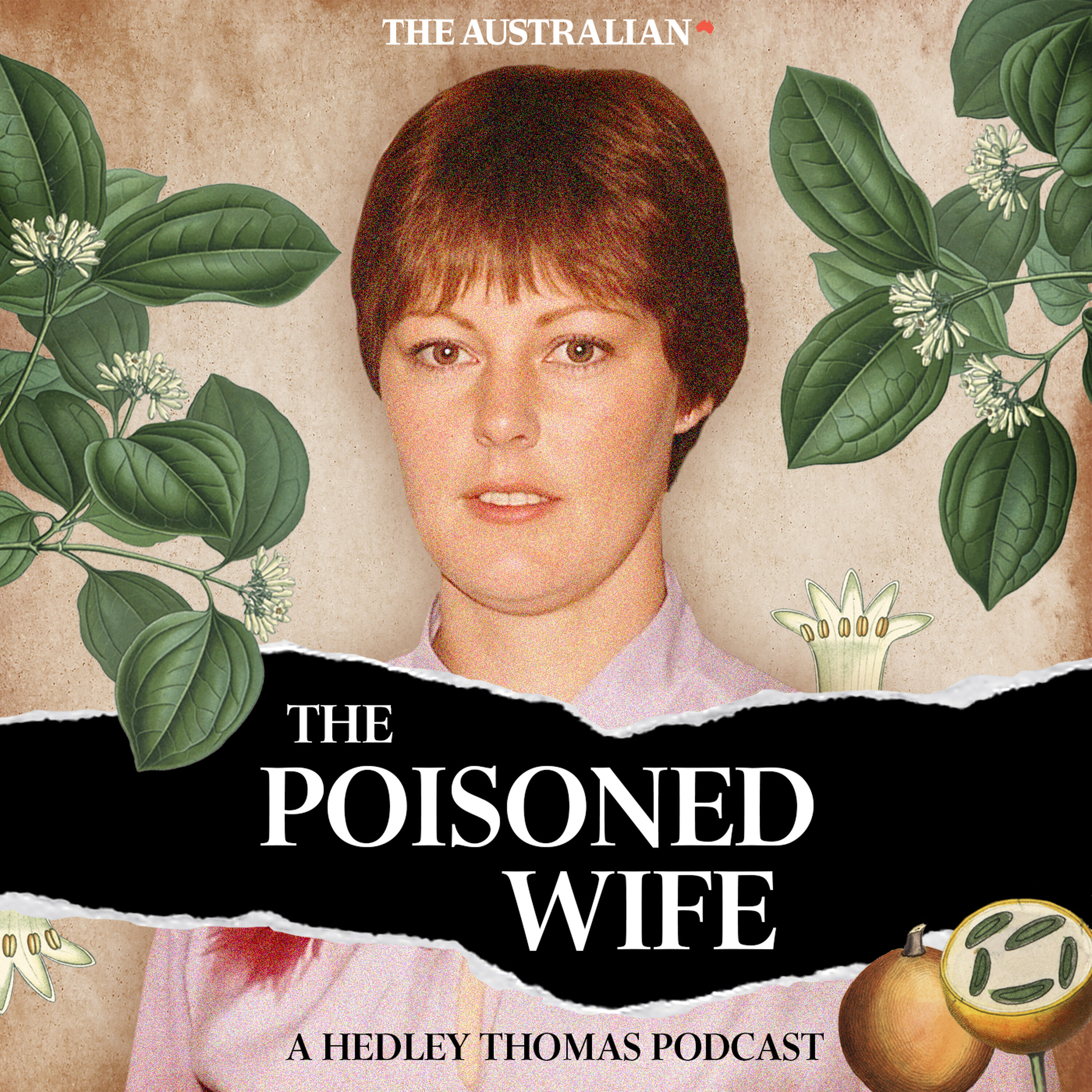
The Poisoned Wife
by The Australian · English · True Crime
Who killed Rosslyn McQueen? The Australian’s Hedley Thomas and Karina Berger investigate the unsolved 1986 murder of a 30-year-old pregnant mother, poisoned with strychnine in her own home in country Victoria, as her toddler played nearby.
More from The Poisoned Wife
-
S1 · E6 · 1 Oct 2026 · 58 min
Episode 6: Fearful
Former detective Ron Blackshaw breaks his silence to reflect on critical aspects of the police case, 40 years after charging Ray with Ros's murder. Ray told friends, neighbours, work colleagues and teenager Donna that Ros had cancer and might die. Ros and her doctors told a very different story. A former neighbour of Ray and his first wife Jeanette speaks publicly for the first time about helping Jeanette flee the family home. Peter and Yvonne Dixon "call bullshit" on Ray's claims their neighbour Vin McKenzie supplied the strychnine that killed Ros. They say Vin went to his grave heartbroken…
-

S1 · E5 · 24 Sep 2026 · 59 min
Episode 5: The Charge
Donna drops a bombshell during her police interview. Two months after Rosslyn's sudden death, Ray asked Donna to live with him in a "husband and wife relationship". Her mother and stepfather are horrified. Ray tells his friend Evan Doherty that Donna had offered to live with him to repay him for his help to her. Evan doubts Ray's supposedly altruistic motives in relation to Donna. Donna endures an intrusive medical examination to test her claim to police that she has not had sex with Ray. After hours of questioning by homicide detectives, Ray is charged with murdering his wife. He maintains…
-
S1 · E4 · 17 Sep 2026 · 58 min
Episode 4: Volatility
Ray's mother Beryl McQueen tells police they used strychnine to poison foxes on the family farm, where Ray lived for about 25 years. Ray's first wife Jeanette McQueen makes startling disclosures to police about the tumultuous end of her marriage to Ray and his violence towards her. Ros is so concerned about Ray and Donna's closeness that she involves her mother-in-law. Friends notice Ray and Donna's intimacy and ask Ros if something is going on. In the months before Ros dies, Donna and Ray are often seen close together in Ray's car at the local tennis club. Members of the club are highly…
-

S1 · E2 · 3 Sep 2026 · 50 min
Episode 2: False Trail
Documents from the brief of evidence reveal that when police ask Ray McQueen whether he has any idea why his wife died at the kitchen table, he tells them “Yes, she’s had cancer”. Police decide there are no suspicious circumstances, but her general practitioner refuses to provide a death certificate. Almost three months later, toxicology tests show strychnine killed Rosslyn. Hedley Thomas, Karina Berger and Rex Bakes meet in Bendigo for new interviews and investigations. Subscribers hear new episodes of The Poisoned Wife first. Listen at thepoisonedwife.com , in The…
-

S1 · E1 · 20 Aug 2026 · 52 min
Episode 1: The Suitcase
A cold case murder by strychnine poisoning of a pregnant mother of one is revived when a suitcase filled with documents is sent to the newsroom by a retired private investigator. Secrets and lies surrounding the death of Rosslyn McQueen in a small rural community four decades ago spill out of the suitcase and trigger a new investigation into this unsolved homicide. And a vulnerable teenager groomed by a married man more than twice her age breaks her silence. Subscribers hear new episodes of The Poisoned Wife first. Listen at thepoisonedwife.com , in The Australian’s app or search for…
-
20 Aug 2026 · 1 min
Introducing The Poisoned Wife
Who killed Rosslyn McQueen? Join Hedley Thomas, Karina Berger and retired private eye Rex Bakes as they mine dark secrets in Victoria’s gold-rush country. The mysterious 1986 death by poisoning of a 30-year-old mum and her unborn baby has become one of Australia’s most intriguing cold cases. Subscribers hear episodes first at Apple Podcasts, thepoisonedwife.com and The Australian’s app. To contact the team, email us at thepoisonedwife@theaustralian.com.au See omnystudio.com/listener for privacy information.
-

S1 · E7 · 8 Oct 2026 · 52 minNew
Episode 7: Donna
Donna reveals she received a secret letter from Ray after Rosslyn's death. The then teenager tells Hedley and Karina that she didn't give it to police when they came to her home with a search warrant. Donna recalls how the letter "freaked her out" and regrets not handing it over. Donna asks herself whether things might have turned out differently if she and others had "not fought for Ray" had they known about his lies at the time. Back in Bendigo, Rex tells Hedley and Karina why the inscription on the headstone of Rosslyn's grave infuriates him. Subscribers hear new episodes of The Poisoned…

Take it with you
The Melo app keeps playing with the screen off, works in the car and on your watch, wakes you to your station, and browses the whole catalogue offline. Free, no ads, no account.