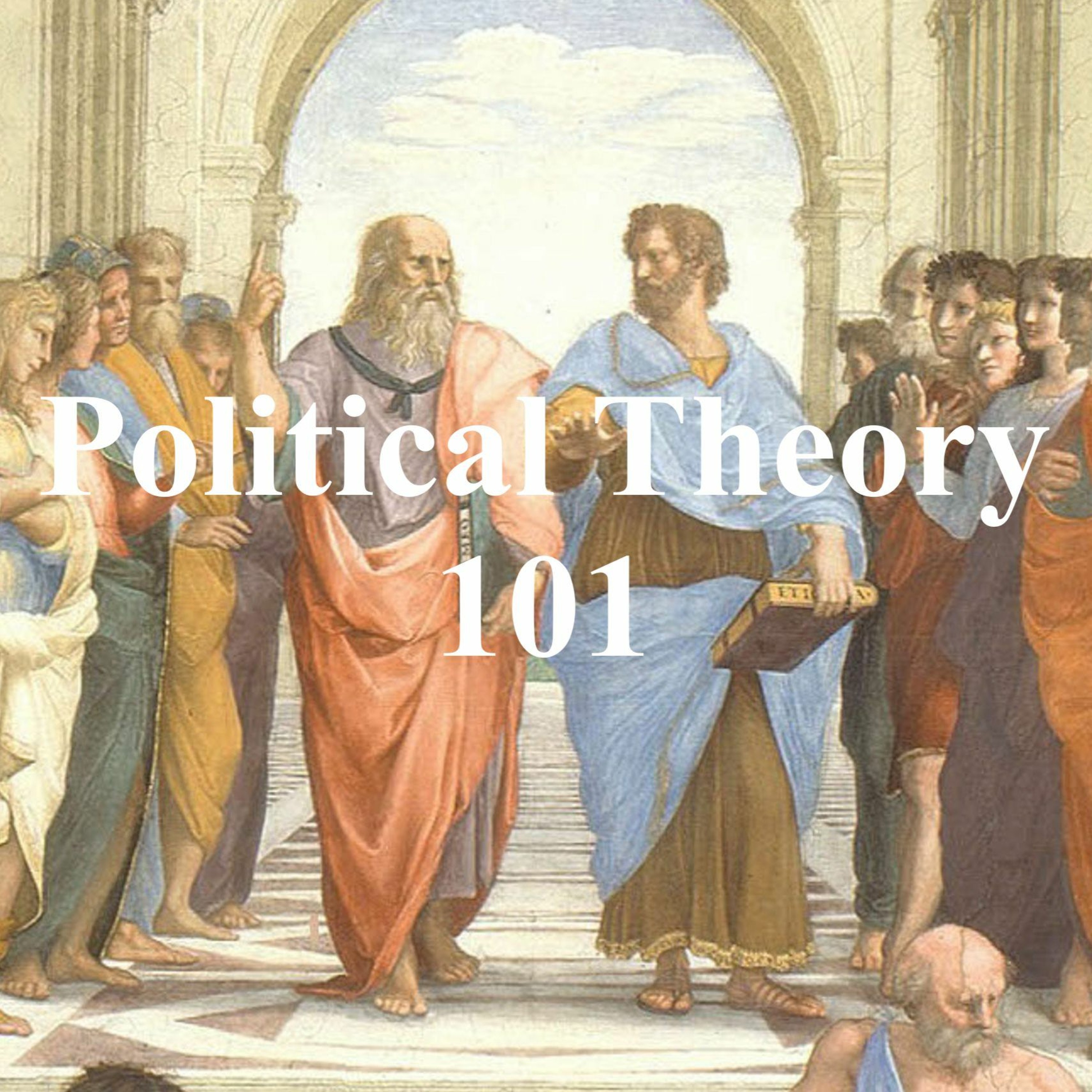
A podcast about political theory. Freely available to all, but we'd love your support on Patreon:
https://www.patreon.com/politicaltheory101
Also available on iTunes, Spotify, and Google Play
We talk about Alexandre Kojève, whose reading of Hegel gave rise to a theory of recognition and of an "end of history". We also discuss Kojève's influence on Francis Fukuyama and on contemporary liberalism.
We discuss Streit's 1939 proposal for a international federation of democracies to avoid a new world war. We explore the limits of argumentation and the difference between making an argument and doing politics.
We discuss Friedrich List's many careers, his struggle for a German customs union, his belief that nationalism would lead to the "uniting of all nations under a common law of right", what happened instead, and why.
We discuss Vico's theory of nature, his unorthodox mix of stereotypically ancient and modern approaches, and how his "new science" seems to be going so far.
A whole episode of Political Theory 101 devoted to Thomas Hobbes' Behemoth. We discuss Hobbes' historical narrative and his theory of education, both of which receive little attention in Leviathan.
Michael Downs joins Benjamin to discuss the political thought of Nick Land, its relationship to the work of Deleuze and Guattari, and the degree to which it has influenced the contemporary left and right.
We discuss how Plato used dialectical thinking to deal with objections to the theory of the forms. Then we discuss how this kind of thinking enriches our ability to make use of all sorts of political concepts and abstractions.
We discuss the work of John Morley, a British viscount heavily involved in the government of Ireland and India during the late 19th and early 20th century. Morley was a liberal, but he was often in situations in which his liberalism was pushed to its limit. We discuss how he thought about liberty as a young man, and how he worked to put his beliefs into practice in difficult circumstances.
Daniel joins Benjamin to discuss Plato's Philebus. We traverse the dialectic of limit and unlimit and discuss the difference between memory and recollection, connecting all of this to Plato's political thought.
Elizabeth Dearden-Williams, a former student of mine from Cambridge who is currently pursuing a masters, comes on to discuss the work of the Prussian general Carl von Clausewitz.
Alex and Benjamin discuss the work of Michael Pettis, putting him in conversation with older theorists of imperialism like J.A. Hobson and Vladimir Lenin.
Alex and Benjamin discuss Huntington's early emphasis on centralization and institutions, his turn toward civilizational thinking, and the position of religion - and particularly Catholicism - in his account.
Alex and Benjamin explore the history of political thought from the point of view of Bastiat - who threw many ancient and enlightenment thinkers together into the basket of plunderers. If we think we come from God whole and complete, the need for civic education falls away...
Alex and Benjamin discuss Terry Eagleton's work, focusing on interactions between religion and Marxism in the context of the "end of history" - the 1990s and beyond.
Alex and Benjamin discuss the Roman persecution of the Christians - why the Romans did it, how the Christians responded to it, and the ways the experience shaped Christian political thought going forward.
We explore the methodological contributions of the late historian of political thought, John Pocock. We talk about the role of language and context in interpreting texts, distinctions between "history" and "philosophy," and the implications of these methodological shifts for the political economy of the university.
Alex and Benjamin talk about 18th century German philosopher Christian Wolff. Wolff suggested that there are reasons behind our motivations. Even a soldier who deserts his post is motivated to desert for a reason. Does that mean that rebels are motivated to rebel for reasons? And when two states are motivated to war with one another, does that mean that they both have reasons to go to war?
Alex and Benjamin talk about the explosion of monasteries in late antiquity. As it turns out, withdrawing from politics can be yet another way of trying to do politics.
Alex and Benjamin explore a debate G.K. Chesterton and George Bernard Shaw had a century ago concerning political economy, then we dive into their political writings.
Alex and Benjamin discuss Jean-François Lyotard's critique of Marxism, his "evil book," intersections between politics, art, and science, and how Lyotard answered the charge of relativism.
Alex and Benjamin explore the agonistic political thought of Deleuze and Guattari, focusing especially on their ideas about territory, change, and flow.
Alex and Benjamin bring on Doug Lain to talk about free speech in the 21st century. Doug offers his take on why free speech matters, and we discuss the political economy of speech and the role the state and civil society play in shaping public discussion. They also discuss his critique of Noam Chomsky and his interest in the work of Guy Debord.
Alex and Benjamin discuss Nicole Oresme, a 14th century French bishop who took an interest in political economy. An advocate for limited monarchy, Oresme argued against the right of king to debase the currency and even to raise taxes. Yet, at the same time, he argued for major redistribution of wealth within the church. These seemingly conflicting positions were, for Oresme, reconciled by appeal to Aristotle.
About Political Theory 101
A podcast about political theory. Freely available to all, but we'd love your support on Patreon:
https://www.patreon.com/politicaltheory101
Also available on iTunes, Spotify, and Google Play
Political Theory 101 is a English news podcast from Political Theory 101. Melo plays each episode straight from the publisher's own feed — no ads added, no account needed — and remembers where you stopped, in this browser only.
The Melo app keeps playing with the screen off, works in the car and on your watch, wakes you to your station, and browses the whole catalogue offline. Free, no ads, no account.