
Episode notes
In this special crossover episode, Science Quickly shares an appearance by host Rachel Feltman on Vox’s Unexplainable. Together with host Noam Hassenfeld, she explores Scientific American’s special issue on impossible questions, diving into some of science’s biggest mysteries, from how common medications can work without scientists fully understanding them to whether there’s a limit to what humans can ever know. The conversation also ventures to the edge of cosmology, examining competing theories about what may have come before the big bang and why some questions might remain forever…
Podcast
Science Quickly
Scientific American · Tech & Science · English
Host Rachel Feltman, alongside leading science and tech journalists, dives into the rich world of scientific discovery in this bite-size science variety show.
More from Science Quickly All episodes →
-
25 Sep 2026 · 34 min
Unexplainable: Dark matter and the end of answers
In this episode of Science Quickly, we share part two of our crossover with Vox’s Unexplainable in which we explore one of the universe’s biggest mysteries: dark matter. Host Noam Hassenfeld talks with Scientific American senior reporter Joseph Howlett, a former physicist who spent years searching for dark matter deep beneath an Italian mountain. Their conversation traces the decades-long hunt for the invisible substance thought to make up most of the universe’s matter and explores an even deeper question: What if some mysteries are beyond science’s reach? Recommended Reading: What if we…
-
24 Sep 2026 · 20 min
Rethinking Age-Related Vision Loss [Sponsored]
Treatment for wet age-related macular degeneration has advanced significantly with anti-VEGF therapies, but the need for frequent injections remains a challenge. A new, longer-lasting treatment now in development aims to reduce treatment burden while helping preserve vision. This podcast was produced for Ocular Therapeutix by Scientific American Custom Media, a division separate from the magazine’s board of editors. Learn more about your ad choices. Visit megaphone.fm/adchoices Learn more about your ad choices. Visit megaphone.fm/adchoices
-
23 Sep 2026 · 16 min
Should you be ‘poop maxxing’?
As colon cancer rates rise in younger adults, more and more people are paying attention to their poop and talking about it on social media, where such “poop maxxing” has become a hashtag. But what’s considered normal, and how can we measure our number twos? Board-certified gastroenterologist Wendi LeBrett joins Rachel Feltman to talk about what’s going on with the poop maxxing trend on social media, what a healthy stool should look and feel like, what common misconceptions around gut health people have, when to see a doctor, and more. Recommended Reading: Colon cancer is killing more young…
-
21 Sep 2026 · 15 min
Space weapons are here, and AI experts are sounding alarms
In this episode of Science Quickly, we discuss newly revealed U.S. space weapons, growing artificial intelligence safety concerns and the Environmental Protection Agency’s rollback of power plant emissions limits before we end with a look at the tiny sand hoppers reshaping California’s beaches. Recommended Reading: It’s official: The U.S. has weapons in space Trump repeals emissions regulations of fossil-fuel power plants The real danger in OpenAI’s Hugging Face hack E-mail us at [email protected] if you have any questions, comments or ideas for stories we should cover! Discover…
-
18 Sep 2026 · 20 min
Can you hear a forest disappear?
In this episode of Science Quickly, filmmaker and journalist Leah Varjacques takes us to a Bornean rainforest area, where centuries-old patterns of human and wildlife behavior are being disrupted by the construction of a new capital city. In the midst of all this change, Varjacques documents the work of Wendy Erb, a primatologist and bioacoustic scientist at the Cornell Lab of Ornithology. Erb’s team, working with members of the local Balik population, placed audio recorders around the forest to capture the sounds of this diverse ecosystem before it changes forever. Recommended Reading: Can…
-
14 Sep 2026 · 13 min
From 9/11’s lasting legacy to AI’s disruptive future
In this episode of Science Quickly, we explore newly released 9/11 records and their revelations about the attacks’ lasting health impacts, unpack a controversial artificial intelligence breakthrough that solved one of mathematics’ biggest problems and examine the growing backlash to a massive AI data center as communities grapple with the costs of powering the AI boom. Recommended Reading: 25 years after 9/11, survivors are still getting sick—here are the numbers AI may have just solved a million-dollar math problem. The field will never be the same The data center backlash comes for…
-
11 Sep 2026 · 26 min
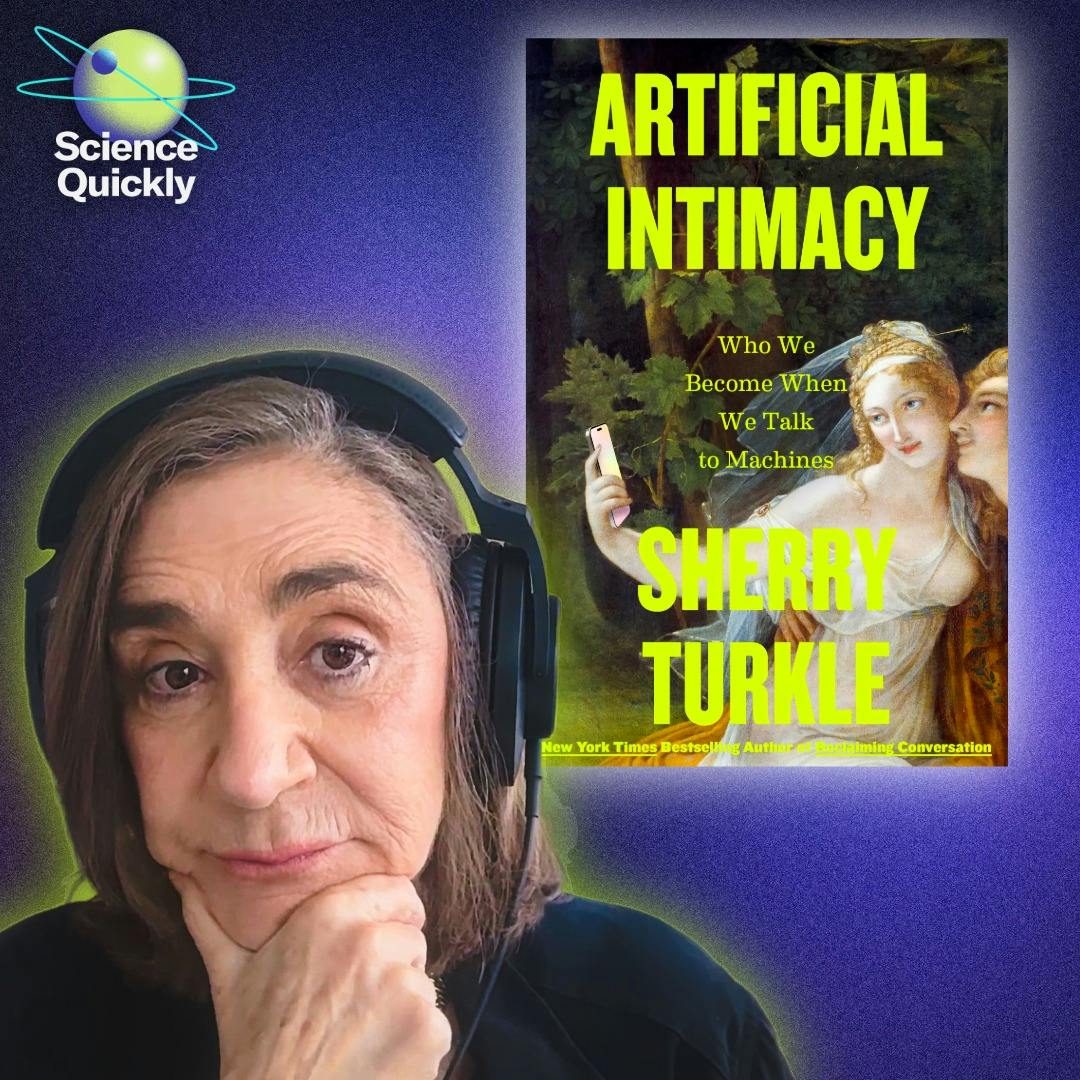
Is AI making us less human?
Can an artificial intelligence really be a friend? In this episode of Science Quickly, Scientific American books and culture lead Bri Kane sits down with Massachusetts Institute of Technology researcher Sherry Turkle to discuss the rise of AI chatbots and their effect on human connection. Turkle explains why she believes AI can imitate intimacy, from empathy and companionship to friendship and love, without truly caring and what we risk losing as machines play a bigger role in our emotional lives. Recommended Reading: Artificial Intimacy. Sherry Turkle. Little, Brown and Company, 2026 E-mail…
-
9 Sep 2026 · 18 min
The surprising science of friendship
Friendships are key to our well-being, but what kind of friendships do we really want? Despite being such a foundational part of the human experience, the science of friendship is still mysterious. Assistant professor of psychology Jessica Ayers is trying to fill in the blanks. While it’s long been assumed that people want either a few close friends or a large network of friendships, her recent research shows that many people need a mix of both friendship types to feel connected. Her research points to new ways we can understand our own friendship styles and gives insight to the loneliness…
-

4 Sep 2026 · 16 min
What if a dating app matched you with a dead body?
What if a dating app could optimize human connection, even after death? In this episode of Science Quickly, books and culture editor Bri Kane speaks with author Sarah Pierce about her debut novel For Human Use, a darkly comic thriller centered on a dating app that matches users with dead bodies. Pierce discusses dating apps, human behavior and the search for meaningful connection. Together, they explore what modern dating technology can and can’t offer and what our reactions to a truly bizarre innovation reveal about human behavior. Recommended Reading: For Human Use. Sarah G. Pierce. Run…
-

2 Sep 2026 · 15 min
The hackers fighting to keep our water safe
Across the U.S., the digital infrastructure that runs our utilities is quickly aging, becoming more vulnerable to cyber attacks. Recently at least a dozen states reported attacks on their water systems. Stepping up to defend these utilities is DEF CON Franklin, an organization that pairs expert volunteers with infrastructure operators who want to step up their cyberdefense. To learn about how the program works, Science Quickly host Rachel Feltman talks with Eric Geller, a senior reporter at Cybersecurity Dive. They talk about why so many water treatment plants need a cybersecurity glow-up,…

Take it with you
The Melo app keeps playing with the screen off, works in the car and on your watch, wakes you to your station, and browses the whole catalogue offline. Free, no ads, no account.


