
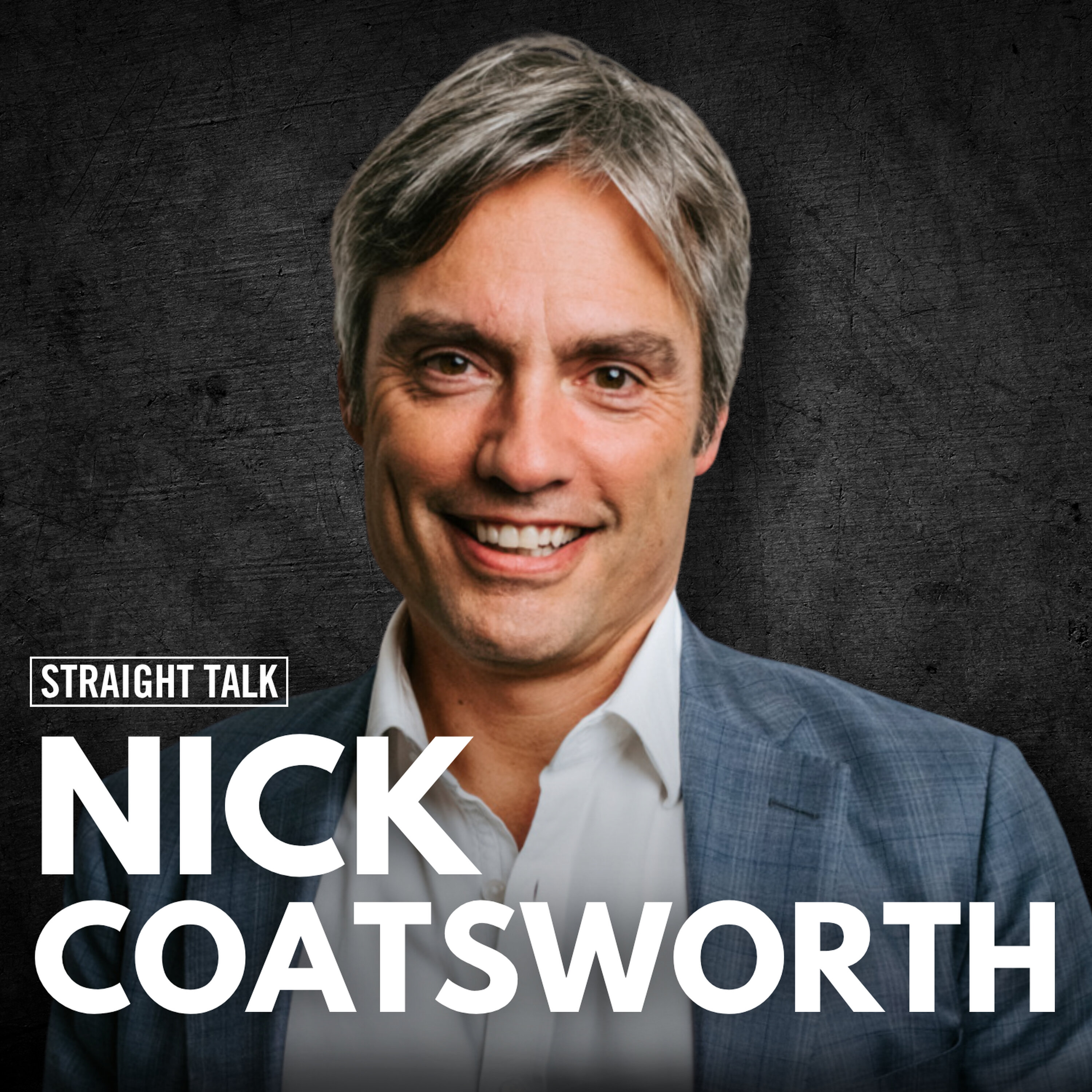
Episode · Straight Talk with Mark Bouris
Dr Nick Coatsworth: COVID Mistakes, Big Government & The Future of Australia
22 Jul 2026 · 1 hr 11 min
Episode notes
Former Deputy Chief Medical Officer Dr Nick Coatsworth joins me for a wide-ranging conversation on leadership, healthcare, and the future of Australia. Drawing on his experiences in humanitarian medicine, the COVID pandemic, and the health system, Dr Coatsworth shares his perspectives on public policy, economic challenges, and what Australia needs to do to build a stronger future. It’s a thoughtful discussion on resilience, responsibility, and the lessons that shape better decision-making Subscribe to the Mentored newsletter here:…
Transcript
Read the transcript · about 13,410 words, follows along as you listen
Speaker 1:Doctor Nick Coachworth, welcome straight talk mate.
Speaker 2:Oh thank you mate.
Speaker 1:You've been pretty vocal lately, or not not lately, forever, but lately. Yeah.
Speaker 2:Look, mb I've got the opportunity from COVID to have a bit of a platform, a bit of a voice. And you know, it was once when I actually learned how to do my debating and public speaking at school that I actually became, you know, reasonably good at it. And I would never claim to be the best doctor in the world, but you know, my latent talent is sort of talking. So with everything that's happening so far in the world, and I think what's happening to the country as well, what's happening to Australia, I think it's important that people with something to say get up and say it.
Speaker 1:Well. I think it's also important to Nick that people with it's called status. And I don't mean that in sort of any condescending way or the opposite to that as a matter of a matter of fact, but people with status, I think have an obligation to say something if they've got an opinion. If they're an opinion, fair enough, but if they've got an opinion on something, I think there's an obligation to say something. Do you do you think you fit into that category? And do you would you agree with that proposition?
Speaker 2:Oh, I definitely agree with the proposition. I think there's limitations on what people can and can't do, and I think from my point of view, I'm relatively unconstrained, you know. I'm yes, I work with the Nine Network. I've you know, very fortunate to have that sort of position. I still work as a doctor. But I think as long as you keep your opinions within a reasonable discourse or reasonable left or right of arc, you can have strong opinions and you should express them.
Speaker 1:So, you know, one of the things you're from my point of view at least, that you're best known for and is the COVID period. How did you get go from being a medical practitioner to being someone that effectively became the federal government spokespersonally for COVID or during COVID. How did that sort of all occur? Yeah?
Speaker 2:Well, I mean, some of it's always going to be the right place for the right time, But there were a few key steps in the Korea that got me there. I think the first one was probably working with doctors with our borders, getting a real passion for crisis medicine and humanitarian aid.
Speaker 1:And maybe you explained that a little bit. I mean, I've heard of it, but explain a little bit about that. What does it mean is that like charity not charity work? Is that like freebie stuff, like you're doing it you don't get paid?
Speaker 2:Yeah, no, we won't paid for it. And it was it's a French organization with a very long and deep history of going into some of the most difficult conflicts in the world. Where were you pleased, Well, I went to I went to the Congo. Now there's two congos. Two congos. There's a Democratic Republic of Congo, which is the least democratic, and then there's the Republic of Congo, which is sort of the old French Congo, the DRC, which is the one who's playing the moment, the DRC is playing footy and has gotten a bowler outbreak, right, So that's not the one I was in, but we were just across the river from that. They're both next to each other, the old Belgian and the French Congos from colonial days, so it was post conflict mark, but it was a long way away. Like if you from the capital. Like if you think about Sydney and and I don't know Burke or wester Dubbo or something like that, that's where this was relatively in that country. So there's nothing there. We're in the middle of the jungle. We're in a village of thirty thousand people. We're providing the only healthcare there the hospital. MSF had built a hospital
Speaker 2:there when the need arose ten years ago, and now we're sitting there going, well, what do we do with this hospital? And we ended up being the last group of MSF doctors. I was the doctor. There was a nurse or a couple of other people, and we were the last ones there because the home base in Paris said no need here anymore and we need to shut down. So I'd gone out thinking I was going to be, you know, save the world. There was a program back then called er where there was a young doctor called Carter, and I used to love that program, and he was out doing the similar sort of thing, and you know, I got to be honest. There was a little bit of you know, glamour raman, a bit of romance about it, but the truth was exactly the opposite. We were the down sizes. We were like the management consultants of MSF, we needed to close this thing, and so we ended up leaving after I'd been there for six months. And it was a hugely emotional experience, sort of leaving a town of thirty thousand people with no healthcare. And I can remember distinctly going because you know, no plan's going in and out. We had to go down via canoe
Speaker 2:and we're leaving on a canoe waving and everybody's in tears and they know that there's going to be no free health care for them.
Speaker 1:The day that we leave, is that because they are no longer going to get free healthcare or end or is because you start to build relationships to them, they build relationships to you. Like a small community.
Speaker 2:Really, yes, small community and only two things driving the economy. So MSF being there and paying people to work for us. We had a staff of about thirty and they spend and they spent yep. And then there's an Italian logging company. Now this is an important story because the Italian logging company weren't paying its workers. So we were the only source of money into this town. And when we leave, it's not just healthcare that goes. It's not just friendships that go. The economy of last place collapses. And I thought, geez, you know, for all the romance of this and for all the good that we were clearly doing for a period of time, eventually you've distorted the economy. We've created a problem. Now. The night that we left, so we were on the canoe, we were out. There wasn't any mobile no mobile phones, well, satellite phones. So we go down the river and get to the next stop, and we get a call and the nurse that had worked for us for longest, and he got the biggest payout because we're doing French labor laws, right, you've worked with us for ten years, we'd give your stack of cash just like you would hear, like a redundancy payment, like
Speaker 2:a redundancy payment. So the coppers find out, the police, the Congolese police, they find out.
Speaker 1:That he got a pay out.
Speaker 2:They knew that everybody got to pay out, they knew that he got the most. They stop him in the street. So at the point of a gunpoint, give.
Speaker 1:Us your cash, like, here's a robbery.
Speaker 2:Here's a robbery. He said no. They shot him, no, they shot him dead, dead, Well, he got to the hospital, but you know, the thirty staff are not there anymore and it's just three three government Congolese staff, no equipment. We've taken all the equipment and Jacques died that night and we found it out about it the next day.
Speaker 1:Why didn't he go with you?
Speaker 2:Well, he was what we call local or national staff. So you come in with your team with five usually expats. It's a bit different now with MSF, who used to be people from overseas. You come in with your five basic teams, a field coordinated doctor, nurse, logistician, and an admin person. And that was us. There was core for five person team. And then you build your local team around you. So you employ you employ nurses and doctors from local people, from the local health system, and you're providing with jobs, training and do it. You're building capacity. So there's good stuff here.
Speaker 1:But you're building a business.
Speaker 2:Basically, you're building healthcare. I mean, obviously you're providing it for free because you're doing.
Speaker 1:It's still revenues, but you are building a business system.
Speaker 2:And then that money is going in to the local economy. Yeah, and so we managed to successfully collapse the local economy overnight.
Speaker 1:Wow.
Speaker 2:So corruption is a big issue, oh, I mean in those sort of regions, and it's not it's not so different corruption anywhere in the world, back where where there's lots of money and perverse incentives. And you know, we can talk about a bit of the soft corruption or hard corruption that goes on in Australia later on, but this is like hard, brazen corruption on behalf of anyone with power given to them by the government. And in this case it was the place.
Speaker 1:How old were you at that point, I was twenty seven. I think what you learn from that, well, I learned.
Speaker 2:That the road to hell proverbially is paved with good intentions no matter you know, you are doing genuine good, but in the course of doing that good, you can create a whole heap of you know, in economic terms, negative externality is pretty pretty serious negative externality for Jacques who lost his life because of it, and that just shocked us. I mean, you can imagine what that did to our Core five team when we find out about that. We all knew why, and we all knew it was related to us and what we've done. But now you know, now in Africa, this has sort of added just switching back to the sort of the romance of it, I suppose, and it's not like this anymore around the world. But we couldn't communicate with anyone were it not for a satellite.
Speaker 2:I was sending emails to my current wife who i'd split up with as a girlfriend boyfriend at the time, and I had to send her. I was sending her emails and it would cost me most of my per DM, which was like ten euros a day just to send one email of like forty words, So it was hard to communicate.
Speaker 1:Did she realize how much you loved when you're told of it?
Speaker 2:Ah, she did when I took her to France afterwards at day's pay.
Speaker 1:As a day's pay, I just spent a day's pay on on a whatty word email to you.
Speaker 2:I still remind her about that.
Speaker 1:Yeah, well she'd be watching this, no doubt. So you went from there then? What happened? So you come back to Australia. What did you do? No?
Speaker 2:So at the end of MSF missions, there's always another mission, so they said, you know, there's a measles vaccination up in Chad, Chad. I didn't even know where it was. For the listeners viewers next to Sudan, Maley, that's sort of very Subsharan Africa.
Speaker 1:Pretty hectic though, very very hectic, and.
Speaker 2:At the time probably one of the bottom three poorest places in the world. So we went there and we had to try and vaccinate. It wasn't just me. There was a big team there because it was an emergency that probably forty internationals came in to try and vaccinate ten thousand kids in three weeks.
Speaker 1:Is the objective sort of part of being a doctor and becoming a doctor back in your own country? I mean, or just did you feel like you need to give back?
Speaker 2:No, this was something I'd wanted to do for years. This is something I wanted to do before I was even a doctor. Yeah, I saw this idea of.
Speaker 1:It wasn't a career idea though, it.
Speaker 2:Wasn't a career idea, But I mean I stayed with MSF for a long time afterwards, just not going into the field. I went to the field once more and I went to the Dat region of Sudan. But I then was on the board of MSF Australia for six years and did a lot of the governance work with them, and I think we achieved a lot. We took it from sort of forty million dollars a year to seventy million dollars a year in revenue, which was pretty good, and had a lot of interactions with the global governance of it. So for me, no, it wasn't a career, but it was a pretty important part of my life and I kind of knew that I'd wanted to do that.
Speaker 2:It was a service humanitarian thing. I I'd seen a thing like a profile of MSF in my French textbook when I was in year ten, and that's what planted the seed. Like I was looking at that, going, oh, that sounds like something I'd like to do. You combine that with, you know, just the sort of global view that my parents had instilled in me, and it was always going to happen.
Speaker 1:But when I see something like that, and if I'm thinking then about I'm the Prime Minister and who can I trust to give advice and to talk to Australian people about what COVID may or may not be going to do, And you know, it was a big drama here, I'm thinking to myself in terms of profile. Must be a practitioner, doctor, must be able to stand on our own two feet they actually have a conversation. But having that background would definitely go to the top of the list for me, you know, like you know, someone's used to used to dealing with potentially epidemics, being in the field, measles, epidemics, that sort of immediately qualifies you. Not I mean we put you up with there in the list.
Speaker 2:It put me on the pathway. And of course, you know Prime Minister Morrison and Greg Hunting and Minister hunt didn't know any of that about my background when they appointed me. I had actually been part of the National Critical Care and Trauma Response Center, which is a disaster response out of Darwin. So that was this is before COVID. Yeah, this before COVID. So between MSF and COVID, I'm up in Darwen. My wife and I had two of our three kids up there, and there was a policy called developing the North at the time, and we developed the North.
Speaker 2:We had two kids, we built a house, we did all sorts of defty contributed. Yeah, four years up there, and I remember clearly, you know, it was a great time. Beck was heavily pregnant with our third and flying in and doing remote consultations she's a doctor as well out in the back community. It was a good time in our lives, but for me it was disaster response, and the architecture of disaster response in Australia is very much linked in with Foreign Affairs, Health Department, those names that we never knew before but known now chose Chief Health Officers, HPPC, the Protection Committee. This was something that I'd lived and breathed for four years. So when we went from Darwin to Canberra, I was there working as an infectious disease doctor for five years. Then COVID hits and I get this call about, you know, late February twenty twenty from Professor Paul Kelly, who was one of Brendan Murphy, the Chief Medical Officers deputies, and he said, listen, this is real.
Speaker 1:Did you know him ready?
Speaker 2:I did throw all this Darwin stuff. So he goes, this is real. We'd like you to come. We've already spoken to your boss. She's released you for three months. Come across from Camberra Hospital and come and work with us as one of Brendan's deputies.
Speaker 1:I mean obviously remember well, but I remember talking to David Heslot, Oh yeah, and he was telling me about the powers of the Surgeon General and in Australia, and also we talk about Morrison and this whole process of basically locking to join down and David who's at the University New South Wales in Department of Medicine, one of those faculties. And so around that period it seemed to me that Morrison was creating a cohort of people around him like that that he could rely upon in terms of making the calls on all of this. You know, so, would you consider yourself as at that point in February when you first got the call, as someone who was enrolled or enlisted that's called by the Prime Minister.
Speaker 2:Yeah, yeah, I think so. I mean really it was Brendan who was advising the Prime Minister on that, and look, I wouldn't have couched in those terms at the time. I simply said yes, But it was the first time that i'd stopped. And I mean usually when an opportunity like that comes in front of my lap, i'd say yes straight away. But as a sense of duty, as a sense of duty as because in these sort of careers where you sort of you know, start to leap frog and and go higher and higher, and higher. It's often because you say yes to the opportunity, it's not necessarily and you say yes quickly. But on this occasion, you know, I put down the phone. I said, Paul, I'm on a ward round. I'm going to call you back.
Speaker 2:And I called my wife straight away and said, listen, this is this is going to be big. Am I in the right frame of mind to do it? And you asked her that, yeah? I asked her that. Yeah, I was asking myself that question, but she'd obviously not. I'd gone through a bit of a troubling time in my mental health in the in the previous six months, and and I had to ask myself, am I the right person to do this at this time? Fortunately?
Speaker 1:I was on well fit for purpose?
Speaker 2:Am I fit for purpose? Am I fit to serve? And I think it was a really, really important reflection. I'm glad I gave myself the time to reflect.
Speaker 1:How much time do you give yourself?
Speaker 2:Oh an hour?
Speaker 1:Do you walk in the bathroom at the hospital you're working the rounds it and just looked at yourself in the mirror, saying, okay, we've got sixty minutes.
Speaker 2:Let's talk this. Yeah, let's work shop this. No, I mean it was a that sounds a bit glib. It was only an hour and I got back to Paul, but it was some serious for us, compelling just to pause and say stop, let's have a think. Are you Are you enough on the road to recovery because you've seen I mean, we've got a lot of good examples of what happens to people in public positions, and people have been really open and frank about their mental health, and particularly when it's led to the end of their careers.
Speaker 2:Now this was on the opposite. This was really what launched where I am, and I had to reflect about whether I was in the place to do it.
Speaker 1:When you think back at it, do you think you had any sense of what you're saying yes to?
Speaker 2:No, No, I don't think. I don't think we knew just how enormous this was going to be, the gravity of our decisions, what it would do to the country, And I think it's done an immense amount. You know, both positive, but I have got some concerns about. You know, Mark, we talk about critical junctures in the life of our nation, and that's where you're on one railroad and something happens and you hop on another railroad. And I've listened to a lot of your guests on this podcast, and I do worry that we shifted quite markedly to a heavy dependence on government as a result of some of the things that we did. And that is something that I couldn't really have predicted in the thick of it there or even reflected on.
Speaker 1:So let's talk about that. Would you say, sitting back here today on reflection that governors may have advantage of that opportunity that they knew we would become more reliant upon them. When I was saying Scott Morris, Scott, wasn't it long enough? But are the governments? Dan Andrews.
Speaker 2:Perhaps I think that at the start there was a genuine desire from most leaders to try and do the right thing. Yes, But when I'm talking about the start, I'm really only talking about the first three months February March April February March April, because after that we had a fairly clear idea of who this was going to affect and who wasn't at risk. But we got into this and the thing that troubled me most mark was that it showed us that instead of being a hopeful Alarican nation, which is what I want. I want to be part of that nation. Yeah, we were part of a locked up and very scared nation.
Speaker 1:So how do we become those people?
Speaker 2:Though I don't know, I think it was a combination. Well, I can say I don't know. I actually just did a PhD on why we closed the international borders, and it was, you know, in those sort of academic terms, it was because the fear that was generated, legitimate fear the images out in New York and Italy, which you know were as all media images are partly true. Clearly those images happened, but I think the magnitude of what was going on there was probably inflated, at least in people's minds about how that would happen here. Nonetheless, it's important New York Italy combined with the advice from public health, and then you get no counterweight from anyone in the economic or business fear, Like the only guy who's kicking up a fuss is is old mate from flight Center. Yes, screw, yes, screw Graham, screw Turner, Yeah, absolutely sorry, screw. I know him very well, so I should remember his name there.
Speaker 1:And legitimately from an economic point of view, because his business would have been just completely decimated at that point.
Speaker 2:Absolutely, But everybody else was locking in, including Treasury.
Speaker 1:But why were we so compliant? You've done pere well.
Speaker 2:That was the lock in effect of all the institutions. So the Business Council of Australia, the big four banks, all the banking executives, everybody was behind this.
Speaker 1:But what happened to that? Larry put you said, what happened to that anti authority lark and piece that we ordinarily would have? Yeah?
Speaker 2:I think was I think was overwhelmed by it. You know what was initially a very strong and legitimate position, which was Team Australia, we're in this together. But once we headed down that path, it was very very difficult for people to turn around and go, okay, we need to course correct here. Now we've overcooked it. Now we're into twenty twenty one and twenty twenty two. I mean Mark McGowan still wanted to keep the WA borders closed in January of twenty twenty two, and we got to this idea that the only thing you couldn't die of in this country was COVID nineteen. Now let's look at some of the other things that we get worried about.
Speaker 2:We closed again last year because there was supposed to be some asbestos in playsand you remember that I don't think there was that much asbestos in the sand, and I'm pretty sure as a respiratory physician the lifetime risk of a kid developing asbestosis or mesothelioma was pretty close to zero from that, but we still closed the schools. So that sort of covid mentality you can see playing out in that sort of fear of asbestos, and then you move very quickly into how the whole country is completely overregulated and we're dominated by a culture of safetyism.
Speaker 2:So it ends up being that the Larican Australian is a legend and a myth, and maybe we need to look hard in the mirror and go, do we want to get back to that hopeful Alarican that's built a nation from settlement to over two hundred years ago, and we're one of the most successful nations in the world.
Speaker 1:We were to.
Speaker 2:Now one of the most you know, insular naval gazing over regulated. You know, I'm not talking, you know, I'm not having to go a individual Australians here. I'm talking about let's have a look at what sort of nation we want to be, and let's get try and get back to that nation, which is, you know, let's have a national project, let's have some big ideas. Let's be the successful nation of the nineteen nineties, of the two thousands that was built off the back of good governments.
Speaker 1:You know, in an economic sense, Australia was from nineteen ninety six through to twenty twenty was the most successful in economic terms nation in the world. No other country had it at as many quarters of GDP growth. Then Australia we've gone from being the envy of the world to being the question of the world. Why is a country with so much resources, so much safety, so much beauty struggling. It's a conundrum, it is.
Speaker 2:Well, it is a conundrum until you put it in terms that we've just discussed.
Speaker 1:When if I look at you, Nick, I go back to twenty twenty did you feel when you when it was all over in twenty twenty two, whenever this whole thing finished, did you think, wow, shit, what was I part of?
Speaker 2:Yes, And I've said it on a number of occasions.
Speaker 1:What regrets do you have and what would you have done differently. Perhaps what could you have done?
Speaker 2:I think the one thing that you could do differently if we ever have a pandemic again and the government brings in a rule or a regulation, it has three months to conclusively prove that that's benefiting the country or it's got to go.
Speaker 1:Yeah, so you put a time limit on it.
Speaker 2:You've got a time limit these things, and that includes you know, I think I've spoken as the face of the national vaccination campaign which was underpinned by mandates and mandates that you know I discussed on TV, on press conferences and to know you yeah, backed in essentially government policy. I thought that that was a critical error in judgment and I think that we could have got very high.
Speaker 1:What what do you mean having a national vaccination program?
Speaker 2:No national vaccination program was fine. Mandating people to get vaccinated was a huge process.
Speaker 1:It should have been left to our choice.
Speaker 2:Yeah, absolutely, and we could have look if you, if you were looking at what Australians were doing and how they were behaving and the Team Australia approach, we we could have successfully vaccinated the country with education alone.
Speaker 1:Absolutely, without without the job, without you.
Speaker 2:You would have got sufficient vaccination rates amongst the at risk population, just by recommending it, educating people that was the right thing to do, using people like me, and forgetting the idea of mandates right, I will, I will die on that hill, I reckon we could have done.
Speaker 1:It and at risk meaning what if you just give it out to me?
Speaker 2:Yeah, yeah, Well the risk clearly started to go up from COVID. It was, it was extraordinarily low, and then for the age of fifty and above it made a material uptick as a result of what was well, it was just you know, COVID was a virus that the older you got, the worse the inflammation was in the lungs, the more likely you were to have to go to ICU. And certainly for people who were in their seventies living at home, you know, retired Australians enjoying their lives as grandparents.
Speaker 2:I do think there was a material risk of letting that virus into this country. You know, so the borders closures before we were vaccinated, So the border closures were important. The vaccination program was important, but we overcooked the mandates. It was a risk to healthy elderly Australians, but they were all going to get themselves vaccinated and they did huge like close to ninety five hundred percent of healthy Australians over the age of seventy were vaccinated and they weren't going to lose their job because they were mandated.
Speaker 2:They were already retired. So we were always going to vaccinate our healthy, at risk population. And then we could have we could have left the rest to choice, and I still think most people would have got it anyway.
Speaker 1:Do you think those people are over seventy would have got vaccinated whether it was mandated or not. In other words, that's just a behavioral process, you know how they behave? Or is it people over seventy in Australia is compliant? What is it?
Speaker 2:No? No, I think we knew enough at that point to know that they were at risk and that if they didn't get the vaccine. I can't tell you how many, but an unacceptable number of healthy elderly Australians would have lost their lives. So that would have driven that behavior, would have would have driven high vaccination.
Speaker 1:Rates because I saw some modeling right at the beginning, and maybe not like the way you guys do modeling, but in my world, when we do modeling, the model is pretty easy to build. It's the assumptions that are I can manipulate the model by the assumptions, and if I want a certain outcome, I'll say that this is going to be the outcome, and then I work backwards and I'll say the model says this is going to be the outcome, and I'm selling you the outcome to get something else I want to get done.
Speaker 2:So the question is did that happen?
Speaker 1:Well, I asked my question to you if you don't mind, because you know, like I saw models getting trotted out by I don't know who, by maybe me, and you might have been other people. Governments are I'm talking about five hundred thousand people Austrains going to die.
Speaker 2:Yeah. So the quote was one hundred and fifty thousand, and it came out in the papers in about March and Paul Kelly said it. Now, that was the Doughty Modeling Doughty Institute, And I can with one hundred percent confidence say that those inputs were not given to to produce a certain outcome. I cannot tell you what happened with state governments after that. Right, So, the modeling that was commissioned by Victoria to justify their prolonged lockdowns. I cannot tell you whether that was reverse engineered or.
Speaker 1:Not, because they didn't use a Doughity modeling. No, they used to build their own modeling. They used which one.
Speaker 2:They used a different institute.
Speaker 1:A different institute, and did New South Wales use something different?
Speaker 2:Again New South Wales, I can't recall whether they were still using Dohity or not.
Speaker 1:Yeah, because they were nowhere near as bigger numbers as they were getting towered down there in Victoria.
Speaker 2:Yeah, the Victorians successfully convinced their population that this was going to be a doomsday scenario for them, and then successfully convinced their population that New South Wales was the enemy. It was like a state of origin for COVID.
Speaker 1:It was dreadful and I in those days were probably the same as say, we had like fifty officer branches in Victoria, and they weren't allowed to travel more. They weren't allowed to trouble for more than five k's from their home to go to work, to go to the office. And most of the people's offices are outside away from where they lived. And unless you're at essential work or something along those lines. So, and it was all based on the modeling, and I saw I seen themsels model little bullshit like I can make modeling. As you said, it's a beut the inputs or the assumptions that you input into the model. And so they must have been somehow the managed to scare the life out of everybody though they did did they do you think in hindsight, just pick Victoria for a second. People were scared of getting caught and getting into trouble, or they were actually scared of what COVID might do if they got if they caught COVID.
Speaker 2:No, they were scared of what COVID might do in the main like there, yeah, I don't I don't think. I don't think I.
Speaker 1:Was worried, worry really about what would.
Speaker 2:Happen if they got caught. There was, you know, but obviously, if if you're going to if you're going to let's use the right word, subjugate a popular for that long, they will eventually start to rebel against it. And by the fifth lockdown they did, and you have those enormous protests which we've never seen rubber bullets used before, but they were used at the end of that fifth lockdown. Wow, when when the population started to go, well, enough of the population started to go, no, this is this is this is enough. We've had enough. Now, you know the thing that is interesting and it gets a little bit controversial, but we remember the Black Lives Matter protests. Yep, well a lot of those were either they were either condoned and they were allowed to happen, or people turned to blind eye when they did happen in or yeah, yeah, well around it around Australia there were there were several of them during COVID, even more of them in the US.
Speaker 2:So it's okay to protest if you're if you're protesting against the you know, the preferred issue or the presumptive good. But if you're protesting for your individual freedom, no, no, we're going to shut that out. That and that to me, you know, Mark, this was a this was a it was a change in my politics. I was I was looking at this going, you know, we have got the philosophical balance wrong in this country. And when I say philosophical, I am talking about John Stuart Mill. The only reason that you can restrict the liberty of one person is to prevent harm to another. Now we decided or we were fearful or someone you know, was fearful enough that so much harm was going to happen that we wanted to restrict the individual liberties of people For two hundred and sixty five days. I was way too long down in Victoria. And so we exceeded that fundamental principle of individual liberty. And I guess you know some of the population, a significant amount of the population went along with that.
Speaker 2:So we go all the way back to what you asked me. Did we know that this was going to shift the way Australians think? Well, I think Australians are a lot more accepting now of government policy that restrict impedes, you know, the individual and what they can achieve in life. And that's why, like this is how you link COVID to capital gains, tax changes to negative gearing changes and people, and there's people who believe in the success of the individual being absolutely conducive to the success of the country.
Speaker 2:And that's people like you and me, I presume and we think, hang on, you know, we've got to help the individual succeed here. But there are still a lot of people in Australia as a result of COVID who think the opposite and the principles are exactly the same. They sit there and go, we want the collective to succeed, and if we have to chip away at the success of the individual to get that, then we're happy to vote for it. So there is actually, for the first time I'm ever probably in the past thirty years, a fundamentally different choice in politics in Australia at the moment, like left and right is very very different in terms of the choice that Australians have to make at the balance ballot box.
Speaker 1:And something that actually bothers me by the way the division it is like so nakedly obvious between left and right, and I can put it down to the the commencement of this so I can put it down to the COVID period. You're right, I have never seen so many regulations in this country, state or federal what doesn't really matter that have occurred since COVID. And I often wondered to myself, and I don't want to be conspiracists, but I wondered to myself, if governments have thought, look, we know Australians are basically able to be complied. Prior to they I would have thought Australians there's stuff you're not doing that. You know they too, the Aussie guy woman whatever's in no way, stick it up your whatever. We're going to live our life down to we've got too.
Speaker 1:Maybe has government found out that we're so compliant, they thought, you know what, we want to build a big government and by one of them, and we've just been rewarded by we will bill big government by giving people more jobs, to be more regulatory against people like in private and prise like you and me, and no one's going to really object. And as a result of that, we can take more control of the individual and we the government are the best place to determine whether the whole community is successful as opposed to individuals like Nickosworth or my Buris or whoever it is. Those individuals, by being individually successful, will make the whole community successful. Is that where you're at, That's where I'm.
Speaker 2:At, That's where I'm at. I mean in my mind, Mark, A strong individual makes for a strong family, makes for a strong country, and then government can step in to help the peace people that need to be helped. We've got a very different government at the moment. Who is picking and choosing, often based on identity politics, Who the winners and the losers should be weakening the individual, which in my view is going to weaken the country and make us less able to help the people the data. Now, the biggest trick that progressivism ever pulled was convincing people that it united a country. It doesn't. It doesn't because progressivism now is tied to identitarianism. So you get this fragmentation or atomization of your community into different identity first, individual, second, country, distant third, and suddenly your country is divided. Now, this is very different to what the and I'll call it what the Labor Party go around and tell everybody. Labor parties say that the right side of politics is responsible for the dew vision. I take it completely different. Me to sit there and look in those sort of terms,
Speaker 2:look at it in those sort of terms. If you put if you, if you, success requires adhering to a list of identities, or benefiting from government requires adhering to a list of identities that the government thinks they're acceptable. Then you are going to split people into those identity groups. And that's a problem.
Speaker 1:Force them to take sides, force.
Speaker 2:Them to take sides, and the one thing that they're not taking the side of it's the country's and that's a problem. And this is why you get one nation rising up because people there are enough people in the country that look at that and go, that's not the way I want to be.
Speaker 1:They don't really know how to articulated, though I don't say only they just feel something's wrong.
Speaker 2:I know, and that and that to me, and that, to me is the great opportunity for conservative politics in Australia. You you know, everybody is saying the Liberal Party is dead whatever, there will be a phoenix moment where someone comes along or a group of people ideally who can articulate this, and then people will go, yes, that's the way we want to live. Yes, we're Australians. We want to help our fellow AUSSI, but we know that to do that we have to be successful as an individual first, and we have to have successful individuals, families, country, and then government can come in.
Speaker 1:Do you put it down to just a temporal cause, like something that happened in time twenty twenty that was the start of it and it was just a cascade of events, or do you put it down to where we are sitting right now? Do you put down where we are right now and down to ideology taking advantage of the situation.
Speaker 2:Yeah, I think the time course is much longer. I think COVID's what accelerated it and was that critical juncture that acts as a sort of pat accelerator for this malaise that we've got in the country with big government and dependence on government. But this was going on in the nineties, just at the time when we were sucessful. As you said earlier in the pod, we were undergoing a very significant left Wood shift in our institution. And I think you know, there's actually nowhere where you see it more than in medicine. Oh really absolutely, Like you look at some of the big cultural issues at the moment, the medical communities adopted a significantly progressive or left wood leaning position on them. And we don't need to get into the controversy of this because it is a very controversial topic. But let us just compare COVID with gender medicine in Australia.
Speaker 1:What's that mean, Joe, So.
Speaker 2:Gender medicine is transgender medicine and sex changes and puberty blockers and all that kind of thing, which we don't need to get into the clinical side of the moment. But all I can say to you is that the rest of the world has shifted back to a more nuanced and precautionary position around these sort of treatments, whereas Australia has so have stayed in the let's go, let's charge your head with puberty blockers and allowing young people to change their sex and that sort of thing. Now, is it really? Absolutely? Now, this is very similar to COVID, So the rest of the world had moved on significantly before Australia did. It took Australia a good What is that?
Speaker 2:I think I do think that it's partly because the medical profession is dominated by a sort of that sort of progressive ideology. You said it was ideology, and that that started when I was a medical student. You know, this has been going on. Absolutely, this is not being something and I was, you know, I was part of it.
Speaker 1:I was.
Speaker 2:I was a card carrying member of you know, the other side of politics at once. I probably just ruined my chance at a political career.
Speaker 1:But you know, now, I think you might have enhanced it. And then those podcasts you definitely enhanced it. But because it's funny, no, I was thinking back to when I wand to university nine as in his three and started university and I was doing a commerce law degree, and I remember they told me I had to do a subject and it was called women in Society. And I might had an Irish man, like a very strong minded male. I didn't need anyone to remind me of the position of a woman in society. And on the Greek side of the family, of the Greek women definitely were in control of everything, and so I didn't need any reminding it.
Speaker 1:But the book that we had to read I was written by a doctor, Anne Somemmers, and it was called she was an academic doctor, but her book was called Damned Whores in God's Police. And I was like seventeen, because I started Union seventeen, and like totally mature, being in a boys school my whole life, like played footy. I didn't know anything you know about women and whatever. And I remember reading this book and and then many years later I thought about it and I thought they were trying to when I remember the context of book trying to push me a certain direction about feminism. What it had to do with what I was doing, had zero to do with what I was doing. But I was the University of Southwales, which is one of the newer universities, which was trying to be very modern, but the place was infiltrated by this system. By the way, I since met doctor An Summers, and she's a lovely person, by the way, really really nice person, and generally people are.
Speaker 1:And she wasn't trying to she wasn't trying to influence me or students. But that was a book she wrote about something she believed in, but the institution grabbed hold of it and then sort of pretty much jammed in our throats because we got tested on this stuff. I had to do exams on this stuff. And you're right, so I mainly reflect you on your comment. This goes right back to on in seventies.
Speaker 2:And I think the movement was generally the progressive movement in the seventies, sixties, seventies and eighties.
Speaker 1:It was probably a good idea, was full of good ideas because I had no year about women in society other than what I experienced my pant family.
Speaker 2:A quality of pay, women on boardrooms, to an extent, the broader diversity movement, all of those, you know, basically started as good things, but when you need the pendulum to shift back into sort of conservative politics is when those things have gone too far right. And let me give you a little example. I've been sticking a little bit of hughesy David Hughes on my Instagram feed, a lot of it from when you did the interview. He was great. And I get a call from my nearest and dearest friend and she says, I think it's bad for your brand to stick that on your Instagram feed?
Speaker 2:Is it okay? Well, I don't think he's saying anything unusual. I mean he's just basically saying that someone should have taken a policy to an election instead of bringing it on people two years later or a year later.
Speaker 1:One year.
Speaker 2:Lady exactly exactly one year later didn't want to engage with that. Do you know what words I heard? Oh, he's privileged, Okay, hugh'sy hu'sy right. Privileged. Actually that's not what is meant. It's meant that he's a bloke, he's white, and he's got some coin behind him. So there was no desire to engage with the actual debate, which is which is what I was trying to do. So I said, well, the principle. Well, a prince, what about what about democracy?
Speaker 2:You know, what about taking something to an election? If you turn around, as Jim Chalmers has said, and say, I'm introducing this policy because you know, social media is so difficult at the moment that I couldn't possibly take this to an election, which I understand is what he says.
Speaker 1:Because we might lose.
Speaker 2:Because we might lose, well, let's just let's just forget about the ballot box. Well, we'll have a dictatorship of the proletariat for the next twenty years like Victoria and will be absolutely fine. You know. So I raised that because that's how people position arguments these days, and they they will sit there and go, okay, that you are privileged. Therefore I'm not going to listen. I don't. I don't consider Husy privilege. I don't consider his views particularly outrageous.
Speaker 2:And what I want to do is debate the substance of it. And when I put something up on Instagram about CGT and negative gearing, I said, actually, I can understand why they're doing it, but the problem is they're doing it and then they're not giving anything back to people in personal income tax cuts.
Speaker 1:Yeah, you have said that, which I responded to. That's how why I reached out to you, because it's funny you said, because many many years ago, I was asked, as an economic concept, what do I think about negative gearing and caupl gainst tax discounts. This is back in two thousand and I said, in an economic sense, it's not good policy because it can disdorder market. This is back in the early two thousands. Because bear in mind that it was it was it was in ninety ninety eight, I think ninety eight the Costello actually brought in the couple gainst tacks discount. Before that it was porkeeating system, which was indexation, which is what we now got. And I was just asked, and this was quote in the fin Review many years later. I remember the journalist George Leicacas at the fin Review came back and said, look, the govern was thinking about ten years later. They said, the thinking about getting rid of capital gainst tax will change the discount and getting rid of the negative gearing.
Speaker 1:What do you think. I said, well, it's not a good idea. Well he wrote that up and he grabbed my quote from fifteen years earlier and said, well, boris you know contradicting himself. But my point being, my point being is my point was, is that you can't have something that gets embedded in a system where millions of Australians are using it to build wealth and then not only not going to election with it, but making that change. It's in the middle of a high interest rate period and all the other stuff that's going on around the world.
Speaker 1:It's so structurally disruptive that is too dangerous to big a risk, and we're now seeing the results of that right now. I mean, the place is all over the shop.
Speaker 2:It is, and there's so much there's uncertainty around it. The thing that got me more because I you know, I do I very much empathize as the as the dad of three kids and think about how they're going to own a house or whether they're ever going to own a house. The thing that got me was you take away these so called exemptions. And by the way, the word exemption is a problem because it assumes that the government has a default right to your money, which you know, it's not good language. We should change it completely.
Speaker 1:Can I just well, I do want you to finish your sentence, but I do want to add to the well, I think about it. By the way, the reason you get a tax deduction, why it's called negative gearing. That's that's a bad terminology. You get a tax deduction because you're actually losing money, because.
Speaker 2:You're actually making a loss.
Speaker 1:Yeah, And to say to say that that's different to running a business. If you own a property and you're going tenants and you're paying strata title and you're paying interesting, you're running out trying to get the best interest rate, and you're trying to do the repairs and maintenance and collect the money every organized you are running a business. As like I said, so you should get a tax reduction because you're losing money.
Speaker 2:Yeah, correct.
Speaker 1:And the story, Yeah, it's not negative gearing, it's not exemption. All these trick words that are thrown around the place suits the moment to reframe it, reframe the narrative.
Speaker 2:And the media does that a lot because they just buy into those ports terms. It's an easy thing to write.
Speaker 1:Now.
Speaker 2:So you know, we've suddenly got rid of these exemptions, and the biggest problem is that you're not passing that back to anyone in any sort of meaningful income tax. You're taking it in to increase government spending and I think eventually what's going to happen, and I hope it happens sooner rather than later. But the broader Australian community will start to look at these areas of government spending and they will recognize it is inefficient, it's not getting to the people who need it, and it's aldly causing problems for them as individuals and families. I recognize this this year with my mother who needed a home care package.
Speaker 1:Oh, my dad, so hard to get, so.
Speaker 2:Hard to get waited what waited for six months? And then she was allowed sixty percent of the home care package. It's like saying, what do you do? Go into surgery and so I'll give you sixty percent of surgery like.
Speaker 1:What my mother and I passing away before she did to take advantage of it.
Speaker 2:Absolutely wait so long. I'm sorry to hear that. That's but that's the sort of.
Speaker 1:Thing a MND and I can't believe it. And you know how to do what I'm saying that is, and she couldn't the application process. It was also hard and traumatic for my dad to do it. And a joke and so.
Speaker 2:We have we have a triangle in our care economy, the much vaunted care economy of Jim Charmers that is supposed to, you know, somehow cause the growth of this country. I haven't quite worked out how it's going to do that, but it does need to work for families. That's true. Now it's composed of hospitals, it's composed of age care, and it's composed of the NDIS yep. And if any one of those is out of balance, the other two are going to fall over. And what we see at the moment is the NDIS at fifty six billion that no one could possibly have imagined. That is just extraordinary.
Speaker 2:And you're seeing hospitals starting to fall over, and you're definitely already seeing age care fallover because of the distortion that the NDS has created in the care economy. And that's all we need to say. But you're not hearing anyone actually say that, because apparently.
Speaker 1:Why don't they want to say Why is it that they're reticent about correcting end or saying.
Speaker 2:Because I think I think you'll get you'll get smashed by the disability sector for doing it.
Speaker 1:Is there like a lobby group that represents that sector.
Speaker 2:You have a look at my LinkedIn So I made these comments at the AFI Health Summit this year because I was frustrated and the new South Walest Health Minister is there. Mark Butler had done the space each and nicked off on a plane, so I couldn't I couldn't have a go at him. So Ryan Park I had to go at Ryan. Ryan's actually great in your Southwest Minister health Anyway, I said, you know, why aren't we taking some of them in NDIS funding and putting into our hospitals and putting into our urge case system, so you don't have two thousand people in your hospitals waiting for an age care.
Speaker 1:Bed, which is by the way, the case in your Southwest.
Speaker 2:It is the case in your South Wales. And that got applause in the audience of the AFO Health Summit and so.
Speaker 1:Huge he would have agree with you by it.
Speaker 2:He did agree with me, and huge play on social social media, particularly Instagram, but on LinkedIn. Got I got murdered and by the Disability Advocacy group now came after you, came after me, just as I came after me and COVID when I was suggesting that we should open the borders around about mid mid twenty twenty one. So I was one of the first official voices or anyone who had had any sort of role in COVID to say let's open the border in twenty twenty one. The people who came after me the worst were disability advocates. Now I'm not talking about the whole disability community or everyone in Australia with a disability. I'm talking about certain advocates and they're the same people that went after me when I started talking about the NDIS. And all we are asking for here is balance. It gets right back to the way that our country is structured. It can't be it's got to be individual community country and then identity, because if not, then we are just run by this conger line of different advocacy groups and interest groups, and you see them. The conga line turns up every time Parliament happens, and so there's no sort of there's no
Speaker 2:national direction, and every time you try and do something to rebalance, no one wants to stop funding the NDIS. We know it's going to cost tens of billions of dollars, and it should cost tens of billions of dollars, but it can't be fifty six billion, and it can't imbalance the two other sects.
Speaker 1:Extorts the other two care economy.
Speaker 2:To the extent that it distorts the two other careconomies. That is the problem, and that's a good point. I want to put something to you, and I thought about this the other day. I was trying to simplify things in my head about what is the role of government. Obviously, the govern that includes regulatory stuff and all the sorts of things. Just keep safe and make sure there's water, and is electricity in power and all those things. But just just put those part those for a moment. I want to put this to you. Is the role of a government. I'm taught about the politicians and everybody sits below them in the bureaucracy.
Speaker 1:Is it okay to simplify a like this. You are there to build the progress of the country of every individual in the country, in other words, our standard living, every individual standard living. You're there to maintain or improve it more economically, which is the most of the country. But then there will be some people in the country you don't do as well as others, and there's a level at which you have to determine. But those people need welfare. So that's the welfare part of your role.
Speaker 1:So your role is progress. It's not necessarily GDP, but it involves GDP involves all those things. But it's about the standard of living of Australians. You know, can we all afford to send our kids to daycare? Can we afford to send our kids to get a music lesson? You know, if I live in the West, can I afford to send my kids to swimming lessons? That type of stand living. I'm not talking about living in palaces. I'm just about stand living. Can I afford to buy a house and just have a roof over my head?
Speaker 1:Or if I'm renting because I don't want to buy a house, can I afford to pay me rent? I've been too stressed out. So building the standard living and for Australians, all Australians and for those who people who don't fit in there. They could be disabled, they've never had a chance, a bit properly educated, they could come from that. They could be First Nations people never had an opportunity. They need welfare. I hate the word, but let's come up with some other word. But we have to be look or support support. There are the support economy that you definitely need. You need a generous public baseline of support, and we do have that in this country.
Speaker 1:But we can't be overdone there.
Speaker 2:But we've moved towards defining what level of success is acceptable and government tells you no, no, no, you're a bit too successful.
Speaker 1:We've got a too successful is what we need.
Speaker 2:I know. But government is now telling us two successfuls that we need we need more of that. Yeah, now we've got government saying, oh, we'll be the ones that decide when you can be successful or not.
Speaker 1:So you see, therefore, Nick, you would sort of sort of agree to some extent with I know I'm over simplified, but I just wonder whether the voters in Australia we need to have a simple formula. Like at the moment, it's convoluted. It's all over the joint because care economy is the ndis is the you know, the older people, younger people, people haven't got a job, apprentices. I mean, there's so many sections. You don't know where the money is being spent. You can't follow the dollars anywhere. The taxes are really high. There's some people getting tax for a couple of against tax. Some people are not getting getting a pay white rise, other people are not getting a paid rights. There's just out of control. If they just said something simple, we're going to increase the standard living of every Australian. But at the same time, we're going to make sure that there is a work well, we're going to make sure we look after the welfare of everybody as well. So nobody's going to really get be in too much trouble. Everyone is going to get a chance to get up. And you know, and because and in terms of money is taxed. You know, the
Speaker 1:taxes we raise, we're going to try and spend less on government.
Speaker 2:Well, there was always I just want to touch on the first two things you said. Yeah, government is there to always raise the standard of living of Australians.
Speaker 1:Correct or not? Definitely not lose it. No, we're gone backwards. We've got we're going backwards. They have been if you do it in proper measurement terms, we've gone back forwards over the last ten years.
Speaker 2:That's correct. So that should that should be a measure Australians want Australians who are in need supported. That's another measure we all want that. We all want that that we want to do that together. The third one used to be a very clear measure, which was governments had a certain you know, we didn't have a have a debt ceiling like the US, but we had a charter of budget honesty and a notional percentage of GDP that we would take into government coffers, which is, as you know, being blown out. So I would I would suggest you that on those three measures we're actually failing because standard living is measurably going backwards relative to both our own standard of living and the OECD. We don't seem to be able to have government programs that adequately balance each other.
Speaker 2:And the nd S age care health care example is a good one.
Speaker 1:So one of those three should not be paying for one of the others, or two should never be paid for one.
Speaker 2:Two shouldn't be paying for one, that's right. And the third one is that the relative proportion of government spenditure as a proportion of GDP is too high.
Speaker 1:It's a an all time record, it's never been as high.
Speaker 2:And then you know, meaning.
Speaker 1:Just for people watching this nig meaning that more money is being spent by government on government employees or projects that are put out by government. More money has been spent on that relative to the amount of total gross domestic products of the whole country than there's ever been spent out as a percentage in our history.
Speaker 2:Now, what happens when we go out of balance? Because I think we are out of balance. When you've got lots of money in big pots, whether it's private, especially when it's government, you start getting leakage, you start getting fraud. We see that with the NDIS. But the other really big one that we see at the moment is what's going on with Building Bad down in the Victoria and the big build what we call is bordering on corruption fifteen billion dollars. And I know I'm doing a shameless plug for the conspiracy cabal, but we do have an episode on this where we interview Nick mackenzie from the Age, who's plowing the lid on this, and it is a fascinating insight into what happens when the world's of politics, organized crime, business intersect together in a Venn diagram that is far too overlapping. Now, in a democracy, you don't want that organized crime circle. You never want it overlapping.
Speaker 2:And we were right at the start we talked about corruption in sub Saharan Africa. Well, we have the worst example of corruption in your and my living memory occurring down in Victoria at the moment, and we've got to find a way to let Australians know about it, and firstly to let them know about it, and secondly to make them care enough to turf that mob out in the election of the nom in November, because you know, anything you read about it where they listen to the podcast Conspiracy Cabal or other things that Nick mackenzie has done.
Speaker 2:This is stomach curdling sort of stuff. When you're just the bloke or the girl holding that stop sign, you can earn more in this country than a nurse can.
Speaker 1:What is that.
Speaker 2:It's a problem, That's what it is.
Speaker 1:But how does that ever happen?
Speaker 2:We have to ask ourselves. You know, we have been sitting in this steadily boiling water, as the proverbial frog, getting hotter and hotter and hotter into this political boiling water of corruption that we've got at the moment, and we just haven't noticed it. And we do have to get we do have to notice it. We need to get some balance back into our politics and the only way you can do that is with your vote.
Speaker 1:I think do you think you said something interesting before? One be aware of it Australians to be aware of a particularly Victoria Victorians to be aware of it. But two care enough about it?
Speaker 2:Did you?
Speaker 1:I know so many pim Victoria and so many times I'm in a car drive whatever taxi driver Uber all complaining over the last couple of years. Yeah, yep, it doesn't get nothing happens, nothing changes.
Speaker 2:Yeah, the polls, what is that? Well, I think I think partly it's apathy, but it's partly also the framing because you and I talking about this, people are going to just like my mate did with Dave Hughes. You know, two fellows have done pretty well waxing lyricle about this stuff having a winge. Okay, when we interviewed Nick mackenzie on this, one of the problems with building bad is that the CFMU could be paid out to turn a blind eye to worker exploitation by companies. So the purpose of the union movement, which is to protect workers, is the opposite. And yet that whole little corrupt sphere there has bastardized what the union movement is all about. Now again, something will probably blow up a conservative political career. I'm a member of a union. I've been a member of the Australian Salaried Medical Offices Federation and now a member of the Health Services Union, So you know my soupers with an industry fund. I know what the value of organized labor is in a country. But this is where the balance has been completely lost and we need to We need to overcome people's apathy, but we also need
Speaker 2:to make them realize that even if they are a labor voter, this is bad for the union movement, really bad. What's going on down there?
Speaker 1:If it gets understood, probably if it gets something. Is it because it's complicated, No, it's because we haven't had a royal commission. And who calls it? Is that Victorian government or.
Speaker 2:It's got to be a Victorian one I think. I think from COVID days, my understanding is that a federal government could call one, but then it wouldn't necessarily have the powers that a state government one would. So if the problem is in the state, it's preferable that the Victorian state government call it.
Speaker 1:Would you have liked to see in a cover raw commission? Ultimately, yes, I think we were just to examine it properly.
Speaker 2:Yeah, I think so. I think so. I think they were you know, maybe maybe have the Royal Commission down the track, maybe you know, big build first. Yeah, and then and then let's have a look at COVID now that things have settled down and we can be a bit more dispassionate and less political about it. I do understand by virtue of time, by virtue of time, but we need there are still lessons from COVID that perhaps only a Royal Commission can can uncover.
Speaker 1:Yeah, I often wonder. I mean I resisted the vaccination until the very end, and because I had to travel to my farm, the only way I could actually travel was to produce a vaccination certificate. And I got the very first one. Because I was over the age group. Whatever it was, I couldn't. I couldn't get the m R and A. Yeah, you've got the astros with me, and literally they told me that we didn't do it. I got my asters and I caught it two days later. Yeah, Oh, I got COVID two days because it was rand news.
Speaker 1:Even my sons had all been out together on New even they all must have mixed with all their mates, and they got it. And they come at my place. Next thing, you know, I got exposed to it and I caught it, but astrosenic didn't do anything for me. And since an Astroseneka pulled out, like have said it didn't work or something like what.
Speaker 2:Yeah, they had to pull out because they had a very rare complication, but a fatal ultimately a fatal one about one in two hundred and fifty thousand people got it. Now, ordinarily one in two hundred and fifty thousand is not a big risk in medicine. That's probably the risk you have of dying under a general anesthetic, and plenty of people go and have surgery. But because we were giving everyone the vaccine at once, you were going to get deaths as a result of it, and there was one particularly tragic one. Katie Lees can read my comments about that in the media, but that really shifted my view as well. This was a young woman who got the astrosenica vaccine, was doing it because you know Team Australia.
Speaker 2:That was genuinely her view. I've spoken to her folks about it and died and lost of life and didn't get adequately compensated for it. The family got a poultry amount of money. So once again, you know, people would have tolerated all this if we've got the balance of the settings right. And you know, even the ABC, I think, has now done a radio national background briefing on the forgotten people who were vaccine injured. Now, I'm not of the view that that number is in the tens or hundreds of thousands. That's what you'll see online on Facebook, and that's what you know one nation senators will say and others. I'm not of that view at all in terms of numbers. In terms of numbers, but I am of the view that we undercounted it, and I've said that publicly.
Speaker 1:And so again I think they should be compensated.
Speaker 2:I think the compensation. I was the guy up there, honestly, Mark, I was the guy up there telling people it's going to be okay, we've got a functioning compensation scheme. But we didn't have a functional realization scheme. We didn't. I think it's accepted that our compensation scheme was suboptimal. So this is the sort of thing.
Speaker 1:Give me some women.
Speaker 2:The quantity of money that was given out for people, it was only seventy thousand dollars for Katie Leesa's family who lost her life seventy thousand. It's an insult. They might as well not have paid anything.
Speaker 1:But how did they calculate that?
Speaker 2:Oh, raw commission, raw commission. Yeah, that's why you need it, so you can you can sit there and ask those sort of questions.
Speaker 1:But was there not enough money in the fund, the conversation fund to pay out the number of people that you because nobody expected this many people to be affected? Or was it the rules and regulations to sit around how much people get paid out per event?
Speaker 2:I suspect it was, you know, the rules around her qualified number one so it was too narrow cast, and number two the quantum that was available. And so they're you know, but these are things that I think people will accept. You know. Let me give you just quickly the example of open disclosure in hospital settings, when you get something wrong, the worst thing you can do to a patient is not a admit it straight away. You'll get in more legal trouble every single time if you don't admit it straight away. And yet there have been very very few public figures who have sat down and reflected on COVID and said, okay, we could have done this better, or in some cases we did things that were that were wrong.
Speaker 1:What would you say you were, Nick Cosworth, I mean, what sort of things would you like to say that perhaps you could have got you could have done better, or you may have you may have got glaringly wrong.
Speaker 2:I think I think the mandates were wrong. I've already said that the mind get the mandates to get back sides. So I think forcing people to get a medical treatment it'll be astonishingly difficult if we would have to have the most devastating pandemic ever. I mean it's possible, but it would have to be devastating to bring that policy back in. That's that's one view. Number two, stopping people crossing state borders in their own country, that was a.
Speaker 1:Major I've heard of people in New South Wales who want to go visit their dying parent inquins and who couldn't get there Palichet wouldn't let them in.
Speaker 2:So that that that's that's really got to go. It's got to be a team Australia approach. And I think if we got you know, if we got those two things right and then brought in the third one, which was you know, if you're going to bring in any sort of policy review, its evidence, have a time bound, and genuinely think about whether you need to continue it. Then if we did those three things, then I think we'd be in a better position. We'd certainly have more trust.
Speaker 2:We lost, We lost trust amongst a good portion of the population.
Speaker 1:Do you think that trusting government has disappeared? Oh?
Speaker 2:I think you know you spoke earlier Mark about polarization and how we're further apart than we were before. That's the problem. It's not we have lost the middle. We've lost the balance and some of those people were driven further towards what we were termed the political right as a result of COVID, no doubt, and you know, the people who sort of believed in what we were doing for COVID are moving more to the left. So we're in desperate need of, you know, something in the middle that can come back and and reinvigorate the center and give us give us a national project to work towards.
Speaker 1:But what happened to that? Aussie uses who used to say, at least when I was younger, when you were younger, don't tell me what to fucking do. Like I'm a good person, I work hard, payment taxes, don't tell me how to leave my life. Whatever happened to that? Aussie? That's a very Aussi trait.
Speaker 2:Yeah, that's to me. That's the national project. Let's get that back.
Speaker 1:Yeah, but what do you think happened to with that?
Speaker 2:Maybe life got a bit easy for us, bit complacent, we did too well? Yeah, who knows? I mean, you know again we spoke right at the start of the challenges my old man had losing his job in the eighties. Losing your job in the eighties as a thirties early forties bloke was that was a big deal.
Speaker 1:My dad lost his job in the same period.
Speaker 2:In fifteen to seventy eight percent interest rates. Yeap, you know, struggling. I don't know how much debt that. My mum and dad were into our school by the time my brother and I finished, but they were paying it off for a long time afterwards. And they believed it. They believed in sending us to a private school. They worked hard to do it. Dad worked himself into the grave to do it, no doubt, got early dementia because of it, and they had to work really hard.
Speaker 1:Did your father die with dementia or from dementia.
Speaker 2:He died from dementia and he got it. He probably started getting it in his sort of mid to late fifties. Wow, awful, awful type of dementia, fronto temporal dementia. And you know, we just thought he had really really bad dad jokes because they didn't make any sense. But there was the dementia starting. Yeah, and it was nasty. It wasn't that any one who knows anyone with FTD, which has a little bit of an overlap with made in your own disease, I might add, is you know, aggression violence, you lose your inhibitions, and ultimately he lost the ability to speak.
Speaker 2:So that was a that was a sort of devastating thing. But you know, he was a man who never stopped working for his family.
Speaker 1:Yeah, it's we're sort of sitting here painting not a great picture about Australia. But it doesn't take much to pick up from where we left off a long time ago before all this stuff happened. It doesn't take that much, but it does take a bit of courage, political courage. Just finally, I'm seeking you to take sides here because we've just talked about that. But do you think that one nation might be showing us the courage that a lot of Australians who used to sit in the middle of all this, who want to see Australia pull back towards the middle. Do you think that one nation is appealing to them, not through policy, just by just by examples of courage or interpretation that what they're doing, what one nation doing is courageous. Do you think that.
Speaker 2:I think there's a difference between anger and courage, and that sometimes that they can be confused and in the absence of courage, people are going to go towards anger. Yeah, and so we lack anyone who's really bold and courageous in Australian politics in terms of a party at the moment. And I think it's generally accepted that the Liberal Party had nine years of steadily declining courage when they were in power. I don't think the Labor Party's courageous at all.
Speaker 2:I don't see any positive nation.
Speaker 1:There's no book getting there.
Speaker 2:I don't see any positive national vision from them, and I think I don't see a positive national vision from one nation. But I do see justifiable anger, and I think that if you can take that anger and move it into the courageous space. Then you've got you've got something that Australians can work towards.
Speaker 1:Do you think Nick Coachworth ll ever stand for Parliament. It's a pretty hard environment to sit on the sidelines, mate.
Speaker 2:It really is.
Speaker 1:Well I take that as a positive outcome. If I got anything out of this interview, that's my number one takeaway.
Speaker 2:Well maybe if I ever decide to stand a company. Call now it's on straight Talk.
Speaker 1:Give me a call. Good to see me.
Speaker 2:Thanks, Mane
Transcript supplied by the publisher with the episode.
Podcast
Straight Talk with Mark Bouris
Mentored.com.au · Business · English
Too often, we avoid real conversations. Entrepreneur Mark Bouris sits down and gets to know people, understands what makes them tick, and shares the great and unusual things they’re doing. There’s no sugar coating. There’s no hiding behind fancy marketing slogans. Just an honest conversation.
More from Straight Talk with Mark Bouris All episodes →
-

17 Aug 2026 · 46 min
Michael Cheika on the Sydney Roosters, Building Winners & Coaching Culture (round 2)
Most coaches talk about culture. Michael Cheika has actually built it — across five countries, two codes, and some of the hardest turnaround jobs in world rugby. In this live podcast at the Sydney Roosters Business Club, MB sits down with Cheika to unpack what real alignment looks like from the inside, why pressure is an illusion, and what it actually takes to build a team that knows how to win. Subscribe to the Mentored newsletter here: https://the-mentored-platform-pty-ltd.myklpages.com/l/WWJGc5 Join my exclusive Mentored+ community: https://mentored.com.au/become-a-member/ See…
-

12 Aug 2026 · 1 hr
Nikki Osborne (Bush Barbie): The Aussie Comedian who broke the internet!
It’s all very serious today, so it was refreshing to have a funny conversation. Nikki Osborne didn’t just get the Prime Minister on her podcast. She DMed him, turned up at the Lodge in Canberra wearing a pith helmet, and got him talking about things you’d never hear in a press conference. In this episode of Straight Talk, I sit down with the comedian behind Bush Barbie to find out how she pulled it off and why her alter ego has tapped into something a lot of Australians are quietly desperate for. It’s a conversation about comedy, character, political correctness, and…
-

9 Aug 2026 · 1 hr 23 min
David Pocock on Life before politics, gas, gambling and taking on the major parties
David Pocock is a former Wallabies captain turned independent Senator for the ACT. Born on a farm in Zimbabwe, he arrived in Australia at 14 after his family lost their land in the seizures of the late 1990s, found his feet through sport, and went on to represent the Wallabies before swapping the ruck for the red benches of the Senate. I sat down with David for an honest conversation about where he came from, how sport shaped him, and why he decided to take on the major parties as an independent. We speak about: Growing up on a farm in Zimbabwe and the violence that forced his family out…
-

2 Aug 2026 · 1 hr 8 min
Ex-Army Soldier & Defence Investor Steve Baxter on how War has changed forever
Steve Baxter is a former Shark Tank investor, ex-Army guided weapons technician, and founder of Beaten Zone Venture Partners, a fund backing Australian defence startups and pushing them into the US market where the real money is. In this conversation, Steve takes us from growing up in outback Queensland and joining the army at 15, through building and selling one of Australia's biggest dial-up internet providers, to why he believes private capital — not government grants — is the key to Australia's sovereign defence capability. We get into cardboard drones that took out Russian…
-

26 Jul 2026 · 1 hr 21 min
Gerard Rennick on How Australia’s Economy Is Broken and How We Fix It
Gerard Rennick, founder of the People First Party and former Queensland senator, joined me to discuss his journey from rural Queensland to politics and why he believes Australia needs more leaders with real-world experience. Drawing on his background in finance and a Master’s in Tax Law, Rennick shared his views on the economy, housing, taxation, productivity and capital markets. He has since built his own party from the ground up around five policies he believes could fundamentally reshape how Australia handles money, tax, superannuation and infrastructure. Subscribe to the Mentored…
-

19 Jul 2026 · 1 hr 4 min
Communication Expert: The 4 Psychological Drivers Behind All Self-Doubt
Most people think self-doubt is the problem. Dr. Shadé Zahrai says it's not... it's what's underneath it. In this episode we sit down with communication expert and PhD researcher Dr. Shadé Zahrai to unpack the four psychological drivers that either fuel your self-doubt or build what she calls "Big Trust." This isn't therapy-speak, it's research-backed, practical, and built for people who are already doing the work but can't figure out why they keep getting in their own way. Subscribe to the Mentored newsletter here: https://the-mentored-platform-pty-ltd.myklpages.com/l/WWJGc5…
-

15 Jul 2026 · 1 hr 4 min
Exercise Expert: Dr Stacy Sims On The Best Way to Train, Eat & Age Well (Project 100)
Dr Stacy Sims is one of the world's leading exercise physiologists specialising in women's health, and she joins Project 100 to explain why the science women have been given is largely based on male data and what that means for how women should actually train, eat, and protect their healthspan. From the cellular differences between the sexes, to perimenopause, creatine, protein timing, Alzheimer's risk, and why sleep beats everything else. This is a conversation every woman (and the people who love them) need to hear. Subscribe to the Mentored newsletter here:…
-
12 Jul 2026 · 1 hr 19 min
Jim Jefferies on Albo's Joke Scandal, His Nephew's Tragic Death & America's Madness
Jim Jefferies has done 6 Netflix specials, more than any comedian on earth. But this conversation goes well beyond comedy. Jim opens up about his nephew Lieutenant Maxwell Nugent, one of four soldiers killed in the Whitsundays helicopter crash, and why he believes both Liberal and Labor governments closed ranks to bury the truth. From ICE raids to Prime Minister Anthony Albanese's joke scandal, Ozempic to sports cards, this is Jim Jefferies completely unfiltered. Find tickets to see Jim on his Australian comedy tour here: https://jimjefferies.com/ Subscribe to the Mentored newsletter here:…
-
8 Jul 2026 · 57 min
Property Expert: Why Australian House Prices Are Falling Faster Than Expected
Tim Lawless is Australia's most closely watched property data analyst and right now, the market is moving faster than anyone predicted. As Head of Research at Cotality (formerly CoreLogic), Lawless sits at the centre of every major shift in Australian housing. In this conversation, he and Mark Bouris go deep on what the federal budget has done to investor confidence, why the numbers are deteriorating faster than the data can capture, and what the property market realistically looks like from here. Lawless also walks through the economics of holding an investment property in 2026, city by…
-

5 Jul 2026 · 1 hr 12 min
"It was a Disaster" Chris Joye on the Budget, Australia’s Property Correction, Trump & Bitcoin
Chris Joye is one of Australia's sharpest economic minds. He's a fund manager, AFR columnist, and architect of the indices used to measure Australian house prices. In this conversation, Joye delivers a blunt assessment of where Australia is headed economically. He argues the federal budget was a defining moment that exposed the government's agenda: taxing the private sector to fund an expanding public service. He connects that policy shift to rising inflation, falling house prices, and a growing brain drain that few politicians are willing to confront honestly. Topics covered: • Why the…

Take it with you
The Melo app keeps playing with the screen off, works in the car and on your watch, wakes you to your station, and browses the whole catalogue offline. Free, no ads, no account.


