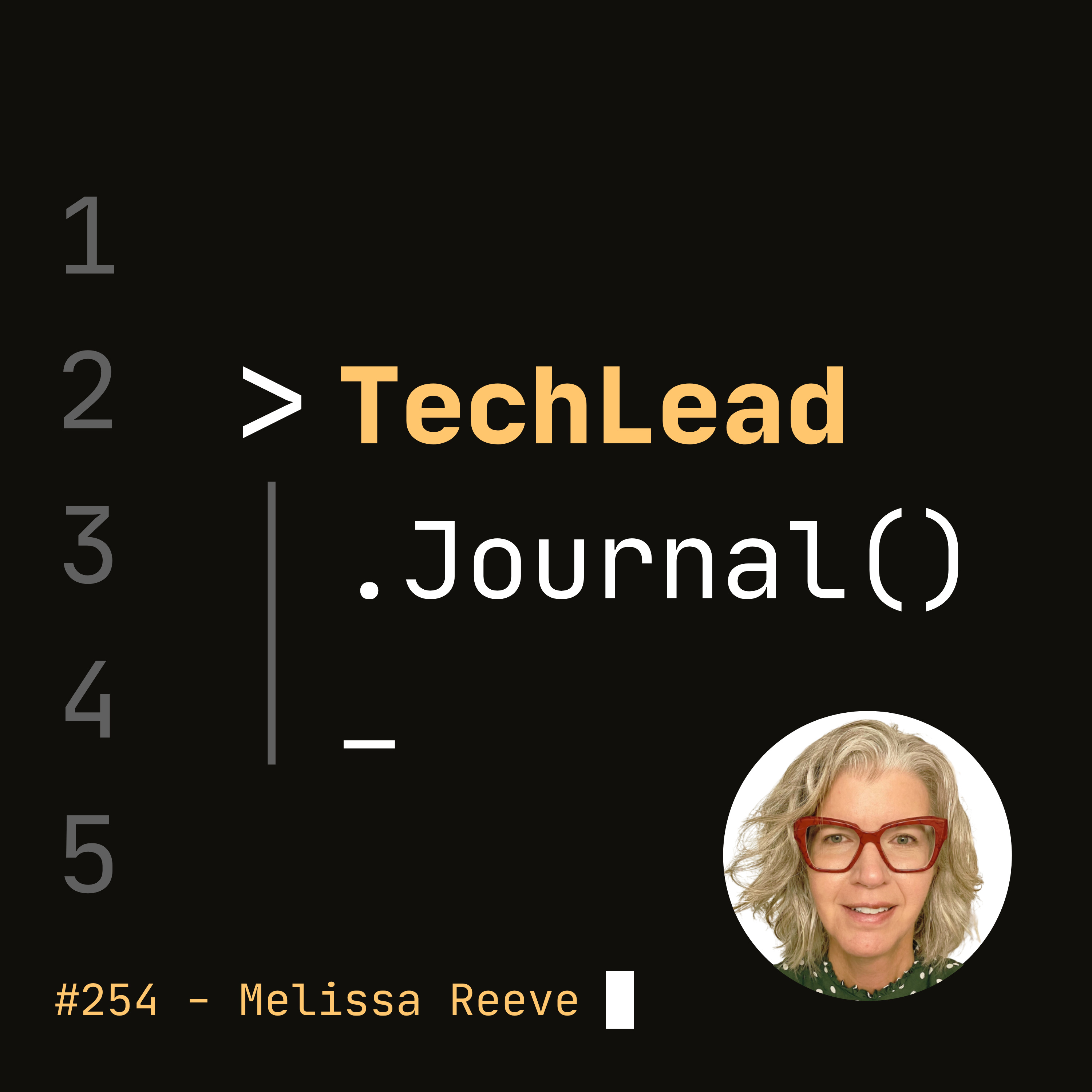
Episode 254 · Tech Lead Journal
Why Incumbents Will Fall: How to Build a Hyperadaptive AI-Native Organization
13 Apr 2026 · 1 hr 4 min
Episode 254 · Tech Lead Journal
13 Apr 2026 · 1 hr 4 min
Why do 80-95% of AI initiatives fail — and why is your organization’s structure to blame? Most companies are treating AI like a software upgrade, when it actually demands a complete rewiring of how work gets done. In this episode, Melissa Reeve, author of Hyperadaptive and organizational change expert, shares a practical model for transforming legacy enterprises into AI-native organizations built to thrive — not just survive — in the age of AI. Drawing on her experience with the Toyota Production System, Scaled Agile, and deep research into leading AI adopters, Melissa argues that the real…
I do believe that giants will fall because they won't be able to pivot fast enough. And it'll be your decisions that Today's guest is Melissa Reeve, IT Revolution author of Hyperadaptive. From Toyota's factory floor to Scaled Agile, she has now built the playbook for surviving the AI disruption before your company becomes the next casualty. What made digital transformations different with the AI transformation? Speed is a primary differentiator. AI native organizations are more respond and react in near real time.
AI will finally be the catalyst for changing the way we actually organize the business and the operating model. Despite a lot of this AI adoption of AI really in the industries? People defaulted to treating AI like a software installation. The board of directors putting pressure on the C-Suite to go do something with AI. The C-Suite would tell people under them to go do something with AI. Unfortunately, it hasn't worked. Many organizations are thinking about downsizing. What is your view on this?
So when we say jobs are going because we treat jobs as monoliths. AI might automate parts of jobs, interactions. AI is really like the fast brain. It can process things very, very quickly. And we still need the human to be the slow brain to building, monitoring and maintaining the agents that do the tasks. We haven't done the hard work of are implementing AI? Is it AI just for AI's sake? Or are we trying to do Hey, quick pause. My goal with Tech Lead Journal is simple. Learn from the best in tech so we can all grow together. If this resonates with you, hit subscribe to follow the channel.
It's the biggest way for you to support the show and help us keep bringing great guests and insights to you. Thanks for being here, and let's get back to it. Hello, everyone. Welcome back to another new episode of the Tech Journal podcast. Today, I have with me another IT Reeve. She's the author of the book titled Hyperadaptive. So this is kind of like rewiring getting us ready to work in this AI era. So I think we all know about the that AI has brought to the world as of this day.
So I think today we'll talk a that and how organizations can So Melissa, thank you so much for your time, looking forward for this conversation because I'm sure all of us here are still kind of a bit clueless. Thanks for having me on the show and it's a pleasure to be here with you today. Right. Melissa in the beginning I'll, I have taken a look at your background, right? So I think you have dealt a lot with, you know, changing culture, transformations, and things like that.
Even back then when you studied the Toyota Production System. Maybe tell us a little bit more how those experience actually shaped you for who you are now and what made you can relate those experience to the current AI era. Yeah, I'd like to say that the impetus of the book or the start of the book happened on the Toyota factory floor in Tokyo. And it was there where I saw firsthand the Toyota Production System in action. And I saw how one little change to the system could affect, could have an outsized effect. And even though I continued my career as an executive and with a specialization in marketing, I always had this system view.
And I didn't necessarily have the words around growth mindset or systems thinking or agility for a long time. That's exactly what was happening in terms of the way that I led. And in 2011, I did come across something called Agile marketing, and I thought, oh, this is — this feels much more natural, a much more natural way of working. Being able to take things in small batch sizes and experiment with them, that felt very, very natural. So then, when I landed at Scaled Agile, who's the provider of the Scaled Agile framework, all of a sudden I was exposed to the world's experts in not only things like Agile and scaling Agile, but the fellows who worked there had a really rich understanding of everything from change management and leading organizations through change.
So I had a front row seat to not only success full implementations, but what was happening to failed implementations. All of that came to fruition when I was running the Agile Marketing Alliance and was continuing to spread the word, good word of Agile to marketing audiences, when ChatGPT came along. And it just sucked all of the oxygen out of the room. And it really was all anybody could talk about. So I pivoted to really think about AI, and I had this notion in my head of what I was calling automated execution pipelines, and that's just the end-to-end execution of a workflow. The light bulb that went off for me was this feels very much like DevOps.
And so I'm sure you're gonna but that's like my history up everything that led me to this a-ha moment. Very interesting, you know, insight, how you probably can like kind of come up with this book in the first place, right? So I think one question that I would like to ask you first. Like you have seen a lot, you know, in Toyota Production System, back then it was probably more like Lean methodology and you have dealt with, you know, Agile marketing, you know, Agile that. Some people also might have heard about digital transformations that happen.
What made those transformations actually different with the AI transformation that we are currently having now? Yeah. I think speed is a primary differentiator. You think about — I think about digital transformation really taking hold around 2008, when we saw the advent of things like Airbnb and Uber really threatening the existence of other giants whether that was Marriott with Airbnb or whether that was taxis with Uber. But it still played out over many years.
And I feel like AI is much more intense in terms of its speed. And these AI native companies I think digital transformation will. I think the other big piece is really contained for the most And AI, I believe, is going to And because of that it will finally be the catalyst for changing the way we actually organize the business and the operating model. Wow! So yeah, indeed this, the speed of change, it's quite intense. Like every, maybe every few weeks we will hear new inventions, new advancements of the, you know, maybe state-of-the-art model or whatever that is.
So, but I, yeah, it feels like especially for leaders who are kind of like new to all these AI craze. I think probably the kind of level of stress to keep up with the pace of change is definitely very frightening. So you mentioned about digital transformation back then. There are disruptors like Airbnb, Uber, and all that, and we all know what happens since then, right? They become giants, big enterprises. Do you think AI native companies will be doing the same, this kind of disruption?
Like would... Absolutely. ... that be in fact the most danger for incumbents that they have to act now? That's right. Yeah. And that was the impetus for existing organizations are what I call linear organizations. And we'll explore this more. But that's different than a hyperadaptive organization, which is one that's more or less AI native. And they're able to — their ability to sense and respond in near real time is much greater because they have fewer handoffs, they have fewer layers of hierarchy, they're So I do believe that giants will fall, giant brands will fall because they won't be able to pivot fast enough.
Wow! So quite frightening, I guess, for some of us here, who are used to this linear organization model. So maybe if, before we go into the book, I'm a bit curious about the first idea when you came up with this concept, right? You call it like automated Are you referring more towards the marketing pipeline in the very beginning that you can automate the process? And how since then it evolved Thanks for asking. And the original automated execution pipeline was, in my mind, I could see an AI agent end-to-end executing a to the copywriting to the developing an ad, all the way to deploying it on a platform especially a digital platform, like a Facebook Ad or Google Ads.
But the spark that I had was we've seen this before, and we saw it with DevOps and the automation of the software delivery pipeline. So we went from having an individual who did the coding to an individual who did the testing to an individual who put it into production, to all of a sudden being able to deploy hundreds if not thousands of times a day for the most mature DevOps implementations. And so I went back to the DevOps connection with Gene Kim and IT Revolution.
I had read it before when I was with Scaled Agile, and we started to explore the DevOps space, and had been to the DevOps Summit many times before transitioned into the enterprise leadership summit, Enterprise Technology Leadership Summit. But I went back, and I said, well, what lessons can we learn from DevOps that we can now apply to this moment? And the biggest shift that I saw was that we went from having people do a lot of those individual tasks, like I'm gonna manually do this test or I'm gonna manually push this into production, to building monitoring and maintaining automations that did those parts of the software delivery pipeline.
And I thought a-ha, that's it. That's the pattern that we'll most likely see as we introduce these agents. And yes, they might be able to build themselves, but we probably want some level of telemetry and monitoring. And because AI capabilities don't stand still, we'll have to maintain them. We'll have to continually update them as the capabilities continue to expand. And so I took that concept and then I also used AI deep research to surface the patterns of leading companies around the world who already were integrating AI into their organizations. And then the third bucket was just research and organizational change patterns — Peter Senge, John Kotter, could we take the lessons that we learned from digital transformation and failed digital transformation, and weave those three things together: the DevOps, the research, and the success organizations into a model that people could follow.
And that's really the underpinning of the book and the hyperadaptive model. Thank you for sharing, you know, So maybe some people already hear about this hyperadaptive. Maybe if you can start by defining what do you mean by hyperadaptive organizations? Yeah. So I started to describe it a little bit. And I wanna dive into that notion of a linear organization. So you have strategy to execution, a lot of layers of hierarchy, and then you have concept to delivery, and handoffs and delays as people are doing their specialized area.
And AI compresses both of those dimensions. And AI native organizations, because of this compressed structure, are more quickly able to sense and respond and react in near real time. And that's the state of hyper adaptivity that I think we're headed toward, as the learning loops compress, as execution compresses. And it will be a competitive to have those capabilities. And things like AI-assisted decision-making. And even organizing around value, and instead of being organized functionally, organizing around value streams. I think those types of things will be very much competitive differentiators going forward.
You know, taking action in real time, I think we all aspire doing that, especially in big organizations where they have lots of people and, you know, lots of hierarchy. Like everything seems to take working in those companies, right? Plus the hands-off and maybe the misalignment, miscommunications that could happen. So definitely very interesting how AI could compress all those, you know, from strategy to execution and delivery. But we have seen in, maybe in the past one year or so, despite a lot of these AI advancement, what do you think is the adoption of AI really in the industry so far, especially for those linear organizations? Yeah, so we've seen some pretty consistent patterns. And it started with confusion.
AI is so big and it's so amorphous, so it's hard to pin down, that a lot of executives were frozen. And we, what we saw is we saw the board of directors putting pressure on the C-suite to go do something with AI. And then the C-Suite would tell people under them to go do something with AI. And then people defaulted to treating AI like a software installation. And what that means is they or ChatGPT or Gemini. And then they invested in a little bit of training, like we've always done training: video libraries or a two-hour session.
And then they told people in the AI. Unfortunately, it hasn't worked. so what organizations are waking just a software installation, that it requires deeper exploration. AI learning is what I call social learning. So we learn from each other, so the learning patterns look differently. And it requires a different mindset than just updating a piece of software. And I feel like that's what I've, that's the path that I've seen many organizations. And now they understand that they need to invest in infrastructure to support the rollout of AI.
Yeah, definitely. I mean I can also borrow from my experience, right? I'm a bit confused as well like how can we actually implement that in kinda like a big part of organizations. You know, talking about software development probably is more straightforward. We can use a lot of these coding lot, right? We can see the benefits. But making a transformational change in organizations probably is a bit like, you know, very confusing and some people probably are paralyzed by like the sheer of amount of change, not to mention the cultural change that might happen as well, right, because of this.
So I think you mentioned also in your book, which I kinda like, because you mentioned there are three kind of like barriers that maybe hinder some of these organizations from adopting AI or integrating AI. Maybe if you can elaborate a little bit, what are these barriers so that people can at least conceptualize these kind of barriers? Sure. So information friction is definitely a barrier. And think about even something as simple as an as AI governance or an AI council.
You have AI that's moving so, so quickly, and that means the rules are changing. When AI was first rolled out, the data that was input into AI was now owned by the company. And that scared a lot of enterprises because they didn't want their data in these large language models. Well, that quickly changed, but the perception that the data was not secure really remained. And that's an example of information friction within the organization. Like there might have been a pocket of people who understood that the large language models had moved on and now protected enterprise data if you had an enterprise license. But disseminating that information throughout the organization is very, very difficult. And you need structures in place to create information flow in a more ongoing way.
So that's one example of a Decision bottlenecks is another barrier to AI integration. So who determines who gets to If I don't feel safe that I can use AI, I'm not gonna do it. I'm just gonna continue using the safe way to do it. And then functional boundaries. Maybe somebody over in accounting has created a great use case for AI, but getting that into other parts of the difficult. And so those are some of the structural barriers that people see when they're thinking about AI and trying to day-to-day work. Yeah.
I can see all these barriers actually happening in many organizations, especially again like big, large corporations where they have a lot of functional silos, different hierarchies, right? All like information, decision making and a functional thing definitely becomes a big barrier for them. Another thing that I also find interesting is that for linear organizations is the concept of Taylorism. You know, Frederick Taylor, the management system that he brought up maybe decades ago.
So maybe tell us why this Taylorism is also kind of like one of the big barrier for organizations to adopt hyperadaptive. Sure. So Taylorism, John Winslow Taylor, 1911, wrote the first book on management theory. And he said that there are two classes. There's a management class and there's a laboring class. And it's management's job to find the one best way of doing it and impart that knowledge onto the laboring class. And you can imagine this. It's the world is assembly lines figuring out how to best assemble materials.
And then they have, they share on the front of the assembly line. And that's what made the Toyota Production System so unique is now it empowered the people who were closest to the work to actually give their input on what was best. But when you think about that exists in many organizations. The manager has the best answer and it's your job to take that and just execute with it. So that's one part of Taylorism that's blocking organizations. The second part is the functional silos that emerged right after World War II. And this was the idea that in order to have a big global organization you needed to put all the salespeople together and all the marketing people together, and that you gained efficiencies by doing that.
And that might have been true more slowly than it does now. But in today's world, like we've known that this has been a problem for a while, right? Everybody feels it in their work. You know, how slowly things move across function or up and down the hierarchy. But we haven't really had a forcing function to change it. And I think now that this is the forcing function that will cause these embedded structures to reinvent themselves. And the people who don't reinvent themselves will be struggling.
Yeah, I mean, from my point of view, all I can see all organizations are structured this way. You know, like you have like senior executives, you have managers, and you have the people who are doing the work. And in fact, you know, I mean you talk about functional silo, it's, I think, still predominantly every organizations are structured this way, right? I personally haven't worked in, you know, a company that is structured differently. But actually, very interesting, after I read your book, right? And also looking back on how other companies like, you know, Zappos or some of these companies which seem to and the success stories that they have, I'm sure some of these definitely can help for us to adopt AI much more effectively. So for these, actually you mentioned five different capabilities, right, for organizations to be hyperadaptive.
I think you have named some of them. But if you can maybe walk us through what are these big five capabilities that companies need to invest so that they can actually, you know, become much more hyperadaptive? Yeah and I think what I love about these capabilities is that they supersede or they go above the actual capabilities of the models, and so they're much more durable in terms of things you can invest in. For example, augmented decision-making and using AI to make better decisions.
That's something that I think we'll be doing today, tomorrow, three years from now, five years from now. And maybe AI will get better at making some decisions, but I think we'll still want humans in the loop. And I think about all the ways that we shortchange decision making today. So for example if you're doing financial scenario modeling, you might have a best case scenario, a worst case scenario. I think what AI will unlock is our ability to create 40 scenarios or 100 scenarios, and then as we are seeing reality unfold, then we get a better sense of how the scenario might play out.
And that's what I mean when I talk about AI-augmented decision making. Value orientation is another one. Why are we doing AI? What value is it bringing to the organization? When we orient toward customer value, we're using this powerful new tool in a way that shows and demonstrates ROI. And I actually believe that orientation will extend into our And that's one where we actually And value streams, just think about it as your end-to-end delivery of value. So if you're a bank and you service people who are new grads from college, that's an example of a value stream. You're delivering products and services specifically to that market in a value stream, you would have everybody needed to deliver that value.
So it's another durable capability that you can incrementally rewire yourself toward. Things like AI-powered sensing, responding, we touched on that. Continuous adaptation. So building in the ability in your AI systems to adapt over time. And then, the last capability And I think that this one — it's When you think about, again, that Toyota Production System, the Kanban — not the Kanban systems, but that's part of it — Agile, retrospectives, it's all about capturing those learnings so we can continuously improve.
I think the breakthrough with AI is that we'll finally be able to close the loop. So a lot of times what happened, what I saw happen in Agile is that people would run their two-week sprints, they would get to the end of that, they would hold their retrospective. They would surface some learnings, and then those learnings would just sit there. They would never get actioned. But the opportunity we have now is for AI to not only capture some of those learnings, but then improve itself as it's running that process the next time. And I think it allows us to get much more structured in our not only capturing the learnings, but also integrating them in a way that enables continuous improvement. I like when you mentioned closing the loop, right? I think from like very primitive view of me, right? So some of these principles actually already exist. You know, things like feedback loop, right? You know, your learning organizations, adaptation. I think it's mentioned a lot of times during those transformations, Agile transformations. Also organized around value stream is kind of like maybe Lean principles as well.
Like I feel all these principles ago. And probably now it's kind of like more amplified. Like why the need of making them amplified. Is that the correct interpretation from, you know, my primitive sense of understanding? Oh it is. And I believe that AI will unlock many of these things that we've been trying to do on a small scale, and really help us refine them. And we need to remember the, these roots. So like you said, the lean and the value stream, absolutely, I'm not inventing anything new here. And I'm saying we've known for a long time that that's a more effective and efficient way to organize. And yet, the organizations as a whole have remained structured by functional silos.
And so the question becomes organization in that direction disruptive. Because what we know for sure is that we can't shut one way of operating down and then spin one up. And so we have to do this gradually over time. Yeah. I would assume like many people would think about the effectiveness and efficiency of, you know, creating, you know, different value stream-based organizations or teams, right? Because like there will be duplicates of roles definitely, right? When, you know, many people in the world now is talking more about, you know, downsizing, efficiency and all that. So definitely will be interesting like how, you know, organizations can transform gradually to that way. I wanna touch on a little bit about augmented decision making. I think some people might already embed AI in their day-to-day workflow.
You know, even for me, like asking questions now, I don't go to Google more, I go to maybe Gemini more, to get much more, you know, richer interactions and be able to iteratively, you know, understand a problem. But I think many organizations, many people are not, yes, are not yet used to this model. And in fact, now with agentic AI that it's not just like a chat interaction anymore. The AI agents can do much more beyond. You know, maybe doing some sensing and responding based on those outputs, right?
And also asking you back, as a human in the loop. So tell us like how would this human in the loop process evolve over the time and what would be your advice for people who are still not yet used to this kind of a model? Yeah, I mean I think you have to for your decisions, and also become more aware of the places AI already exists. So for example, I come from this marketing background, and things like dynamic ad, bidding, dynamic bidding for ads, has been around for a long time.
Now that's an AI algorithm that's making decisions around pricing and around purchasing ad space that doesn't have a human in the loop. I mean it does in that it, the human might set the ceiling and it might set the floor, but in general then the algorithm guardrails. When the stakes get higher, you never want AI to be the one making the decision to fire somebody. You never gonna want AI to deliver that communication. You never want AI to make a decision that would cost the organization millions of dollars. You want humans to stay in the loop. Now AI can do some analysis.
It can make a recommendation. But you have to think about the stakes and really start to tease your decisions apart. I want to invite your listeners to really think about how their decisions are made today organizationally. Because what we often do today is to reduce risk, we actually have decisions go through layers in the hierarchy, and that's the way that we reduce the risk. So I'll propose a decision I'll have my boss check it, I'll have that person's boss check it, and we assume that if four people's eyes have been on it then it must be an okay decision.
And as you're thinking about AI-augmented decision, I want you to think about how decisions are made right now and how you can start shifting that risk profile with the help of AI. If the only reason we're having four human beings look at it is to reduce the risk and cover ourselves so we don't lose our job, maybe there's a different way to be thinking about that decision making process. Wow, I really like that practical tips, right? Because, yeah, I can see some people would already understand how they can benefit using this AI. And in fact, you know, AI is such a, you know, like compressed so many different capabilities and you know, knowledge that is available out there, right? Maybe in fact, arguably it can be even better in terms of, you know, understanding a concept, you know, getting some experts from resources out there to actually vet your right? And in fact, some people already can like build different skills, different personas, you know, ask AI in different ways such that they can shape, you know, the kind of, you know, thinking or output that the AI can respond to us. So definitely that's practical
tips for those of you who are still not yet used to this working model. Another thing that I wanna dive a little bit deeper is the value orientation that you mentioned, right? So I think many organizations now is kind of like structured in a functional way, like what you said, sales, marketing, technology and all that. How would organizations start, organizations by this value stream? Yeah, so in these large organizations in particular there are usually areas of the business that are more leaning in. Like they're more progressive than other areas of the business.
And these are probably the areas already adopting AI more, like they're more advanced in their use of AI. And so the, these are the same areas of the business that you might target and say, hey, let's see if we can start doing a small value stream in this area of the business. And I'd really encourage organizations to experiment with this idea of a value stream on a smaller pilot scale, maybe a couple of pilots. And what that will allow you to do is it allows you to see the impact of organizing in this way on the organization.
So you'll understand how roles start to change when you orient around value. You start to understand maybe how some of the upskilling needs to change. What impact did it have on productivity? What impact did it have on your ability to deliver value faster? And then as you start to learn these things, and I spin up something I call the AI impact hub that's specifically tasked with measuring the shift. What happens when you shift from the functional hierarchy into value streams? And then you start to integrate those learnings before you attempt to do that on any sort of a broad scale. And it's only when we get to, we'll dive into the stages, but stage four, where we start to dabble with orchestrating doing it on any sense of scale at all.
So you can see how gr- you can gradually grow into these new ways of operating. Yeah. I think the interesting part is definitely you mentioned the roles kind of change. I mean, since I'm in technology, I can see like the dynamicism of the roles have changed quite dramatically, you know, with the introduction of AI. Thinking about, you know, software development, product manager. And even could be like designer, right? These roles seem to evolve a lot little bit of product management now, you can also do a little bit of design. Product managers can do a bit of Being able to create prototypes. And, you know, use them to actually validate the idea of getting more feedback and all that. So outside of technology, have you ever seen, you know, such kind of roles that have been blended simply because of the AI?
So I love what you're touching adjacent competencies. So it's things that we would do if we had the skills. And when you think about Agile, one of the challenges of Agile was that they wanted a fully staffed cross-functional teams. But the challenge was that what if you only needed a designer 20% of the time or you only needed the UX person 50% of dedicate full-time employees to an Agile team. I think what AI does is it starts to fill in some of those gaps. So maybe you still have a full-time UX designer, but their job is to monitor custom GPTs and make sure things like right context, that they're operating in the way that they're supposed to, so that somebody like you could go and interact with that agent or interact with that GPT and get reliable results. And I start to feel like that's where we extend ourselves in different directions.
In terms of what we're already seeing, there was a great article that was just produced by Harvard, and they talked about exactly this phenomenon. And they said that what's happening with people who are using AI is they're starting to explore these adjacent more than they were doing before, when they just had my job as a software developer, and so that's all I'm gonna do, I'm not gonna go into to UX or I'm not going gonna go into prototyping. And they say that what's happening for people is their days are becoming more intense, because they're actually doing more. And I think it's really interesting to think about how our roles change.
And maybe it's not about the function anymore of being a software development. It's about what outcomes are we producing. Yeah. So I really like that, you Especially if many things can be automated, right? Part of your daily tasks, right? Obviously, I mean, you would want to explore other things, right? Especially those things that you Like I'm thinking about maybe financial model, right? You will require like a data scientist or people who can query the data, right?
Now you can actually chat. Even the natural language chat interface itself is kind of like a door opener for people to actually, you know, start all these adjacent capabilities, right? So I think definitely this is something that people must try, in order to kind of like maybe blend yourself into different areas of the organizations. But the other argument to this for many organizations is that AI will actually reduce the number of people that we actually need in the organizations.
What is your view of this? Because I think still many organizations are thinking about downsizing. I don't need a lot of developers, I don't need this, maybe so many manual people anymore. What is your view on this? Yeah, my view is... I have this great graph and it has three circles on it. And in the left hand circle, it's everything that an organization wants to do and it's very large. Think of it like the sun. And then in the middle is what the organization actually does. And think of that like the Earth, t's a fraction of the size.
And we can only get so much done and time constraints and people constraints. And then what AI starts to do So what we can actually get done is one of the bigger planets like Jupiter. And I think for the forward looking organizations, they will see that opportunity. And they'll say we have good value with those good people. Unilever is a great example of a company that thinks this way. So they have a program that was used to be called Flex, and now it's called U-Work.
And it's understanding that they've hired good people, and those good people have a purpose that they want to fulfill, and they have a set of skills. And then they use AI to match those skills with the different opportunities within the organization. And in this way, they start to envision their workforce not as one person doing a specific task for their lifetime but as a whole group of individuals who can be deployed in multiple goals. And I think that's a much healthier way of looking at it than this productivity shrinking mindset that seems to be predominant in our headlines.
Yeah, I would also assume like the people who are thinking that way is like people who are still thinking within their functional thing, you know, like the silos, right? And also like layers of Because then, yes, because you this, you know, organizing around value streams definitely makes sense. We reduce those kind of people, but actually at the same time, these people can be transformed into like much more beyond just doing some, you know, specialized skills, right? So I think thanks for highlighting that. Definitely for people who are, you know, still thinking AI will just reduce the number of people we need, I guess like you have to rethink again because yeah, all organizations want so many different things, right? And I think with AI, maybe they even want more, right? They are more ambitious.
So let's go into the stages. You outlined in your book the five different stages, how company in terms of maturity adopt this, you know, AI and becomes hyperadaptive. So maybe walk us through what are these stages so that people can identify where they're at the moment. Sure. So we start with stage one and I is helpful to have a shared language. There's some magic in the other parts of the model, but the stages really are just reference points. So we think about laying the foundation.
We've got to put some governance sure that governance is dynamic. We start to identify our AI leads, because we know from John Kotter that we have to identify champions, and those champions will help change the culture within the organization. In stage two, we're all about process optimization. This is task augmentation with AI. And it's so important for the organization to really take a look at its processes and figure out where AI can be plugged into those processes.
And one, the discipline of it is teaching the organization how to analyze processes. And we need to do this because we know that processes will continue to reinvent themselves over and over as the AI capabilities continue to grow. So that's all about stage two. We also fire up what I call AI activation hubs. And these are the people who start to own, it's a network of these hubs that own AI integration in their area of the business. And one of the mistakes I see organizations doing is they expect everybody to keep track of AI advancements. And it's just not realistic.
We all have day jobs, so let's ta- let's task groups of people to keep track of these AI advancements, and atomize, do what I call atomize the learning. So break the learning down Let's say that Claude 4.6 just released. It would be the res- the job of this AI activation hub to understand how that impacts your software developers, and then send that information to the AI leads, that then also sends that people who are either building agents or coding.
And that's the hard work we're doing in stage two. With stage three, we start to we're automating entire parts of workflow. And I think it's important to are made out of tasks, processes, decisions, and human interactions. So when we say jobs are going away, it's prob- it It kind of bothers me because we treat jobs as monoliths when we do that. But the reality is that AI might decisions, but probably not the human interactions. And so the work in stage three is taking those puzzle pieces, breaking them apart, and seeing where they fall back together with agentic AI. And like we talked earlier, I believe that we're going to go from people doing a lot of the tasks to building, monitoring, and maintaining the agents that do the tasks. So we take a pause in stage three where we fire up those AI impact hubs that I mentioned, to really look at the impact organization. Stage three is also where we start to fire up our value stream pilots, and we do that learning before we move into starting to scale agentic AI across the organization.
We're really rewiring the roles in stage four. We're expanding our value stream experiments. And then stage five is now we're entirely new way of operating. This is orchestrated value streams. We fire up our telemetry network We start to operate in a new talent model, one that instead of viewing a career as a ladder, it's a portfolio of experiments or experiences. And we even start to really implement different funding models where we might be funding value streams, where we're funding experiments that I call innovation circles. And then we're funding a very stable layer of infrastructure. Things that are pretty predictable. And you can see gradually over time how radically the organization starts to change and shift as we move through these stages.
Wow, very inspiring indeed, right? So if we can, you know, aspire to go to stage five. Have you identified companies like stage four, stage five? The one that I profiled, and I do call stage four and five the emerging frontier. So these are early signals that we're getting from the market. The company that I profiled out in stage five was Ping An Insurance out of China. And they started their AI journey in 2008. And that's when they first got their data infrastructure in place, that now empowers them to become this AI powerhouse that they are.
They are both insurance and interwoven together, and they're using the power of that ecosystem to really create unique customer experiences. Wow! So for people who are kind of like aspiring to build this kind of, you know, hyperadaptive capabilities, definitely you can check out, refer to this Ping An Insurance, you know, case study. I think Ping An has also been previous digital transformations book. Definitely very exciting to hear AI within their organizations. So I wanna touch on about this maybe shortcut that leaders are thinking, right?
Because when you mentioned in the very beginning, people still think that AI is kind of like a tools, it's like a technology thing that they just embed, integrate into organizations. And hence they kinda like jump into stage three, you know, like applying this agentic AI and you is, right, automation. So tell us why there is this danger if they don't actually set up, you know, like stage one, stage two. You mentioned a few things like, you know, pointing AI leads, AI activation hub, and those kind of things. What are some of the dangers if leaders are kind of like shortcutting themselves to stage three? Yeah.
We see it right now, right? We see it in the failure rates. You know, I've heard 80% failure 95% failure rates from MIT. And it's this disconnect between — sometimes it's the simple disconnect, that we see a lot between IT and business, right? So IT spins up an agent and the business isn't ready to use it or it doesn't meet the business requirements. But I think what we're doing is we're trying to push ahead to orchestration and to agents when we really haven't built those foundations. We don't really have good governance in place. We don't have ways to update the organization. We haven't done the hard work of Star. What is that reason that you are implementing AI? Is it AI just for AI's sake or are we trying to do something meaningful with it?
And those are some of the mistakes that I see leaders making with AI. And I get it because there's so much pressure out there to do something with AI. And the Sam Altman's of the world, the Mari, sorry, Dario [Amodei] of the world from Anthropic — like they are out there every day making it seem like this is happening and you are missing out. And I don't think it — here's the thing. AI is moving fast, labor markets move much slower. Yeah. So yeah, definitely they kind of like, you know, mentioned a few, you know, bombastic sentiments, you know, out there.
You know, no more software engineers, you know, everyone will just use AI. So in fact, yeah, it hasn't really happening at full scale. So yeah, definitely for leaders who are thinking like just shortcutting yourself probably is a bit of a danger, right? And speaking about governance, you mentioned governance a few times now, right? Because I'm sure like executives about this risk of adopting AI. First is like definitely hallucination, your data leaks, right?
Those things sometimes are in like wide big scale, right? And that's why people are probably more scared about it. So what are, what do you think are like practical governance thing that we can do in organizations such that, you know, we are not paralyzed to adopt AI, but at the same time, we also don't want to bear too much risk? Yeah, I like to talk about dynamic governance. And I like to talk about it in four different layers. So when I think about traditional governance, I think about a committee that's gotten together, decided the rules, maybe they meet quarterly and they put the rules. They do two things.
They put the rules out on the create some online learning that everybody in the organization has to take. And most people in the organization take this learning. They watch it at 3x speed. You know, they try and pass the test and they check the box, like okay, we've, I understand what the rules are. With AI, I think we have to system. So yes, you probably need a group at the top who's establishing high level guardrails. You know, again, Ping An Insurance has a very robust ethical guidelines and guardrails around their AI usage.
And we need that in place to directionally show where the organization is going. Those people need to be meeting on a very regular basis, every two weeks, every month, you know. Not quarterly, it's too slow. And then you probably need a layer underneath them, maybe at the functional layer, to interpret those guardrails for your area of the business. And really hash through any exceptions or any more granular detail you need to guide your area of the business. Then your AI leads become your frontline lieutenants. So those people really understand. They work with those functional area groups to really understand what the limitations of AI are and what it translates to in the real world on the front lines. And so if you're working together in a team or a group, you could ask your AI lead, "Hey, I'm thinking about doing What do you think?" And that person could get you your guidance. But I think even more powerful than that is a custom GPT or a custom engine that contains all of your guardrails, that anybody in the organization could query and say, "I'm thinking about doing these things with AI." And maybe it's a traffic signal,
where the GPT responds and says, "That's a red light. Absolutely do not do that." You can do it but consider these, tweaking it in this way." or "It's a green light, you're free to go." And even though I use the words custom GPT, it would have to be connected to something that's much more predictive like a RAG or, you know, a database, that's contained. But the advantage of doing it feels much more natural. People can ask about their specific instance. And then it can be continually updated so that people always have the most updated version and you don't have to go searching out into the internet and maybe finding an outdated doc document from a quarter ago. Wow!
I think, again, good practical tips for people. you know, when you want to kind of like, you know, upscale, you know, the implementation of AI. Definitely there are a lot of questions, right? And I think even the leaders themselves probably are also still catching up, right? Because there are so many And how do you actually catch up with all these, definitely is very difficult. And I think some of these practical tips, like I like the custom GPT that you mentioned.
I'm also thinking like, for example, the way you interact, like with NotebookLM, you can kind of like ground it with your guardrails, policies or whatever that is, right? So that people can just query meeting them where they are, right? Because some people understand about AI much more naturally, but some may think it's like an alien technology. So another thing that I like, reading in your book is you mentioned about how these organizations would behave once they are more hyperadaptive and you kind of like brought this concept from Daniel Kahneman's Thinking Fast and Slow.
I like that analogy. Maybe if you can explain to us that would be great. Sure. So Daniel Kahneman, Thinking Fast and Slow, there's the fast brain that's like your instinct, right? You react to something, you process it. And then there's the slow brain which is more deliberate, more mulling things over, thinking things through. And I feel like the AI is really it can process things very quickly. And we still need the human to be the slow brain, to think about AI's output. And what I see job shifting to is actually from doing a lot of the tasks to evaluating the output of AI. And that requires a real level of critical thinking, because you're trying to identify what is AI missing, what are the holes in its logic or what are the holes in its reasoning. And we need to be very deliberate about this new emerging role of human as evaluator of output. And I think where it gets scary for some people is a lot of our identity is tied to the doing of the thing. And it's almost like we're furniture craftsmen, and we we've gotten so used to building this beautiful furniture, but all of a sudden IKEA comes in.
And there's a new type of furniture that is built and everybody still wants the craftsman furniture, but there's a place for IKEA furniture. Yeah, definitely. Especially, software engineers. Also the same, right? We kind of like spend years understanding, you know, language, syntax and you know, the nitty gritty of how you write programs. But now suddenly, you know, and it will write the program for you. Definitely there's a little bit of identity crisis here happening. But yeah, nevertheless, I think people needs to be able to still exercise their critical thinking, which I don't think it there're still human in the loop in the process, right?
Even though maybe some people everything to AI agents, definitely there will be a risk there. Because we all know, like, you know, the brain system, you know, thinking always in a fast mode definitely is not the best thing, right? Especially because for things that require, you know, high stakes, more risk, you would still want kind of like human to be in the picture. Another aspect that I find in your book, which I find really interesting is you mentioned about this three triple bottom line, the 3Ps.
Normally I would not see that elsewhere. You know, people talk about process, technology, and you know, people. But you mentioned about people, profit and planet. So what do you mean by these triple bottom line? Are we as organizations need to aspire doing that more? So the triple bottom line has been around for a long time, and it's this notion that we as enterprises, we as corporate citizens — You know, certainly there's governments, but I feel like enterprises are this global influence. And in some ways enterprises lead the world. And so we have this responsibility to not only think about the profit, but also our impact on people and our impact on the planet.
But when you think about human cognition, that is very difficult for a human to hold all three of those at once. You know, it's hard enough to optimize for the profit part, much like, much less think about second and third degree impact on the planet or what are we doing to humans. And so my hope is that AI can help unlock some of that additional thinking for enterprises and for corporate citizens, that we might finally, you know, this is, again, this is the circle getting bigger.
Like, oh, we now have the capacity to focus on some of these other things in a more meaningful way. And that's where I land the book, and that's really my hope for humanity. Wow, that's definitely a lovely message, lovely advice for all of us, right? So I think if we can aspire to much more bigger, right? Hopefully we can, you know, invent much more thing and, you know, solve a lot of human problems that are currently unsolvable. So Melissa, we have spoken a lot of things. Are there any other things that you think I'm missing that we need to talk about before we wrap up for the last question? I, we've, it's been a wide ranging conversation. Really appreciate being here.
I think you've got one last question and I'd love to close on that. Yeah. So my last question is like tradition in my podcast, I call this the three technical leadership wisdom. You can think of it just like advice you wanna give to the listeners. Maybe if you can share yours, that will be great. Yeah. I think the first thing is really thinking about installing AI is needing to install a new system. So systems thinking. Instead of optimizing for an agent, really think through how do you create an interconnected system that looks today. I think the second thing that we've touched on is thinking through what's possible with AI, not just the minimum. Not how can you keep doing what you do today, but what new capabilities does AI unlock for you, your business? There's always more things that we want to do. And the third thing is really embracing a growth mindset. So we have these concerns around our identity, and I actually think it gets bigger.
The bigger concerns, the farther Because there's more at stake. You've worked your entire career to get to this position. You have great financial benefits, and now you're potentially being asked to change. And I think that we're under investing in the AI literacy of our C-Suite. I think of everybody in the organization, those are the people who need to invest in themselves at this moment to really understand AI's capabilities, its limitations, separating hype from reality. Because it's your decisions that will be reverberating throughout the organization.
And it'll be your decisions that be a giant that falls or if you're gonna be one of the winners in the AI revolution. Again, lovely wisdom, lovely message for all of us here to listen, right? So thank you so much for sharing those. So Melissa, if people love this conversation, they would check out more resources or ask you questions online, is there a place where they can find you? Thanks so much for the ask. So my website is hyperadaptive.solutions.
And feel free to connect with And I'd love to connect with Right. Thank you so much for your time today. I think this book is kinda like one of the rare thing that people can check out, especially if you are into, you know, doing transformations with AI, building new types of culture. Because I'm sure people are still kinda like scrambling how to actually adopt AI, implement AI effectively in organization and not just talking about, you know, downsizing, you know, optimization and all that. So definitely check out Melissa's Hyperadaptive book from IT Revolution.
So thanks so much for being here today. And yeah, looking forward for our next conversation. Thanks so much for having me. Take care.
Transcript supplied by the publisher with the episode.
by Henry Suryawirawan · English · Tech & Science
Great technical leadership requires more than just great coding skills. It requires a variety of other skills that are not well-defined, and they are not something that we can fully learn in any school or book. Hear from experienced technical leaders sharing their journey and philosophy for…
E257 · 4 May 2026 · 1 hr 15 min
(07:22) Brought to you by Mailtrap Mailtrap is a modern email delivery for developers with native SDKs support along with security compliant API & SMTP. Plus, you get 4,000 emails a month completely on their free tier! It also provides 24/7 support where you actually talk to real people, not an AI chatbot. Try Mailtrap for free at mailtrap.io . What does code review mean when AI writes most of the code? The answer isn’t to review more carefully. It’s a fundamentally different process, one built around rules, agents, and governance rather than diffs and comments. In this episode, Itamar…
E256 · 27 Apr 2026 · 1 hr 5 min
(05:00) Brought to you by Mailtrap Mailtrap is a modern email delivery for developers with native SDKs support along with security compliant API & SMTP. Plus, you get 4,000 emails a month completely on their free tier! It also provides 24/7 support where you actually talk to real people, not an AI chatbot. Try Mailtrap for free at mailtrap.io . What happens when AI ships code faster than your team can review it? As agentic development accelerates your SDLC, the guardrails matter more than ever — and most teams don’t have them. In this episode, Egil Osthus, CEO of Unleash, makes the case for…
E255 · 20 Apr 2026 · 1 hr 16 min
What if vibe coding is the worst thing you could do with AI agents? The developers seeing the biggest gains aren’t prompting harder. They’re planning smarter, spec-first, and treating AI as a facilitator rather than a code generation engine. In this episode, Brian Madison, creator of the BMad Method, shares how a year of late-night AI experiments led him to a structured, Agile-inspired approach to building software with AI agents. Brian explains why jumping straight into agent mode without upfront planning (what most people call vibe coding) reliably hits a wall, and how a disciplined…

E253 · 6 Apr 2026 · 1 hr 30 min
What does it take to build a world-class engineering culture when you start with five engineers on minimum wage? Tommy Sullivan did exactly that at Vidio — and the team’s average tenure of seven years tells you everything about whether it worked. In this episode, Tommy Sullivan, CTO of Vidio (Indonesia’s largest streaming platform) shares how he built an engineering culture from almost nothing, growing a team of five to over two hundred using Extreme Programming principles and a relentless focus on hiring for attitude over aptitude. Tommy traces his journey from Pivotal Labs in San Francisco…
E252 · 30 Mar 2026 · 1 hr 4 min
Why do so many talented senior engineers struggle the moment they step into a tech lead role? Most of them are promoted based on their coding ability, but that same strength becomes a liability the moment they start leading a team. In this episode, Anemari Fiser, tech lead coach and author of “Leveling Up as a Tech Lead”, shares the three mindset shifts that define the transition from senior engineer to effective tech lead: moving from an “I” to a “We” mindset, shifting focus from code to value, and trading short-term thinking for long-term impact. She explains why so many engineers hold on…
E251 · 16 Mar 2026 · 1 hr 4 min
In a world where AI can build your MVP overnight, what actually gives you a lasting competitive edge? Andrew Stevens argues it’s not the software — it’s the data, the trust, and the systems you build around them. In this episode, Andrew Stevens, CTO of Sakura Sky and a technology leader with 30+ years of experience building, scaling, and selling companies, shares hard-won lessons from his journey across startups, enterprises, and AI ventures. He explains why product-market fit matters more than shipping fast, why data outlasts software as a competitive moat, and how leaders must design…

E269 · 28 Sep 2026 · 1 hr 7 min
Why can’t you “move fast and break things” in a factory? Because a small software bug doesn’t just crash an app, it can shut down a plant the size of a small city. David and Willem explain the hidden world of operational technology, where safety always comes before speed. In this episode, David Ariens and Willem van Lammeren, co-authors of “The IT/OT Handbook” and hosts of the IT/OT Insider podcast, break down the divide between IT and OT, information technology and operational technology, and why closing it matters more than ever as manufacturing digitalizes. They explain why OT prioritizes…

E268 · 7 Sep 2026 · 59 min
What’s the one rule that matters most when AI writes most of your code? Emilie says it comes down to a single line: don’t outsource your thinking. In this episode, Emilie Schario, co-founder of Kilo Code, unpacks what it actually means to lead in a world where AI can write most of your code. She explains why Kilo went all-in on being model agnostic, supporting over 500 models instead of betting on a single lab. Emilie shares her core rule for using AI responsibly: never outsource your thinking, especially when it comes to auth, billing, or security. She introduces a metric more companies…
E267 · 24 Aug 2026 · 56 min
If you’re not using AI five times an hour, you’re already behind, says the man who built the first AI assistant back in 1998. Kevin explains why that pace is now the baseline, not the exception, for developers who want to stay employed. In this episode, Kevin Surace, the inventor of the first AI assistant and CEO of Appvance, joins to unpack six decades of AI evolution, from hidden Markov models to the LLM breakthroughs now powering coding agents. Kevin shares how his work at General Magic became the licensed technology behind Siri and Alexa, and how he ended up inventing post-training…
E266 · 10 Aug 2026 · 1 hr 2 min
Does moving faster with AI mean you get to skip the laws that governed every software project before it? Milan Milanovic argues the opposite, the old laws of software engineering now apply twice as hard. In this episode, Milan Milanovic, CTO and author of Laws of Software Engineering, returns to unpack why the laws that have quietly governed software projects for decades are more relevant than ever in the AI era. He walks through Gall’s Law and why AI lets teams generate complex systems on unvalidated assumptions faster than ever, Conway’s Law and how it now runs twice, shaping both human…

The Melo app keeps playing with the screen off, works in the car and on your watch, wakes you to your station, and browses the whole catalogue offline. Free, no ads, no account.