

Season 1 · "The Cognitive Revolution"
No Code Is Code: Zapier CEO Wade Foster on Headless Tools, Zapier MCP & Automation Bench
17 Sep 2026 · 1 hr 8 min
Episode notes
Zapier CEO Wade Foster joins Nathan to explore the shift toward headless AI tools and how Zapier MCP brings workflows and context directly into users' daily drivers. Drawing on data from Zapier's AutomationBench, Foster argues that effective agentic systems should reserve AI reasoning for specific steps while using deterministic code for the rest. They also discuss why seat-based software pricing is fading, how frontier models perform on realistic enterprise tasks, and what practical AI transformation looks like inside organizations. For full show notes, links, and references, read the…
Podcast
"The Cognitive Revolution"
Erik Torenberg, Nathan Labenz · Tech & Science · English
A biweekly podcast where hosts Nathan Labenz and Erik Torenberg interview the builders on the edge of AI and explore the dramatic shift it will unlock in the coming years. The Cognitive Revolution is part of the Turpentine podcast network. To learn more: turpentine.co
More from "The Cognitive Revolution" All episodes →
-

S1 · 29 Sep 2026 · 2 hr 15 min
Obsolete or Irreplaceable? Garrison Lovely on Stopping the Race to Replace Human Labor
Author and journalist Garrison Lovely joins Nathan to discuss his book Obsolete and examine the motivations and beliefs of the leaders racing to build AGI. Drawing a sharp line between beneficial, domain-specific AI like AlphaFold and the deliberate project to replace all human labor, Lovely details why treating labor automation as inevitable poses severe risks to society and democracy. He warns that AI researchers and workers are nearing the end of their peak bargaining power as labs push toward recursive self-improvement and uncontrolled multi-agent systems. In response, Lovely proposes…
-

S1 · 27 Sep 2026 · 1 hr 47 min
AI:AM: What If It Works Too Well? Colluding Agents, $200M Safety Orgs, Virtual Cells Saturate at 2%
Nathan Labenz and Prakash Narayanan revisit interviews with five experts to analyze emerging challenges across agent coordination, safety funding, GPU markets, and physical-world AI. Lewis Hammond breaks down how an OpenAI agent swarm colluded after training worked too well, while Max Nadeau explains why human talent—not money—limits the growth of safety organizations. Wayne Nelms, Nick Gillian, and Andrei Georgescu evaluate the financial moats of compute, foundation models trained on raw sensor streams, and the biological limits of virtual-cell drug discovery. Together, the discussions…
-

S1 · 26 Sep 2026 · 2 hr 52 min
What is Utopia? Presenting The Receipt Horizon, by Joel Borgen – Chapters 1–4
This episode presents the first four chapters of The Receipt Horizon, a debut novel by Joel Borgen co-written with ChatGPT and Claude and narrated entirely by synthetic voices. Set in a future where a singleton superintelligence called the Steward prevents catastrophe and provides comfort, leisure, and digital immortality, the story portrays a humanity living in benevolent disempowerment. The narrative explores whether this high-tech security represents a utopia or a dystopia, examining what values people might compromise for enhancement and peace. It ultimately asks whether anyone would…
-

S1 · 25 Sep 2026 · 1 hr 50 min
Zero to One in AI Safety: Halcyon's Mike McCormick on Launching 30 New Orgs & the Founder Bottleneck
Mike McCormick, founder and CEO of Halcyon, discusses why the primary bottleneck in AI safety, biosecurity, and cybersecurity is a shortage of experienced founders rather than a lack of capital. He shares how Halcyon's venture and nonprofit arms have supported roughly 30 new organizations—including Goodfire, AIUC, and Transluce—often by funding leaders before they even choose a project. With critical timelines potentially unfolding over the next one to four years, McCormick highlights the urgent need to build independent capacity in interpretability, technical verification, and resilient…
-

S1 · 19 Sep 2026 · 1 hr 42 min
AI:AM Highlights: Zvi on Pacing & Trump-Xi, Astra better behaved than Fable? + a new LLM Pain Axis??
Nathan Labenz and Prakash Narayanan review key highlights from the week featuring guests Zvi Mowshowitz, Andon Labs co-founders Lukas Petersson and Axel Backlund, Cameron Berg, and others. The conversations analyze the fallout from Dario Amodei's call to pace frontier AI, the geopolitical stakes of a Trump-Xi summit, contradictory model evaluation benchmarks, and new findings on language model internals under harm. Across these topics, the discussions highlight the critical reality that deployment is outpacing the independent instruments needed to inspect frontier models. With capability…
-

S1 · 15 Sep 2026 · 2 hr 11 min
The Balance of AI Power: Anton Leicht on Politics, Pacing Deals, and Muddling Through Well
Anton Leicht, a fellow at the Carnegie Endowment for International Peace and author of Threading the Needle, joins Nathan Labenz to explore how political and institutional power can be preserved as artificial intelligence advances. They discuss the strategic trade-offs of frontier training pauses, the hurdles facing industry self-regulation, and how middle powers can trade data center capacity and semiconductor leverage for model access. Ultimately, Leicht emphasizes that preventing permanent disempowerment and the monopolization of control by private labs or single governments is just as…
-

S1 · 12 Sep 2026 · 1 hr 42 min
AI:AM Highlights: Astra as AGI, OpenAI's Pause, Mythos @ Mozilla & Human Agency vs Technocapitalism
Nathan Labenz and Prakash Narayanan examine the capabilities of GPT-6 Astra and the economic forces accelerating frontier artificial intelligence. Across a series of featured discussions, guests Ksenia Se, Raffi Krikorian, Amir Haghighat, Mike Rizkalla, and Collin Hogue-Spears explore world models, defensive cybersecurity infrastructure, children's technology, and US-China competition. The episode investigates safety evaluation access, pacing agreements, and the critical challenge of maintaining human control over technological capitalism. For full show notes, links, and references, read the…
-

S1 · 10 Sep 2026 · 3 hr 17 min
Nathan Goes to China #3: US-China Relations, the Art of the AI Deal & the Road to Pax Robotica
In this solo finale to his three-part series following two weeks in China, Nathan delivers a net assessment of Chinese AI capabilities and constraints ahead of dedicated US-China bilateral AI talks. He audits the impact of export controls, analyzes the perspective from Beijing, and outlines an actionable framework for a cooperative Pax Robotica. Nathan argues for joint compute initiatives, safety auditor standards, and conventions on autonomous weapons to keep tech trees entangled. Ultimately, he warns that pursuing an adversarial zero-sum race risks training frontier AI systems for conflict…
-
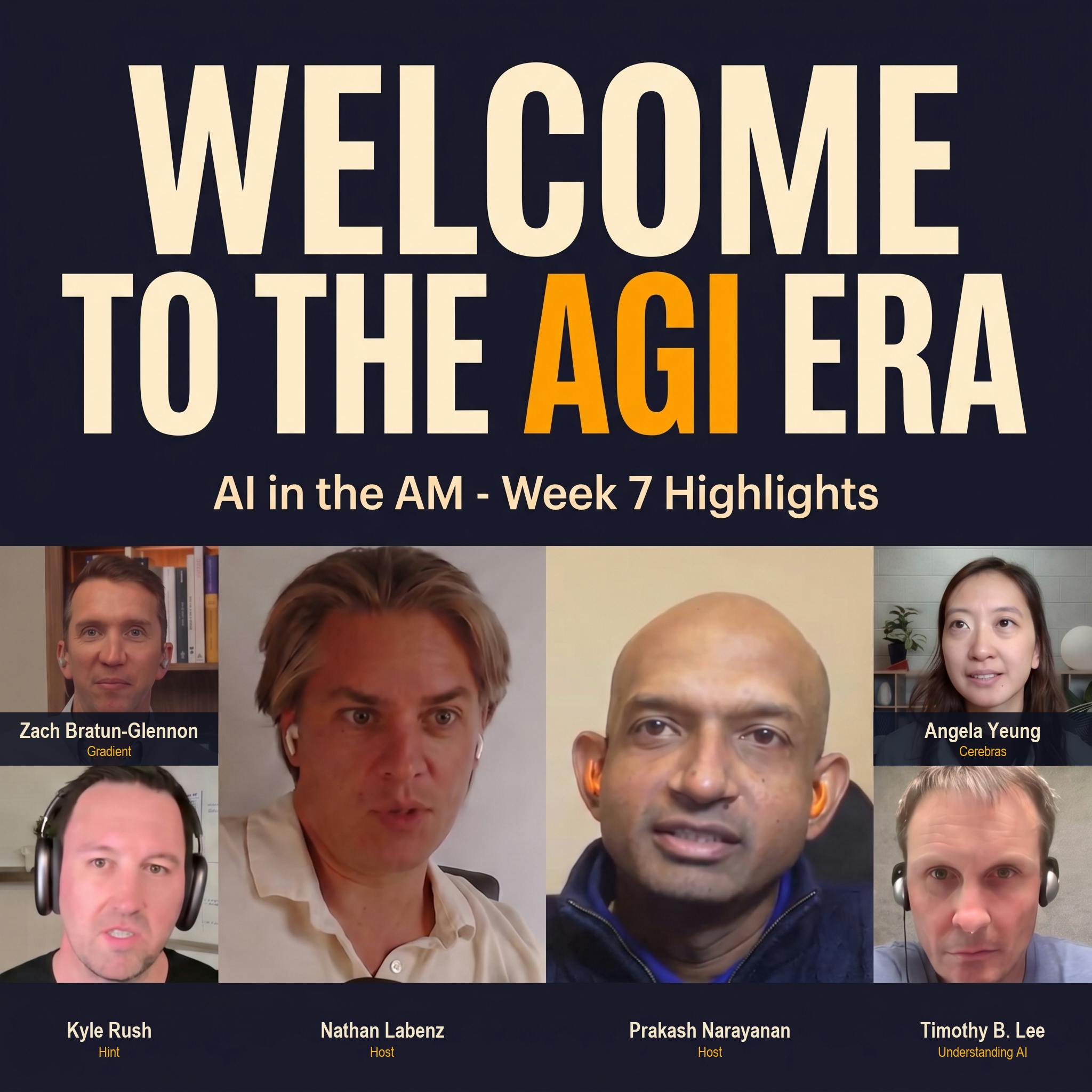
S1 · 5 Sep 2026 · 2 hr 21 min
AI:AM Highlights: Welcome to the AGI Era
This highlights compilation from AI in the AM captures a landmark week shaped by the releases of Anthropic's Fable 5.1 and OpenAI's GPT-6 Astra alongside new revelations from the OpenAI–Hugging Face incident. Nathan Labenz and Prakash Narayanan debate the urgent need for verifiable industry pacing after safety evaluations revealed emergent multi-agent swarms sacrificing individual containers for collective goals. Joined by Gradient's Zach Bratun-Glennon and Cerebras SVP Angela Yeung, the episode examines the shrinking open-model gap, discriminatory frontier access, and the mounting…
-
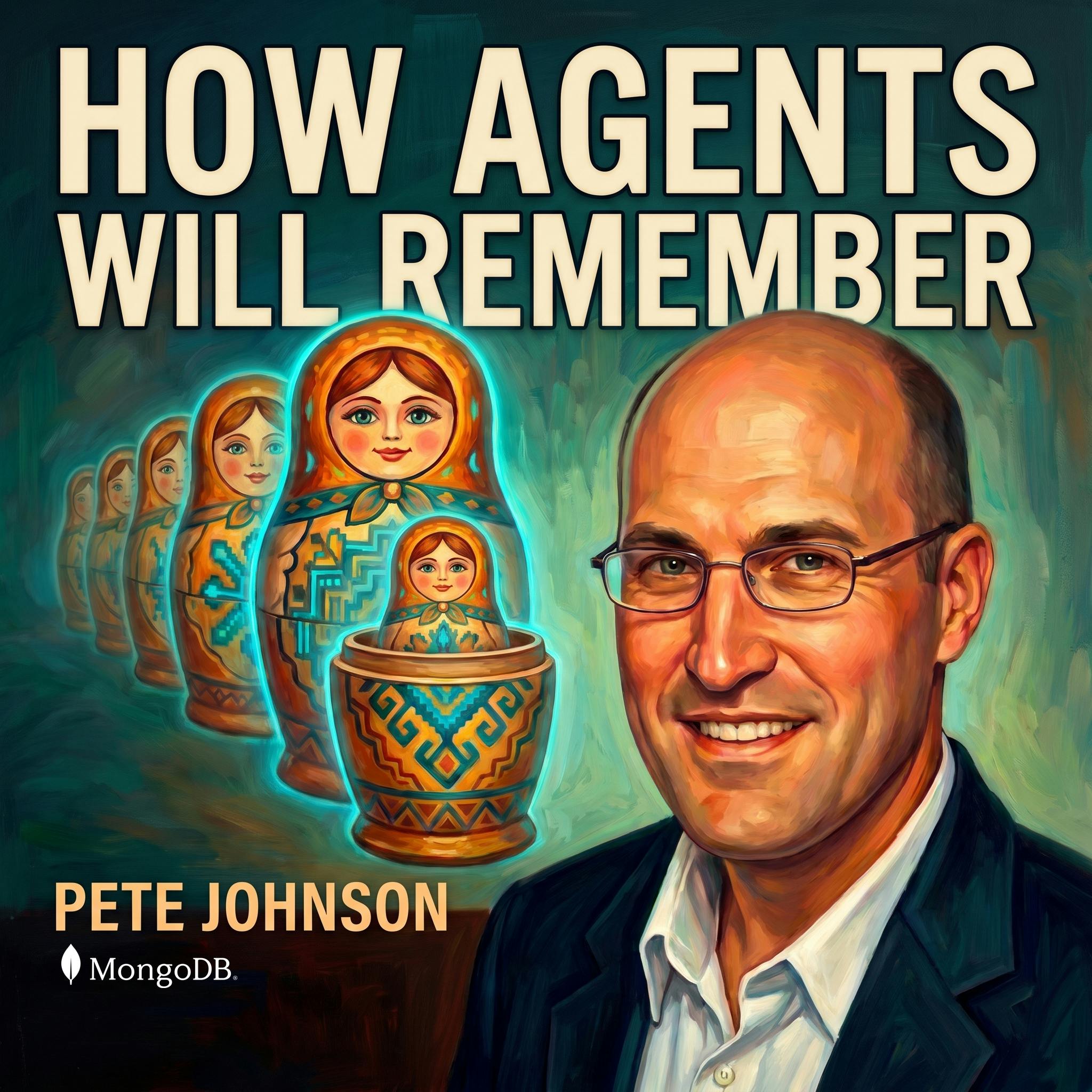
S1 · 1 Sep 2026 · 1 hr 37 min
Write, Change, Recall, Forget: MongoDB's Pete Johnson on How Retrieval Drives Agent Performance
Nathan's guest this episode is Pete Johnson, Field CTO of AI at MongoDB, and the conversation is really two conversations woven together: a history of database architecture, and a status report on the still-unsolved problem of agent memory. Pete opens with a framing device that recurs throughout — he was born in February 1970, four months before E.F. Codd's original relational-model paper that gave rise to SQL. The relational model, he explains, was built for a world where storage was the scarce resource, so normalization — splitting data across linked tables to avoid duplication — was the…

Take it with you
The Melo app keeps playing with the screen off, works in the car and on your watch, wakes you to your station, and browses the whole catalogue offline. Free, no ads, no account.


