
Episode · The Product Podcast
Bolt CEO on Turning AI Prototypes Into Production Code Engineers Trust, the Story Behind a 5M-to-20M ARR Ramp in Two Months | Eric Simons | E311
9 Sep 2026 · 32 min
Episode · The Product Podcast
9 Sep 2026 · 32 min
One month before Bolt exploded, Eric Simons was preparing to wind the company down. In this episode of The Product Podcast, Carlos (CEO at Product School) sits down with Eric Simons, CEO of Bolt, to tell the story behind one of the fastest revenue ramps software has ever seen, and what he learned building toward it for seven years first. Eric is a high-school dropout who approaches life from first principles and treats endurance sports as training for the pain of building a company. He and C...
Tap a chapter to play from there.
Trailer Eric Simons | StackBlitz 00:00:00 People are not losing their jobs because of AI, at least certainly not to the degree some AI leaders said it was going to happen. What's actually going on, though, is... Carlos González de Villaumbrosia | Product School 00:00:07 I was driving around and I saw a billboard by your company that said... Eric Simons | StackBlitz 00:00:13 The team was like 10 or 12 people at that time, and overnight we just woke up with tens of thousands, or hundreds of thousands, of paying customers. Carlos González de Villaumbrosia | Product School 00:00:20 Eric Simons, CEO of Bolt. I saw a post you made a few weeks ago that said your best advice is "don't die." I think that is so powerful. Eric Simons | StackBlitz 00:00:27 We launched in October of 2024, and in the first month we went from zero to five million of ARR. Carlos González de Villaumbrosia | Product School 00:00:32 And back in the day, the whole winning strategy was you have to be hyper, hyper specific: analytics, product roadmap. And now it's about a platform. Eric Simons | StackBlitz 00:00:40 There are only two ways to make money in the software business. Introduction Carlos González de Villaumbrosia | Product School 00:00:44 Hey, this is Carlos, CEO at Product School and your host on The Product Podcast. My guest today is Eric Simons, CEO of StackBlitz, the company behind Bolt, and I'm a user of the product. He skipped college, spent seven years getting to half a million dollars in ARR, and had a board meeting scheduled to wind the company down. One month before that meeting, they launched Bolt and went from half a million to $5.5 million in 30 days, with a team of 12. Here's what we'll cover: the pivot that happened one month before the shutdown meeting. Why the cloud IDE market turned out to be a mirage. His Yahoo and AOL warning for everyone building everything. Why he signed the open weights letter. And the billboard apologizing for the SaaS apocalypse. Let's get into it. Carlos González de Villaumbrosia | Product School 00:01:22 Welcome to The Product Podcast, Eric. Eric Simons | StackBlitz 00:01:24 Thank you for having me. I'm excited to be here. Carlos González de Villaumbrosia | Product School 00:01:26 I'm excited to have you, because I'm a user of your product, and it's always great to put a face to the name and learn more about the story behind the scenes. Eric Simons | StackBlitz 00:01:36 Yeah, awesome. I'm excited to dig in. Startups Are an Endurance Sport Carlos González de Villaumbrosia | Product School 00:01:37 Last time we spoke, you were wearing an Ironman hat. I know you're big into sports, so maybe we can start there. Eric Simons | StackBlitz 00:01:43 Yeah, I have my Ironman hat over here, I can put it on if you want. So, what do you want to know about the sports side? Carlos González de Villaumbrosia | Product School 00:01:50 I'm obsessed with sports too, but I think you take it one step up. There's a story that connects with your upbringing. I know you're a high school dropout, and you've always been looking for a hard path in a way. So tell us more about what drives you so much to not give up. Eric Simons | StackBlitz 00:02:07 Yeah. Well, my parents would have shot me if I'd dropped out of high school, so I finished high school, but then instead of going to college, I started doing startups. I think I tend to look at how I want to approach life in a very first-principles sort of way. That's an overused term at this point, but for where I grew up, the city of Chicago, back in the late 2000s the thing was: you graduate high school, you go to college, you get a job. That was the path. There were no other kids I grew up with who did not do the college thing. My co-founder and I actually grew up down the street from each other. I think we were 13 when we learned how to code together. By the time we came to graduate, I was like, we're going to have to pay for college out of pocket, and it was going to cost, for University of Illinois at Urbana-Champaign, something like $30,000 a year in-state. And we thought, this doesn't make a lot of sense. We were making, I think, maybe 50 bucks an hour at that time, at 17 or 18, writing software. So to me it just seemed obvious: what am I going to go to college to learn? I'm writing software. I can learn, but I can read textbooks, and that's free. It's kind of the Good Will Hunting thing, not that I'm anywhere close to the IQ of that character Matt Damon played. But to me it was just going and doing what seemed obvious, and that's not priced in. The whole college-as-default-path thing, many people are questioning it, which I think is a good thing. Especially if you're going to do business, if you're starting startups, you're not going to have a good time with it. You'll quit pretty early on if you don't develop a lot of grit and resilience, because that's kind of the entire game. This is an endurance sport, and it's about pushing through pain. A couple of years ago I got into doing Ironmans, and it's very analogous: you have to be going for very long stretches, and it's not even about race day, it's about all of the training that goes into it. You're spending six hours a day, every weekend, for six months leading up to that thing. And startups are the same: it's not about one big launch, it's about every day putting in the work, embracing pain, and pushing through it. That's how I view these things. Carlos González de Villaumbrosia | Product School 00:04:38 I love that connection you made between sports and business. I feel the same way. I saw a post you made a few weeks ago that said the best advice is "don't die," and I think that is so powerful, because sometimes the pressure is on growing fast at all costs, or winning the short term, but in reality, staying in the game, finding ways to not die, compounds much more than trying to win the sprint. Eric Simons | StackBlitz 00:05:07 Yeah, totally. Over the past year and a half, there have been a lot of short-term strategies in the space. Every time this happens in business, there are these moments where you have manias, where you can do very short-sighted things and maybe walk away financially up. The problem, from my view, is: you're going to build a business, so why do this if you're not trying to build something that's actually durable for the long term? You've got to do it the right way, because otherwise it's a pretty high-risk endeavor for you, and certainly for anyone else working for you. So it's the quote of "play long-term games with long-term people." I think that's a good quote, and I believe in it. The Pivot One Month Before Shutdown Carlos González de Villaumbrosia | Product School 00:05:54 Let's talk about your product and your business. Even your current company is called Bolt, but that wasn't the original name, right? StackBlitz was the original name, and you actually started the company before AI was mainstream. So tell me more about that major pivot you had to do to take the AI tailwinds and make sure you're in the position you are today, at a scale of around $700 million in valuation. Eric Simons | StackBlitz 00:06:17 Yeah. So we've been around a while. We started StackBlitz, which is the underlying company behind Bolt, in 2017. The insight we had was that browsers had become very powerful, and it seemed technologically possible to bring full-stack web development to the web. In the same way that Figma brought design to the web for the first time, the idea that you could come into just a browser, without downloading anything, and actually be building real full-stack applications from a browser tab, was possible for the first time. We wrote some really cool technology. We basically wrote an operating system that runs in WebAssembly in your browser. Very nerdy stuff, but no one had ever done it before, and it took us three or four years to build. We launched it in 2021, into the cloud IDE market. At that time, in the late 2010s and early 2020s, there was all this hype around cloud IDEs, but it ended up being a mirage of a market: a lot of hype, but people weren't willing to spend money, because developers were very happy with their local environments. Fast forward to 2024, and us and all the other cloud IDE companies were on the rocks. We had to figure out what we were going to do. We'd set the target that we had to inflect revenue, we had to prove this was a venture-scale business, otherwise we'd start winding the company down by the end of the year. So through 2024 we tried out a whole bunch of different ideas, different product shapes we thought would be interesting and that customers would like. And none of them worked. Bolt was actually the last product idea we tried. We launched in October of 2024, and our board meeting was one month later, where we were going to start spinning down the company. In the first month, we went from zero to five million of ARR. Before that, we'd spent seven years getting to 500K, half a million, of ARR, and then in 30 days we went from 0.5 to 5.5 million of ARR. And then the month after, we went from 5.5 to 20.5 million or something. So it was just crazy. Our team was like 10 or 12 people at that time, and overnight we woke up with tens of thousands, or hundreds of thousands, of paying customers. Growing into that scale was insane. But that's kind of the story of how Bolt came to be. Carlos González de Villaumbrosia | Product School 00:08:42 Speaking of product-market fit, it's hard to pick an official definition, but like you just said, when the market is pulling, that is ultimately the best validation. Eric Simons | StackBlitz 00:08:50 Absolutely. I've worked on a lot of things in my career, and I've never seen anything like what happened there. There are a number of companies now that have had these zero-to-explosive revenue ramps, but we were the first thing that hit the market that anyone had seen do this. In the AI era there have now been more of these, but being the first one was an interesting experience, because normally the playbook to grow the team of a company that's at 20 million of ARR gives you a minimum of two years to prepare. That happened in two months for us. There were no playbooks, so we ended up having to create new playbooks on how to deal with this kind of scale this quickly. It was a fun and very challenging experience. Focusing on B2B and Product Builders Carlos González de Villaumbrosia | Product School 00:09:46 Moving forward, you raised over $100 million at a valuation of around 700 million. So what is the current state of your business? Eric Simons | StackBlitz 00:09:56 Yeah. When we first launched, we had lots of different types of customers using the product. What we've gotten very focused on is how we really help very specific types of users and workflows. PMs and product folks are one of the key ones. So we're really focusing on the B2B side of the business and doing a great job on the product-development workflows folks use on Bolt. That's been a key focal point. Our B2B revenue year over year is up significantly; it's the fastest-growing segment of revenue for the company, and that's where we've been focusing all of our time. Carlos González de Villaumbrosia | Product School 00:10:34 As I think about the category you in a way pioneered, this cloud IDE that then turned into AI prototyping tools, and then evolved into full-on end-to-end coding tools, what is the current state, and where do you think it's going? Eric Simons | StackBlitz 00:10:51 Yeah, for vibe coding in general, you mean? Carlos González de Villaumbrosia | Product School 00:10:54 Yeah. I see a lot of these companies in your category just letting users prototype something that looks cute, that was more of a demo. But then you evolved into a real solution that allows deployment into production. So it's not a toy anymore; this actually works. So first I want to learn more about what's going on, and then where you think this is going next. Eric Simons | StackBlitz 00:11:16 For sure. I think a lot of the core use cases you're describing are going to continue, and there's going to be a lot more depth to the workflows. For example, as a PM or a designer, I want to be able to rapidly iterate on how the experience should feel. It's actually useful to do that in an environment detached from your production environment, because it's way faster to iterate and get that feedback. But the problem is, if you do it outside of your production codebase, how do you marry that back into the production codebase in a way that your engineering team signs off on? So the stuff we've been working on is creating a very seamless connection: using the exact production components, and having a seamless handoff flow to developers where it automatically pulls in your changes. I think we're going to see more depth of integrations and workflows that pave out those experiences. On the flip side, we have a lot of entrepreneurs who use our product to build their businesses. We have lots of entrepreneurs generating millions of dollars on our product. So how do you further enable people to do that? What are the types of applications they're trying to make, or would want to make, and how do you make our agent the best in the world at doing those things? Those are kind of intertwined, because what is a prototype but a proposal to ship functionality into your real production codebase? And perhaps that production codebase is in Bolt, or perhaps it's not. But that's how we're seeing these things evolve. Positioning in the Vibe-Coding Landscape Carlos González de Villaumbrosia | Product School 00:13:03 I see the competitive landscape evolving that way. The analogy here is in LLMs: ChatGPT got the first-mover advantage and grew within consumer, while Anthropic grew within enterprise. Now of course they're converging, but they kind of picked lanes at the beginning. In your world, the vibe-coding world, you see other companies like Replit and Lovable, and there are always new ones popping up like mushrooms. So how do you position your product? Eric Simons | StackBlitz 00:13:30 It's a really good question. Over the past year, I think it was about a year ago, we made the decision to orient more toward people building products professionally at businesses. There are a lot of people excited about AI. There's a lot of general-consumer excitement; maybe they've had an idea for a long time, and we have a lot of people who come to Bolt for that. But the way I view it is, we want to build tools that help professional builders of products, PMs, designers, engineers, to raise the ceiling of what they can do, and remove complexity, so instead of having to use coding agents in the CLI or whatever, we help you go from A to Z as fast as possible. That focus is where it matters. When we go into our conversations on the sales side, obviously all the other players, including the frontier labs, there are bake-offs that happen. But this is where the importance, and just generally for startups the importance, of really going deep on a specific ICP and workflows really matters. That's where we went, because we have a level of depth on certain workflows and capabilities, especially for product builders, that the other guys don't, because they're going very broad. So to use your analogy of OpenAI and Anthropic, we're taking a very Anthropic-type approach: really trying to make certain types of users and workflows within B2B usage insanely great, and we're not just spraying hundreds of millions of dollars at everything on the consumer side. Everyone Competing With Everyone: The Dotcom Parallel Carlos González de Villaumbrosia | Product School 00:15:25 That's an interesting dichotomy. On the one hand, you want to grow the addressable market or the category by expanding, but at the same time you want to be remembered for something very specific that you do very, very well. I noticed you recently launched a slides capability; now you can also create interactive slides. You're also launching templates to make it easier for people to build apps, but that also creates new pockets of competition, right? The Canvas of the world, the Gammas of the world, suddenly become frenemies in a way, because you probably need to work with them too. So how are you thinking about that? Eric Simons | StackBlitz 00:16:00 Yeah, I was on a podcast with one of the Gamma founders a week or two ago. It was the week we launched slides, and he said, "Oh yeah, I saw you guys launched slides," live on the podcast, and I kind of forgot that we had launched it, because for us it was just a fun project we made for ourselves. It's not like we're trying to get into the business of slides. But we ended up talking on the podcast about how everyone's competing with everyone. What I said to him, which I'll repeat here, is I don't think it's bad. We added some unique ideas into the mix as far as slides go. The reason we even launched it is that as a product, if you're an innovative company, you're going to have ideas, and you want to put them out there. If you've got the skills to do it, it's fun. And we open-sourced it too; it's not a closed-source thing. But I look back at the dotcom era, and there was a lot of this thinking where everyone was competing with everyone on everything, and everyone was trying to do everything. Back then it was portals, like Yahoo and AOL. "Media is coming to the internet, we have to have media. People need a home page of the internet, we need to be Yahoo or AOL, and we're going to do all these things. Oh yeah, search is just this tiny box up there, but it's the portal." Except, no, that tiny box was the juggernaut. That was the focal point. Google was like, "All this other stuff, forget it, just the input box: how do we make that thing insanely good and the best in the world?" And that was actually right underneath the other guys' noses, but they were so unfocused that they completely missed it. That, to me, is the era we're in. I look back historically, and maybe this time is different, but the comps don't track. We're in the middle of this, so it may seem like this time is different, until it's clear that this time isn't different, and certain companies break away because they actually focused. That's how we view our product strategy. It's not to say we won't release things that would be competitive with Gamma or whatever, but even on this product, both sides are cool: it's open source, you use it with any agent. On the flip side, I don't know Gamma's full feature suite. They've certainly got a ton of stuff we don't, and probably never will, and that's cool. That's why you'd want to use those guys. That's their entire product, so surely there's depth there. Carlos González de Villaumbrosia | Product School 00:18:31 The positioning is also very clear in each of the products. You're starting from a vibe-coding solution for PMs and engineers; the other ones started as a solution for marketers. Eventually there are some points of convergence, but that doesn't mean you don't have your own identity. I've seen this movie play out even in the product-tech category, which didn't even exist before. There was Optimizely doing A/B testing for marketers, and designers using Photoshop, and suddenly you start seeing tools created specifically for PMs. Back in the day, the whole winning strategy was that you have to be hyper, hyper specific: analytics, prototyping, road-mapping. And now it's about a platform instead of a portal. Now the game is the all-in-one platform, and everybody's overlapping. At the same time, they're also integrating, because they're assuming a lot of these enterprises are using different point solutions, and the winner, in a way, needs to let the data flow. Eric Simons | StackBlitz 00:19:22 It reminds me of the quote from the old Netscape CEO. His name slips my mind, but he said there are only two ways to make money in the software business: bundling and unbundling. These things go in phases: bundling will happen, and then unbundling. Streaming services are an excellent example. Netflix really rose to prominence by bundling, and people were like, "Okay, I don't have to buy all these subscriptions." And now there's a whole bunch of streaming services, so everything is getting unbundled. Typically it becomes clear that unbundling is where the value is going to be once there's too much bundling going on. That's kind of the issue, and I think we're approaching that in the market, if not already there in certain parts. The Case for Open Weights Carlos González de Villaumbrosia | Product School 00:20:23 Another thing you mentioned briefly is open source, and I think that's a big deal here. You recently signed the open weights letter created by Microsoft, and you connect with so many different models. So I want to hear more about your take. Eric Simons | StackBlitz 00:20:37 Yeah. StackBlitz as a company has been deeply, deeply invested in open-source software since we were founded, and that's not even just lip service. We've put substantial amounts of money, even when we were not profitable, behind open source. There's a project called Vite, which is pretty much how everyone does web development these days, and we were the earliest backer of that. We hired people onto our team to just work on that full time, in open source. So as far as our roots to this stuff, and if you look at the open weights models, it's key that these things remain available and usable to all companies and all people around the world. There are a number of reasons for this. I looked at past parallels: I think back to the 90s, with Windows versus Linux, and the amount of innovation that has come. By the way, Windows is fine, Windows is used everywhere and doing great, and they've added a lot of value to this world. But Linux has been a workhorse for the hyperscalers we have, our ability to spin up micro-VMs, everything. And back then, these same things were being said, like, "Hey, Linux maybe should be outlawed." Crazy stuff in retrospect. And it reminds me a lot of now. So if you fast forward ten or twenty years and look back at where the bulk of the world's innovation is and what it's being powered by, I'd be surprised if open weights models were not a key pillar of that story. Geopolitically, I think it's a very bad idea, if Western countries were to try to bifurcate the open-source models coming from non-Western states, restricting their availability within Western states and forcing use of frontier labs. It does not appear we're doing this at this point, but that tends not to be a good recipe for how, at a national level, countries actually play to win. You see a lot of great companies in the States doing incredible things with these open models. There are some companies I've talked to recently doing really great research on how to optimize open-source models to run at a fraction of the cost. Imagine running Kimi K2 at one-tenth the current price. It's possible, if not 90%, then 80% off the list price, because they have access to the weights. If you don't have access to open model weights people can use, no innovation happens. If those guys crack that nut, it's going to be transformative for the level of ubiquitous, affordable access to these models. So to me, it's unfathomable that we would cut off that kind of innovation, but that's what would happen if open weights models were not permitted to be used. Carlos González de Villaumbrosia | Product School 00:23:49 The way I think about this is that it's much riskier to not participate in the open-source game than to participate in it. I think about your product as an application layer on top of a ton of models, and I kind of trust you, in some cases, to make the right decision and pick the models that optimize for my use case as well as my price sensitivity. Eric Simons | StackBlitz 00:24:10 Exactly. Price is a really important thing, where the open weights models allow us to give more value to our customers at a lower price. So you're hurting customers, you're hurting the people trying to use AI, if these models can't be used. And of course there's the ability for us to use our own data to better tune the open weights models so they better fit the workloads our customers are doing. Cursor has been the phenomenal example of this with their Composer models, and that moves the needle to a way better experience at a fraction of the price. Getting Aggressive on Pricing Carlos González de Villaumbrosia | Product School 00:24:50 So how are you thinking about pricing for your own product? Eric Simons | StackBlitz 00:24:52 Good question. For us, we want to get really aggressive on pricing. The big sea change happening here is that open-source models are really catching up with the labs. There's a very tiny, I wouldn't even call it last mile at this point, but a last bit of distance to really marry these things where we can provide the same level of experience. Some number of weeks from now, we're going to be rolling out some stuff that will be our first foray into this, where we can offer things at price points that just would not have been possible before, while providing a great experience. We're all in on giving our users the most bang for the buck. That's how we've approached this from the get-go: when we figure out ways to reduce costs, which is always a top concern for us, it's not just for us as a business, it's really more about how we can make this a better economical decision for the folks using the product. We're always trying to figure out how to make it better and more affordable. Apologizing for the SaaS Apocalypse Carlos González de Villaumbrosia | Product School 00:25:53 Speaking of pricing and being aggressive: the other day I was driving around and I saw a billboard by your company that said "Sorry, SaaS." So I want to hear your take on this apocalypse, and how these previous pricing models are probably not going to cut it, and what you're thinking about to make sure you end up on the winning side. Eric Simons | StackBlitz 00:26:14 Yeah, for sure. So we're doing this whole campaign. We have all these billboards in New York and San Francisco that say "Sorry, SaaS." We're apologizing for the SaaS apocalypse. I think the per-seat model is the biggest risk point for SaaS businesses. With agents, as agents become more capable and powerful, you may not need as many seats for certain types of products. Not because those people won't be at the company, but because you're going to have agents going and doing things, and it makes a lot more sense to charge based on usage and access. When we launched Bolt, I'm very proud of our team, we got a lot of things right that ended up being how the industry now works. At that time, all these AI tools were, for whatever reason, charging like Netflix does: one price, all you can eat. Except in the case of these AI things, if you eat too much, we're going to throttle you and make you come back later, but it's 20 bucks a month. Copilot was doing that, Cursor was doing that, everyone was doing this. When we launched Bolt, the demand was so nuts that in the first 24 or 48 hours, people ripped through our subscription, which was like nine bucks at the time, in not even a day, and they were like, "I want to give you more money." So within 72 hours, we shipped usage-based pricing, where you could upgrade to the amount of usage you wanted. Within a few weeks of that, Barclays, an investment banking outfit, wrote a report they sent to their whole client base that said, "We think this model, that this random company StackBlitz, Bolt, has, is actually going to end up being how this stuff gets priced." And that is exactly what has happened. All these AI products, everyone's charging based on usage. In the case of Claude, they have the $20 plan, the $100 plan, the $200 plan. That's what we pioneered. I think that's just going to continue, where it's, "How do you charge based on the value being provided?" versus, "Oh hey, you have 10,000 people at your company, and if you want them to log in and use this, they're going to have to pay." It's, how much value are all those people getting out of this? Because if the value isn't there, what's probably going to happen is people are going to use their agents to hit your APIs, and then there are going to be three people at your company who actually need to use your product, and 2,000 who are getting it through an agent via the API. So you have to go, "Okay, how do we actually price the value?" To me it's actually kind of healthy. To be in the incumbent position is of course uncomfortable, but such is the nature of free markets. The reason those margins are under pressure is not because this stuff is bad. What we're seeing is that people are not losing their jobs because of AI, at least not to the degree some AI leaders said it was going to happen. What's actually going on is it's bringing into question the value of all these seats you're forcing people to buy. In a lot of cases it was really more of, "Well, we have to do it," not because we're getting that much value. So that comes back to you, and then you need to go innovate. That's my view on this side of things. Sharing Risk and Reward on Value Carlos González de Villaumbrosia | Product School 00:29:52 We're seeing this across the board. Back in the day, B2B SaaS was mostly a captive audience, because first of all, the person buying the thing is not using the thing, which is already a yellow flag. But also, usage was only being measured maybe the week before renewals, where all these customer success managers had to prove, "Hey, someone in the company did something very good, hence we did 12 more months of grace." And now you're on the hook, and you're sharing risk and reward, but ultimately the access to value and usage is right there for everybody. Eric Simons | StackBlitz 00:30:26 Exactly. To me it's just a good fattening of margins where value was not tremendously present. Because then you see other SaaS companies that are crushing it, like Shopify. Early on there's an over-rotation, "all of SaaS is done," and so on. But what's really going on? There was a pending question of, okay, which of these things, is it clear any of them are going to be able to thread the needle here? And now we're seeing the first crops of these where it's like, yeah, these guys are doing great. Those are the gold standards other SaaS companies have to look up to and go, "Okay, this is how we have to approach the problem." It's a similar sea change to what happened during the dotcom era, where the traditional media and print companies faced these same questions. Some threaded the needle really well, some did not. But such is life and business: how good are you at embracing pain quickly, and then pushing through it and figuring out what needs to be done? Carlos González de Villaumbrosia | Product School 00:31:32 That's a beautiful way to wrap up this conversation. Thank you so much for your time, Eric. It's been a pleasure to learn from you. Eric Simons | StackBlitz 00:31:38 Yeah, thank you for having me. It's been a blast.
Transcript supplied by the publisher with the episode.

by Product School · English · Tech & Science
Hosted by Product School CEO Carlos Gonzalez de Villaumbrosia, The Product Podcast drills deep into the minds of Chief Product Officers from Cisco, Lovable, Perplexity, Shopify and many more. We move beyond high-level theory to reveal how top executives actually lead in the age of AI. We dig…

30 Sep 2026 · 31 min
HP is best known for hardware and printers. Faisal Masud is turning it into a software and AI company, and he thinks the era of stacked management layers is ending. In this episode of The Product Podcast, Carlos (CEO at Product School) sits down with Faisal Masud, SVP and President of Worldwide Digital Services at HP, for a candid conversation about building enterprise AI, and what it does to how companies are actually run. Faisal has a rare vantage point: two decades across Amazon, eBay, Gr...

25 Sep 2026 · 31 min
Toast was built long before generative AI existed. So how do you weave AI agents into a platform that thousands of restaurants already run their business on, without breaking the thing that works? In this episode of The Product Podcast, Carlos (CEO at Product School) sits down with Maggie Crowley, VP of Product at Toast, to unpack what it actually takes to build AI into mature, pre-AI SaaS. Maggie is a former Olympic speed skater (fifth at the 2006 Winter Olympics) turned product leader, wit...

16 Sep 2026 · 26 min
Most apps optimize for time on screen. Hinge optimizes for you leaving. In this episode of The Product Podcast, Carlos (CEO at Product School) sits down with Ben Celebicic, Chief Product and Technology Officer at Hinge, the dating app "designed to be deleted," to unpack how you build a product whose North Star is great dates, not engagement, and still chase a billion dollars in revenue. Ben has been at Hinge for 11 years, since the 2015 relaunch, and recently became one of a growing number o...
2 Sep 2026 · 26 min
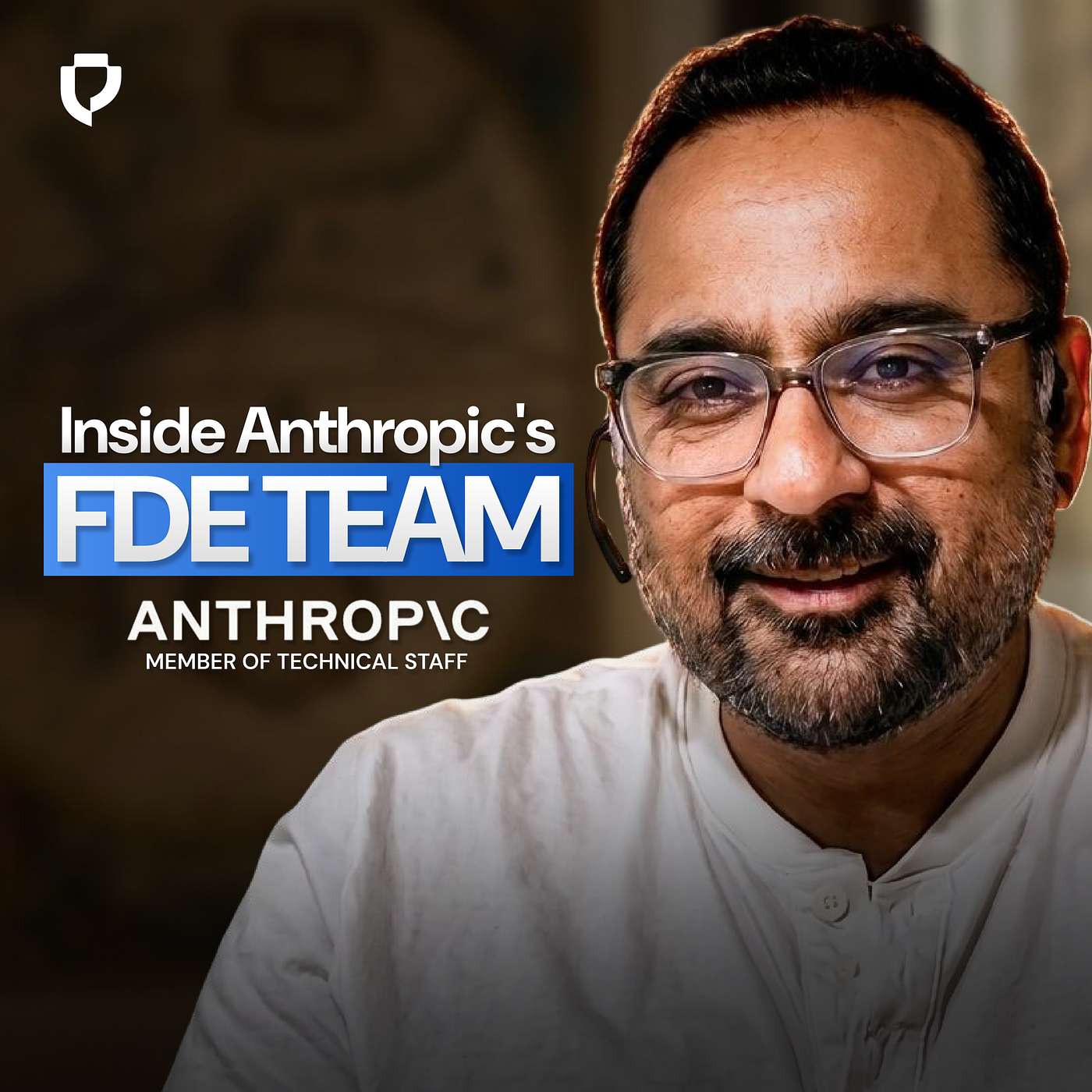
What do you do after you've founded a company, sold it to Databricks, and could coast? Amandeep Khurana went back to being hands-on. In this episode of The Product Podcast, Carlos Gonzalez de Villaumbrosia (CEO at Product School) talks with Amandeep Khurana, now on Anthropic's go-to-market team, about a career built on deliberately choosing the harder path. Amandeep traces the whole arc: training as an engineer, moving to the Valley to go customer-facing at Cloudera, catching the company-bui...
26 Aug 2026 · 32 min
Visual collaboration is missing from the AI era. That's the provocation Elaina O'Mahoney, Chief Product Officer at Mural, brings to this episode of The Product Podcast with Carlos (CEO at Product School). We spend all day alone in our tools, typing or talking to an LLM, and when it's time to collaborate we drop words into a doc instead of thinking together visually. Elaina makes the case that AI has quietly turned work into "solo-player mode," and that the teams who win next will be the ones ...

19 Aug 2026 · 29 min
Two years ago, Square tore up its general-manager model and rebuilt the entire company around functional excellence. In this episode of The Product Podcast, Carlos (CEO at Product School) sits down with Willem Avé, Global Head of Product at Square (part of Block), to unpack why they made that bet, what it costs, and how AI is now reshaping the org itself. Willem started at Block as a CTO whose company was acquired, grew up through engineering, and has seen every era of the company from the l...

12 Aug 2026 · 32 min
Most people think of drones as toys. Alden Jones thinks of them as infrastructure. In this episode of The Product Podcast, Carlos (CEO at Product School) visits Skydio's California office to sit down with Alden Jones, VP of Product at Skydio, the autonomous drone company building "flying robots" for public safety, defense, and infrastructure inspection. With a history degree and a military background (he was a truck-driving officer running supply convoys in Iraq) rather than an engineering on...
29 Jul 2026 · 46 min
n8n's founder puts the company's GitHub repo, nearly 200,000 stars, right next to the paid signup button, and he's genuinely fine if you never pay. In this episode of The Product Podcast, Carlos (CEO at Product School) sits down with Jan Oberhauser, CEO of n8n, the open-source automation platform that's crossed $100 million in ARR at a $5.2 billion valuation. Jan breaks down the "fair-code" license bet that let him give the product away and still build a business, how that free version became...
E305 · 22 Jul 2026 · 54 min
In this episode of The Product Podcast by Product School, Carlos González de Villaumbrosia sits down with Amit Zavery, President and Chief Product Officer at ServiceNow. The platform runs more than 75 billion workflows a year with around $15 billion in annual revenue growing over 20%. Its market cap is above $100 billion, yet the stock is down more than 30% this past year, while its AI business is on track for $1.5 billion, ahead of a $1 billion plan. Amit previously ran product and pla...

E304 · 15 Jul 2026 · 33 min
In this episode of The Product Podcast by Product School, Carlos González de Villaumbrosia sits down with Saral Jain, SVP of Engineering at Snapchat, the last independent social platform operating at global scale, with 956 million monthly active users closing in on the one billion mark and a community that opens the app more than 30 times a day. Saral joined Snap nine years ago, right around the IPO, after nearly a decade leading engineering teams at Amazon Web Services, and today leads all...

The Melo app keeps playing with the screen off, works in the car and on your watch, wakes you to your station, and browses the whole catalogue offline. Free, no ads, no account.