
Episode · Training Data
Inside Zipline's Autonomous System: 140M Miles, Zero Incidents
7 Jul 2026 · 55 min
Episode · Training Data
7 Jul 2026 · 55 min
The largest commercial autonomous system on earth isn't a robotaxi fleet — it's Zipline, which has flown 140 million autonomous miles with zero safety incidents. Co-founder Keller Rinaudo Cliffton and Eric Watson, who leads systems engineering and safety, explain why the drone itself is only 15% of the solution. The rest spans inventory management, air traffic integration, and engineering systems such as a dual flight computer failover protocol that recently saved a delivery mid-flight. They trace Zipline's path from launching blood delivery in Rwanda in 2016 (when drone delivery was illegal…
by Sequoia Capital · English · Tech & Science
Join us as we train our neural nets on the theme of the century: AI. Sonya Huang, Pat Grady and more Sequoia Capital partners host conversations with leading AI builders and researchers to ask critical questions and develop a deeper understanding of the evolving technologies—and their…
29 Jul 2026 · 49 min
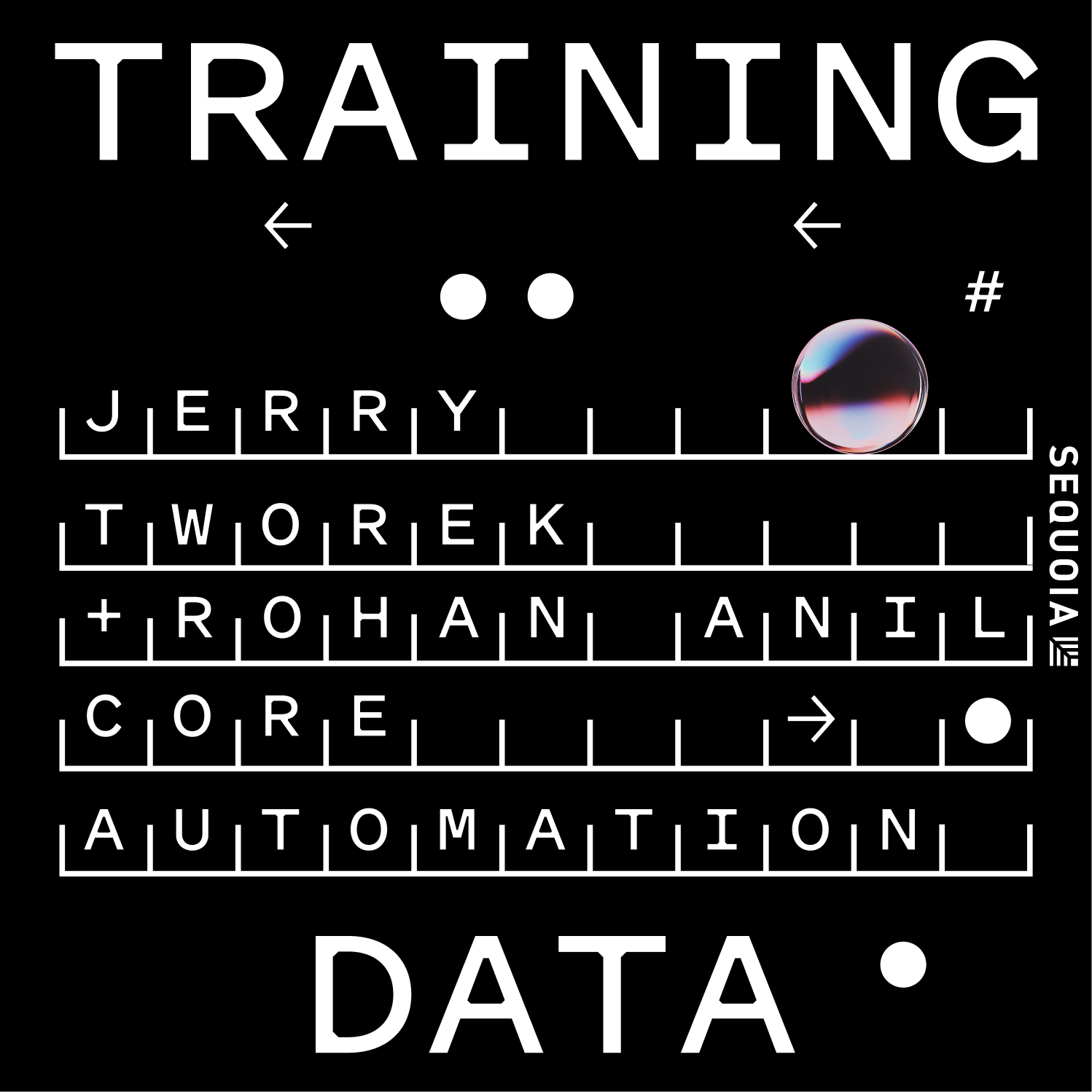
Jerry Tworek led reasoning at OpenAI, convinced that scaling reinforcement learning was the path to AGI. Rohan Anil co-led Gemini pre-training and built the Shampoo optimizer. Now they've teamed up at Core Automation on a contrarian premise: the transformer has carried us as far as it can, and the bottleneck to smarter systems is no longer scale — it's the architecture itself. The missing capability is continual learning, models that adapt at test time, which transformers can't do. In-context learning taps out fast (Codex needs compacting after ~20 minutes) and fine-tuning invites…
21 Jul 2026 · 52 min
Factory started building fully autonomous coding agents in April 2023, two years before enterprises were ready. Matan Grinberg now says this is indistinguishable from being wrong. The Factory co-founder and CEO explains how the company survived its "journey in the desert," including the decision to hand nearly all of its revenue back to customers when the product wasn't making developers obsessed. Matan makes the contrarian technical case that a model-agnostic harness beats the model-and-harness co-design that labs like OpenAI and Anthropic favor, because exposing a harness to many models…
14 Jul 2026 · 49 min
Katelyn Lesse and Angela Jiang lead the team building Anthropic's developer platform - the layer that both outside builders and Anthropic's own products run on top of. Angela frames the platform as a three-layer stack: knowledge, execution, and coordination. She argues the real leverage is what’s at the top: "strategies," or meta-harnesses that give each token a different job, from advising to executing to reflecting to memory. On the question of open ecosystem vs. walled garden, they say they aren't precious about owning the stack. Katelyn points to Anthropic's self-hosted sandboxes with…
30 Jun 2026 · 1 hr 10 min
Dylan Patel, founder of SemiAnalysis, argues the biggest gains in AI don't come from faster chips, they come from software-hardware co-design. Optimizing the model, the kernels, and the silicon together turns a 2x here and a 2x there into 100x. He explains why DeepSeek's experts were shaped for Nvidia's Hopper (and why TPUs struggle to run it), why OpenAI's sparser models and Anthropic's denser ones pull them toward different hardware, and why the so-called CUDA moat was never really about CUDA. Dylan breaks down InferenceX, his living benchmark that runs the latest models on over $50M of…
24 Jun 2026 · 45 min
Dan Biderman and Jessy Lin, co-founders of Engram, are building a neolab around memory and continual learning, which they call two sides of the same coin. Their contrarian premise: instead of stuffing ever-larger prompts into the context window or bolting on RAG, bake a team's knowledge directly into the model's weights, so it knows your company the way an employee of several years does. The payoff: matching or beating frontier models while consuming up to 100x fewer tokens. Working with partners like Microsoft, Notion, and Harvey, the team draws on roots in computational neuroscience and…
16 Jun 2026 · 39 min
The race to build superintelligence is producing models that keep getting better at objective problems, but not at behaving like actual people. Joon Sung Park, founder and CEO of Simile and creator of Stanford's "Smallville" generative agents study, argues that simulating human society requires a fundamentally different kind of model. He frames today's frontier models as the "CPU of intelligence"—rational, superhuman at problems with right answers—and Simile as creating the "GPU of intelligence," built to encode the diversity of people's values, preferences, and tastes. It simulated 1,000…
6 Oct 2026 · 1 hr 4 min
At 100,000-accelerator scale, something fails multiple times an hour, which is why Google's Chief Technologist for AI Infrastructure Amin Vahdat thinks FLOPS is a vanity metric. The metric that matters is what he calls goodput: the useful work a workload actually delivers through real failures. Amin walks through the calculus that split the TPU line into 8i and 8t for the first time, why the TPU's core primitives haven't changed since v1, and how Google and DeepMind co-design in the same rooms, intercepting chip architectures mid-flight before tape-out. He explains why long-horizon agents…
15 Sep 2026 · 1 hr 5 min
Starting a company is hard. Reinventing your company for AI as a public company with quarterly earnings results is even harder. Aaron Levie has pulled off the transition with Box and offers hard-won advice for founders. The cofounder and CEO of Box argues the value isn't only in the model; it's in the bridge from a model's raw capability to the actual workflow inside a bank, a law firm, or a pharma company. That's the case for the application layer, and Box is building it: an agent harness tuned so tightly to its own file system, permissions, and search that it beats handing the raw API to…
1 Sep 2026 · 52 min
Most public safety technology companies grow by collecting more data. Peregrine inverted the model: no sensors, no new data, a business built on connecting the data and information cities already own. Co-founders Nick Noone and Ben Rudolph received more than two dozen no's before San Pablo PD let them in the door in February 2018. Today, Peregrine powers law enforcement, emergency medical services, fire and rescue, and other services in more than 400 cities and communities globally. Nick and Ben explain their north star for data sovereignty, and discuss how Peregrine's philosophy and…
25 Aug 2026 · 55 min
Parag Agrawal is making a bet that goes against two decades of web search: agents will query the web a thousand times more than humans ever have, and the infrastructure built around human clicks is wrong for them. The former Twitter CEO, now founder and CEO of Parallel Web Systems, explains why Parallel treats human click data as a bug and trains on agent feedback instead. He unpacks the counterintuitive choice to ship a search agent before a search engine, building an index incrementally, and how the new Turbo product cut agentic search to 200 milliseconds. But the problem Parag keeps…

The Melo app keeps playing with the screen off, works in the car and on your watch, wakes you to your station, and browses the whole catalogue offline. Free, no ads, no account.