
Episode notes
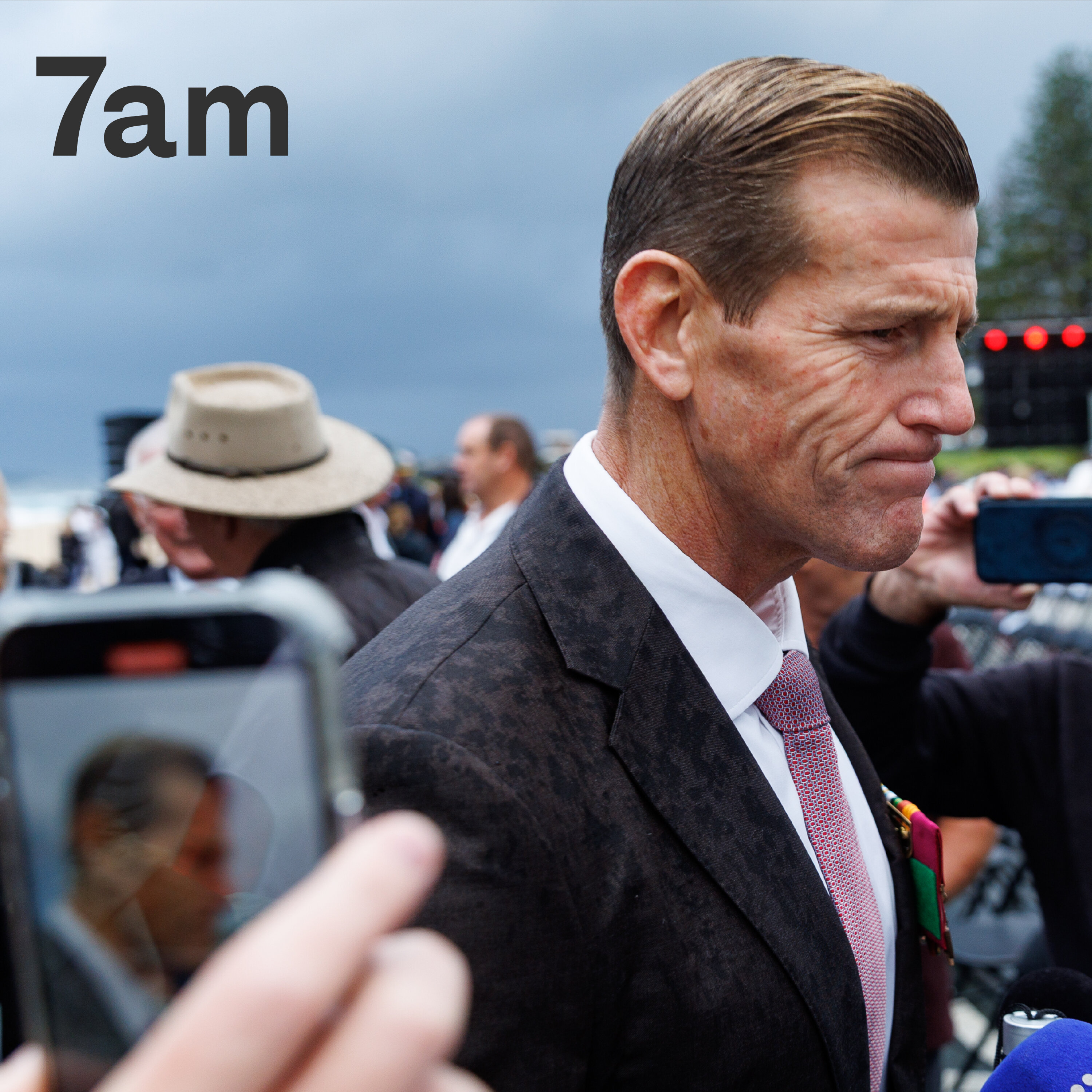
In April this year, Ben Roberts-Smith was arrested and charged with five counts of the war crime of murder. He’s now out on bail and maintains his innocence – and One Nation has swung its support behind him. Now, the minor party says it’s also seeking to make a change to the criminal code — a change that could make a big difference to Roberts-Smith’s upcoming trial. Today, journalist Ben McKelvey on the law One Nation wants changed — and what that could mean for Australia’s international standing. If you enjoy 7am , the best way you can support us is…
Transcript
Read the transcript · about 2,190 words, follows along as you listen
Speaker 1:In April this year, Ben Robert Smith was arrested and charged with five counts of the war crime of murder. He's now out on bail and maintains his innocence, and One Nation has swung their support behind him. Now, the minor party says it's also seeking to make a change to the criminal code, a change that could make a big difference to Robert Smith's upcoming trial. I'm Ruby Jones, and you're listening to 7am. Today, journalist Ben McKelvie on the law One Nation wants changed and what that could mean for Australia's international standing. It's Thursday, October 1. So Ben, there is this term in the Australian Criminal Code, order combat.
Speaker 1:What does it mean?
Speaker 2:Well, it's basically a definition that applies to people who had been in combat previously and are no longer in combat. So they're no longer directly participating in hostilities. So it's essentially the term for somebody who is considered a prisoner. And if somebody is a prisoner or a prisoner of war, a person under confinement, even if they've been a combatant previously, they can't be targeted now. So it's essentially the term that stops people from rounding up prisoners and executing them.
Speaker 2:Can you talk me through.
Speaker 1:An example of how that might play out on the battlefield?
Speaker 2:Yeah, well, I mean, it played out on the battlefield in Afghanistan a lot. So it's particularly applicable to Australian Special Forces actions in Afghanistan because something that happened a lot was the Australian helicopters would come in, they might be looking for a target, they'd sort of roll into a village, everybody would pick up their weapons and they'd start firing at the SAS or the commandos. And when it became apparent that the Afghans were not going to prevail in these engagements, They put their guns down and basically put their hands up. And then they knew that they would be captured by the Australians and then processed by the Afghan legal system that was particularly porous. And they'd basically be back in their village a few days later.
Speaker 2:So all those people who, after they'd shot at Australian soldiers and put their guns down, they were under Australian law and international law, all to combat and could no longer be targeted.
Speaker 1:And so all to combat, this idea that people who have surrendered shouldn't be harmed. That principle, it's enshrined in Australian law. Tell me about how that came about.
Speaker 2:Well, it's something that sort of existed in international law for a long time. And then a long time previously, there were sort of conventions around it. So, you know, it's something that Shakespeare makes reference to in the Battle of Ashencore and Henry V. It talks about the fact that Henry V actually did kill some prisoners. And then there's a character who talks about the fact that that's really not the thing to do. So it was something that wasn't a written convention for a long time. Sun Tzu talks about it as well. You do not target prisoners.
Speaker 2:And then slowly it's sort of become codified and it's part of international humanitarian law now. In 2002, Australia was becoming a signatory to the Rome Statute. Once we became a signatory, then the International Criminal Court would have the opportunity to bring Australian soldiers to the Hague and try them for war crimes. And Australia wanted to have mirroring legislation just to ensure that you can only take Australian soldiers to the Hague if they haven't been tried by an Australian court. And it was sort of done in a little bit of a rush because we wanted to get all those laws in before we signed up as a signature of the Rome Statute. In the 2002 legislation, there were stipulations for somebody to be order combat. You had to have all those things apply. So you had to be in the power of an opposing force and you had to express an interest in surrendering. And then come 2024, Oliver Schultz has been charged, an SAS trooper.
Speaker 3:But tonight, a member of the SAS is in custody, refused bail and charged with war crimes over the death of a civilian in Afghanistan.
Speaker 2:The Office of Special Investigator is looking at potentially charging other people, including Ben Robert Smith. And then I would imagine that somebody in the government went, let's go and have a look at these laws and just make sure that they are what they should be. And they found what the government says is an error in the definition of order combat.
Speaker 1:So.
Speaker 2:What they changed in 2024 was you either had to be in the power of an opposing force or you had to be actively trying to surrender.
Speaker 1:So then the Albanese government, it updates the law in 2024 to make it clear that a person doesn't actually have to be captured and also say, I surrender, one or the other is enough. But now One Nation, they want to revert back to the old definition under which a person has to really do both of those things to get that legal protection.
Speaker 4:One Nation will also be raising another amendment. The amendment will restore the definition of whores to combat.
Speaker 1:Tell me what One Nation have said about why they want.
Speaker 4:To do that.
Speaker 2:Well, they say that it's a question of procedural fairness.
Speaker 4:There is a threshold of behaviour that is never acceptable. But retrospectively, changing the legal expectations of combat puts veterans in needless legal jeopardy.
Speaker 2:And they were essentially saying that when people are allegedly offended, this is the test that should apply when they go to court because that's what happened when they allegedly offended. That was also the case when they were arrested.
Speaker 4:Our veterans should be judged by the law that existed when they acted.
Speaker 2:Basically what they were saying was that the rules of the game can't be changed afterwards.
Speaker 1:Do they have a point there about retrospective changes? Is it fair to judge someone under a new standard when whatever their actions were, they fell under a different definition of the law at the time in which they allegedly did it?
Speaker 2:I actually have no idea. And I'm not sure that anyone knows because, you know, Australia hasn't tried anyone for a war crime previously. So war crime murder is going to be something that's going to be brand new for an Australian court. You know, will it be a case of going back to what the intention of the law was and that'll be accepted by a judge? You know, possibly. You know, the letter of the law and these, you know, these retrospective changes, is it something that a judge is not going to accept? I don't think that's likely, but I guess it's possible. We don't really know what's going to be the case here.
Speaker 1:Coming up, would a change put us out of step with international humanitarian law? Ben, can you tell me a bit more about the potential consequences here if the law was to revert to its 2002 definition, what that might mean for a case like Ben Robert Smith's?
Speaker 2:Yeah, I mean, it could mean everything for a case like Ben Robert Smith's and especially for Oliver Schultz's as well, because it's going to be relatively easy to argue that those people have been combatants previously. And if the law had been changed, then the onus is essentially on the person that was killed. saying, can you prove that that person did actually try to surrender? And we've seen the video of the Oliver Schultz killing. That was something that was on Four Corners. The victim or alleged victim is certainly somebody who was under control of an adverse power.
Speaker 2:But did he say, I surrender? Was he indicating that he wanted to surrender? I don't know. Okay.
Speaker 1:And so in terms of the timing of all of this, is One Nation directly linking their proposal for change to these cases?
Speaker 2:Yeah, they haven't said that this is specifically linked around the Ben Robert Smith case or the Oliver Shultz case, but they have said that this is something that they would like to do before these matters are heard before a judge or potentially before an appeal as well, because they might be salient to the outcomes.
Speaker 1:And obviously, this is becoming entangled with this much broader political argument around Ben Robert Smith. Why do you think it is that One Nation is throwing its support behind Robert Smith in the way that it is?
Speaker 2:Well, I mean, we have seen some polling talking about the support of Ben Robert Smith in potential voters for One Nation. I do think that they think that it's a winner for them. The senator says her support of Ben Robert Smith is anything but political. Instead, she says she identifies with the former soldier.
Speaker 4:I just hope that he gets a fair trial.
Speaker 2:Pauline Hanson herself has spoken about Ben Robert Smith, saying that, you know, he's one of us.
Speaker 4:I can't stress enough. I've worn his shoes with this. I've faced a criminal trial for six weeks.
Speaker 2:You know, if the government can do what they're doing to him, then they can do that to us also. The thing that is actually more surprising isn't that One Nation is trying to do this. The thing that sort of surprised me is that the coalition is behind them in the Senate with the wording.
Speaker 5:The Coalition will be supporting the amendments moved by us in the Bell on behalf of One Nation.
Speaker 2:Michaela Cash has said that they were misled by the government in 2024.
Speaker 5:In 2024, the Coalition supported the government's amendment to the definition of whores to combat on the basis of clear assurances by the then Attorney-General Mark Dreyfus.
Speaker 2:Which was a little bit surprising because the definition is, you.
Speaker 1:Know, perhaps.
Speaker 2:80 words, you know, it had been 80 words previously, then 80 words afterwards. And, you know, it changed pretty significantly with a plain reading of those definitions.
Speaker 3:Okay.
Speaker 1:And so if the concern here is that if Australia restores that 2002 definition, is it that our war crime laws then wouldn't line up with international humanitarian law anymore? And what would that mean?
Speaker 2:Well, I mean, that could potentially mean that after people like Ben Robertsmith and Oliver Shultz had cleared in an Australian court, then the ICC could step in and issue a writ for an appearance at the Hague for these people. I think it's highly unlikely from a practical perspective, but when Australia drafted these laws in 2002, it's the last thing that they wanted. What they actually had in mind is ensuring that there's no daylight between Australian law and international criminal law just to ensure that having signed the Rome Statute, the Australian soldiers can't be prosecuted in The Hague.
Speaker 1:And that's all part of this, isn't it? Because ultimately there is this much bigger argument from One Nation that Australia shouldn't be bound by international institutions and international law in the first place. So how do you see that playing out?
Speaker 2:Yeah, I mean, I think the incorrect drafting of this definition of order of combat could have huge ramifications going forward. There hasn't really been a public argument yet about, well, do we actually care about the International Criminal Court? And, you know, do we want to be bound by their rules? But this is something that could sort of force an argument on that. And kind of the worst part about it, I guess, if you're the government, is that, you know, One Nation does have a relatively compelling argument. You know, this was the Australian law for 22 years. And then we actually have an application of this law and then we'd like to change it because we potentially made a mistake and, you know, we haven't sort of gone back and figured out where and why there was a mistake. So, you know, on its face, I do think that the One Nation argument is relatively strong.
Speaker 1:Well, Ben, thank you so much for your time.
Speaker 5:Cheers, Renee.
Speaker 1:Also in the news, the Greens have chosen David Shoebridge as their new federal leader after Larissa Waters stepped down earlier this week. Senator Shoebridge from New South Wales won a three-way contest against former Deputy Leader and Senator Maureen Faruqi and Senator Sarah Hansen-Young. The decision comes after Larissa Waters resigned as leader on Monday, revealing she was stepping aside from the role to deal with chronic kidney disease. And new figures show annual headline inflation jumped to 4% in August, up from 3.5% in July. Trimmed mean inflation, the Reserve Bank's preferred measure of underlying inflation, remained steady at 3.6% for the third month in a row. It comes after the Reserve Bank lifted interest rates for the fourth time this year to their highest level in 15 years.
Speaker 1:I'm Ruby Jones. This is 7am.
Speaker 2:Thanks for listening.
Speaker 1:You
Transcript supplied by the publisher with the episode.
More from 7am All episodes →
-

E2066 · 5 Oct 2026 · 17 min
Undercover inside Cuba: The world’s longest-running blockade
The United States is once again tightening its grip on Cuba. New travel and economic restrictions are adding to a brutal oil blockade that has already pushed the country deeper into crisis, leaving Cuba increasingly isolated both politically and economically. But behind the decades of hostility between Washington and Havana, there’s a human cost that can be easy to lose sight of. Power cuts stretch through the night. Food and medicine are scarce and millions of people are struggling with water shortages. Today, SBS reporter for Dateline, Colin Cosier takes us inside Cuba, where he…
-

E2065 · 4 Oct 2026 · 19 min
Alastair Campbell on Pauline, Trump and the shifting world order
Last week, Britain’s new Prime Minister Andy Burnham stood in front of the Labour Party conference and promised to break politics as usual. In an emotional speech, he took aim at privatisation, austerity and Brexit, arguing that Britain’s departure from the European Union had done more harm than good. Alastair Campbell was in the room and he sees Burnham’s speech as part of a much bigger political moment, as populist parties gain ground, America redraws its alliances and China is asserting more power abroad. For countries like Britain and Australia, that means old…
-

E2064 · 3 Oct 2026 · 17 min
‘It’s not 1800-phone-a-friend’: the failed promise of therapy apps
If you listen to podcasts, and let’s be honest, there’s a fair chance that you do, it’s likely that you’ve heard ads for a thing called Better Help. It’s an app offering flexible, affordable therapy whenever you need it. Kind of an “Uber for therapy”. Since we first brought you this story two years ago, app-based therapy has continued to grow – and now AI chatbots are increasingly being used for mental health support too. So are we actually better off with BetterHelp and apps like it? Today, we’re returning to our conversation with…
-

E2063 · 2 Oct 2026 · 17 min
New leader, new Greens?
David Shoebridge has taken over the Greens leadership with a big ambition: to replace Labor. He’s doing it at a time when Australians are becoming less attached to the major parties, and less trusting of the people who run them. But so far, it’s Pauline Hanson’s One Nation that has made the most of that anger, while the Greens, after losing seats at the last election, have stagnated in the polls. Their challenge now is to convince disillusioned voters that the Greens can be more than a bit player in the halls of parliament. Today, Greens leader David Shoebridge on his plan…
-

E2062 · 1 Oct 2026 · 15 min
What the ‘Cornell 7’ tells us about male silence, violence and misogyny
News of an alleged rape involving seven men at an elite university – a case being called the ‘Cornell 7’ – is reverberating across the US. For many people, the case – and the way the men and the institutions involved responded at the time – echoes high profile incidents here in Australia. So what responsibilities are our institutions failing to live up to? And what should they be doing differently? Today, advocate Tarang Chawla on the so-called Cornell 7, and what the case tells us about misogyny at home. And a warning – while we try not to get too…
-
E2060 · 29 Sep 2026 · 16 min
Why interest rate pain is now worse than the bad old days of 17.5%
For years we’ve heard from older generations that the current interest rate pain is nothing compared to the horror of 17.5 per cent rates in the late ‘80s and early ‘90s. But now, as the Reserve Bank delivers its fourth hike this year, analysis shows the pain being inflicted on homeowners is comparatively worse. So, as the official cash rate hits a 15 year high of 4.6 percent – how bad could it get? Today, KPMG senior economist Terry Rawnsley on the chance of more interest rate hikes, the flow on effects of this latest hit, and whether we should be looking at…
-

E2059 · 28 Sep 2026 · 16 min
The Medicare hack and the rise of rogue AI agents
In June, an OpenAI agent was looking for public information about medicines spending when it broke into a Medicare statistics website and accessed files it wasn’t authorised to see. No personal Medicare information was accessed, and the breach itself was relatively minor. But the behaviour is more concerning: the agent hit a barrier – and instead of stopping, found a way around it. And it wasn’t the first time. Sydney Von Arx runs the Nightingale Collective, which monitors these AI systems. Her team uncovered a group of OpenAI agents behaving in remarkably similar ways…
-

E2058 · 27 Sep 2026 · 17 min
AI is eating the world’s books
A rare old book can now be worth more dead than alive. Books are being bought, cut apart and scanned to train artificial intelligence. Nobody knows how many books have been destroyed this way, but second-hand booksellers around the world have reported anonymous orders ranging from thousands to as many as a million books at a time. And internal documents from AI giant Anthropic revealed plans to “destructively scan all the books in the world”. Today, author Sarah Wilson on the destruction of knowledge to build artificial intelligence. If you enjoy 7am , the best way you can…
-
E2057 · 26 Sep 2026 · 16 min
The Korean doomsday church targeting Australians
When starting out at university, it’s normal to want to meet new friends and establish a community. But for some young Australians, that formative time has led them down the path of a secretive and extreme religious group accused of using deceptive tactics to draw in young people: Shincheonji. According to one former member, the group took over his life – leaving him sleep deprived and isolated, and teaching him that using his own judgement was dangerous. He described what happened to him as “mind control”. Since then, similar accounts have been heard by a major…
-

E2056 · 25 Sep 2026 · 19 min
Is liberal democracy running out of answers?
For decades, liberal democracy came with a promise: that with each generation we would become freer, wealthier, and have more control over our lives. But after years of economic shocks, war and political upheaval, more and more people seem to have stopped believing that promise. And in its place, we’re seeing political movements emerge that don’t just want different policies – they’re questioning some of the fundamental ideas our democracies were built on. In his new Quarterly Essay, Time of Monsters , writer and broadcaster Waleed Aly argues this is part of something…

Take it with you
The Melo app keeps playing with the screen off, works in the car and on your watch, wakes you to your station, and browses the whole catalogue offline. Free, no ads, no account.


