Season 1, Episode 137 · Behavioral Science For Brands: Leveraging behavioral science in brand marketing.
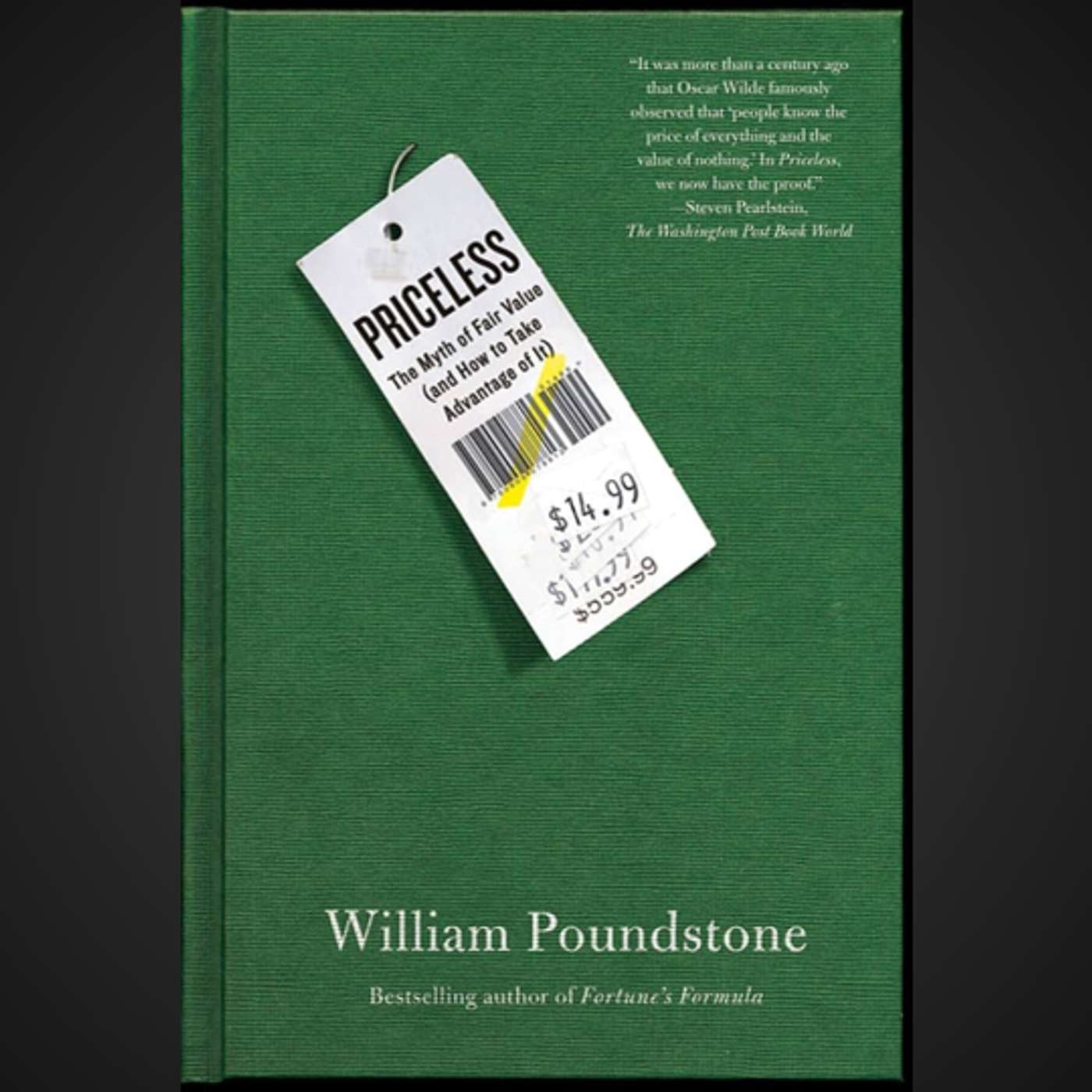
How William Poundstone's book Priceless turns anchoring, relativity and fairness into pricing power
23 Sep 2026 · 42 min
Season 1, Episode 137 · Behavioral Science For Brands: Leveraging behavioral science in brand marketing.
23 Sep 2026 · 42 min
MichaelAaron and Richard revisit William Poundstone's Priceless to unpack why price feels relative, not absolute. They cover anchoring in courtroom and Williams-Sonoma pricing, why a $5 saving matters more on a $15 item than a $125 one, and how visible costs and higher prices signal quality and fairness to buyers.
MichaelAaron Flicker: [00:00:00] Welcome back to Behavioral Science for Brands, a podcast where we bridge the gap between academics and practical marketing. Every time we're together, we go deep behind some of the science that powers great marketing today. I'm MichaelAaron Flicker.
Richard Shotton: And I'm Richard Shotton.
MichaelAaron Flicker: And in today's episode, we're exploring William Poundstone's Priceless.
Let's get into it So Richard, we were very happy to welcome William onto the show back in episode 85, and I'm thrilled we're returning to his book because pricing as a topic is so consequential and often I think comes later in a brand's optionality, decisioning tools they pull on. So it's really something important to bring to the forefront of marketers' minds [00:01:00] because marketers might think that every product has a fair price just waiting to be discovered.
You take the costs, you add the margin, you look at the competitors and then you get a number. But Poundstone's main argument is that consumers don't experience price that way. And when we interviewed him, something I pulled from our conversation was his analogy to suitcases, which was so unexpected and so interesting.
He said, "Most people can pick up two suitcases and tell which one's heavier, but without a scale, they're far less capable at telling you the absolute weight of either one." And he argues that pricing is similar. We're often much better at deciding which one of the options feels more or less expensive rather than determining what's the objective price actually worth.
And [00:02:00] he called that, and I believe he said this is the w- what researchers call coherent arbitrariness, that our judgment can be internally consistent. We know better wine should cost more than w- weaker wine whilst the starting point and the scale remains really flexible. And of course, that's why we wanted to bring it to today 'cause it has big implications for marketers.
And for business leaders and marketers, bringing pricing much earlier into the conversation and thinking about how consumers experience price really is the opportunity that we can that we can bring to today's discussion and a way we can make it tangible for everyone. Richard, let's start with the first idea.
What is anchoring?
Richard Shotton: So anchoring is a principle that we've covered before. All the way back, [00:03:00] episode 21, we talked about anchoring in the DeBeers episode But Poundstone, I think, comes up with a series of experiments that explain the principle a bit more simply and I think a bit more practically. So anchoring essentially is the idea that when we are weighing up what is a reasonable amount to pay, we don't just judge the situation on its inherent merits. We are deeply influenced by a reference point. So if we believe that I don't know, a wine used to cost £100 and we're told it's 40, we will think that's a better deal than if it's always been £40.
Even though in both circumstances the quality, the enjoyment of the wine might be the same, by putting this reference point in, it changes people's perception about what is a fair amount to pay. So the study that Poundstone talks about [00:04:00] is quite an old study, 1989 study. It comes from John Maloof at the University of Southern Colorado, and it involves a mock jury.
So people are told about a personal injury case where the defendant has been found responsible for the damages. Now, in every telling of this case, the defense lawyer says that there should be only £50,000 in compensation. But the 158 participants see a slightly different request or a quite a different request from the plaintiff's lawyer.
So sometimes the plaintiff's lawyer says it should be $100,000, sometimes 300,000, sometimes 500,000, sometimes 700,000. So a quarter of people each see that request Then when the mock jury weigh up what is a fair amount for the to be paid out, what is that the initial [00:05:00] request from the plaintiff's lawyer, it has a huge effect on their estimates.
So if the plaintiff's lawyer asked for $100,000, average award is $90,000. If the plaintiff asks for $300,000, that average award goes up to $188,000. That's a doubling. If they'd asked for $500,000, we're now up to $283,000 as an award. And then finally, if there's a request for $700,000, we're now up to a $422,000 award.
MichaelAaron Flicker: Wow.
Richard Shotton: So what logically people should do is weigh up the distress that was caused by the injury. But that is a complex question, and what people often do is when they're faced with a complex question, is they replace that complex question with a simpler one that gives an almost as good answer. And the simpler question is they think to themselves, "Is the amount the plaintiff has asked for [00:06:00] reasonable?"
They take it as a starting place. On many occasions, they think it's far too much, but they adjust downwards. But crucially, they don't adjust far enough. So that original offer, that original request, that affects people's later evaluations.
MichaelAaron Flicker: And I think it's easy to hear this story and feel that based on that is there no upper limit to the to the number that you can request?
And so bringing in some brand examples we thought would help contextualize this concept. When William was on the podcast, he told us the stories from Williams Sonoma, which is a which is a kitchenware company. And they had an early bread maker when bread makers were still new that was priced at [00:07:00] $279.
And what they saw was uptake by consumers was very slow. Not a lot of people were buying it. Then they introduced a larger model at $429. That $429 model was a flop, but sales of the original 279 bread maker nearly doubled. So the $429 product gave the conser- the c- customers a comparison point, and the 279 model stopped feeling like an un- an unjudgeable extravagance- Yeah
and started feeling like a sensible choice in the middle.
Richard Shotton: Yeah. So i- in both the situations, people are faced with a situation in which this bread maker is gonna bring them joy. They're gonna have nice smell of fresh bread, nice tasty bread. But if you just show the $279 model you're essentially posing a very complex question.
Is this [00:08:00] nice taste and this nice smell, is it worth $279? In the second scenario where there's the two bread maker options, people still remind themselves, "I'm gonna get this wonderful tasting bread. The house is gonna smell brilliant." But they can now say to themselves, " do I want the basic model or the premium one?"
And it's a simpler question to think, " I'd rather just save the $159 and go for the cheap dollar." You get the same benefits and you can frame this new price as being 100 and what is it, $150 saving. Yes. You're replacing the complex question with a, a simpler one. And I think that's what makes it so effective.
MichaelAaron Flicker: I, absolutely. And we see this example of giving people a context and a frame used over and over again. Everyone will have been in a restaurant where there's a extremely high-priced item, call it the seafood [00:09:00] tower in the appetizer- Sure ... a Wagyu beef or lobster dish that's twice the expense of everything else on the menu.
So there, restaurants are using it to create context and and and an anchor point. But even in luxury handbag or shoe stores, you walk in and there's the $50,000 bag, not in the back of the store, but right up front, front and center. And that becomes an anchor that everything else is compared to.
And so to me, the important management lesson is that every item should not be judged on its own sales alone, but perceived as part of the portfolio driving sales holistically. And if you could put a $50,000 handbag in a- Yeah ... In a store selling mostly $2,000 handbags, if you could put a $700,000 [00:10:00] request rather than a $100,000 request back in the Maloof study maybe there really is an argument that you should reach high to make to make things feel more in context.
Richard Shotton: Yeah. And I'd, I think double down on your point about measurement. That's where m- marketers often go wrong. So your Williams Sonoma example, it would be very easy to look at the sales figures and think, "Oh, this $429 model, that's a flop. It's not working. It's... Let's remove it." But exactly as you say, you've got to look at things holistically.
Sometimes the role of the higher price items is not to generate direct revenue, it's to make everything else look a bit better value and increase the sales of your other models. So to think of it as a system, an overall system rather than individual elements. Absolutely agree with that.
MichaelAaron Flicker: So do you think there's a point where the anchor becomes so extreme [00:11:00] that people reject the entire frame?
Richard Shotton: Do you know what? Often people ask that, but the evidence is actually the other way, that it doesn't seem like even ridiculous requests encourage a backfire effect. So Poundstone talks about another study, 1996 study, Gretchen Chapman, who's at Louisiana State University, and she pushes anchoring to ridiculous levels.
So like the Maloof study, this is around a mock jury. People are told about a hypothetical lawsuit in which a young woman is claiming she's contracted ovarian cancer from birth control pills, and she's living in near constant pain Now, the people taking part in the experiment, they hear different requests for damages.
So it goes all the way from $100, $20,000, $5 million, and then the utterly ridiculous one, a [00:12:00] billion dollars.
MichaelAaron Flicker: Jeez.
Richard Shotton: Now, what Chapman finds is very similar to Maloof. You ask for $100 and the average award is $990. You ask for $20,000, average award is 36,000. You ask for 5 million, now people are getting somewhere between 400 and 500,000 award.
You ask for a billion, and it edges up from, what was it? 440,000 to 490,000. So even when you get to utterly absurd anchors, they still have an effect. They're still pushing up the amount that people are awarded, although there are very strong diminishing returns between 5 million request and the billion request.
You're improving the award by about 10%, even though the number has gone up by, what? 200-fold.
Advertisement: Yeah,
MichaelAaron Flicker: 200-fold. So maybe the, the practical takeaway is a little more [00:13:00] nuanced than simply saying name the highest number you can. The study shows that an aggressive anchor can still pull judgments upwards even when it looks implausible, but the gains begin to flatten out, and of course, they'll come with other negative effects.
So for brands, I think the most useful lesson is to avoid anchoring timidly, which is the point you made, that we more often than not will just hold back. If a premium tier, a flagship package, an opening proposal has some genuine defense, then it can establish a range that allows the conversation to happen within.
A- and going back to the Williams-Sonoma example, the anchor does not need to become the best seller to do the job it needs to do- Yeah ... in the portfolio. So when leaders evaluate price architecture, they should again look at the entire portfolio effect, not just, as you say, did the SKU [00:14:00] sell better or worse than another SKU?
Richard Shotton: Yeah, and it is probably worth thinking about the specifics of the experiment. They're both mock jury trials. People are being asked to estimate damages. It is a situation of extreme uncertainty, and what we often find is in situations of uncertainty, the impact of the bias becomes magnified. If you are 50 years old and you have bought 100 bread makers and you've got a very well-attuned sense of what a bread maker should cost I would imagine the anchor is far less influential.
So there is a variance between, I think, situation. Context is important. The more uncertainty, the probably the more aggressive you can be with an anchor.
MichaelAaron Flicker: Yeah, I think that makes a lot of sense. So we picked the next experiment from the book, and this time it's about price relativity. [00:15:00]
Richard Shotton: Yeah. So this is around the idea that when we think about the value of a saving, we don't judge it as an absolute amount.
We're often influenced by what it's compared to. So there's a real classic study done back in 1981 by Kahneman and Thaler, so two giants in behavioral science. Kahneman got the Nobel Prize in 2002, Richard Thaler in 2017. And they asked people to undertake a thought experiment. So the thought experiments start out the same way.
They set up a situation. You're in a store, you're queuing up for an item, and then you are told that if you drive 20 minutes, you could get this item for cheaper. So that's the kind of basic setup. But people are put into one of two groups. So the first set of people are told, "Would you drive 20 [00:16:00] minutes to save $5 on a $15 calculator?"
And 68% of people say, "Yep, I would do it. 20 minutes, it's worth it." The other half of people are asked what is essentially the same saving, but they're asked about it in a slightly different context. So they're asked, "Would you drive 20 minutes out of your way to save $5 on $125 leather jacket?"
So same saving, but now the reference item is much, much larger.
Here, only 29% of people say yes. So 16- Less than half ... 68 when it was the $15 calculator, it's now 29 when it's the $125 leather jacket. Mathematically, logically, the comparison item should be irrelevant. What you're really being asked is, "Is it worth 20 minutes of effort to save [00:17:00] $5?" that $5, whether it's off a leather jacket or a calculator, it allows you to buy the same amount of things.
Money is fungible But people don't treat it that way. They are influenced by the relative size of the saving. So five compared to 125 sounds trivial. Five compared to 15 sounds like it's a, a significant sum. So it's this slight kind of logical error in which people give too much emphasize to the kind of proportion or the relative size of the saving rather than the underlying amount itself.
MichaelAaron Flicker: And of course, that gives marketers and business leaders a big opening. The creative task is then to choose the comparison set rather than just live with the defined price. Meaning if it's $5 in either scenario, $5 compared to [00:18:00] 15 is a lot more attractive than $5 compared to 125. So we covered this in our book, Hacking the Human Mind, in our chapter on Red Bull.
Red Bull does this brilliantly in a commercial setting They're launching the first energy drink into the market, and they decide not to use a standard 12-ounce soda can. They use a taller, narrower can that was actually smaller than a soda can, and it made a direct comparison with the cost of a Coke or a Pepsi or Sprite much harder.
And so that unusual format helped define a new category for high-potency energy drinks that most importantly came with a higher price point for them. And so we see this ability to take what might feel like a disadvantage and turn it into an, an, an advantage. And you could see the same thing on [00:19:00] a the-- on larger formats.
If you have a 12-ounce beer can should cost X, 16 ounces, and now all of a sudden your reference point is harder to say, " how much more should a 16-ounce bottle be than a 12-ounce can?" So you can really use this to your advantage on both ways.
Richard Shotton: Yeah. Yeah. A-absolutely. And it's one of those experiments where I think there are absolutely marketing implications, but there are also really important personal implications.
I remember when I bought my house, it's the most expensive purchase I've ever made. And I could find myself becoming seduced by the idea that the conveyancing fees or the removal fees, they don't matter, they feel completely trivial compared to the size of the house. But I can remember stopping myself and thinking, "Wait a minute.
For a little bit more effort, a little bit more searching, I could save 1,000 pounds." Now, how often is it in life that you can save 1,000 pounds with a few [00:20:00] hours' effort? There is no way that I would ever think of g-going and doing a supermarket shop and ignoring the opportunity that I might get, be given 1,000 pounds if I was gonna spend a couple of hours searching around for a better store to buy from.
Yet, when you're buying a house, you forget about the absolute value of money, and it all becomes re-relative. So my advice is always anyone that's buying a house for the first time, do not fall into this trap. And for those extra add-on costs that you have to go through Don't take the first offer. Always push back and look for a saving.
It'll be the best couple of hours you ever spend.
MichaelAaron Flicker: Yeah. I think it's a lovely takeaway because the $1,000 is the $1,000, just like the $5- Exactly ... in the experiment is $5, regardless if it's next to a 200,000 pound house purchase or whatever the price of the house is. Exactly. I think it's a great point.
To me, the [00:21:00] lesson for marketers to take away is that we rarely encounter price alone in a vacuum. It's always next to the package, alongside competitors, with some knowledge of the category. And so the way the brand positions itself has enormous influence over the way whether that price feels reasonable or expensive.
And so I think we can take the lesson from our marketing and our commercial work, we could take the lesson from our personal experience, but either way, it tells us we've got to be thinking more holistically about how pricing is received.
Richard Shotton: Yeah. Yeah. It's very easy to fall into the trap of thinking people behave in a fully logical, considered way.
There are repeated examples when it comes to price that it is a, a relative comparison, not an absolute one, and I think that is an amazing tool in any [00:22:00] marketer's armory that they should use again and again.
MichaelAaron Flicker: In our next experiment-
By Richard Thaler- Yes ... it talks about how fairness of a price is shaped by context.
Richard Shotton: Yeah. This is a old study, 1985 done by Thaler, Nobel Laureate, University of Chicago. And I thought for this one, rather than me- ... Summarizing the study into just a couple of key points, let me read out the exact wording of the experiment.
MichaelAaron Flicker: Yes.
Richard Shotton: And we'll do- Never-
MichaelAaron Flicker: It's not usually this flowery, right?
Richard Shotton: No. It's not usually this enjoyable. But I like it. You can see what's going on. I'll read out the first version and then I'll just talk about what they did for the second version. So participants are asked to imagine you're lying on a beach on a hot day. All you have to drink is ice water.
For the last hour, you've been thinking about how much you'd enjoy a nice cold bottle of beer of your favorite brand. A companion [00:23:00] gets up to go and make a phone call and offers to bring back a beer from the only nearby place where beer is sold. And then this is the crucial bit. It's a small, rundown grocery store.
He says that the beer might be expensive and so asks how much are you willing to pay for the beer. He states that he'll buy the beer if it costs as much or less than the price you state, but if it costs more than the price you state, he will not buy it. You trust your friend and there is no possibility of bargaining with the store owner.
What price do you tell him? So 1985. Do you wanna have a guess? What do you think people, what do you think people said? What would
MichaelAaron Flicker: a beer cost? A, $1.50. $1.50.
Richard Shotton: $1.50 for a beer. $1.50. You are suspiciously accurate. You've been reading your Thaler. It is exactly $1.50. Okay. Oh. So that's the f-first one. I didn't know it was exactly $1.50. No.
MichaelAaron Flicker: I don't
Richard Shotton: remember that. Yeah. We'll be doing a lie detector test later, don't worry.
MichaelAaron Flicker: That's
Richard Shotton: good. [00:24:00] Second group of people, they get exactly the same original part of the story.
But when it comes to the part where he says, "A companion gets up to go and make a phone call and offers to bring back a beer from the only nearby place that, where beer is sold," he then says, "A luxury hotel." So remember, first example, small rundown grocery store. Second example, luxury hotel. So this is a fresh group of people.
They are then asked what's the maximum bid they would pay. So grocery store, $1.50. What do you think for the hotel?
MichaelAaron Flicker: It's gotta be more. $2.25.
Richard Shotton: $2.25. Very close. Not quite enough. It goes up to $2.65. So we've got this 77% variation. Now, remember, this is a really cleverly constructed experiment. He's asking-- Thaler asks the participants, "What's your [00:25:00] maximum bid?"
MichaelAaron Flicker: Yep.
Richard Shotton: And you would think if people were just gauging the enjoyment they would get, and then translating that to, " how much, how many dollars am I prepared to pay per unit of enjoyment?" You should get a very similar answer in each situation. But you don't. You get this 77% variation. Thaler argues that people are asking themselves, "What is a fair price to pay in this particular context?"
And people recognize there are different overheads, different norms of payment between a grocery store and a luxury hotel, and they adjust accordingly. So it's this interplay of fairness and context that sets what people's price ceiling will be.
MichaelAaron Flicker: It's really actionable for brands to know this because it gives us the chance to make the premiumness visible.
If we want [00:26:00] to charge more, then we should make seen the environment, the service, the craftsmanship, the quality that you're getting if you want the rise in price to be considered fair from the consumers. In fact, when William was on our podcast, we talked about how Dyson does this so well in talking about the thousands of prototypes that they have behind their products.
Yeah. It he- it's information that helps the customer understand why it's legitimate for them to charge $800 for a vacuum, not $200 for a vacuum
Richard Shotton: Yeah, you- you're absolutely right. I think there are lots of ways to create a perception of a fair price to pay. It could be signals that you have lots of overheads.
You're a fancy hotel. You've got all these accoutrements that need, need covering. That would encourage people to pay more. Or it could be a fair price to pay because you've put lots of effort into a [00:27:00] product or service. The, the key thing that unites both those angles is that the willingness to pay is not a reflection of the benefits, or it's not only a reflection of the benefits that the user's gonna get.
It's partly that, but it's also partly this point of fairness, and y- you've got to, as a service provider, tell people these stories to increase their willingness to pay. If you just think a great product is enough, you are gon- not gonna make enough money, and the danger is you go out of business.
MichaelAaron Flicker: I think I think it's a critical point is to drive at the word fairness because the reverse matters too.
If you raise the price and the consumer cannot answer why it costs more, it feels extractive, it feels unfair, and that can be a real problem for brands that might need to take price. When [00:28:00] COVID happened and then when the United States started implementing tariffs, there were two times in a brand's life cycle here in the United States in four years where there was legitimate outside factors that caused brands to say, " we cannot afford to sustain the increased cost to us.
We must pass it to the consumers." And there was much less of a backlash than- Yeah ... I think experts an- anticipated. If there was a legitimate reason that everybody could understand I believe it led to less pushback than some predicted.
Richard Shotton: So there are some lovely studies. I think it's, it might even be a Kahneman-Tversky tie-up again, where people are were-- are told about certain scenarios and then they're asked is the price increase fair?
And one of the scenarios will be hardware shop sells snow shovels. They normally sell for [00:29:00] $5 each. There's a massive snowstorm. They triple the price. They're now $15. Is that fair? Virtually everyone says no. Most people think that is a deeply unfair thing to do. You are just taking excess profits by maximizing on other people's misfortune.
Other scenarios that the psychologists give are things like greengrocers normally sells lettuce for 10 cents. Because there are supply issues and their wholesale costs have tripled, they're now charging 30 cents. Is this fair? And most people say, "Yeah that's okay." and what this variety of thought experiments shows is that people treat increased profit-taking and price gouging completely different from passing on costs.
So if, as you say, you're in a situation where COVID's hit and prices have gone up, or the coffee bean price has tripled, or the cocoa bean price has tripled, [00:30:00] actually being very clear that you're passing on costs rather than just exploiting the situation, it does help. It does help sugar the pill, as it were.
So I think you're absolutely right in that, that scenario. I think that's an absolutely fair explanation.
MichaelAaron Flicker: It gives you a lot to think about how you can ethically apply this. Where is there legitimate cost pressures that can be part of the marketing explanation versus trying to hide the reality that glass is more expensive, raw ingredients are more expensive?
Where, what is the right story to use? And I think, Yeah ... used ethically, this can be good for the brand and good for the buyers.
Richard Shotton: A- absolutely. And if you have a conception of your consumer where fairness matters, why wouldn't you honestly tell people when your costs have gone up?
[00:31:00] If you have a conception of your consumer who will pay an amount for a product solely based on the benefit they think they'll get, the, the natural thing to think is, " why would I bother telling them about my costs? That, that's an immaterial fact." So I think what behavioral science is very good at is giving you the right model of what the consumer's thinking and what influences them, and then how to respond to that then suddenly becomes a very easy logical route to take.
MichaelAaron Flicker: We brought one final insight-
Richard Shotton: Yeah ...
MichaelAaron Flicker: to today's conversation, and you and I agree, one of the best-named papers.
Richard Shotton: Yes. It's a brilliantly named paper, and it's, it-- You very rarely get a bit of joy from the academic paper title. But this is a paper from 2006 from Dan Ariely and Drazen Prelec at MIT, and George Loewenstein at Carnegie Mellon.
And the paper's called Tom Sawyer [00:32:00] and the Construction of Value, and it has this name because they take a scene from The Adventures of Tom Sawyer and it's a famous scene where Tom is being essentially punished or he's being given a boring task by Aunt Polly. He has to whitewash a fence. So he really doesn't wanna do it, but he's forced to.
But what he cleverly does is when his mates turn up, he pretends he's having an absolutely amazing time, and he's very glad to be painting it. It's really good fun. He won't let them do it, so they start to try and bribe him. They fall for his gift of the gab, and they bribe him with, I don't know, marbles or apples or other such things so they can have the fun of painting themselves.
And it's essentially a little anecdote about how what we value is remarkably fluid. And once the [00:33:00] psychologists have read this book and have taken the inspiration from Tom Sawyer they put it to the test. So they try to interest marketing students in a poetry reading that Dan Ariely was supposedly gonna give.
They approached lots of people, and half of the participants are told the poetry reading's gonna cost $2 dollars. If you wanna come along, let us know. The other half of people were told, "Come and listen to Dan do his poetry reading. You'll be paid $2 dollars." So that's the first bit of the experiment. Now, as you'd expect, you get wildly different uptake rates.
If people think they have to pay, 3% agree. I'm not sure if Dan Ariely has a particularly big reputation as a poet. If people think they're gonna be paid, now remember these are students, this is 2006, 59% of the students will sit through this [00:34:00] poetry reading for $2 dollars. So far, so obvious.
But then the next step in the experiment, that's the clever bit. They-- After they've given-- The participants have given their answer, would they attend, they're now told, "Oh, actually, sorry, y-you're not gonna get... You're not gonna have to pay to come. It's gonna be free," or, "You're not gonna get paid. It's gonna be free."
And then what they find is if people had thought there was gonna be a payment involved, now that it's free, 35%, yeah, say, "I'll come along." Whereas if people thought this was something they needed to be paid for, now you've only got 8% saying they're gonna, they're gonna come along. So people are essentially using price, whether it's a fee or a cost, they're using that as a guide to how valuable they think the offering will be.
So price is this guide to value, and I think [00:35:00] that is a remarkably powerful study that people can put into practice
MichaelAaron Flicker: Yeah. It really drives home the point that pricing is a positioning decision as much as it is a financial decision. And free can signal generosity and accessibility, but it can also signal, as you say, low value.
And charging can create friction, but it could also signal quality or value. And so the bigger question is, what does the price teach the customer about the experience before they had it? I think that's really the underscore.
Richard Shotton: E- exactly. This study is set up in this really extreme way that you flip things from does it deserve a fee or does it deserve a, a wage?
You're going these extremes of flipping from one to the other. When it comes to the marketer, I think the much more practical application is [00:36:00] thinking of price as a signal of value. The... If you want to convey something's high quality, you need your price signal to match that. People are not gonna believe you've got an amazing new bit of technology or an amazing wine if you say it's $199.
Now, why would- Yeah. How could that be? ... somebody sell an amazing product for so cheaply? The price and the claim are clashing, and often the power of the price will overwhelm the communications. So yes, think about pricing as a tool to emphasize value and quality, not just as a, a kind of a mechanism for determining how much money you can make.
MichaelAaron Flicker: And I think that ni- nicely brings us back to the core idea of priceless, which is value emerges from the product and from the comparisons surrounding it. And speaking of famous leaders in [00:37:00] our field- Amos Tversky famously summed this up that people don't choose between options, they choose between descriptions of options.
And I think that really gives us the f- the way to remember this, we have to set up the narrative, and the narrative is what is getting evaluated within the pricing.
Richard Shotton: Nice. Yeah.
MichaelAaron Flicker: So Richard, what do you think would be the most important things to bring back- Yeah ... over the flow of the episode for people to remember as we're wrapping up today?
Richard Shotton: So probably the overall theme is one of consumers not behaving as homo economicus. They behave in a more complex, psychologically rich way. One of the key themes within that is when people are working out what is a reasonable amount to pay for a product, what they tend not to do is think [00:38:00] about the amount of benefits they'd get, turn those benefits into a cash sum by thinking about, " it gives me 100 units of happiness.
Prepared to pay $1 per unit of happiness, therefore I'll pay 100 pounds." People don't do those complex calculations. They look at simpler ways of weighing up what is a reasonable price, and some of those simple ways have been experimented on and are covered brilliantly by Poundstone. So you've got ideas like anchoring.
If you are negotiating, throw out a very large sum and it will shift people's expectations about what is the right amount to pay. Even though they won't settle on what you've asked for, they take what you've asked for as a starting place. They then adjust up or down from it, but the crucial thing is because they've taken that as a starting place, because they repeatedly don't adjust it far enough, that irrelevant anchor, that initial price you mentioned, tends to affect [00:39:00] where you end up.
So that was the kind of first point, anchoring. We then talked about how money is often judged, especially in terms of savings, relatively rather than absolutely. So people were completely happy to do 20 minutes of work to save $5 on a $15 item. They were completely unhappy to do that when it was 20 minutes of work to save $5 on a $125 item.
It's a clever experiment that shows people conceive of value relatively rather than absolutely. So if you can change some of the comparison sets you can harness that, that idea. We then talked about fairness. That was the sailor study, the beach study, how people's willingness to pay for a beer varied wildly by the fairness and the context of where that purchase would happen.
So if you want to harness [00:40:00] this insight, what you need to be doing is making sure people know the efforts, the costs that have gone into your production so that people feel that the amount you're asking for is a fair sum. And then finally, we talked about that wonderfully named paper, Tom Sawyer and the Construction of Value, and we talked about how price was a signal, and high prices are equated in people's minds with high quality.
So discount and reduce prices at your peril because you're training your customers to think that your product isn't very high quality.
MichaelAaron Flicker: Thank you for the summary. And with that, we say thank you to our listeners. If you enjoyed today's conversation, please do share it with others and and comment on our pages so we can reach more people just like you.
And until next time, I'm MichaelAaron Flicker.
Richard Shotton: And I'm Richard Shotton.
MichaelAaron Flicker: Thanks so much for listening.[00:41:00]
Advertisement: Behavioral Science for Brands is brought to you by Method1, recognized as one of the fastest-growing companies in America for the third year in a row, featured on Inc.'s 5000 list. Method1 is a proudly independent creative and media agency grounded in behavioral science. They exist to make brands irresistible, helping people discover products, services, and experiences that bring moments of joy to their lives.
As behavior change experts, Method1 creates emotional connections that drive true brand value for their clients, focusing primarily with indulgence brands in the CPG space. Find out more at method1.com.
Transcript supplied by the publisher with the episode.
by Consumer Behavior Lab · English · Business
The Consumer Behavior Lab is dedicated to teaching marketersacross the United States how behavioral science principles can beapplied to help their brands. By decoding the underlying motivationsof how consumers make decisions, the CBL seeks to make a betterindustry - where both brands and agencies pu

S1 · E139 · 7 Oct 2026 · 30 min
After 12 tons of KitKat bars vanished the week before Easter, the brand turned a supply chain crisis into a Cannes Grand Prix winning campaign. MichaelAaron and Richard unpack the scarcity, Zeigarnik and IKEA effects behind it, and how brands can turn spectators into participants in a story.

S1 · E138 · 30 Sep 2026 · 36 min
Polish law requires every club to identify each fan entering the stadium. Wisła Kraków's Football Club turned that compliance database into the Lucky Fan Index, a metric for how much luck each supporter brings, and game attendance rose 42%. MichaelAaron and Richard dissect the superstition research behind it.

S1 · E136 · 16 Sep 2026 · 46 min
MichaelAaron and Richard unpack Writing for Busy Readers by Todd Rogers and Jessica Lasky-Fink: six evidence-backed principles for readers who skim rather than read. Why a 49-word email beat a 127-word one, why subheadings doubled newsletter clicks, and why making a task easy beats making it exciting.
S1 · E135 · 9 Sep 2026 · 46 min
Charles Spence's book Gastrophysics argues that taste is built by every sense, not just the tongue. MichaelAaron and Richard work through the evidence: classical music lifting restaurant spend 10%, heavy cutlery raising willingness to pay 16%, rounder chocolate read as 50% creamier, and what brands should do with it.
S1 · E134 · 2 Sep 2026 · 58 min
Guinness made you wait, Avis was second, VW was small. Andy Nairn and Richard unpack why owning a flaw beats hiding one, and how the same instinct led Lucky Generals to raise its own size in pitches before a prospect could ever hold it against them.

S1 · E133 · 26 Aug 2026 · 52 min
MichaelAaron and Richard explore why charity donations are especially resistant to typical marketing tactics. They unpack behavioral studies on anchoring, present preference bias, reciprocity, and overhead aversion that show small shifts in framing and timing can raise donations by double digits.

S1 · E132 · 19 Aug 2026 · 55 min
Courage strategist Rami Dudin joins MichaelAaron and Richard to discuss why distinctive often beats different, using SickKids' $1.3 billion fundraising turnaround, CIBC's no-fee campaign, and neobank scarcity tactics like Monzo's golden ticket to show why owning one idea can perform better than chasing novelty.

S1 · E131 · 12 Aug 2026 · 46 min
MichaelAaron and Richard explore why half of chronic-illness patients skip their medication, and why scaring them into compliance backfires. They cover a study on avoiding bad medical news, a simple diagram that cut medication errors in half, and two studies showing doctors are swayed by menu order and time of day when prescribing.

S1 · E130 · 5 Aug 2026 · 50 min
Harvard professor Michael Norton, author of The Ritual Effect, joins MichaelAaron and Richard to explore why identical actions feel meaningful to one person and trivial to another. They cover how Oreo, Stella Artois, and Guinness turn consumption into ritual, and what marketers should watch for when customers improvise their own rituals.
S1 · E129 · 29 Jul 2026 · 48 min
MichaelAaron and Richard unpack a new Behavioral Insights Team report on why most companies fail to get employees using AI, covering how social proof lifts adoption, why removing small points of friction beats motivational pitches, and why framing AI as something to lose outperforms framing it as a gain.
Every episode of Behavioral Science For Brands: Leveraging behavioral science in brand marketing. →

The Melo app keeps playing with the screen off, works in the car and on your watch, wakes you to your station, and browses the whole catalogue offline. Free, no ads, no account.