
Episode · DataFramed
#369 How to Become a Top Business Intelligence Analyst | Helen Wall, Founder at Helen Data Design & Microsoft Influencer
20 Jul 2026 · 49 min
Episode notes
Business intelligence has never been only about building charts and writing queries. Most of the work that makes a report trustworthy happens below the surface — in the data models, documentation, and stakeholder conversations that users never see. For analysts, technical skill is just the starting point; understanding what the business actually needs, and why a number exists, matters just as much. So what really separates a competent analyst from a great one? How do you build something that answers the right question, not just any question? And which skills are worth investing in first?…
Podcast
DataFramed
DataCamp · Tech & Science · English
Welcome to DataFramed, a weekly podcast exploring how artificial intelligence and data are changing the world around us. On this show, we invite data & AI leaders at the forefront of the data revolution to share their insights and experiences into how they lead the charge in this era of AI.…
More from DataFramed All episodes →
-

24 Aug 2026 · 46 min
#374 How to Thrive in a World of Continuous Transformation | Phil Le Brun and Jana Werner, Executives in Residence at AWS
Technology is now moving faster than the organizations trying to adopt it. A model can be tested in an afternoon, but the approval to test it can take half a year, and that gap is where most transformation budgets quietly disappear. The structures that made companies safe and predictable — layers of sign-off, centralized control, standardized processes — were built for a world where getting things wrong was expensive. That world is gone. So what actually has to change inside a company for AI to deliver value? Which habits are holding things up? And where do you start when everything needs…
-
17 Aug 2026 · 52 min
#373 What Do Your Colleagues Do All Day? (The Value of Institutional Knowledge & AI for Process Reengineering) | Jennifer Smith, CEO at Scribe
Four years into the AI boom, headlines still promise agents that will run entire departments, yet most companies can't point to the transformation they were sold. The gap isn't intelligence — today's models are remarkably capable — it's context: no model arrives knowing how your company actually gets things done. For anyone tasked with deploying AI at work, this raises pressing questions. What does it take to turn generic intelligence into something that understands your specific operations? And why do so many well-funded AI initiatives stall before they ever reach production? Jennifer Smith…
-

10 Aug 2026 · 49 min
#372 Bulletproof Large Scale Data Science with Srini Raghavan, Chief Product Officer at Freshworks
Software buying decisions used to be made once, by someone far removed from the people actually using the tool. That model is breaking down. Teams now expect software to work out of the box, without weeks of setup, integration, and configuration before anyone sees value. At the same time, a growing share of "users" aren't people at all — they're AI agents calling the same systems through APIs and chat interfaces. That raises a set of questions worth sitting with: what happens to user experience when the user isn't human? Can personalization and simplicity coexist, or is one always traded for…
-
3 Aug 2026 · 40 min
#371 The Real Reason Your Product Team Needs a Feedback Loop with Todd Olson, CEO at Pendo
Software teams are shipping faster than ever, but speed hasn't solved the oldest problem in the industry: most software still isn't very good. AI coding tools have lowered the barrier to building something, yet they haven't lowered the barrier to building something worth using. As more people who aren't trained software creators start shipping products, a new question is forming across product, design, and engineering teams: if AI can build almost anything, how do you make sure it builds the right thing, and builds it well? Todd Olson is co-founder and CEO of Pendo, the product experience…
-
27 Jul 2026 · 44 min
#370 Failure is Data (and Other Career Advice) | Todd Dewett, Leadership Author & Speaker
As AI takes over more technical and routine work, the skills that set data and AI professionals apart are shifting. Raw technical ability and a high IQ still matter, but they are becoming table stakes as tools get more capable and teams get smarter. What increasingly separates people is harder to automate: communication, self-awareness, authenticity, and the ability to keep learning through failure. For anyone building a career in this space, that raises real questions. Which skills are actually worth investing in now? What holds up as AI advances? And how do you keep growing once you have…
-
13 Jul 2026 · 51 min
#368 AI Agents Are Now Your Database's Main User | Reynold Xin, Co-Founder at Databricks
For forty years, the rule held that transactional and analytical databases had to be separate systems, connected by fragile pipelines that move data from one to the other. That assumption is now being questioned. As AI agents start generating the majority of database activity, the old architecture is being redesigned around speed, scale, and a single copy of governed data. For anyone who works with data day to day, this raises practical questions. Do you still need separate systems for live and historical data? What happens to the pipelines you maintain? And how does your stack change when…
-
6 Jul 2026 · 52 min
#367 Don't Build on Jell-O: How to Make Agentic AI Reliable with Dan Klein, CTO at Scaled Cognition
Across the AI industry, capability has exploded while trustworthiness has lagged badly behind. The same technology that writes fluent prose can invent a refund policy that was never real, and most of those errors are subtle enough that no one notices. As more teams hand high-stakes work to AI — in banking, healthcare, customer service — the cost of confident mistakes adds up fast. So how common are hallucinations, really? Can chaining models together or adding humans to the loop fix it? And is reliability something you can design into a system from the start? Dan Klein is the CTO and…
-
29 Jun 2026 · 49 min
#366 Can AI Agents Outperform a Data Scientist? | James Zou, Professor at Stanford University
AI agents are no longer limited to automating routine tasks like customer support or report generation. Research labs and pharmaceutical companies are beginning to deploy teams of specialist AI agents capable of designing experiments, analyzing data, and proposing new hypotheses — in some cases producing results that outperform human experts. For data scientists and researchers, this raises urgent questions: Where do AI agents excel in scientific workflows today, and where do they fall short? How do you build an agent that can genuinely innovate rather than just replicate what's already been…
-
22 Jun 2026 · 53 min
#365 Your 90 Day Blueprint for AI Success with Charlene Li, Author of Winning with AI
Most organizations know AI matters, but few have turned that conviction into a written plan. Ambition and hope are everywhere; a clear roadmap tied to business strategy is rare. For teams on the ground, this gap shows up as scattered initiatives, tools nobody fully uses, and a lot of activity that never adds up to real value. So where do you actually start? How do you move from a long list of use cases to a focused plan you can execute? And who in the organization should own the job of turning AI into business results? Charlene Li is a New York Times bestselling author and strategic advisor…
-
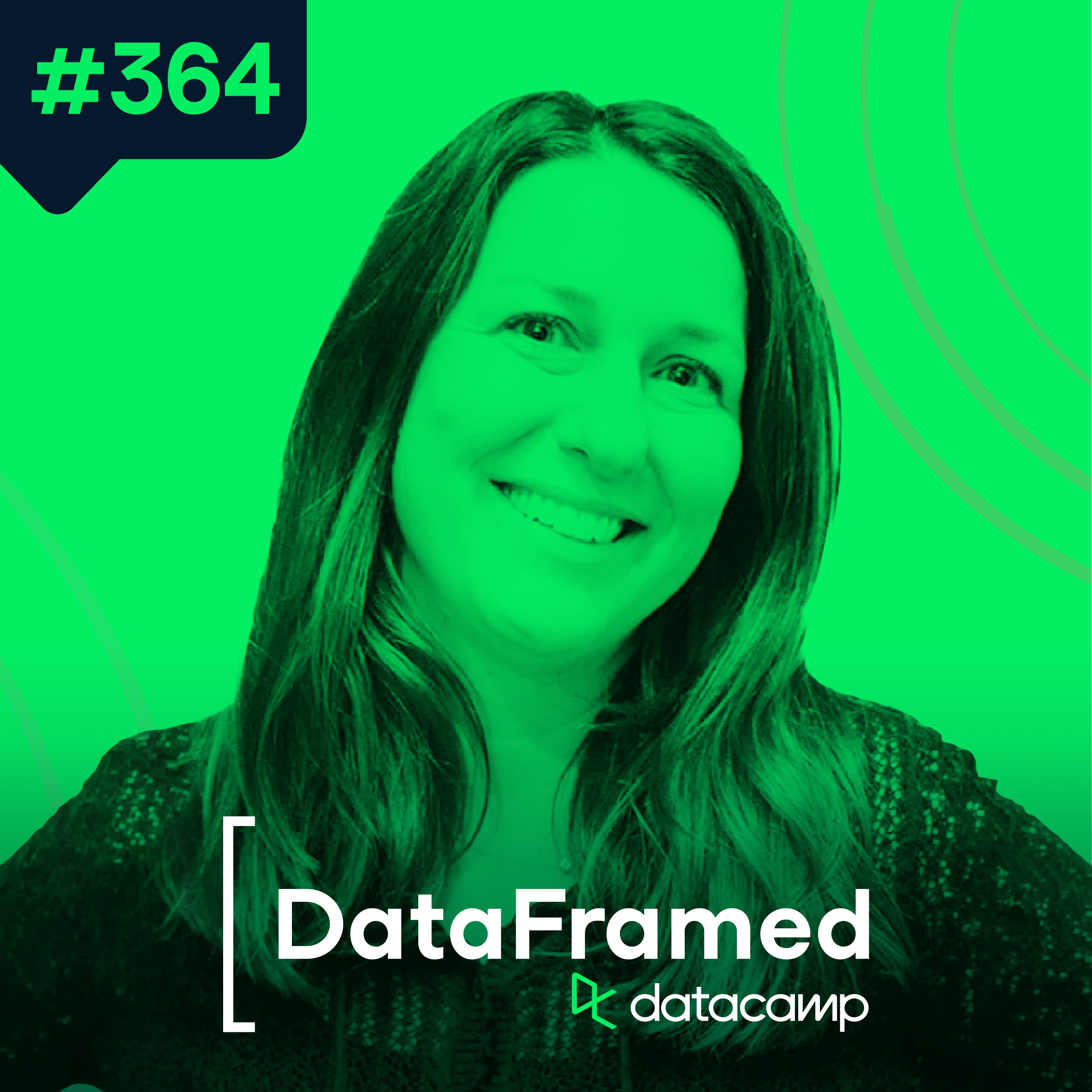
15 Jun 2026 · 44 min
#364 How to Enable Agentic Commerce with Nell Thomas, VP of Data at Shopify
AI agents are starting to handle parts of the shopping journey that used to require human judgment — discovery, comparison, checkout. But behind every agent recommendation is a massive, invisible layer of data infrastructure. Product catalogs need to be structured, inventory synced in real time, pricing accurate, and quality signals clear. For data engineers and teams building at companies like Shopify, this shift means rethinking how data flows through systems and what "good enough" quality actually means. How do you ensure data is ready for AI? And how is this reshaping what data teams…

Take it with you
The Melo app keeps playing with the screen off, works in the car and on your watch, wakes you to your station, and browses the whole catalogue offline. Free, no ads, no account.


