

Season 4, Episode 32 · Interpreting India
Cybersecurity in Outer Space: A Growing Concern
31 Oct 2025 · 37 min
Season 4, Episode 32 · Interpreting India
31 Oct 2025 · 37 min
In this episode of Interpreting India, host Tejas Bharadwaj is joined by P. J. Blount, an assistant professor of space law at Durham University. Together, they delve into the critical topic of cybersecurity in outer space, exploring the challenges and implications of protecting space-based assets amidst rising geopolitical tensions and technological advancements. Blount shares insights from his extensive research in international space law and cyberspace governance, highlighting the complexities of legal attribution and the evolving landscape of space security.
by Carnegie India · English · News
In Season 5 of Interpreting India, we continue our exploration of the dynamic forces that will shape India's global standing. At Carnegie India, our diverse lineup of experts will host critical discussions at the intersection of technology, the economy, and international security.

S5 · E35 · 3 Feb 2026 · 37 min
In this episode of Interpreting India, Dinakar Peri is joined by Mohan Kumar, former Indian Ambassador to France and a veteran trade negotiator, to unpack the newly concluded India–EU Free Trade Agreement and why he describes it as the “mother of all trade deals” for India. Kumar explains why the agreement is strategically significant, why the timing matters, and what it signals about India’s trade posture, competitiveness, and broader alignment between trade, technology, and security. Why is the India–EU FTA seen as India’s most consequential trade deal to date? Why did it take so long to…

S5 · E34 · 30 Jan 2026 · 47 min
In this episode of Interpreting India, Nidhi Singh is joined by Shalini Kapoor, chief strategist for Data and AI at the EkStep Foundation, and Tanvi Lall, director for strategy at People+ai. They unpack why so many AI initiatives get stuck after impressive demos, and what it takes to move from pilots to real, sustained adoption. Drawing on research spanning 1,000+ use cases across 25 countries, the guests introduce the Use Case Adoption Framework (UCAF) and explain how India can translate AI ambition into population-scale impact—especially across public services, agriculture, health, and…
S4 · E33 · 21 Nov 2025 · 45 min
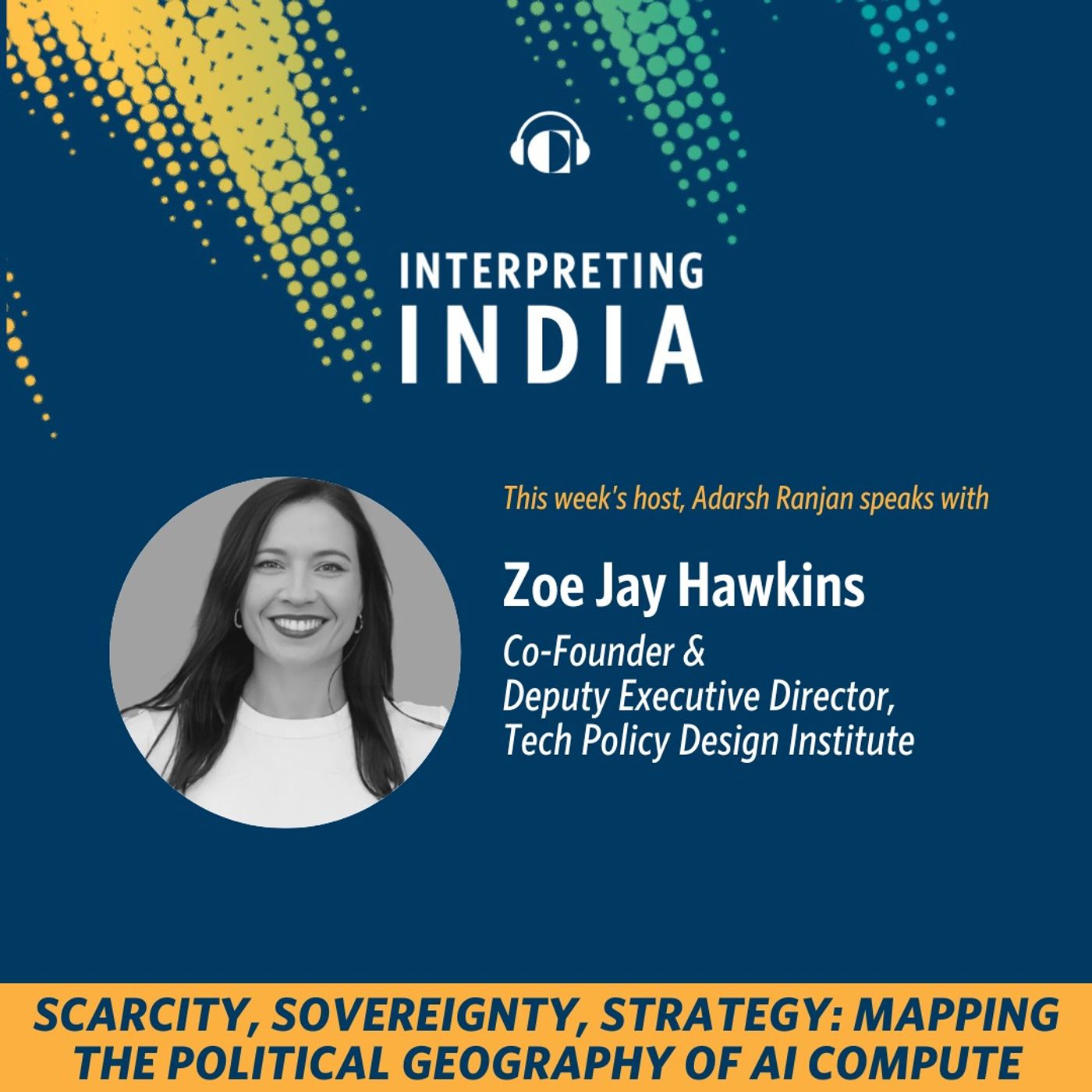
In this episode of Interpreting India, Adarsh Ranjan is joined by Zoe Jay Hawkins, co-founder and deputy executive director of the Tech Policy Design Institute. They explore the evolving idea of AI sovereignty, the geopolitics of compute, and how countries are navigating access to the foundational infrastructure that powers artificial intelligence. Drawing from her research at the Oxford Internet Institute, Zoe unpacks the political geography of AI compute, the rising concentration of AI chips and data centers, and what this means for both developed and developing economies. What does “AI…

S4 · E31 · 16 Oct 2025 · 48 min
In this episode of Interpreting India, host Shruti Mittal, research analyst in the Technology and Society Program at Carnegie India, speaks with Chinmayi Sharma, associate professor of law at Fordham Law School and nonresident fellow at the Stoss Center, the Center for Democracy and Technology, and the Atlantic Council. Together, they explore the evolving and often misunderstood debate on openness in artificial intelligence. Drawing from her forthcoming paper, Unbundling AI Openness, in the Wisconsin Law Review, Sharma explains why the traditional “open versus closed” framing oversimplifies…

S4 · E30 · 18 Sep 2025 · 50 min
In this episode of Interpreting India, host Dinakar Peri is joined by Air Marshal (Retd.) Diptendu Choudhury, former Commandant of the National Defence College. Together, they unpack the evolution of India’s multilayered air defense network, tracing their journey from limited radar coverage in the 1960s to today’s multilayered, integrated network capable of projecting power into adversarial airspace. The discussion highlights how offensive and defensive air power work in tandem, lessons from Operation Sindoor, the growing challenges posed by drones, missiles, and cost-effectiveness, and the…
S4 · E29 · 28 Aug 2025 · 55 min
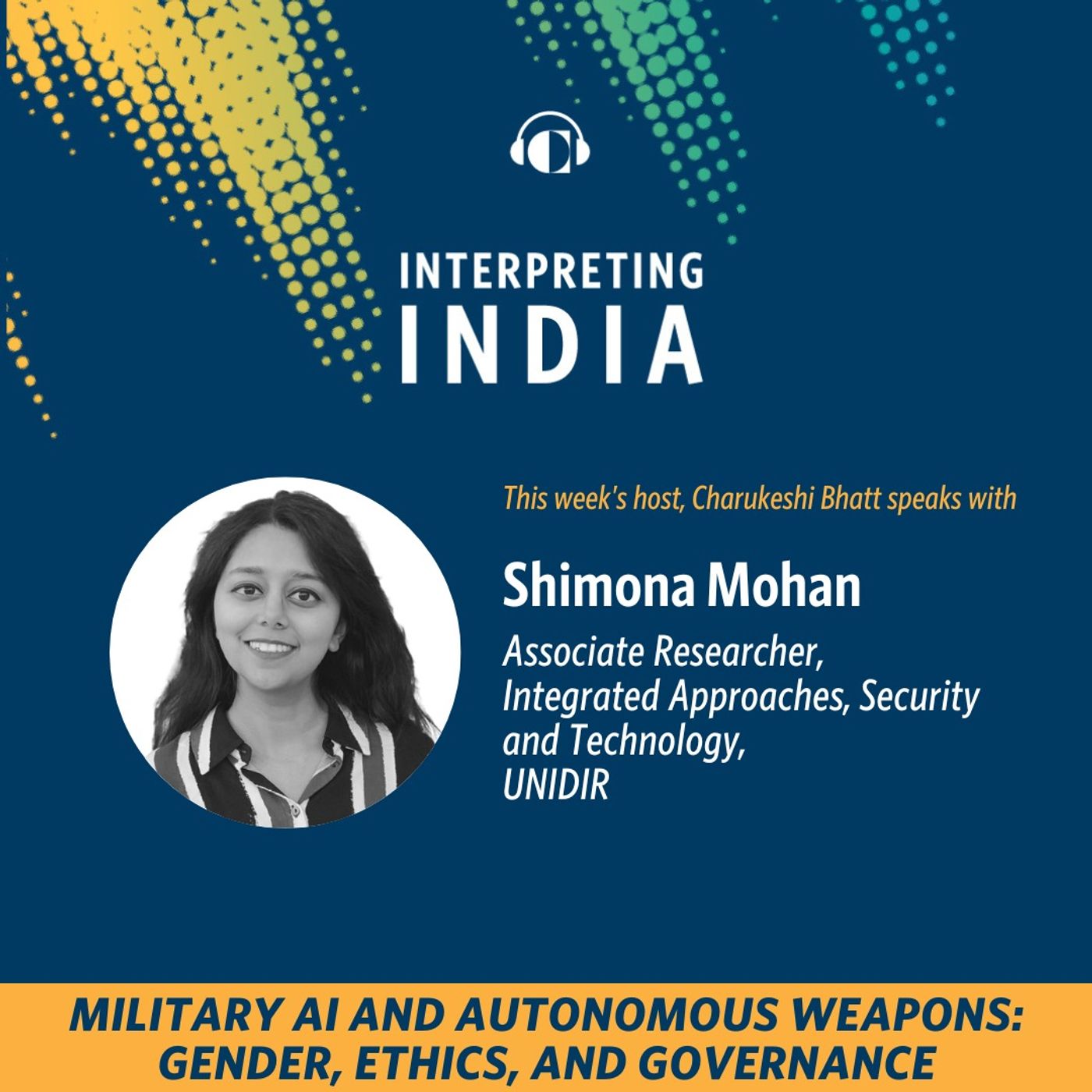
In this episode of Interpreting India, host Charukeshi Bhatt is joined by Shimona Mohan, associate researcher at the United Nations Institute for Disarmament Research (UNIDIR). Together, they unpack the rapidly evolving landscape of artificial intelligence in the military domain, with a special focus on lethal autonomous weapons systems (LAWS). The discussion traces how AI’s dual-use nature complicates governance, highlights the risks of bias and miscalculation, and explores why progress in international negotiations has been slow despite nearly a decade of debate.

S5 · E50 · 27 Aug 2026 · 45 min
In this episode of Interpreting India, Charukeshi Bhatt speaks with Jane Munga, fellow with the Africa Program at the Carnegie Endowment for International Peace, on the subsea cable landscape in Africa. With the continent now home to around 77 submarine cables and one of the fastest growing AI infrastructure markets in the world, the conversation moves beyond the headline investment numbers to ask harder questions: who benefits, who governs, and what does resilience actually look like when the cables go down? This episode explores: • Africa is seeing a surge in AI and cable infrastructure…

S5 · E49 · 13 Aug 2026 · 50 min
In this episode of Interpreting India, Shruti Mittal, research analyst at Carnegie India, speaks with Professor Mohan Yellishetty of Monash University on the India-Australia critical minerals partnership, what it has delivered so far, and where the two countries can build the most meaningful cooperation over the next decade. This episode explores: • How have India and Australia's mineral positions evolved individually over the last few years, and where do their trajectories stand today when viewed together? • Beyond the standard supply-demand complementarity, what do genuine areas of…
S5 · E48 · 10 Jul 2026 · 34 min
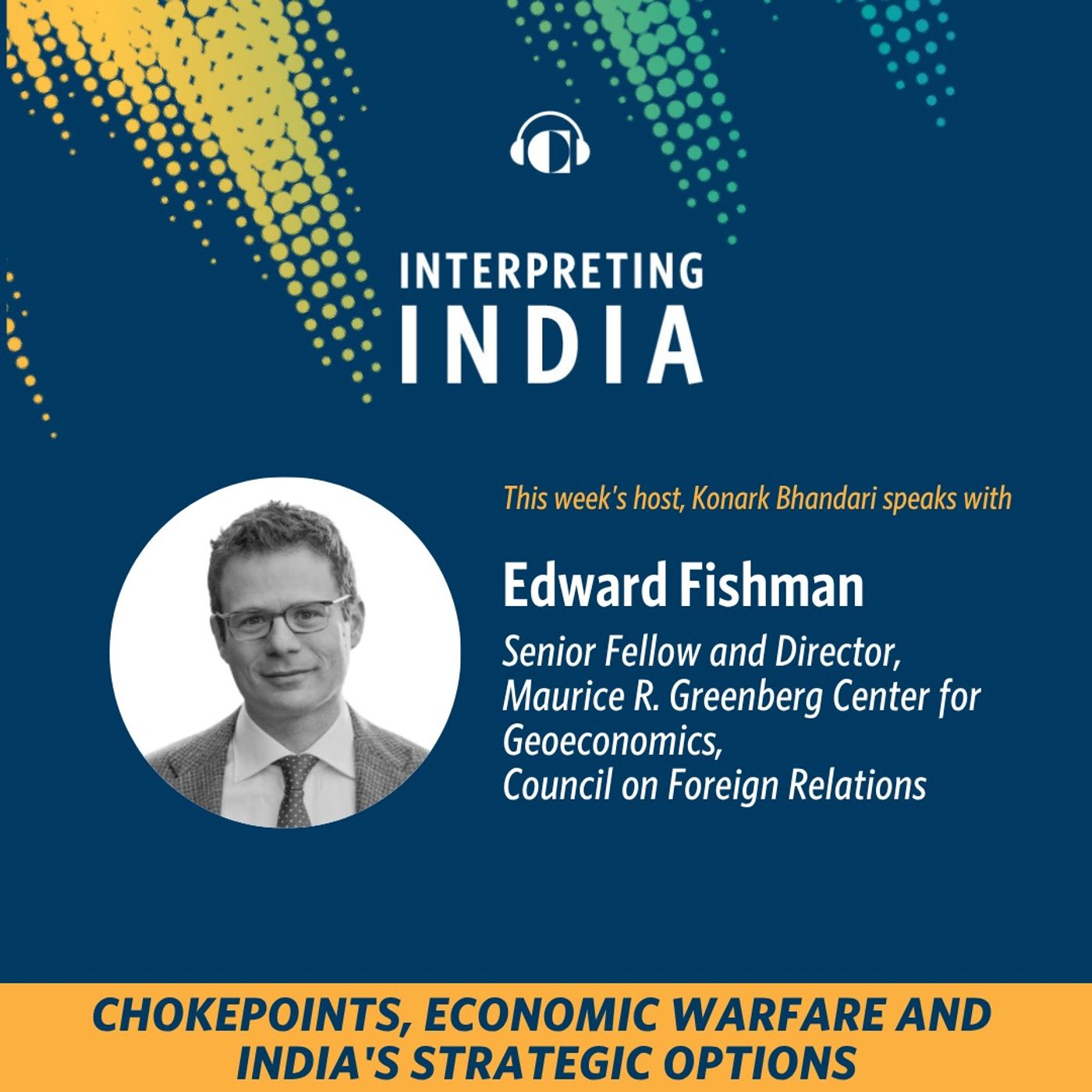
In this episode of Interpreting India, Konark Bhandari, speaks with Edward Fishman, author of Chokepoints: American Power in the Age of Economic Warfare, on economic statecraft, how the U.S. built its playbook for economic warfare over time, and what the lessons are for India as it looks to build its own economic resilience. This episode explores: • What makes something a genuine choke point, and is there a playbook that other countries can actually replicate? • Why were China's rare earth export controls and Iran's leverage over the Strait of Hormuz among the most consequential acts of…
S5 · E47 · 2 Jul 2026 · 33 min
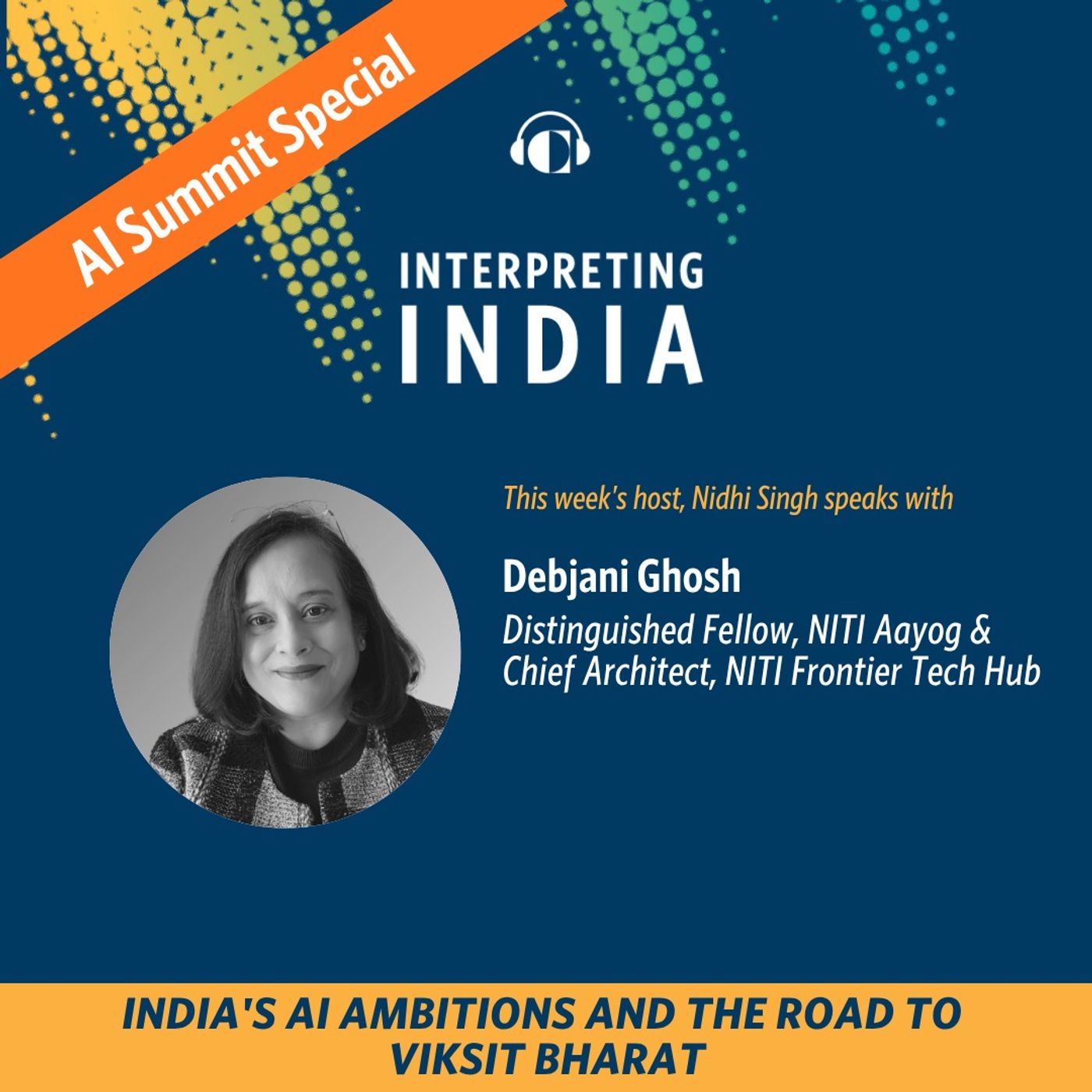
In this episode of Interpreting India, Nidhi Singh, speaks with Debjani Ghosh, Distinguished Fellow at NITI Aayog and Chief Architect of the NITI Frontier Tech Hub. With nearly three decades across Intel, NASSCOM, and now NITI Aayog, Debjani brings a perspective that is both deeply practical and genuinely optimistic. She co-chaired the working group on AI for Economic Growth and Social Good at the India AI Impact Summit, and in this conversation she reflects on what the summit delivered, what India's AI journey needs to get right, and why the human being has to stay at the center of all of it.

The Melo app keeps playing with the screen off, works in the car and on your watch, wakes you to your station, and browses the whole catalogue offline. Free, no ads, no account.


