Welcome! We engage in fascinating discussions with pre-eminent figures in the AI field. Our flagship show covers current affairs in AI, cognitive science, neuroscience and philosophy of mind with in-depth analysis. Our approach is unrivalled in terms of scope and rigour – we believe in…
Tsung-Hsien (Shawn) Wen, CTO of PolyAI, tells Tim Scarfe why voice agents are harder than text agents. Voice adds time, and a good conversation depends on adapting to the person on the line, not just on reasoning to the best answer. Shawn describes an audio-native model (Dialog-RSN-1) that first predicts a turn-taking signal, then replies in text with citations, and writes the transcript last so enterprises can audit it.Along the way: training on real, noisy calls with synthetic noise added, and why over-cleaned audio made the new model worse. Latency, and what a voice agent should do while…
Leonardo de Moura created Lean and co-created Z3. ---This episode is sponsored by Parallel.Parallel, where agents find answers: web search, extraction and deep research APIs built for AI agents.Start free with the Parallel MCP server and $5 of credits every month: https://parallel.ai/mlst?utm_source=creator&utm_medium=podcast&utm_content=MLST---Tim Scarfe talks with Leo about how Lean escaped its original audience, why dependent types and Mathlib made it useful to working mathematicians, and what happens when formal verification leaves the lab. De Moura explains the small trusted kernel and…
Weco let an AI coding agent rewrite the harness around another agent for eight days: its code, prompts and tools, while the underlying language model stayed fixed. Tim Scarfe asks Weco co-founder Zhengyao Jiang what the reported gains over two years of human engineering actually demonstrate.The discussion examines AIDE 85's generated code, held-out evaluation and the difficulty of separating useful discoveries from reward hacking. Jiang explains Weco's four levels of recursive self-improvement and compares the experiment with AlphaEvolve and the Darwin Gödel Machine.The limits matter as much…
Frank Hutter, co-founder of Prior Labs, talks about TabPFN, a tabular foundation model that makes predictions in a single forward pass, and the research behind it. TabPFN is pre-trained on synthetic datasets drawn from a prior over structural causal models, rather than on real data. At prediction time it takes the whole training table as context and outputs an approximation of the Bayesian posterior predictive distribution, without per-dataset training or hyperparameter search. Frank explains how this grew out of his earlier work on AutoML and neural architecture search, how the priors are…
Alexander Mattick is a researcher at Fraunhofer IIS and a PhD researcher at the University of Technology Nuremberg (UTN), and a regular on Yannic Kilcher's Discord. He first came on MLST in 2022, after helping research the Yann LeCun and Randall Balestriero episode on interpolation. SPONSOR: --- Cyber Fund built the Monastery to help founders ship products that were impossible a year ago. Applications for Batch 1 are now open. Apply now: https://cyber.fund --- Alexander treats inference as the thread running through modern machine learning: once you have a model, what does it cost to get an…
The car making a left turn at the start of this episode was never filmed. Cosmos 3 generated it. Ming-Yu Liu, who leads the Cosmos research at NVIDIA, explains how one model can describe a video, generate one, and produce robot actions. He walks Tim through the architecture. A vision language model reasons one token at a time; its weights then initialise a bidirectional diffusion generator for video, audio and action, and a shared temporal position scheme lines up signals that run at different rates. Ming-Yu treats "world model" as a set of tools, not one definition: forward dynamics,…
Pavan Kumar Reddy leads audio research at Mistral AI. He joins Tim Scarfe for a deep technical tour of Voxtral — and explains why the frontier of deployed voice is still a cascade of specialised models rather than one end-to-end system. IN PARTNERSHIP WITH MISTRAL AI: --- This episode was produced in partnership with Mistral AI. Mistral AI: https://mistral.ai/ --- The conversation opens on architecture. Voxtral Chat feeds a 3B Ministral text trunk with continuous embeddings from an audio encoder, passed to the decoder as direct token input rather than through cross-attention as in Whisper,…
Can a machine learn the judgement that separates a plausible-looking result from a faithful experiment? Edward Hughes, Chief Scientist and co-founder of Inherent, joins Tim Scarfe to argue that creativity is not optimisation, and that the missing capability in AI is choosing which questions are worth asking. SPONSOR: --- Cyber Fund built the Monastery to help founders ship products that were impossible a year ago. Apply now: https://cyber.fund --- Edward makes the case that Move 37 was innovative rather than creative, and that the field, not the individual, decides what counts as a…
Could slowing AI development make superintelligence safer? Daniel Kokotajlo and Thomas Larsen of the AI Futures Project join Tim Scarfe to examine AI 2040: Plan A, a proposal to buy time before AI exceeds human control. SPONSOR: --- Cyber Fund built the Monastery to help founders ship products that were impossible a year ago. Apply now: https://cyber.fund --- After revisiting AI 2027 and the limits of forecasting, they ask what happens when AI can automate research and sustain an economy without human workers. Tim challenges the case for general models and asks whether intelligence alone…
Tom McGrath is co-founder and Chief Scientist at Goodfire, and a former Google DeepMind researcher. He joins Tim Scarfe to ask what neural networks actually learn, whether their internal representations converge on structures in the world, and whether interpretability can extract new scientific knowledge rather than merely explain model outputs. Beginning with AlphaZero and learned modularity, the conversation moves into neural geometry: concept manifolds, reusable computation inside Llama, and why activation steering can fail when it pushes a model off-manifold. McGrath then makes the case…
Tim Scarfe speaks with Ilia Shumailov and Alexander Panfilov about their paper, Stealing Reasoning Traces from Proprietary LLM APIs.The core bug sounds deceptively simple: providers return encrypted reasoning state so conversations can be resumed or forked. But those blobs can be replayed across users and sibling models. A smaller model can ask the provider to decrypt the trace, then repeat the hidden reasoning in plain text. The discussion covers leaked private data, a broadly reusable jailbreak, poisoned agent traces, chain-of-thought monitoring, responsible disclosure, and possible…
Astrophysicist Adam Becker, author of "What Is Real?", joins Tim Scarfe to take apart the futures Silicon Valley keeps selling: the 2045 singularity, mind uploading, Mars colonies, and the AI apocalypse. His new book *More Everything Forever* argues these ideas are hugely influential, mostly evidence-free, and bankrolled by tech billionaires who need a story in which growth never ends.Becker does the physics the boosters skip. Kurzweil's "law of accelerating returns" rests on cherry-picked data, and every exponential ends. Grant Bezos his perpetual energy growth and humanity boils the oceans…
This episode is sponsored by Notion. Learn more about Notion's Developer Platform today at https://notion.com/mlstWhy can deep networks discover abstractions that shallow models miss? Statistical physicist Matthieu Wyart joins Tim Scarfe to argue that the answer lies in the hidden hierarchy of data. Language and images are built from parts within parts; depth lets a network recover those coarse-grained variables and escape the curse of dimensionality.The conversation moves from jamming transitions and rough loss surfaces to Chomsky, context-free grammars and machine creativity. Wyart…
Can an AI do the right thing for the wrong reason? Tim Scarfe speaks with Apollo Research’s Alexander Meinke, Axel Højmark and Jérémy Scheurer about Measuring Reward-Seeking via Contrastive Belief Updates, their new research with OpenAI. The panel asks how models infer what graders reward, why good behaviour can come from the wrong reason, and whether that difference can be measured. The conversation moves through promise-breaking, grader awareness, reward hacking, scheming, opaque reasoning and corrigibility, then turns to a detailed walkthrough of the contrastive-belief method and what its…
This episode is sponsored by Notion. Learn more about Notion's Developer Platform today at https://notion.com/mlst Britain's most capable coding model can't be exported, and that ban is the whole reason Cosine set out to build one from scratch. Alistair Pullen, CEO and co-founder of Cosine, sits down with Tim Scarfe to explain how a frontier system he calls Fable, locked behind US export controls, became the founding case for a UK sovereign model trained on the Isambard supercomputer in Bristol. The bet underneath it is economic. Pullen argues that an inference company, rather than a…
Tim Scarfe travels to Zurich to sit down with the Tufa Labs ARC-AGI-3 team — founder Benjamin Crouzier, with Jeroen Cottaar, Dries Smit, Stefano Viel and Michal Tesnar — to work out what their leaderboard-topping system does and what the benchmark is really testing.The cut opens on the games: a walkthrough of the Locksmith game, where you read the rules of an unfamiliar world straight from raw frames. ARC-AGI-3 makes ARC interactive and agentic, so the model has to *discover* the goal rather than transduce a static grid. It stays easy for humans and breaks LLMs, and it runs through…
Thomas Ahle wants Normal Computing to be the Lovable for chip design: type your intent, and a swarm of agents carries it from design through optimisation, formalisation and verification to tape-out. To get there, his team at wrote their own open-source Verilog simulator, 580,000 lines in 43 days, because commercial EDA verifiers run about $10,000 per core and there are no decent open-source compilers to build on. That sets up the question Tim keeps pressing: if an agent can produce a chip design, a proof, or a working program, how do you actually know it is correct? Passing 70% of tests is…
This episode is sponsored by Notion. Learn more about Notion's Developer Platform today at https://notion.com/mlstProtein folding stalled biology for fifty years. A sequence of amino acids dictates a three-dimensional shape, but reading that shape meant a year and roughly $100,000 of crystallography per structure. Then AlphaFold 2 won CASP14 so decisively the organizers called the problem essentially solved.In this documentary cut, John Jumper, who shared the 2024 Nobel Prize in Chemistry and has since left DeepMind for Anthropic, walks Tim Scarfe through what the system did and, more…
Brad Carson was the Army's General Counsel, served two terms in Congress and was Acting Under Secretary of Defense for Personnel and Readiness. He now heads Americans for Responsible Innovation, the AI-policy advocacy group he co-founded. Keith Duggar spends roughly eighty minutes pushing back. SPONSOR: --- Cyber Fund built the Monastery to help founders ship products that were impossible a year ago. Applications for Batch 1 are now open. Apply now: https://cyber.fund --- Carson's whole case rests on one line: the genie is not out of the bottle. We have pulled dangerous tech back before.…
Michael I. Jordan, described by Science magazine as the most influential computer scientist alive, has never thought of himself as an AI researcher. In this conversation he explains why that distinction matters. SPONSOR: --- Cyber Fund built the Monastery to help founders ship products that were impossible a year ago. Applications for Batch 1 are now open. Apply now: https://cyber.fund --- Jordan trained as a statistician and cognitive scientist, and his career has been spent building machine learning systems that work in the real world: supply chains, commerce, healthcare, and large…
Beth Barnes and David Rein on the one graph that ate the AI timelines discourse, and why the two people who built it are the most careful about how you read it.**SPONSOR**Prolific - Quality data. From real people. For faster breakthroughs.https://www.prolific.com/?utm_source=mlstInterview: https://youtu.be/cnxZZTl1tkk---Beth Barnes and David Rein from METR on the one graph that ate the AI timelines discourse, and why the people who built it are the most careful about how it gets read.Beth founded METR after leaving OpenAI alignment. David is first author on GPQA and co-author on HCAST and…
Robert Lange, founding researcher at Sakana AI, joins Tim to discuss *Shinka Evolve* — a framework that combines LLMs with evolutionary algorithms to do open-ended program search. The core claim: systems like AlphaEvolve can optimize solutions to fixed problems, but real scientific progress requires co-evolving the problems themselves. GTC is coming, the premier AI conference, great opportunity to learn about AI. NVIDIA and partners will showcase breakthroughs in physical AI, AI factories, agentic AI, and inference, exploring the next wave of AI innovation for developers and researchers.…
Dive into the realities of AI-assisted coding, the origins of modern fine-tuning, and the cognitive science behind machine learning with fast.ai founder Jeremy Howard. In this episode, we unpack why AI might be turning software engineering into a slot machine and how to maintain true technical intuition in the age of large language models. GTC is coming, the premier AI conference, great opportunity to learn about AI. NVIDIA and partners will showcase breakthroughs in physical AI, AI factories, agentic AI, and inference, exploring the next wave of AI innovation for developers and researchers.…
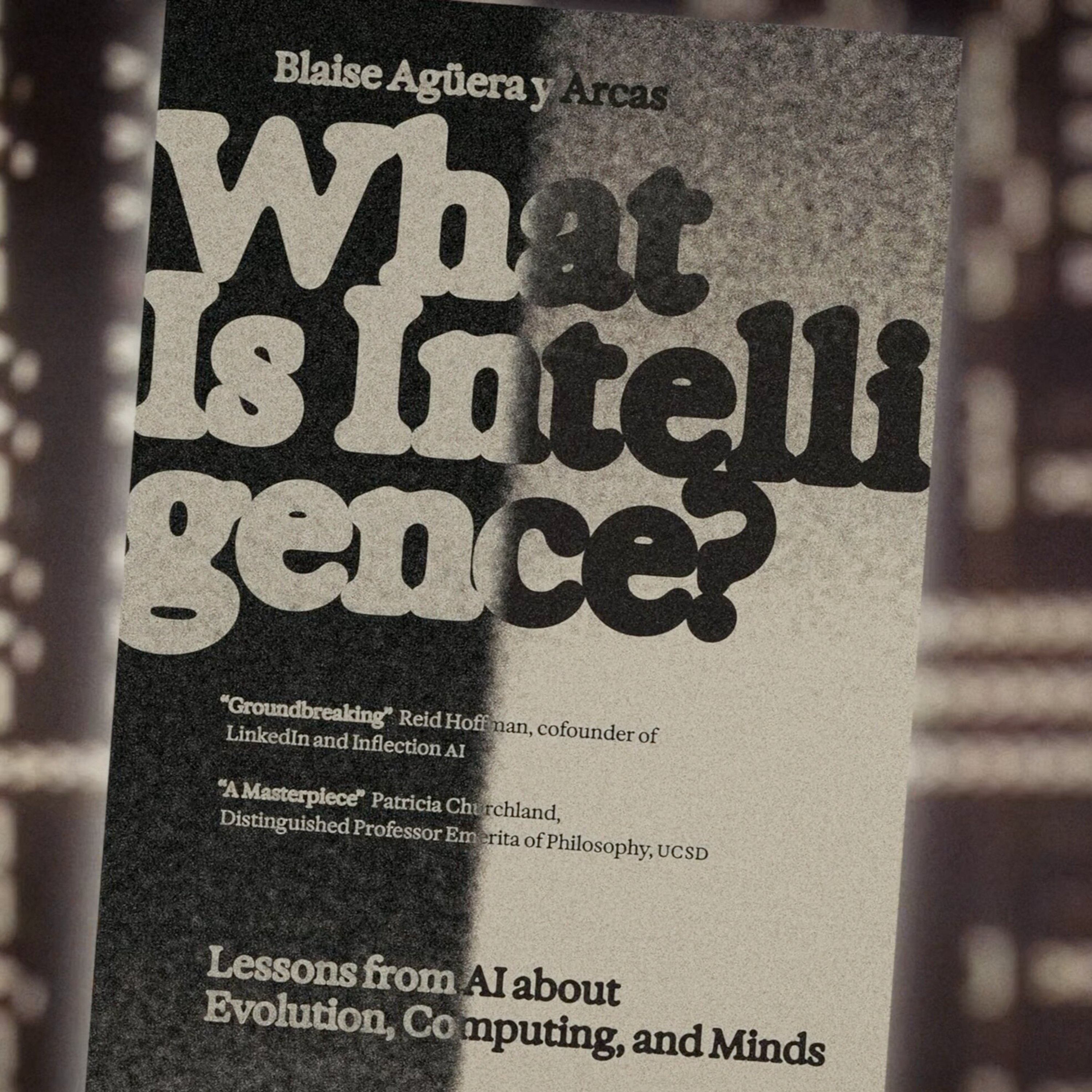
What if life itself is just a really sophisticated computer program that wrote itself into existence? Blaise Agüera y Arcas presenting at ALife 2025 — the most technically detailed public walkthrough of the ideas in his *What is Life?* and *What is Intelligence?* books that we've come across.He covers the BFF experiments (self-replicating programs emerging spontaneously from random noise), the mathematical framework connecting Lotka-Volterra population dynamics with Smoluchowski coagulation, eigenvalue analysis of cooperation matrices, and his central claim that symbiogenesis — not mutation…
What makes something truly *intelligent?* Is a rock an agent? Could a perfect simulation of your brain actually *be* you? In this fascinating conversation, Dr. Jeff Beck takes us on a journey through the philosophical and technical foundations of agency, intelligence, and the future of AI. Jeff doesn't hold back on the big questions. He argues that from a purely mathematical perspective, there's no structural difference between an agent and a rock – both execute policies that map inputs to outputs. The real distinction lies in *sophistication* – how complex are the internal computations?…
Professor Mazviita Chirimuuta joins us for a fascinating deep dive into the philosophy of neuroscience and what it really means to understand the mind.*What can neuroscience actually tell us about how the mind works?* In this thought-provoking conversation, we explore the hidden assumptions behind computational theories of the brain, the limits of scientific abstraction, and why the question of machine consciousness might be more complicated than AI researchers assume.Mazviita, author of *The Brain Abstracted,* brings a unique perspective shaped by her background in both neuroscience…
What if everything we think we know about the brain is just a really good metaphor that we forgot was a metaphor?This episode takes you on a journey through the history of scientific simplification, from a young Karl Friston watching wood lice in his garden to the bold claims that your mind is literally software running on biological hardware.We bring together some of the most brilliant minds we've interviewed — Professor Mazviita Chirimuuta, Francois Chollet, Joscha Bach, Professor Luciano Floridi, Professor Noam Chomsky, Nobel laureate John Jumper, and more — to wrestle with a deceptively…
Dr. Jeff Beck, mathematician turned computational neuroscientist, joins us for a fascinating deep dive into why the future of AI might look less like ChatGPT and more like your own brain. **SPONSOR MESSAGES START** — Prolific - Quality data. From real people. For faster breakthroughs. https://www.prolific.com/?utm_source=mlst — **END** *What if the key to building truly intelligent machines isn't bigger models, but smarter ones?* In this conversation, Jeff makes a compelling case that we've been building AI backwards. While the tech industry races to scale up transformers and language…
Tim sits down with Max Bennett to explore how our brains evolved over 600 million years—and what that means for understanding both human intelligence and AI. Max isn't a neuroscientist by training. He's a tech entrepreneur who got curious, started reading, and ended up weaving together three fields that rarely talk to each other: comparative psychology (what different animals can actually do), evolutionary neuroscience (how brains changed over time), and AI (what actually works in practice). *Your Brain Is a Guessing Machine* You don't actually "see" the world. Your brain builds a simulation…
César Hidalgo has spent years trying to answer a deceptively simple question: What is knowledge, and why is it so hard to move around? We all have this intuition that knowledge is just... information. Write it down in a book, upload it to GitHub, train an AI on it—done. But César argues that's completely wrong. Knowledge isn't a thing you can copy and paste. It's more like a living organism that needs the right environment, the right people, and constant exercise to survive. Guest: César Hidalgo, Director of the Center for Collective Learning 1. Knowledge Follows Laws (Like Physics) 2. You…
About Machine Learning Street Talk (MLST)
Welcome! We engage in fascinating discussions with pre-eminent figures in the AI field. Our flagship show covers current affairs in AI, cognitive science, neuroscience and philosophy of mind with in-depth analysis. Our approach is unrivalled in terms of scope and rigour – we believe in intellectual diversity in AI, and we touch on all of the main ideas in the field with the hype surgically removed. MLST is run by Tim Scarfe, Ph.D (https://www.linkedin.com/in/ecsquizor/) and features regular appearances from MIT Doctor of Philosophy Keith Duggar (https://www.linkedin.com/in/dr-keith-duggar/).
Machine Learning Street Talk (MLST) is a English tech & science podcast from Machine Learning Street Talk (MLST). Melo plays each episode straight from the publisher's own feed — no ads added, no account needed — and remembers where you stopped, in this browser only.
The Melo app keeps playing with the screen off, works in the car and on your watch, wakes you to your station, and browses the whole catalogue offline. Free, no ads, no account.