
Episode · Machine Learning Street Talk (MLST)
Evolution "Doesn't Need" Mutation - Blaise Agüera y Arcas
16 Feb 2026 · 56 min
Episode · Machine Learning Street Talk (MLST)
16 Feb 2026 · 56 min
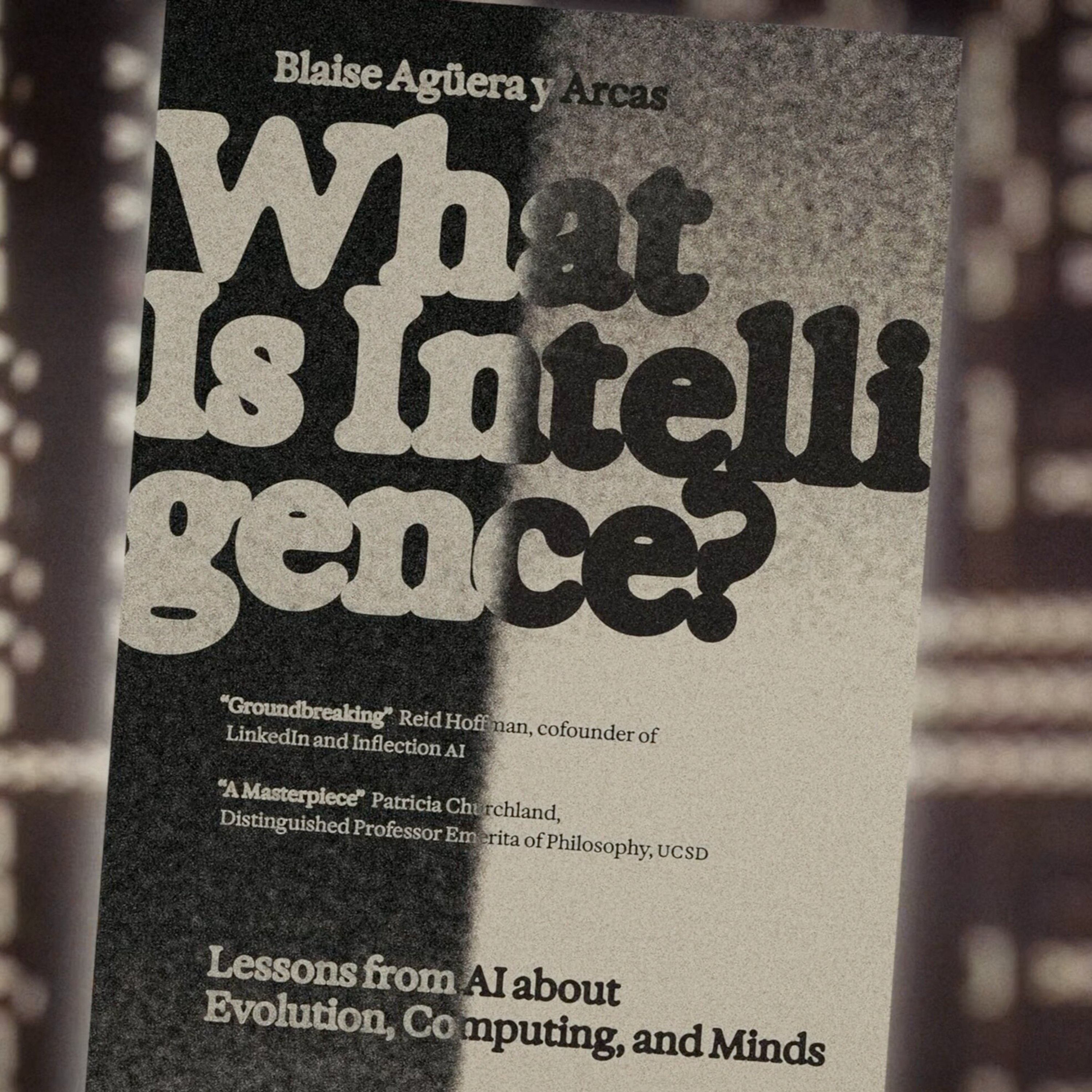
What if life itself is just a really sophisticated computer program that wrote itself into existence? Blaise Agüera y Arcas presenting at ALife 2025 — the most technically detailed public walkthrough of the ideas in his *What is Life?* and *What is Intelligence?* books that we've come across.He covers the BFF experiments (self-replicating programs emerging spontaneously from random noise), the mathematical framework connecting Lotka-Volterra population dynamics with Smoluchowski coagulation, eigenvalue analysis of cooperation matrices, and his central claim that symbiogenesis — not mutation…
by Machine Learning Street Talk (MLST) · English · Tech & Science
Welcome! We engage in fascinating discussions with pre-eminent figures in the AI field. Our flagship show covers current affairs in AI, cognitive science, neuroscience and philosophy of mind with in-depth analysis. Our approach is unrivalled in terms of scope and rigour – we believe in…

4 May 2026 · 1 hr 53 min
Beth Barnes and David Rein on the one graph that ate the AI timelines discourse, and why the two people who built it are the most careful about how you read it.**SPONSOR**Prolific - Quality data. From real people. For faster breakthroughs.https://www.prolific.com/?utm_source=mlstInterview: https://youtu.be/cnxZZTl1tkk---Beth Barnes and David Rein from METR on the one graph that ate the AI timelines discourse, and why the people who built it are the most careful about how it gets read.Beth founded METR after leaving OpenAI alignment. David is first author on GPQA and co-author on HCAST and…

13 Mar 2026 · 1 hr 18 min
Robert Lange, founding researcher at Sakana AI, joins Tim to discuss *Shinka Evolve* — a framework that combines LLMs with evolutionary algorithms to do open-ended program search. The core claim: systems like AlphaEvolve can optimize solutions to fixed problems, but real scientific progress requires co-evolving the problems themselves. GTC is coming, the premier AI conference, great opportunity to learn about AI. NVIDIA and partners will showcase breakthroughs in physical AI, AI factories, agentic AI, and inference, exploring the next wave of AI innovation for developers and researchers.…

3 Mar 2026 · 1 hr 27 min
Dive into the realities of AI-assisted coding, the origins of modern fine-tuning, and the cognitive science behind machine learning with fast.ai founder Jeremy Howard. In this episode, we unpack why AI might be turning software engineering into a slot machine and how to maintain true technical intuition in the age of large language models. GTC is coming, the premier AI conference, great opportunity to learn about AI. NVIDIA and partners will showcase breakthroughs in physical AI, AI factories, agentic AI, and inference, exploring the next wave of AI innovation for developers and researchers.…
25 Jan 2026 · 47 min
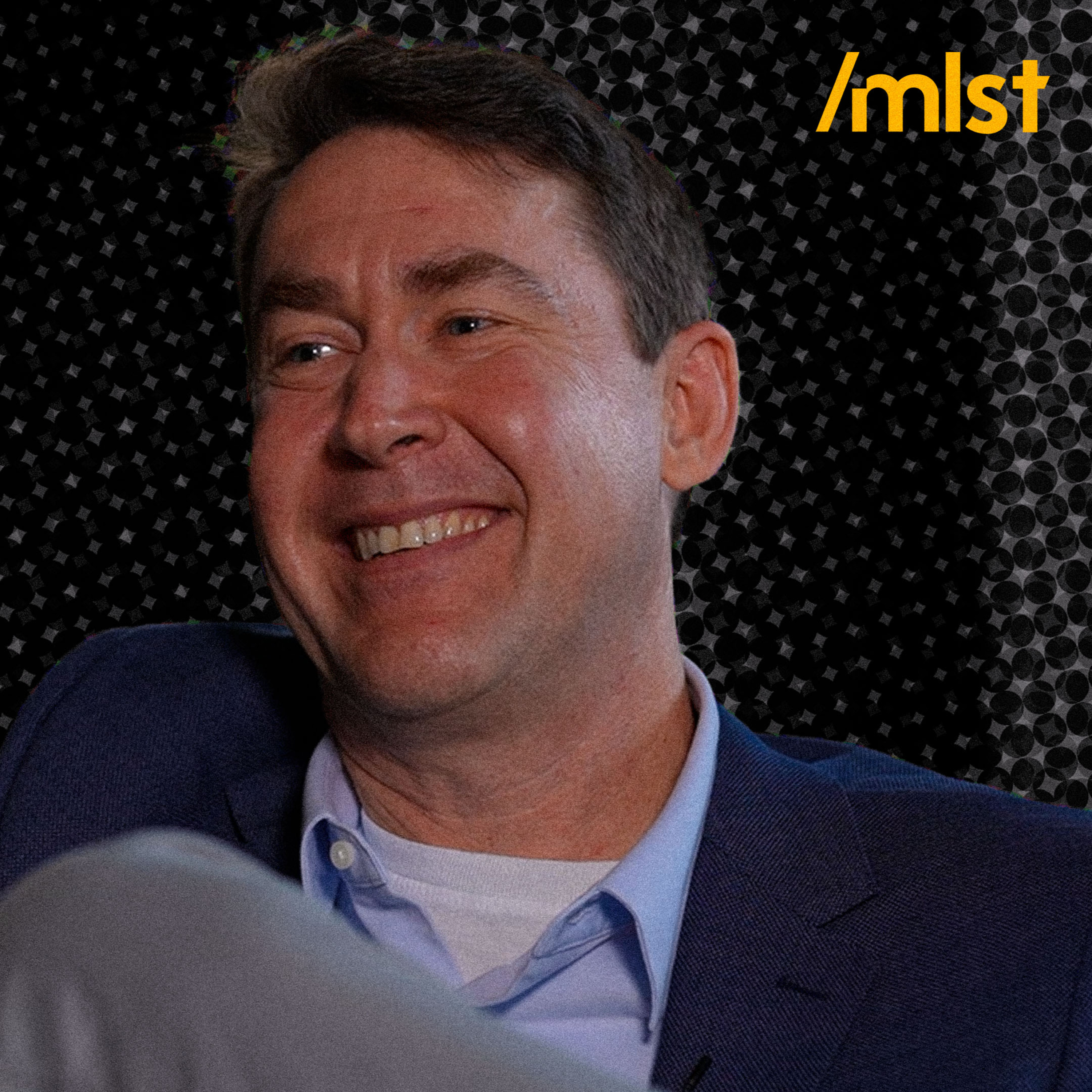
What makes something truly *intelligent?* Is a rock an agent? Could a perfect simulation of your brain actually *be* you? In this fascinating conversation, Dr. Jeff Beck takes us on a journey through the philosophical and technical foundations of agency, intelligence, and the future of AI. Jeff doesn't hold back on the big questions. He argues that from a purely mathematical perspective, there's no structural difference between an agent and a rock – both execute policies that map inputs to outputs. The real distinction lies in *sophistication* – how complex are the internal computations?…

23 Jan 2026 · 54 min
Professor Mazviita Chirimuuta joins us for a fascinating deep dive into the philosophy of neuroscience and what it really means to understand the mind.*What can neuroscience actually tell us about how the mind works?* In this thought-provoking conversation, we explore the hidden assumptions behind computational theories of the brain, the limits of scientific abstraction, and why the question of machine consciousness might be more complicated than AI researchers assume.Mazviita, author of *The Brain Abstracted,* brings a unique perspective shaped by her background in both neuroscience…

23 Jan 2026 · 42 min
What if everything we think we know about the brain is just a really good metaphor that we forgot was a metaphor?This episode takes you on a journey through the history of scientific simplification, from a young Karl Friston watching wood lice in his garden to the bold claims that your mind is literally software running on biological hardware.We bring together some of the most brilliant minds we've interviewed — Professor Mazviita Chirimuuta, Francois Chollet, Joscha Bach, Professor Luciano Floridi, Professor Noam Chomsky, Nobel laureate John Jumper, and more — to wrestle with a deceptively…

10 Oct 2026 · 48 minNew
A lot of people in AI treat evolution as a dumb fallback, basically random search for when you can't take a gradient. Akarsh Kumar thinks that is wrong. Selection hangs on to partial solutions, so mutations only need to be useful about 1% of the time for the search to keep making progress.Akarsh is a PhD student at MIT working with Phillip Isola, works with Sakana AI, and is first author of the Fractured Entangled Representation paper with Kenneth Stanley, Jeff Clune and Joel Lehman. He tells Tim Scarfe why the path a learner takes may shape the structure of what it learns, and why that is a…

1 Oct 2026 · 1 hr 10 min
Tsung-Hsien (Shawn) Wen, CTO of PolyAI, tells Tim Scarfe why voice agents are harder than text agents. Voice adds time, and a good conversation depends on adapting to the person on the line, not just on reasoning to the best answer. Shawn describes an audio-native model (Dialog-RSN-1) that first predicts a turn-taking signal, then replies in text with citations, and writes the transcript last so enterprises can audit it.Along the way: training on real, noisy calls with synthetic noise added, and why over-cleaned audio made the new model worse. Latency, and what a voice agent should do while…

30 Sep 2026 · 1 hr 14 min
Leonardo de Moura created Lean and co-created Z3. ---This episode is sponsored by Parallel.Parallel, where agents find answers: web search, extraction and deep research APIs built for AI agents.Start free with the Parallel MCP server and $5 of credits every month: https://parallel.ai/mlst?utm_source=creator&utm_medium=podcast&utm_content=MLST---Tim Scarfe talks with Leo about how Lean escaped its original audience, why dependent types and Mathlib made it useful to working mathematicians, and what happens when formal verification leaves the lab. De Moura explains the small trusted kernel and…

26 Sep 2026 · 44 min
Weco let an AI coding agent rewrite the harness around another agent for eight days: its code, prompts and tools, while the underlying language model stayed fixed. Tim Scarfe asks Weco co-founder Zhengyao Jiang what the reported gains over two years of human engineering actually demonstrate.The discussion examines AIDE 85's generated code, held-out evaluation and the difficulty of separating useful discoveries from reward hacking. Jiang explains Weco's four levels of recursive self-improvement and compares the experiment with AlphaEvolve and the Darwin Gödel Machine.The limits matter as much…

The Melo app keeps playing with the screen off, works in the car and on your watch, wakes you to your station, and browses the whole catalogue offline. Free, no ads, no account.