
Season 5, Episode 43 · Ruthie's Table 4
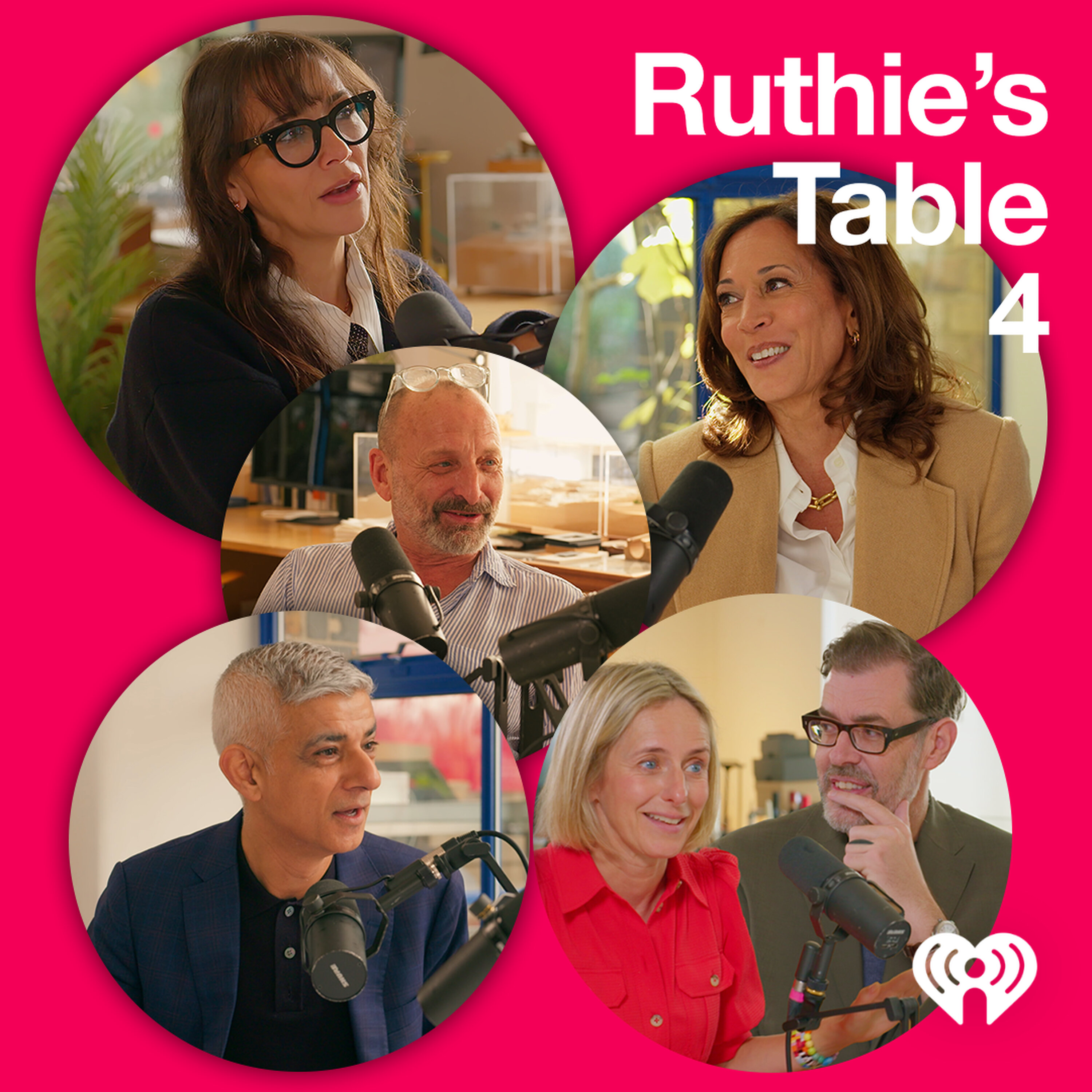
The Food That Shaped Us… Kamala Harris, Sadiq Khan, Ab Rogers, Marina Hyde and Richard Osman, and Rashida Jones.
17 Aug 2026 · 16 min
Episode notes
Childhood kitchens, our parents' cooking—the food we eat when we're young stays with us for life. This special compilation of Ruthie's Table 4 celebrates food and childhood, featuring memories from Kamala Harris, Mayor Sadiq Khan, architect Ab Rogers, Marina Hyde and Richard Osman, and Rashida Jones. Hit FOLLOW to make sure you never miss an episode, and join the Ruthie’s Table 4 community on social. Instagram: instagram.com/ruthiestable4 TikTok: tiktok.com/@ruthiestable4 YouTube: youtube.com/@RuthiesTable4Pod Shop River Café Books and more……
Transcript
Read the transcript · about 3,010 words, follows along as you listen
Speaker 1:Well, would you like to tell everybody what you had for breakfast when you came to the cafe this morning. I have the most exquisite breakfast.
Speaker 2:A beautiful slice of home baked bread that was toasted just to perfection with brada, just a nice slice that was melting and just kind.
Speaker 3:Of just being.
Speaker 2:And then the most exquisite slices of cured anchovy with slices on the side of heirloom tomato.
Speaker 1:I was in heaven. The food we eat when we're young stays with us forever, and this special episode celebrates these memories. Kamala Harris Mayor, City Cohn, A Rogers, Marina Hyde, Richard Osman and she'sah h and tell us their stories.
Speaker 2:My mother said to me when I was young, and you can tell the kids that like to eat good food. And my mother said to me, I'll never forget. She said, you like to eat good food, you better learn how to cook.
Speaker 1:I agree, because people ask me why why do I start cooking?
Speaker 3:There's a point either.
Speaker 1:If you don't have the money to go out to a restaurant every night and you want to eat well, well, then you learned to You know, you learn to cook.
Speaker 2:I have the apron. I got it from a friend and it says I like to cook the food people like to eat.
Speaker 1:So when did you start cooking when I was from the beginning?
Speaker 2:Well, I remember one of the first things that I would make where we would wake up early, mommy's sleeping, and I would make scrambled eggs and I'd make it into a circle on a plate, and then I would cut monterey jack or cheddar cheese to make a smiley face melted on top of this.
Speaker 1:What age are we talking about?
Speaker 2:So sweet?
Speaker 1:Six?
Speaker 2:Yeah, my mother did not like eating breakfast.
Speaker 3:Don't talk about it.
Speaker 2:Of course you had a cup of coffee, right, But tell me.
Speaker 1:About a day in your house would you all have breakfast? How many were you in the house.
Speaker 2:It was the three of us, my mother and my sister and me because my parents divorced when I was five, And it was usually my mother would start cooking like Saturday morning for the week, for the week, and I'd wake up kind of just smelling the food and just kind of just half asleep going into the kitchen. And and you know that's the thing about cooking, right, it really is all the senses it's literally all the senses. It includes the sense of sound, sound, and and of course smell and sight and flavor and taste. It's all of those things.
Speaker 1:Would she repeat, did you know that Monday was lasagna on Tuesday?
Speaker 3:With she would?
Speaker 2:She would sometimes she would because she worked.
Speaker 1:I was going to say, always bake.
Speaker 2:Cookies or cake in the house. She was phenomenal and and she loved she loved to cook. And sometimes she would look at us and she'd say, Okay, girls, tonight we are having smogashboard. We get so damn excited about smogus board. Do you know what Smoga's board was?
Speaker 1:That's a Danish buffet, open sandwiches or something, what it was.
Speaker 3:What it was.
Speaker 2:Is that she would take cookie cutters and cut the bread into heart and flower shapes. She'd get those those toothpicks with the little colors on them, and she'd put little mayonnaise and a thing must a thing and pull out all the leftovers.
Speaker 4:And we were having smallest boy.
Speaker 3:All the leftovers.
Speaker 2:But it was fun.
Speaker 3:My grandparents came at the beginning of this.
Speaker 1:They were part of the Ellis Island, you know, migration from Budapest from Hungary from Kiev, and they again the men came first by boat, you know, if you imagine that journey. My grandmother, one of my grandmothers had they had seven children. She was a seamstress, My other one was stress.
Speaker 3:My other grandmother was a kind of union organizer.
Speaker 1:Apparently she got jobs, you know, making ties and and she was she was very political.
Speaker 3:Politics probably yeah. And she was a great cook.
Speaker 1:She used to apparently used to bring her rolling pin wherever she went. She didn't trust any of her daughter in laws to make a strudle. But I just think what this shows is a parallel of too families. People who leave their families, come to a new country and work and take care of their kids. And how much do we celebrate these people?
Speaker 4:You know, it's from a fun history. Actually, anybody who's taken a consciouscision to leave home travel thousands of miles is not going to go and sit in there bum And they work hard. They've got to work ethic. If you want a job done, ask an immigrants freightline and Hamilton. But that's the story of America and actually of London, I mean London over the last two thousand years. It was originally called Londinium during the Roman times. It's grown and evolved and it's not, in my view, the greatest in the world because of successive generations of migrants. What's fascinating about London. It goes back to your rolling pin story.
Speaker 4:My mum's got a rolling pin. She makes chapati rorty with her. She doesn't trust either her sons or a daughter or to make rowty. She makes it herself, but evokes memory from it, evokes memory from her. Mum have been back home the food because she was incredibly homesick. I mean even now she misses Barkistein. But but food brings it.
Speaker 1:The food brings and she could could here and she could make it and she could Yeah, Richard's mother Toot.
Speaker 4:I've got really fond memories when I was living at home as a child during the month of Robber Dan. You have a meal, a meal just before dawn, and you fast all day, and they have a meal at dusk. And my mum had been fast and all day. She'd get up before dawn to prep you know, half the job in cooking his prep right dawn breakfast was around three o'clock. She must have got up at one thirty, so she's you know, getting the flower ready, making it, getting the rawty's ready, and either wake up with a smell.
Speaker 4:And also when I was growing up, everything was fresh, I mean inside of even you can cheat now if you're making a curry and get plumped tomatoes in a tin, no, no, there fresh tomatoes. You chop them up, you stew them for a while. And so I'd wake up with a smell of what's called parata, a version of chaparties, but with potatoes in the middle of it. She'd make fresh parata. I could smell the omelet being made, and we'd go downstairs and she'd been up an hour and a half before us. We don't have pre dawn breakfast. She would have are on bakfast. We'd go to school or whatever.
Speaker 4:We'd come back up and have a knap because we're starving hungry. My mum would be cooking while she's fast in oh, you know fast breaking mill which were fresh and also fresh barkora, you know silence curries rice. There's two things you learned to do when you're raising the Can family. One is eat fast, yeah if you want seconds, And two is to talk quickly. So if you want to be heard or if you want to eat, you talk fast and eat quickly.
Speaker 3:Do you remember going to restaurants?
Speaker 1:Yeah?
Speaker 5:I remember going to Chinese, going to Mister Chaws. The're going to go into Chinese restaurants, Pizza Express, Yeah, a lot of that. If you and Richard are going to restaurants in Paris.
Speaker 3:Yeah.
Speaker 5:I also remember those Holids days where we would live in a boat house and you would cook you know, sardine.
Speaker 6:I mean it was a very was it was not a.
Speaker 1:Ladd that was full of cootie, wasn't it. We had the keys to the house, we had a map to take us to the house. We had three children, I was pregnant, it was. And we stayed there for three weeks and we never found the house.
Speaker 5:The house found the house.
Speaker 1:So we stayed in this room which we thought we could go to be one night and ended up being sort of three weeks. But I think we did eat, you know, we ate from the sea. We ate, and so I think that probably part of your childhood and growing up.
Speaker 5:I mean, which you couldn't cook, but he would gather. We'd go to the sea urchins, we would get prickly pears, we'd be covered in splinters.
Speaker 1:Yeah, there was a time that I think it was you that was had been going every single day down to the harbor to try and fish and catch a fish, and every day we had this little fishing rod, I think it was maybe it was Rue you, and we'd stand there for hours and one day we just thought we can't go on any longer. So we bought a fish, a little fish in the fishing market, and then jove down underneath the fishing and attached it to the fishing rod, and he.
Speaker 3:Pulled it up, said, what's they doing?
Speaker 1:Then swimming? So they attached it to the to the rod and he pulled it up. Of course, what he did really cunt on to was that it was a dead fish, and so.
Speaker 3:Then he the sardines.
Speaker 1:It was this this big been gutted and we brought it back, the fish back to the house and then by that time was so attached to it he wouldn't let us cook it, and.
Speaker 5:So he slept with it three nights and we were all sleeping in one room. So it started to really really smell and this dried, freckly fish, and we had to persuade him to let the fish go and he's going to get back to his mom. He wasn't well. His mom was going to make him better, maybe to get the hospital we had. We launched it back into the seat and this Viga mortar is completely stiff.
Speaker 3:Did your parents entertain? Did you grow up with dinner parties in your house? Did you have?
Speaker 7:No? They never really did that, And actually we never went out my no. I think it was expensive and we didn't go out, but we my mother sort of hated cooking and sort of still does, but cooked every single meal. But we had about five dishes of rotation, and they were called funny things.
Speaker 3:They were, you know, some of them were like obvious what they were.
Speaker 7:There was like kidneys and rice or spaghetti booonnas. Some of the things were called things like chicken in a mess with rice, okay, and so they were all of these things. But when I was coming here, I was thinking, my god, you know, if I was giving the honest sort of that account of all of those things. There were certain moments and you look back to them. Remember the shot bee Jam.
Speaker 6:Remember I had a Saturday job in Beejam?
Speaker 3:Did you did it?
Speaker 6:It was the precursor to Iceland.
Speaker 3:Yeah, it was that a freezer.
Speaker 7:It's a shot that sold freezers and also things that went in freezers.
Speaker 6:So clever, and I'll take it esthetically.
Speaker 7:It's nothing experience these but for a certain type of woman who did not want to cook, particularly, those chests were treasure chests, and in them were things like I mean, I remember the first time we saw a vernetta. We were like, oh my god, how could such a thing be created and look SuperFect and retain its I mean the answer, of course was a little halter processed or whatever. But at the time we didn't know any of these things, and we lived in blissful ignorant and they had.
Speaker 6:No one's ever no one's ever topped the viennetta.
Speaker 3:Well, Sarah Leise, how did you go?
Speaker 6:I tell you?
Speaker 8:Talking for ultra high processed food. One of the greatest moments of the nineteen seventies was when they brought out ice Magic. Do you remember ice Magic? So ice Magic You'd have some you know, Sainsbury's vanilla ice cream, and you'd get the squeezy bottle that was chocolate flavored, and you would pour this, you know, squeeze out this chocolate sauce and it would instantly form like a hard crust against sorcery, like a chocolate bomb.
Speaker 6:Yeah.
Speaker 8:Yeah, there are some things even now that I think if they hadn't existed in the seventies and some white if you went to a restaurant and someone showed that to you, you go, this is the greatest act of gastronomy in the history of restaurants. But they were so far ahead of the curve. I think the best ice cream flat, But I don't know if you agree with me with the and I I don't think there's any argument with this. I think the best ice cream flavor is mint chock chip.
Speaker 3:Oh my god, I'm so embarrassing. Oh okay, are.
Speaker 6:You gonna say scratch your tailor or something.
Speaker 3:No, you'd be really surprised to I'm amazing. I really love vanilla ice cream. Wow you Yeah, it's kind of for She gets some. Do you want some ice crea?
Speaker 6:This is this is the best podcast.
Speaker 1:Tell me about your family, Tell me about the kitchen, Tell me about the house.
Speaker 9:My parents loved food. My dad especially loved and he loved food from kind of every culture. Anytime I travel with my dad, it was like a sojourn to get something amazing, like you know he loves like shay.
Speaker 3:Lami Louis Louis, Yeah, does it?
Speaker 9:Loved love, love love. He's the first person who exposed me to sol Monier or you know he love He just loved food.
Speaker 3:Because that probably that again, was it not out of his background?
Speaker 9:No, you know, No, it was something he did and he traveled a lot in his twenties to Europe and to the Middle East. He worked for the State Department. He was in the State Department band was Dizzy Gillespie and so he what years was it in the nineteen fifties, early nineteen fifties.
Speaker 1:Isn't it great there was a State Department band.
Speaker 3:Wonder if that exists anymore. I doubt it. I doubt it.
Speaker 9:I don't know for sure, but I doubt it. But he traveled everywhere and he for him it was language food and it's kind of beauty of being out of the United States.
Speaker 1:So I think your grandparents fed him, were they interested? Do you remember your grandparents?
Speaker 9:I do, And I didn't know my grandfather. I knew my grandmother, And no, it wasn't like I think his relationship with food was probably came from an absence of food in his own childhood.
Speaker 7:He was.
Speaker 9:My dad was such a lover of life and culture and food and you know, he just loved beautiful, delicious things. So I think that came from not having.
Speaker 1:That your mother was Jewish and my mom was Jewish, and.
Speaker 9:My dad loved soul food. He also loved his favorite dish, which is so weird because it's like German, I think, was chicken potatoes and sour krap. So we had that at least once a week.
Speaker 3:It's always your house full of people.
Speaker 9:Filled with musicians. Yeah, filled with musicians, really, and what was that like for you?
Speaker 3:So great?
Speaker 9:I feel like my sister and I talk about this all the time.
Speaker 3:We feel so.
Speaker 9:Lucky that we our house was filled with music and artists and people who value that obviously, but also like for you know, for our assessment. And I think, like empirically like the best music. I feel like, you know, my dad, my dad's taste, my dad's fact sophistication. You know, even though he made Thriller, which is the biggest album that ever sold ever in the world when he was fift and so he didn't like he was he was, you know, successful, but he wasn't famous. He wasn't world renowned in the same way that he was by the time I was eight, So that kind of happened when I was a kid that that was like happening, which is, you know, changes things. But but the point is that he brought all of the richness and sophistication of his early jazz days into his like pop world or into our our pop world, which is like a real gift for the world.
Speaker 3:The gift a huge gift.
Speaker 1:And with with being a child in that atmosphere, were you so you weren't shy, You weren't waiting on the stairs, you know for them to go home.
Speaker 3:You were Would you be involved? I was there, Everybody was engaged, were totally social and relaxed.
Speaker 9:Because my parents were very relaxed, everybody felt invited and warm. I was actually talking to a family friend the other day who was like a little younger than my parents, and he was just saying how much he loved coming to their house because it was like, Oh, this is what you can have as a family. You can invite all your friends and it's not stiff, it's not formal. You just come, you relax and you laugh a lot, and the kids are welcome, and all the different generations are welcome. And you have always loved that, which is, by the way, why I love what you do, because that is the kind of that's the mandate is everybody come and feel relaxed and at home and welcome.
Speaker 3:Ruthy's Table for is now a book.
Speaker 1:Paul McCartney, Michael ka Kamala Harris, David Beckham, Tina fey Elton John and many more. It's full of stories, beautifully designed, and a celebration of the way food connects us ale.
Speaker 3:It's available now wherever you buy your books.
Transcript supplied by the publisher with the episode.
Podcast
Ruthie's Table 4
iHeartPodcasts · Arts & Books · English
For nearly forty years, The River Cafe in London has been a home-from-home for artists, architects, designers, actors, collectors, writers, activists and politicians. It is also the home of its co-founder, Ruthie Rogers — restaurateur, cookbook author, podcast host and one of the most influential fi
More from Ruthie's Table 4 All episodes →
-

21 Sep 2026 · 35 min
From the Archive: Benedict Cumberbatch on Living with Wes Anderson, Imitating Ruthie & ‘Daddy Pancakes’
During our between-season break, we’re revisiting some of our favourite conversations from the Ruthie’s Table 4 archive. This week, we're looking back to when Benedict Cumberbatch joined me at The River Cafe to talk about Negronis with Wes Anderson, growing up in a theatrical family, body transformations, and cooking for his children. Hit FOLLOW to make sure you never miss an episode, and join the Ruthie’s Table 4 community on social. Instagram: instagram.com/ruthiestable4 TikTok: tiktok.com/@ruthiestable4 YouTube: youtube.com/@RuthiesTable4Pod Shop River Café Books…
-
15 Sep 2026 · 49 min
From the Archive: Zoe Saldaña on Growing Up in Queens, Family Recipes & Why NYC Has the Best Pizza
As we look forward to Series 6 in October, we’re revisiting some of our favourite episodes of Ruthie’s Table 4 . Zoe Saldaña was a force from the moment she entered the restaurant back in 2025. She told us stories about her grandmother’s coconut desserts, how her family dances through life, and what it was like growing up in Queens. We talked about Caribbean soups, Dominican cooking and New York pizza — and by the end of the episode, we were all ready to eat. Hit FOLLOW to make sure you never miss an episode, and join the Ruthie’s Table 4 community on…
-

S5 · E46 · 7 Sep 2026 · 21 min
How Food Shapes Our Work… Gayle King, Mark Ronson, Graham Norton, Emerald Fennell, and Patrick Radden Keefe.
Whether in film, music, books or television, food can be a source of inspiration or integral to the way we work. In this special compilation episode of Ruthie's Table 4, we're talking about the shared ingredients of what we do, with Gayle King, Mark Ronson, Graham Norton, Emerald Fennell – the director of Wuthering Heights, and Patrick Radden Keefe – the author of London Falling. Hit FOLLOW to make sure you never miss an episode, and join the Ruthie’s Table 4 community on social. Instagram: instagram.com/ruthiestable4 TikTok: tiktok.com/@ruthiestable4 YouTube:…
-

S5 · E45 · 31 Aug 2026 · 28 min
Where Food Meets Politics… Jacinda Ardern, Andrew Jarecki, Erin Lyall, Hilton Als, Annie Leibovitz, Kamala Harris
I've always thought we judge a culture by the way we feed our poor, our sick and our prisoners. In this special compilation episode of Ruthie's Table 4, we're talking about food and politics, in conversation with Jacinda Ardern, documentary filmmaker Andrew Jarecki, CBS conflict producer Erin Lyall, writer and critic Hilton Als, Annie Leibovitz, and Kamala Harris. Hit FOLLOW to make sure you never miss an episode, and join the Ruthie’s Table 4 community on social. Instagram: instagram.com/ruthiestable4 TikTok: tiktok.com/@ruthiestable4 YouTube: youtube.com/@RuthiesTable4Pod Shop River…
-

S5 · E44 · 24 Aug 2026 · 24 min
Why Restaurants Matter… Jamie Oliver, Piers Morgan, Marina Hyde & Richard Osman, Tracey Emin & Dara Khosrowshahi
It may come as no surprise that I have a special interest in restaurants. The River Café is where I work, where I record this podcast, and where I spend so much of my life. In this special compilation episode of Ruthie’s Table 4 , we’re talking about restaurants—how to run them and why they matter—with stories and memories from Piers Morgan, Jamie Oliver, Marina Hyde and Richard Osman, Tracey Emin, and Dara Khosrowshahi, CEO of Uber. Hit FOLLOW to make sure you never miss an episode, and join the Ruthie’s Table 4 community on social. Instagram:…
-

S5 · E42 · 10 Aug 2026 · 41 min
If You Can't Take the Heat… How Does a Restaurant Handle a Roasting Summer?
As a farewell to series 5, I'm joined by Sian Wyn Owen to take you behind the scenes at The River Café during the recent heatwaves this summer—what we cooked and how we served. And Season 6 is on the way, starting off with the stars of Only Murders in the Building , Steve Martin and Martin Short, in an episode full of laughter, food memories, and banjo playing. See you in October! Order Table 4 at The River Cafe —the star-studded, food-filled book inspired by the beloved podcast: https://bit.ly/Table4AtRiverCafeBook See omnystudio.com/listener for privacy information.
-

S5 · E41 · 3 Aug 2026 · 21 min
Dorothée Boissier on Designing Restaurants, Paris, and Creative Partnership
Dorothée Boissier is an interior designer and co-founder of the Gilles & Boissier studio. Together with her husband, Patrick Gilles, she creates exquisite architecture and interiors around the world. Today, we're at Moncler's beautiful flagship store on the Champs-Élysées, designed by Dorothée and Patrick. We'll talk about Paris, food, their creative partnership, and the art of designing restaurants. Order Table 4 at The River Cafe —the star-studded, food-filled book inspired by the beloved podcast: https://bit.ly/Table4AtRiverCafeBook See…
-

S5 · E40 · 27 Jul 2026 · 34 min
Clare Hornby, Founder and CEO of ME+EM
Good food and good clothes should do the same thing: make you feel instantly comfortable, confident, and completely at home. In this episode Ruthie sits down with Clare Hornby, the visionary entrepreneur founder and CEO of ME+EM. Clare has built the UK's fastest-growing luxury label by mastering "intelligent style" -creating crafted, functional wardrobes for women. Bound by a shared love for exceptional ingredients in food and fashion, Ruthie and Clare talk about friendship, building a business from scratch, the food memories that shape them, and much much more. See omnystudio.com/listener…
-

S5 · 23 Jul 2026 · 20 min
Bonus: Michael Elias on his new book, Bender's LA
Ruthie speaks to her brother, screenwriter and author Michael Elias, about his latest novel, Bender's LA. In the coke-dusted canyons and deal-making rooms of 1970s Los Angeles, writer David Bender sets out to remake his life - romantically, professionally, and spiritually - after his wife walks out in Puerto Vallarta with a single sentence and a suitcase. Order a copy now: https://www.amazon.co.uk/Benders-L-Michael-Elias/dp/B0GWC41TVM See omnystudio.com/listener for privacy information.
-
S5 · E39 · 20 Jul 2026 · 22 min
In Conversation With Zanny Minton Beddoes, Editor-in-Chief of The Economist
Zanny Minton Beddoes and I have different professions, and different workplaces. As editor-in-chief of The Economist, hers is in the newsroom mine is the kitchen. But we have much in common, sharing a message of honesty - me with ingredients, Zanny with words. And we both have time limits - in the case of this conversation, just 20 minutes which we recorded live onstage at the Google Zeitgeist conference. In this brief time, we explored her work and life through the lens of food. And what a life it is. Order Table 4 at The River Cafe —the star-studded, food-filled book inspired by the…

Take it with you
The Melo app keeps playing with the screen off, works in the car and on your watch, wakes you to your station, and browses the whole catalogue offline. Free, no ads, no account.


