Season 1, Episode 260 · The MongoDB Podcast
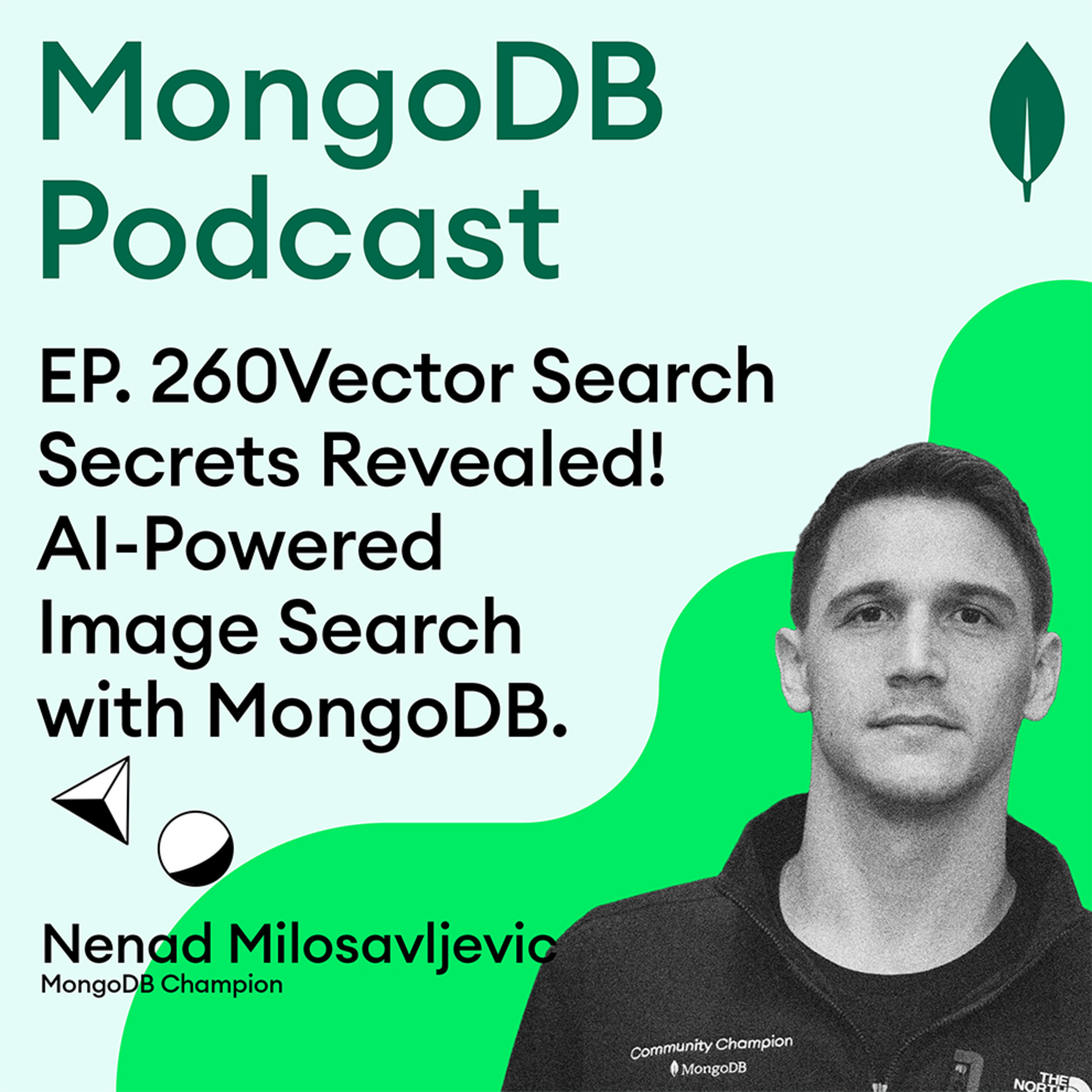
EP.260 Vector Search Secrets Revealed! - AI-Powered Image Search with MongoDB - Live Demo
26 Mar 2025 · 58 min
Season 1, Episode 260 · The MongoDB Podcast
26 Mar 2025 · 58 min
Ever wondered how companies like Amazon or Pinterest deliver lightning-fast image search? Dive into this episode of MongoDB Podcast Live with Shane McAllister and Nenad , a MongoDB Champion, as they unravel the magic of semantic image search powered by MongoDB Atlas Vector Search ! 🔍 What You’ll Learn : Why semantic search is a game-changer for AI-driven applications (spoiler: it’s all about meaning , not just keywords!). How to transform images into vectors (embeddings) and store them alongside your data —no clunky ETL pipelines required! A live demo showcasing real-time image search on a…
Welcome everybody to MongoDB Podcast Live. I'm Shane McAllister, I'm one of the leads here on the developer relations team at MongoDB. Today I'm joined by Ninad who wears many hats and we're going to dive into that during the introductions and I'll let him explain that himself. So without further ado for me, let's get started. Ninad, you're very welcome to the show. How are you? I'm good. Thank you for calling you. Very good, very good. I'm certainly looking forward to this.
Neena. As I said in the intro, you wear many hats. I've met you in person before. I was delighted to have done that at our Mongo DB dot local session in London last year, where you interviewed live on our Mongo DB TV channel with Harshit, one of the community managers here at Mongo DB. But tell us a little bit about how you came into the foray to be what you are today now, which is a Mongo DB champion for us. Yeah, so I'm not. I work in flat field as a senior engineer and also I'm a Mongo DB champion and Mongo DB MAG leader for Serbia.
I basically started as a, you know, freelance world where I kept to learn everything myself, you know, in order to be competitive on the market. And as probably everyone, I also started with the relational databases in the beginning because that is what they are teaching us in in college. But when I was learning things on my own in a freelance world, I discovered Mongo DB. And since I'm coming from the JavaScript ecosystem, I found Mongo DB to be the perfect fit for me. Because the Mongo DB model would directly map to my JavaScript objects.
The schema was completely flexible if I would. Because when you are developing applications, especially in a few ends, it's probably mostly start-ups. So application is usually involving as the things are getting discovered. So you don't always know everything that has to be done in the beginning. So there are a lot of changes to be done and that is where you always have to remodel something in your code, redesign the schema or like refactor the code base.
But Mongo made it that perfectly simple where you can just like add a field, remove a field or change the type and mongo DB schema like was a perfect fit for me and since then I was using Mongo DB exclusively always. Excellent. That's a, that's a perfect pitch that you did my job for me there. Nina, thank you so much. So you started to use Mongo DB and you started to, you know, contribute on our forums as well and get involved in our wider community there.
And and then you, I've seen your name a few times on our Mongo DB Developer Center as the author of some of the articles. Tell us a little bit about that. Yeah, So since I'm a practically a developer, I was visiting Stack Overflow every day multiple times. And after I gained enough knowledge that I was pretty comfortable with, I was starting answering questions on the Stack Overflow mostly about Mongo DB and JavaScript, especially Angular and Node JS, which is my stack. And eventually like people saw my my answers there and I was one of the main contributors.
I started also contributing on the Mongo DB forums, which is practically a tech overflow only for Mongo DB. And that is when Veronica invited me to join the Mongo DB community officially. I was not the champion back then. I was only the creator. But as creator I was able to write blog posts on Nogodb official blog. And that was like a big exposure for me. I also I was also writing on my own. I started my own personal blog and like I was writing about also about Nogodb there.
After that I was invited to join Mongo DB to help Mongo DB certification team by helping them create and review questions for Mongo DB official certification and things to Jordin, the lead for the certification team. She nominated me for Mongo DB Champion title and I got it last year. Excellent. Well, listen, we're very lucky to have you. I see you're wearing the some of the swag that the Champions have as well too. So it's brilliant and champions job. What do you do?
I know you mentioned the meet up groups of Mongo DB mugs. Tell us a little bit about that and particular to what you do in Serbia, please, Nina. Yeah, so in Serbia I'm reading the the Serbian Mug with my friend Alexa. So we are organizing the meet ups about Mongo DB topics and we have we have 3 meet ups so far like with interesting topics about like crack systems and in general vector searches. And we are scheduled to organize the Fort meet up in February.
So everyone that are from Serbia are listening to this live stream, like I would invite all of you to join us there. Other than that, like on Champions, we are basically like trying to contribute as much as possible with the certification team with writing blogs, helping, helping community by answering their questions on various community platforms like the core flow that we mentioned in Mongo DB community forums. So basically we do everything we can to help the to help the community. Excellent.
But listen, as I, I couldn't have said it better and I don't think Veronica or Harshit on our team could have done it better either. Nina, that's brilliant. And as you mentioned, it's Serbia where you're running the mug. And if you go to and I had the banner up a little bit earlier, if you go to community.mongodb.com, you can go and see where we have the MongoDB meet up groups. And hopefully there's one near you and you turn up. It's a very kind of easygoing community. You're going to learn something.
You're going to maybe get some beers, get some pizzas, meet like minded developers as well too. Exactly. But if there isn't a meet up in your area, we're always looking for meet up leaders and we're looking for people who are quite happy to do exactly as you've done. Nina is is kind of say, put their hand up and say, look, I've used MongoDB, I want to meet other like minded people and, and you can create your own mug and we've got resources and facilitators to help you build that and send you out some swag and T-shirts and, and everything that you might need as well too. And indeed, in kind of in conjunction with that, I mentioned it in the introduction that you had joined us on the live stream at MongoDB dot local dot local are Mongodb's events that we tour around the world.
We used to just do marquee events in London and New York, but last year we took them to over 20 cities around the world. So if you go to mongodb.com/events probably not populated for 2025 just yet, but if you go there in a while, you're going to see our full calendar for MongoDB dot locals, which is another way to meet like minded individuals and kind of get involved in the wider MongoDB community as well too. That's a huge introduction. You've got so many hats.
As I said in the in the beginning, what we're here today to talk is about semantic image search with MongoDB. And Nina, we've got a wide audience and I'm looking here in the in the comments and the people joining from Portugal, Atlanta and Israel and India and Afghanistan, et cetera, too. And it's great. Please drop into the comments and say hello. And we've got a wide audience. So talk to us a little bit. You might have heard about semantic search. We might have heard about generative AI, we might have heard about vector search.
Tell us a little bit of the background before we dive in because I, as I said, you've an exciting demo to show us and I'm thrilled to see that. But why is semantic search important and how does vectors help us do that? So guys you are about to cover the semantic in general semantic search especially with Mongo DB but also like in a general way. So as a like a high level agenda, we are going to introduce the appending model and what are the vector embeddings, how we can do vector search in Mongo DB Atlas.
And in the end, we will go through the code walkthrough and we will showcase the application demo as an outcome. I, I called it in the end, you would be familiar with both theoretical and practical concepts of how to implement semantic, semantic searching any application. This on the right side is actual with the application that we are about to, to build. But you will cover that more in the end. So introduction to embedding models. So what are the embedding models? Embedding models are the models that has a purpose of embedding the unstructured data in a way that would capture the semantic move and in the as the output it would produce the array of numbers.
So basically all the semantic move would be captured in that the output vector which is practically an array of numbers. The inputs can be any unstructured data like images, documents, audio, videos, PDF files or whatever. So the input unstructured data once going through the embedding model will produce the vector embedding vector, which would capture the semantic meaning of that unstructured input data and. That's I think a really key point. So we all know about searching and we all understand, you know, that we can search and we've been searching for years, as long as the the Internet has been around as well too. But only recently have you know, and when we search, we're searching for a match or fuzzy search perhaps as well too, which is kind of like or similar to etcetera, semantic searching. That is we're, we're we're able to derive meaning from the data. So as you said there, we can put an image, we can put in audio or we can put in larger documents and the vectorization, the embeddings that happen allow us to categorize the meaning of that essentially, isn't that true? Yes, exactly.
So both the meanings and also the relationship. So the the main purpose of embedding model is to capture that that semantic meaning in relationships and produce the output in a way that can be understand and process processed by machines which is the appending vector. OK. And when you say relationships, you're considering there that similar items or similar content is stored in a in a an adjacent area in the vector database so that they can easily be paired or matched together.
Right that now. Excellent. I got ahead of myself. You got it? Yeah. Yeah. So what are the vector embeddings? So as we said, vector and impending vectors are the output out of the embedding model which captures both semantic meaning but also understanding the relationships. That is the most powerful point. So in this example here on the right side this is of course a simplified example. We have like words like cat, kitten, dog or houses which is practically here vector with 7 dimensions is created for each of them for like demo purposes. So each item in the embedding vector represents one feature of the vector and the number here represents how that feature contributes for that for that whole for whole context. So when we would like to then plot that and for plotting it's also used like reduction in dimension in order for us to see.
We can see that cat and kitten would be really close to each other because they are semantic. Semantically really similar. Dog would be close to cat and kitten, but it would be much much further than a kitten from cat, but again it is closer than houses. So we can see that this would kind of be animals and this would be something else. The next step it would capture the relationships. That is the below example is a good representation of that where we can see that for example, men and women are close to each other. It is the king and queen are far away from men and women, but the distance between king and queen is kind of the same as the distance between men and women.
So the relationship part is maintained. So a bending, a bending model would capture both semantic and the relationships. So where this all began? So in the 1990s we had something called MMS and LSTMS. That is Recurrent Neural Networks and Long Short Term Memory, which is a subset of the first one. They were basically used to process sequences, but they didn't work that well until 2017. Their Transformers were introduced in a paper called On Tension is All You need. And that Transformers model that is actually this image on the right side, which represents the core architectures of the Transformers models.
That is where that open the door for future improvements. And that is the base of our today's elements that we can see like GPT, Gemini Code, Llama from Meta and and others. So the embedding model is actually based on the architecture of the Transformers because transformer scales two parts, left part is encoder of the transformer and the whole embedding model is actually based on this encoder part on the actual transformer. So that is basically where where we got to the to the embedding vectors and the pending models.
Perfect, Yeah. So what are the applications of the bending models where there is a lot of use cases? First is natural language processing where we can have the sentiment analysis, for example on social media where you would like to see about some comment is it like a positive or negative. Then you have like a test text classification that is on the right side where we have like text visualization of book embeddings where we can see that even in two-dimensional space as in this image you can see that the ones are non fiction and this on the most right side is the science fiction ones. So even there is there is a separability between the classes even in two-dimensional space.
So it is really good for search, also information retrieval. It is a semantic search that we are going to cover today with our demo application. And also it can be used for, for example, recommendation systems where maybe networks would like to suggest you some good movie based on what other people similar to you like. So that is how the recommendation systems would be built. And also we can use it for clustering and similarity analysis. Excellent, excellent.
Great to see. So let us start with the introduction. What are the vector databases? So vector databases are the databases that can efficiently store high dimensional vectors and search through these vector as a whole. So we have two types of databases like I called it here, traditional databases and dedicated databases. Dedicated databases would be the ones that are covering only the vector that are storing only and the vectors and they are specialized only for vector search. On the other side, we have traditional databases that also has the vector search capabilities, among which is of course Mango.
That allows us to both store our general data that we would store in our application together with impending vectors and the ability to search to execute the vector search, which in my opinion is much more intuitive and useful because you don't need to maintain two different data sources. You would do everything in one data source. For example Mongo DB you would execute vector search but all the metadata about the things that you are searching for is already there. So easy.
Easy for you to fetch and process in your application. Yeah, and that's a really good point. And I suppose if people want to learn a little bit more, they can just go to the Mongo DB site products, you just do the drop down there and you search for Atlas vector search there as well too. But we launched it in June of 2023 at our dot local in New York. And for us it's been a game changer. It's really allows Mongo DB to leverage, you know, the data that's already in Atlas or the data that's not yet in Atlas, but you're going to bring it there and to use in your generative AI applications. Because as you say, Nina didn't quite eloquently. Your data's there, but your vectors are stored alongside the data in the same document.
Whereas before with traditional vector only databases such as Pine Cone for example, you were doing a big round trip, you were managing two data sources, you were essentially a lot more extract, transform and load of your of your data, a lot more ETL pipelines, right? Exactly exactly. So now how to measure the vector similarity between the two vectors? There are basically 4 main functions. One would be squared euclidean which is basically the the closest path for cost of distance between two vectors. We have a machete which is the same but that allows us only to go on the coordinate axises and we have cosine and dot product. Cosine is using the angle between the two vectors and dot product is using both the angle and magnitude. It turns out that using angle is much better for high dimensional vectors than using the aquidian and Manhattan. So that is why in most applications you would see that the either cosine or dot product are being used. So now this is a little more complex, but I wanted to quickly cover like how the vector, how the vectors are stored for fast retrieval.
Basically when we want to execute the vector search, we can have really a lot of vectors in our vector database, really a lot of impending inside it can be millions and millions or even billions. So we cannot always. If we're one input impending vector, we cannot go and try to compare it with all other vectors within our database because it would take so much time and it is also computationally expensive. So what we want to do is we want to only search in approximate nearest neighbors.
So that's that is on the left. On the left side is a technique developed by Spotify and it's actually its name is Approximate Nearest Neighbors. Oh yeah, that is how they named it. So. I didn't know about the Oh yeah piece. I knew Ann Brilliant. And practically how how that cracks is you would divide first the vector space into two into two subspaces. We can see this this line here. And that would reproduce like for us in a tree structure like 2 paths. Then each of the sub subsets you would you would then divide another again by half and then again by half until you have meaningful small data set.
And then when you have an input vector you would search, you would see where he would fit in which or less subspace and then you would search nearest neighbors there. So that turns out to be the much faster and computationally much less expensive. So on the other side we have HNSW which kind of does the similar thing, but on a layer like structure, where for example, this is our starting point, our input. So on the first layer we will try to see what are the closest, the closest matches for us closest vectors, we figure out that is these three.
So once we project these three in the second layer, we will try to find their closest matches and then we will project it is kind of similar as on the right side with tree, but instead of trees we have layers and these two approaches are the most used ones under the hood when we were executing the vector search. Perfect, perfect. So. What is now the semantic search and how does that whole process works? As we said, we have unstructured data initially as a starting point.
It can be any kind of unstructured data, images, PDFs, audio, video, whatever. We put that through the embending model and we get embending vectors as an output. Then we would store these embending vectors in our database and then after that for each user query input, we would create an embedding vectors from that input and try to find the most similar vector in our database from the unstructured data that we created before. And that will basically results in us having the whole semantic search implemented.
And it's key to point out, because I know we've missed this or we got questions on this and in previous kind of similar talks around vector searches, that your query needs to be vectorized using the same embeddings as your data did as well originally. Yeah, the same embedding model, Yeah, OK, I didn't throw that here. It is really important. So for practical example, this is the application that we are going to build. I found like a good data set of the e-commerce products, a website called Kego. For ones that doesn't know, Kego is a really good website to find any kind of data sets that you would like to play with. And they also are are organising all the competition about like finding the best machine learning model for classification, classification or for a given data set. So I took the data set from Kegel and then we will use the impending model from Google Vertex AI. And this is interesting because I I will going to use the multi model model which will practically allows us to both search by either text or by either input images. Because this model it's a multi model model, it is saving the appendix both from images and
for text are in the same semantic space and in the same dimensions. So that is really important because whatever the input is our query, either text or image, it will be able to search in the same semantic space. Which is ideal. And that's why, yeah, you see the multimodal stuff coming to the fore now. And you know, wasn't always the case, but it's great to see. So many things. Yes. Yes. Before we get into your demo, this has been a superb overview of everything.
Actually, I'm interrupting your tech stack there. Talk through that Nina, before we get into the. Yeah, I think this is the last slide for probably. So the demo is created via the Nordest on the back end and Angular that is a software being used. Mongo DB is a vector database, vertex AI multimodal is used as as a appendix vector. And as I said, the data source is fetched from downloaded from Cagle and that's it. I love that quote. Perfect. Just before we get into the the demo, which I'm really excited to see, two questions really from our comments and please throw any other questions you might have in there and we'll take them on board if we can. So from Michael, he when we had up the nearest neighbor diagram there he asks what if the nearest neighbor is in an adjacent part of the index, So in one of the different colours perhaps?
So that that is the thing with nearest neighbors approach, we are not guaranteed to always get the the perfect, the perfect results. So that is kind of like a trade off with the speed and cost with the trade off is accuracy. These models are actually really, really good. But sometimes maybe if you want to fetch like the 1st 10 results, maybe it can happen that the 10th result is not the one that you would have if you actually executed the full scan throughout the whole data set. Yeah, and I think if anybody's played with LLMS and tried to build, you know, search apps, semantic search apps, even even kind of chat apps etcetera as well too, they're they're familiar with that.
It's not always, always perfect, but as you say, it's it's a compromise perhaps as well too. But Michael, thank you for that question. One for me really, but a compliment for you, Nina. First of all, Yusuf was inspired by a career journey. He's in background is JS and he wants to add more skills and he's looking to help sustain and boost the career. Yusuf, we have the Mongo DB University if you want to learn more about Mongo DB, it's a super resource. It's entirely free and you can go in there and take all the courses at your leisure.
Create, you know, you can go in there and not even register and start courses, but if you register, it'll store your learning plan for you. And the only thing that if you want at the end is to get Mongo DB certified. There is a fee for that certification course. But if you're a student or startups, et cetera as well too, we do various packages and reduced fees. So from a Mongo DB perspective, certainly go to our university. Nina, where do you go to learn generally?
So I, Yousaf, you said like you would add more on skills. And so in my, in my opinion, like I choose my stack about six or seven years ago and they didn't want to learn anything. In addition, I wanted to be expert in one thing and not to know many things, many things a little bit. So I choose Node JS, Angular and MongoDB as my stack and they stick with it until today. So I would say just get, choose whatever you are most comfortable with and then try to become an expert in that field just to learn as much as possible from various blogs, YouTube tutorials, conferences, webinars, specifications, documentations, whatever you can find, just read it and and then you will be really competitive on the market in these fields. Accent, that's a that's a superb answer. Stick tightly.
We got a third one in while you were talking with Bet Simon asking about the slide deck. I don't know, Nina, do you put that anywhere? But obviously, as I mentioned at the beginning, the recording is available afterwards up on up on YouTube and LinkedIn. As well in the description of the YouTube after afterwards. Perfect. Excellent. We'll certainly take care of that. Simon for you as well too. So look, sorry for the interruptions. As Linus says, talk is cheap. Show me the code.
Let's get on and see this in action. Thanks, Nina. Sounds good Zack. So I will just go through the server code. I also prepared the fronted code and I will publish both in the in the GitHub repo together so you can all con it and play with it if you would like. Perfect. And you gave me that link, neenad. So whilst you're showing this, I'm going to grab that link and I'll drop it back in the comments on YouTube and LinkedIn. I want to mention that I still didn't push the code but I will push it later so.
OK link. Will be the same, the link will be the same perfect? No. I would start by bringing the just showing the data set that I found on Kegel and that covers the e-commerce products. There is about 44,000 products and you can just download it from Cagle. But for your convenience, I I already downloaded it and I parsed it as a Jason. So it is already inside the server repo for you to just take it is it's here and it's already structured. So the first thing for us to start with is when we have this data set, we would of course like, want to like model our database. So we need to create a product products collection and we would like to model it.
As you can see here I mostly modelled it to be one-on-one with the data set from cargo except I added additional property which is image embedding that we would like to implement our vector search around. Once we have that and we have our database created and set up, I would recommend everyone to use Atlas. We can now start with the actual logic. I implemented 3 functions for you here. 1 is to import data to the database, one is to actually go and create the bettings and 1:00 is later to search the products that will be used in the fronted up. Importing the data is really easy, only a few lines of code. So you will just parse the big Jason file and then just insert all the all the items in the in the database. It will take around only around 10 seconds probably for all 50,000 records to be inserted.
Second part is the actual part where we will create the bendings. But before we create the bendings we would like to create a vector index and I would like to show you how to create a vector index. I already created one before the demo, but basically when you open the Atlas, you need to create a project. I've already created one. It's called Image similarity e-commerce. And then when everything loads, you would like to go here to browse your collections.
Of course you need to create a cluster first. And here you can see your all your collections. You can see the products are here and there is 42,000. You would you would want to go to address search section and that is where the vector search should be created. You can see here that I already have my vector search index created but if you want to create your own you need to go here create search index and it will ask you three different things. The 1st 2 are related to address search. The third thing is related to the vector search. So you would like to select the third option and click next. And here you need to name your index. You can just name it, for example index one. The fields should be like this.
The type should always be the vector. The path should be the name of the field in your collection where you will store the actual embeddings. So in my in my case the field was called image embedding. OK. The dimension is the dimension that has been used by the bending model, and in our case it is 1408. That is the dimension being used by Google's Vertex AI, which is multimodal. OK. And that that's depending which which models you're using and and MongoDB vector search supports up to 4096 dimensions exactly.
OK. And the last thing is for you to choose the similarity function. As we said, there can be four of them, but in most you can use either Cosignon or or dot product. And after you finish that, you need to select also on the left hand side on which collection you would like this search to be created. And then you click next and it will create the the index for you. I'm not going going to do that because I already created the Enix before and after we have the tracker search created, then we can continue with our actual code. This function create embeddings so you can execute it by just calling.
This endpoint which is exposed to you will do the following. So it will fetch all the products from our database and remember that we already imported all the products in our database that already doesn't have the embedding added to it and it will project only the image back. We are projecting only the image because we want to create the embedding of that image. So the semantic meaning is captured of what that product actually is. OK. That's a really good trick in so far as you're, you're only looking for products that don't already have the image embedding field.
So does that help, say if that data set got updated with more products in the future and you could set a trigger, for example, to go back through and find the ones that haven't had embeddings added. Yep, OK, Yep, perfect. So here I specify the batch size because we have about 50,000 products it would take a long 9 to maybe about one hour for all the products to be processed. Because for each product we need to call Google API to get the pending storm and to update the update the document inside the mongo DB.
So I I implemented here a batch processing which will basically create the batches of 50 products and processes the 50 by 50. Depending how powerful your machine is you can create you can increase this and reduce the time necessary for everything to finish. Yeah, I was going to ask why you selected 50, but it's just from experience yourself. Basically, yeah, yeah, yeah. I hit OK. So now we are processing all the batches here and first thing for us is to fetch the actual image from the data source and we want to fetch it as an array buffer and and now we want to create base 64 representation of this image because that is the format that Google will accept when we would ask Google for the embeddings.
And now we just construct the prompt, we specify the publisher and the model which is necessary for Google typings to work. And here we are calling the Google the Google Google API to actually get us back the empathies. You can see here prediction service client. Let me go up in this code, it is redefined above in the start of the code that is basically up Google official Google package that we can use to help us do things faster. Ideal. Perfect.
Google will return us back the predictions and inside the predictions we will get our actual embeddings. Since Google is returning like a deeply nested structure, we actually have to access nested fields to get the extra appendings. But after we do that we have the final embeddings for this particular image and we want to update the product with it. So we are updating the image and banding field which is the field that we specified when we were creating the vector index in advanced.
And after all the products has been processed then we are ready to execute the actual and search the our actual products semantically. The third the the third endpoint is created for that to search the products. The we have this here a middleware that will part the files if file is uploaded. So we can as we said we can query both by text and by images because this is a multi model model and the search is kind of easy. So we have a a text query potentially or the file.
One of these two has to be present and we will construct the prompt. If the text is passed to the back end we will construct the text prompt and if not we will construct the image prompt. And we will just call Google to create the vector embedding of our input prompt. And depending of if our input was text or image, the Google will return it in a different field. So it will be either in the text embedding or in the image embedding. But as we said this multi model will in this in this image embending and text embending bot will be in the same semantic space by using this multi model model. So bot will work the same and here we are constructing the actual query to for our mongo DB. The first the first stage in our aggregation pipeline will be the vector search.
Then we say that we don't want exact match As we said we want to use the nearest neighbors approach because it is much faster and the accuracy not is probably not 100% but is it is near 100%. Sure, sure. Index is the name of the index to being used. We specify how many items we want to be returned back the path to our field inside the collection. Number of candidates is the field that will specify how many nearest neighbors the the very we will consider when returning on the of 15. It is it is a good practice to for this number of candidates to be about 10 to 13 times larger than the actual actual limit. And then in the end we are passing our search embedding. So input embedding of our input as a query vector. And this first stage will return us back 15 documents. We don't need to return all the fields to the front end. For the demonstration purposes.
We want to project only the name and the image because we don't want additional networking from front end to back end. That makes sense from back end to. Front end and that is it. That is basically the whole business logic. So it is really easy to implement something this powerful. So as we can see here in one 150 lines of code, everything is done. Brilliant. Yeah, super clear. So we took our data set, we created the embeddings by sending them to the embedding model. This instance it's Google, but it could be any. And obviously you're free to choose. And, you know, Atlas Vector Search doesn't care what embedding model.
You just define it, what it is. And then when you do that and you created the embeddings, you obviously have to create your queries and your queries need to go through the same model. And then we're going to see this all in action now, right? Exactly, yes. So this is a server code. I also have a fronted code which is here, but I will not go through it. You can, I will, I will. It's a simple, really simple Angular app with one component. But I will as I said, the gitcap repo will contain both.
That's it. And I threw up the links already. And obviously as you said earlier, Nina, once you push it and that'll all appear up there as well too. And I know you said you didn't want to go through the front end stuff, but do appreciate the the branding that you've put on this our brand police here in Mongo DB, we'd be super happy. Appreciate that. Yes. So this is basically the simple front end up to demonstrate what we have built now. This is now built in my local board.
The front end and back end up live. So this is like a live demo. So we have in our Atlas about 40,000 products. It's all e-commerce products, so various T-shirts, shoes, belts, watches or whatever. So let us start by like searching first by text and then we can switch or search by image so we can start to. Atlas there for a second just to maybe maybe it's loaded, but if you could pick one of the collections or one of the documents and just show the embeddings in there for that product just you know for people to get familiar, we show the numbers in your presentation etcetera, etcetera.
But when it loads I will use compass is either it's already there. That's perfect so. Compass is already loaded here so we can see that all the all the documents. Now we have the image embedded populated and it is like an array of 1408 numbers which are afloat. So that is basically embedding vector for us. Perfect. Yes, and and don't worry, nobody's supposed to understand them or be able to read them or make sense of them. But the embedding models. Do so that and that is why you usually want to like in my code. This is why I added the project step because I don't want the whole the whole document to be returned because it would also include this image abanding.
So there will be additional 1000 numbers passed from back into front end, which will increase the latency. So that is why it's always a good approach to just filter what you actually need for the for the actual front end up. And let us start by doing something in our front end up. So let us, for example, search by T-shirt and we can see all the T-shirts here. So we can add T-shirt for women and we will now see all the T-shirts for women because like semantically it recognized what are the women in the images.
We can also add for example pink. So it should return all the T-shirts that with pink colors and you can even go further like with cartoon character. So it is smart enough to actually add that as well so we can. Also, and it's super fast. I mean I know it's running locally like but you still have 40,000 plus items right? Yeah, exactly. It's really fun. Wow. I mean I mean the server locally, but the mongo DB Atlas is being used as a database that is not locally so it is super fast. Sorry.
Yes, Yes, yes, yes. Yep, Yep. So. Even better then SO. You can see that actually works really, really good and the semantic meaning is really captured properly. We can also go with like belt for man, we can add like colour and we can see that it works really, really good. If anyone wants to make sure that this is not a canned demo, and Neenat hasn't tested all of these searches himself already to know that they're good, pop a search in a comment.
Let's have a look. Exactly. We can also try image search. I I downloaded a few images from the Internet. So for example, we can upload the image of the watch, we can search and we can see the actual watches are returned, but not only the watches itself, but it recognized that the watch is kind of silver. So it returns us all the silver watches. So I have another one for example, like this AT shirt, like it recognized the Mickey Mouse, Mickey Mouse and everything. So basically it works really, really good. And it took us only like how much maybe half an hour to cover everything.
So anybody can build now really amazing applications really quickly. And this is much more powerful than what we could do before vector searches. We could only search by like keyword, like similarity or something or exact match or maybe something like that with elastic search or this is much more powerful and much better user experience for users to actually describe with text what he actually wants. Doesn't have to go through various categories, filters and navigate the website to find actually what he wants. He can just go and type or like upload the image of something similar that he managed to found and he finds the most relevant matches.
Yeah, and semantic searches make things so much simpler. Like in the past, going back to do something like this, you would be either, you know, making sure certain words appear in the product description, for example, or you'd be adding extra keywords or you'd be adding extra filters in there as well too. And the other side of this I suppose too then is the fact that it can obviously going to say on this bit, you know, we could do the reverse as well too. In other words, you could create, take an image, upload that to get, you know, and ask for it. Can I have a, a text description of this image, please, which then can be used to add text into the description if you weren't doing semantic image search as well, too. So there's so many variations of of how you could go about this, but it's been a superbly clear, easy demo to follow Neenad. So it's been great.
And and as I said, if anyone else wants to make sure that this is proper and true, please pop in a an appropriate an appropriate search into the comments and we'll use it If it's inappropriate, it ain't getting on the screen. So perfect. Anything else to add me not I know that you worked on this and you pulled this together in really QuickTime and you showed us, you know, couple of files, 150 lines of code here and there, then the UI obviously as well to, you know, you're an experienced developer, but for somebody looking to try this out with your repo, for example, as a basis, how could they they could easily choose a different data set and and spin this up themselves, right?
Exactly, I will document everything in the GitHub report in the read me file. So actually having the report up and running is really simple. Just navigate and execute 2 commands, MPM installed to install the packages and MPM start to start server. So that's it. But. Zhao took us up on our challenge. So colourful. Socks for men, Nina. Let's see. How do you spell this? Colourful Colo well, in American is oh, or I wish there's AU in there, but don't worry about that Colo or FUL socks for men SOCKS.
So there you go and you got boxes of socks and everything. Brilliant, brilliant, excellent. And we got another one which the name didn't come through into stream yard, the platform that we're using. So I do apologize. T-shirt with the green leaf. I've got a sneaking suspicion this person works at Mongo DB perhaps? Yeah, I don't know if the data set would contain this, but oh, it does. Kinda. Yeah, maybe not bad, but look, it does other green T-shirts, there's other green logos. It's it's getting it.
So, yeah, there you go. Nice one. See, so it's not a canned demo. It's a fully live demo. Nina J It's it's stood up really, really well. And we did have one question. And I don't know, like the accuracy. This is a question from Gabrielle. How, how is the percentage of accuracy? How would you address that? Because it's not always about being accurate. It's about, you know, when we come to semantics, it's, it's the meaning. It's not like matching 100 percent, 100%, right? Exactly.
So I that is the accuracy is hard to actually figure out here. I don't know if you are meaning like the accuracy of what the output should be or the how much accuracy is lost by using the nearest neighbors instead of actually going through the whole data set because that makes more sense. Other than what is the percentage of accuracy because there is not kind of accuracy in this approach. Like, nobody can say that this T-shirt is more accurate than this one, right?
True, true. I suppose Gabrielle, if you have any other add to that, do drop it in there. We still have a few more minutes left on our live stream. Umm, but yeah, and I think a lot of these things are a little bit of, uh, trial and error. Build it. As you can see, building something quickly is easy. Umm, you know, and also you might decide, you know that and, and we know this, some embedding models are, are better at certain tasks than other embedding models.
So it's really about choosing the appropriate embedding model for the application that you're trying to build as well too. One more challenge for your search, which was electric guitar. Nina, I don't. Think they in the data set has contains that, but let us try. No, but it might be on AT shirt, right? Maybe. Let's have a look. Yeah, there you go. No guitar, but it found it in the in the T-shirt. Found it on the T-shirt. Excellent. The others are a bit funny all right too, but yeah yeah. So here that goes back to the.
That is because. I didn't so guys you can also add the additional stage after the actual search, so I returned. I am always returning 15 results, but you can also filter out the results later based on the vector score that is generated for the similarity. So you will you will get for each return document a similarity score that you can use as a filter for the next stage. So maybe like obviously maybe guitar would pass that filter but everything else would not in this case. Yeah.
You see, that's something you do see quite a lot in in generative AI apps. They'll have a thumbs up, thumbs down, you know, because you're trying to get that reinforcement learning going on too in terms of results, right? Perfect, perfect. Nina, this has been super clear. And, you know, to go through from the theory all the way through into the code and all the way through into a demo that held up for this quite discerning audience that we have today. It's it's been brilliant.
Anything else to add as we wrap up and close out in terms of your own thoughts about, you know, how easy this was to build? What you might add to it in the future perhaps? Yeah, so I mean it took me one day to build the whole thing. It is the the hardest part is just going through the documentation, especially Google One Google has always a confusing documentation for me and compiles and multi pages and like you need to go here and there to just fit all the all the pieces together.
But other than that, like everything was, it was really easy. Basically the the only thing you need is data. So to find the cool data set that you can play with that is actually important. So that is why I always suggest go to Kegel. Kegel is a really good website to find that. Excellent. And Jad, thank you for for your your lovely comments as well too. We do appreciate everybody who joins us on these live streams. We try to do, as I said in the introduction, do them regularly.
My show, this podcast live essentially, though there are other hosts as well, too, is every Tuesday. So do keep an eye on that. And before we wrap up, a little plug back for the mug in Serbia. You think it's going to be in February, sometime in February, you're going to pull that together. Yes, probably in February. And I think like the my friend Marco that is like the author of Melwood DB book will be the the speaker. So I would like again to to invite everybody to join whoever is close by. Perfect.
And to find out about that and other mugs, depending on what area of the world you are, just go to community.mongodb.com into our site. There where you'll find our mugs, you'll find our forums. You know where Nina had said he started answering questions in forums after he built up his experience and Stack Overflow and moved across to the forums to say, well, look, I'm going to concentrate on these Mongo DB answers and everything else that goes on there as well too.
And if what Nina had showed you, as we mentioned in his introduction, he has some articles up, up on our developer center, as do the rest of MongoDB, our developer relations team, our product engineers, et cetera, as well, too. So if you want to learn more, the simplest place to go to isdeveloper.mongodb.com and you'll find everything. You can use a filter in there to look for generative AI. You can look for the tech stacks if you're, if you're node, if you're, you know, whatever you want to be, jump in there and filter by those as well too. So they're the the two good links that we'd like you to take away from today.
Show community.mongodb.com for everything to do with our mugs and our meet ups and everything we're doing out in our developer community, which is superb. And also developer.mongodb.com to learn more. Nina, any final words for for our audience today? And I just have to say thank you so much. You made my job super easy with all the effort and work that you put into this stream for me. Yeah. I also just wanted to say like thank you for everybody that was watching us and I hope that you will like it. Perfect.
Well look as we posted earlier in the comments and they will stay put. The repo that Nino or Nina will push to later will have everything that you can go in and play around it yourself. I'm assuming you're looking for any comments, any peers there as well. If people want to improve on what you have as well too, you happily take those on board. Nina of. Course it will be public people so anybody can contribute. Excellent, excellent. Well, listen, that's been great.
It's been a pleasure to have you on board the live stream. I know you've joined us in person before. I'm sure you'll be back again in the future, Nina. So this has been a pleasure to have you on board. And to all our viewers who join us on LinkedIn and YouTube, thank you so much. And somebody has asked, is the recording available as soon as this stream ends? Well, give or take a couple of minutes, you can go back into LinkedIn and go into the events tab and you'll see past shows and you can watch this again. Or you can go up to Mongo DB's YouTube, It'll appear there as well too.
And I do believe as of recently, we've got a Mongo DB podcast live playlist up there as well too. So this and everything else we've done over the last nearly two years now should be available up there as well, too. So that's the end of the plugs. Nina, thank you so much for all the effort and how clear you made everything. So really appreciate it. I hope you enjoyed it. I enjoyed it. Thank you for the invitation. Excellent. So for me, Shane McAllister in Dublin, Mongo DB's office here in Dublin, Ireland, to Ninad in Serbia and to all our viewers all around, thank you so much for joining us. Keep an eye out for the next streams that are coming your way for more massively entertaining and informative content such as this.
Ninad, thank you so much. It's been a pleasure. Take care everybody. Bye bye.
Transcript supplied by the publisher with the episode.

by MongoDB · English · Tech & Science
Whether you're building your first app or scaling to millions of users, The MongoDB Podcast brings you the conversations worth having. Developers, founders, and technical leaders share how they architect systems, navigate hard decisions, and build with AI.
S1 · E263 · 25 Apr 2025 · 1 hr 11 min
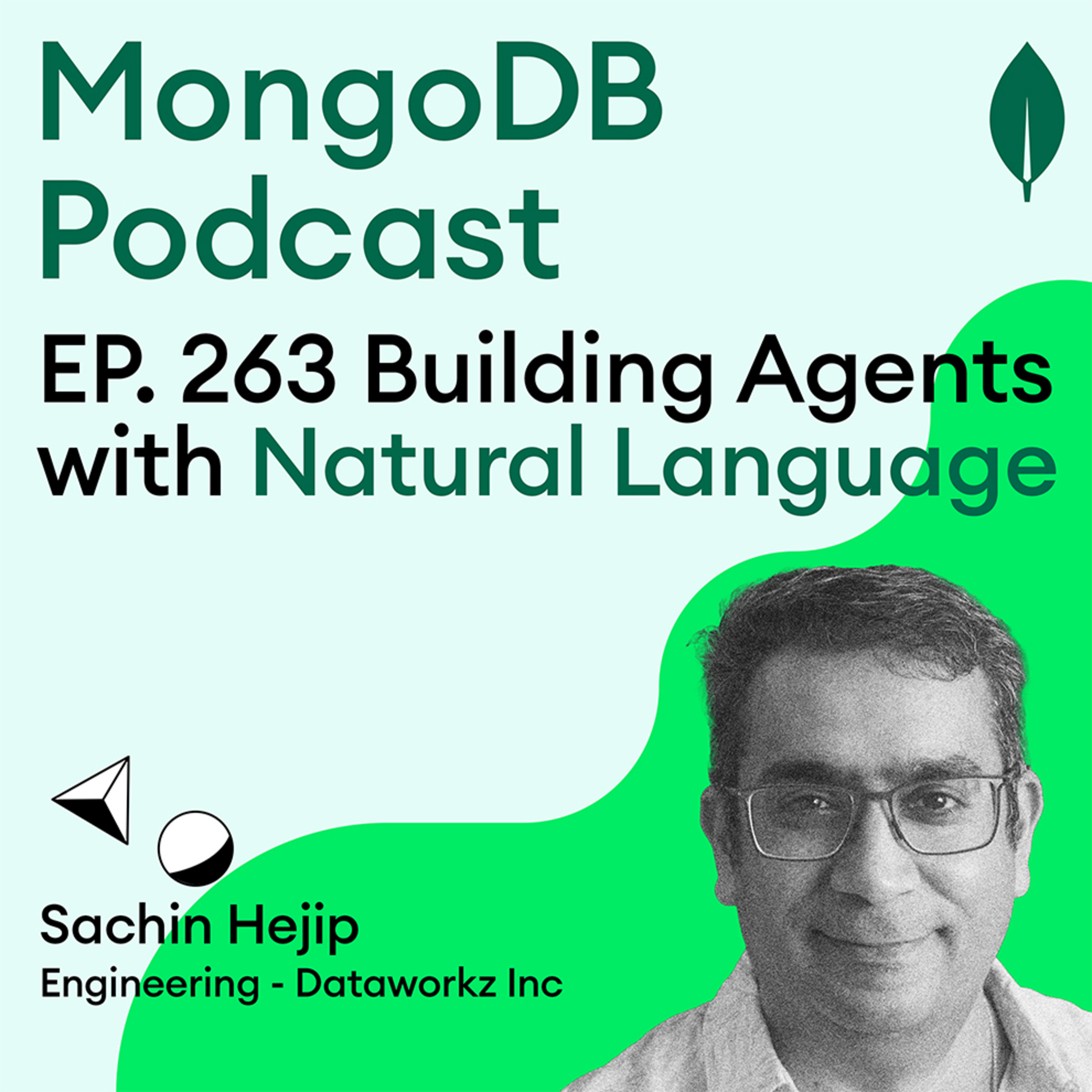
**(Note: Spotify listeners can also watch the screen sharing video accompanying the audio. Other podcast platforms offer the audio-only version.)** In this episode of MongoDB Podcast Live, host Shane McAllister is joined by Sachin Hejip from Dataworkz. Sachin will showcase “Dataworkz Agent Builder” which is built with MongoDB Atlas Vector Search, and demonstrate how it can use Natural Language to create Agents and in turn, automate and simplify the creation of Agentic RAG applications. Sachin will demo the MongoDB Leafy Portal Chatbot Agent, which combines operational data with unstructured…

S1 · E262 · 16 Apr 2025 · 57 min
**(Note: Spotify listeners can also watch the screen sharing video accompanying the audio. Other podcast platforms offer the audio-only version.)** Struggling with millions of unstructured documents, legacy records, or scattered data formats? Discover how AI, Large Language Models (LLMs), and MongoDB are revolutionizing data management in this episode of the MongoDB Podcast.Join host Shane McAllister and the team as they delve into tackling complex data challenges using cutting-edge technology. Learn how MongoDB Atlas Vector Search enables powerful semantic search and Retrieval Augmented…
S1 · E261 · 1 Apr 2025 · 1 hr
MongoDB staff developer advocate Jesse Hall teams up with Storecraft creator Tomer Shalev to dissect how this open-source commerce platform leverages MongoDB for scalable, AI-driven workflows. Watch them live-code integrations (vector search, dynamic pricing, email automation) and explore real-world use cases—from custom discount logic to OpenAI-powered product recommendations. Perfect for developers building modular, future-proof commerce solutions.

S1 · E259 · 19 Mar 2025 · 1 hr 2 min
🔥 How can AI transform customer retention and drive revenue growth? In this episode of The MongoDB Podcast , join host Shane McAllister and Samir Agarwal , Chief Product Technology Officer at Agmeta, as they dive into the future of AI-driven customer insights. Discover how Agmeta leverages MongoDB Atlas Vector Search and cutting-edge AI tools to predict churn, personalize customer experiences, and unlock hidden value in customer interactions. 🔹 Key Takeaways: Why traditional customer surveys fail—and how AI extracts real-time insights from calls, chats, and transcripts. The role of…
S1 · E258 · 7 Mar 2025 · 1 hr 8 min
Welcome to MongoDB Podcast with host Shay McAlister! In this engaging episode, we dive into the transformative realm of AI in revenue operations, featuring our special guest, Fabio, Senior Software Development Engineer at MongoDB. Discover how AI is revolutionizing rev ops through Mops AI, a tool born from innovative hackathons. Fabio shares insights on leveraging MongoDB's own tools and advanced technologies like OpenAI and Atlas Vector Search to optimize tedious processes and enhance data utilization. Perfect for developers, AI enthusiasts, and tech innovators, this episode offers deep…
S1 · E257 · 28 Feb 2025 · 1 hr 6 min
In this episode of MongoDB TV, join Shane McAllister along with MongoDB experts Sabina Friden and Frank Sun as they explore the powerful observability suite within MongoDB Atlas. Discover how these tools can help you optimize database performance, reduce costs, and ensure reliability for your applications. From customizable alerts and query insights to performance advisors and seamless integrations with enterprise tools like Datadog and Prometheus, this episode covers it all. Whether you're a developer, database administrator, or just getting started with MongoDB, learn how to leverage these…
S2 · E8 · 5 Jun 2026 · 56 min
Watch this episode as a video on Spotify! In this episode of the MongoDB Podcast, host Jesse Hall sits down with Karthik Kalyanamaran, Co-Founder and CTO of Langtrace AI, to discuss how engineering teams are building reliable AI products. Moving from traditional, deterministic software engineering to the non-deterministic world of Large Language Models requires an entirely new approach to debugging, testing, and monitoring. Karthik shares his journey from scaling observability infrastructure at Coinbase to creating Langtrace AI, an open-source LLM application observability platform built on…

S2 · E7 · 28 Apr 2026 · 15 min
Watch this episode in Video Format on Spotify . Are autonomous agents about to replace your traditional CRM? In this episode, Anaiya Raisinghani (Sr. Tech. Evangelist, AI Startups & Ventures at MongoDB) sits down with Ishan Mukherjee, Co-Founder and CEO of ROX. They dive under the hood of ROX, the world’s largest-scale revenue agent company that is building AI to handle the end-to-end revenue cycle autonomously.Ishan breaks down his founder journey—from Amazon Robotics to Apple's Knowledge Graph—and opens up about the technical realities of building AI agents today.What you’ll learn in this…

S2 · E6 · 21 Apr 2026 · 45 min
Watch this episode as a video on Spotify ! In this episode, Luis Pazmino, Industry Principal for Financial Services at MongoDB, sits down with Saurabh Khandelwal from Capgemini to explore how financial institutions can transform payments data into a strategic revenue engine. The conversation dives into GenPAL , Capgemini’s solution powered by MongoDB’s modern data platform, and how it enables organizations to move beyond data storage toward real-time intelligence, AI-driven insights, and data monetisation . In this episode, we discuss: • Evolving Payments Landscape: Key shifts shaping data…

S2 · E5 · 15 Apr 2026 · 47 min
Watch this episode in video format on Spotify! If you're building Python applications on MongoDB and still writing raw queries by hand, you're leaving a lot of developer productivity on the table. Beanie, the async-first ODM built on Pydantic, was created to fix exactly that — and this episode goes deep on how and why it works. You'll learn how Beanie maps Python objects to MongoDB documents without sacrificing atomicity or performance, why async-first design matters for modern Python stacks, how schema migrations actually work in a document database, and what the deprecation of Motor means…

The Melo app keeps playing with the screen off, works in the car and on your watch, wakes you to your station, and browses the whole catalogue offline. Free, no ads, no account.