Episode · The MongoDB Podcast
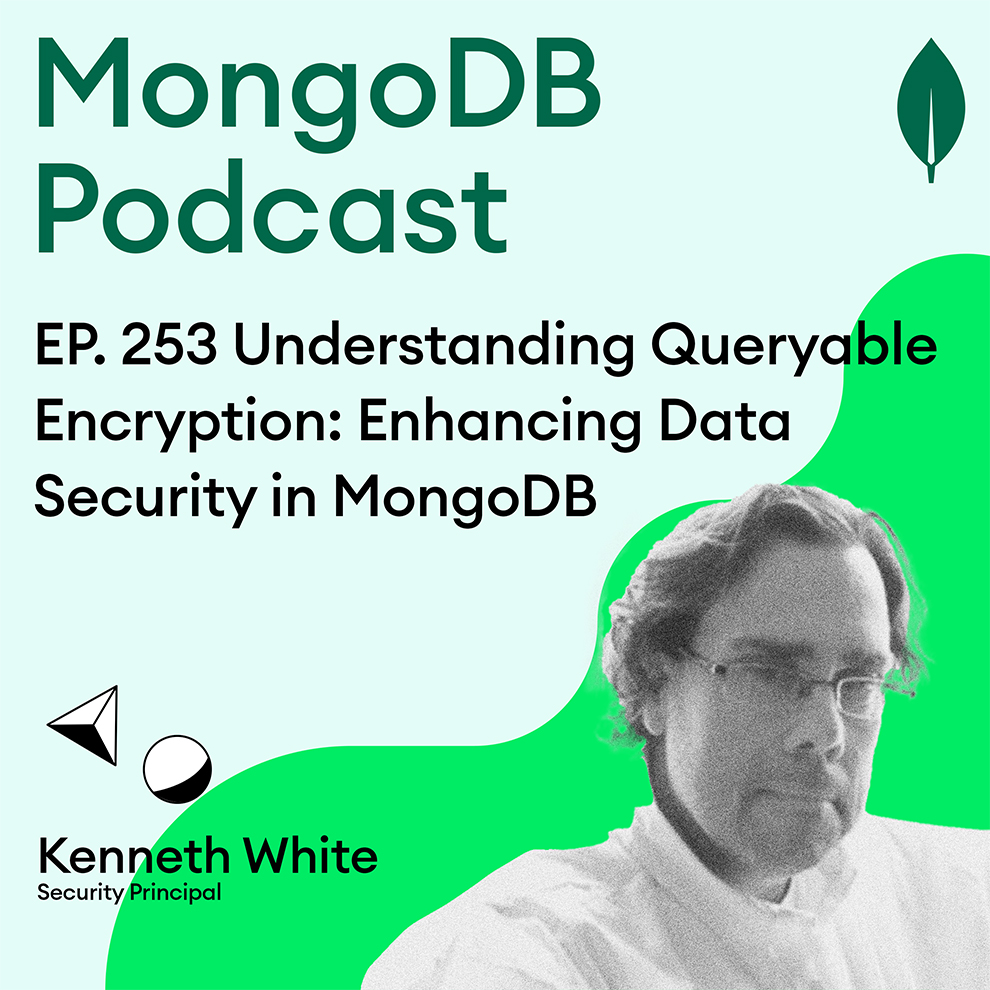
EP. 253 Understanding Queryable Encryption: Enhancing Data Security in MongoDB
16 Dec 2024 · 11 min
Episode · The MongoDB Podcast
16 Dec 2024 · 11 min
In this episode, we dive into the world of queryable encryption with our security specialist. Discover how this innovative feature protects sensitive data while allowing for secure querying without exposing any information. Learn about its applications in industries like banking, healthcare, and government, and how it ensures that even in the event of a data breach, your crown jewels remain safe. We also discuss the recent advancements, including range queries and future enhancements like full-text search. Whether you're a developer or a security professional, this episode provides valuable…
Welcome back to the show floor here at the dot Local London. We do hope you're enjoying all the conversations and all the guests that we've had today. Thank you for staying put with us throughout the everything that we're doing today. Now we earlier on today at the keynote, again expanding on what we learned briefly at the keynote, Queryable Encryption came up. I am. I'm joined by Ken White, our security specialist here and Ken Queryable Encryption. What's it all about?
South queryable encryption is a way to protect our customers most sensible. So we see a lot of this in the banking world, in, in the energy fields, in the DoD. But really everyone has sensitive data, right? Everyone has some kind of crown jewels that they want to protect. And so the idea with gravel encryption is that you can, you can save records in an encrypted format, but the database doesn't learn what that is. And they don't, it doesn't have keys.
And so if there's, if there's an attack, there's a compromise on the database side. If there's, you know, someone comes up and, and black blackmails one of our senior engineers or holds a gun to our CE OS head and says, give me this data from, you know, bank X or whatever. We say, fine, here's a, here's a copy of the data, but it's all encrypted. Good luck with that. So, so that's the that's the basic premise. But the short version, because I was and I think it was at a prior dot local in London that we launched variable encryption a couple of years ago. It was, yeah.
We take the stuff, really. So there's a lot of things in the odd world where you can kind of iterate and move quickly and sort of move on the fly with cryptography and with security. You want to be very deliberate and you really have really rigorous, you know, engineering practices. You want to analyze things very properly. You want to have lots of third party reviews. You want to be very funny and careful about what you do and so we had it in a preview form for about a year and then we G8 it last year. So what we just announced today is that let me is that range supports and being able to do ours, you know, searching for everyone over 25 to 50 and really financial balance it's you know between 10,000 million dollars, OK, every every audit record, every sales transaction happened between this state and that date is supported, but in a way that the database never understands what's being asked for. And even if you have at ADBA level problems, you don't learn anything.
And this isn't the thing that and I spent I, I don't know what event we were at, but I shared a booth with Cynthia who was a prior PM or probably still is the PM in the in the space, but, and I remember poking her all the time going, how does it work? How does it work? And so to me, you know, in that entire query roundset, nothing is exposed. It's like magic. It's still being able to query, but nothing has been exposed and your data secure in transit, at rest and within the query itself, correct? That's right.
So even if, pardon me, even if the network is compromised, even if TLS is broken, even if someone gets a copy of the disk and steals it or, or encryption rest was compromised, it doesn't matter because it's, it's similar to Indian encryption like you'd find in WhatsApp or Signal where the idea is you've got two parties communicating anyone that eavesdrops over the network. If I haven't turned my phone off and you've sent me a message, that message is sitting on a server somewhere. But it doesn't matter if, you know, if I don't log on for a little bit, if they had access to the server, they still can't see it.
So it's a very similar idea to that. What's unique about word on encryption is it was built from the ground up for high performance data been searched. So there's all kinds of encryption sort of libraries and techniques out there, but very few are are meant for, you know, generalized search for operational workload. You mean there's a lot in the kind of academic world that are kind of toy type. You know, use cases were like, I've got 100 records and I've got 1 laptop and one database server. But as soon as you get into distributing systems, as soon as you get into, you know, I've got, you know, threaded web services.
I'm, I'm, I've got high key currency. I've got tons of users, those things breakdown. And then also there's some encrypted search techniques that may take seconds or minutes to get an answer back. Well, that's just not realistic for operation. And I suppose a testament to how serious we take this is that we have a research group for for cortography. That's right. And, and I've built this and when we put it out first, we also open sourced our methods, right, because it needed to be up to scrutiny.
Yeah, exactly. So we worked with the group out of Brown University called the Encrypted Systems Lab when we built our first generation client side encryption. And what they did that was really useful was they helped us think about the model, what are the promises we can make? What are the things that we can't guarantee. You know what, it's important to understand what you don't get from this particular security control. That collaboration was really, really positive and they were working a lot of, you know, other sort of advanced TAT.
Pardon me, no worries. And so about two years after we launched, they had a major breakthrough. We talked to them about it and then eventually we acquired the company. So yeah, today we have an in house cryptography research group. It's headed up by Sandy Kamara and Tarita Wataz and people have been in the field for, you know, in this case, over 20 years. He literally pioneered the field of encrypted search when he was back at Microsoft Research. And, and so a lot of the, the knowledge, the basis, the sort of formalisms have been out there for 1520 years. What we, you know, we're able to do is to operationalize that into a practical database and put things in place that made it easy for developers to use because a lot of times, you know, tech products put a huge burden on the developer. They have to become cryptography experts. There's in different encryption modes and key sizes and all this sort of thing.
And we said, well, what, what if we made this very opinionated based on conservative, you know, sort of cryptographer approved values. So that basically you set up a little boilerplate code. And then as a developer, if you want to insert a document, you just write an insert statement like you used to. You want to query a bunch of documents. You should be able to query without having to think too much about, you know, the underlying crypto. And so, yeah, after that acquisition, we refer to more cryptography researchers.
I think there's like 5 PhD cryptographers in the group. They're publishing papers, they're leading, you know, academic conferences. It is we now have like visiting scientists and student interns. I mean, it's a proper full blown R&D goods. It's. Totally strategic for us given the clients that we have. I mean, I know that, you know, certain institutions and certain industries, financial, medical, etcetera are reluctant to go to the cloud or we're reluctant to add.
But with this approach, essentially it's pretty much the last barrier in being able to say we don't want our our data being shipped around like this, correct? Yeah, that's right. And so while we started with some pretty sophisticated use cases, everybody's got crown Jewelers, everybody has some kind of PII data or sensitive data they want protected. But but our our sort of more high end sophisticated customers said, look, we're not this isn't some James Bond or science fiction scenario.
We have entire nation states that are targeting our platform. When you're moving hundreds of billions of dollars a day through capital markets, that's not fiction. You, you really do have to kind of think about that. And, and none of that to say that we've, we've sort of developed some magic silver bullet that'll cure all problems, but rather that we took a very disciplined, careful approach of confidentiality, of keeping your secret secret, keeping the secret from us. You don't have to trust us that we'll do the right thing because there's also there's, there's this sort of hackers, there's the hacker side, but then there's the what happens if I'm compelled as a service provider?
What if we get a court order or some law enforcement thing or, or you're under litigation and you know, a judge says I need a forensic called Mongo DB. Give me a copy of this customer's data and fine, we'll give you a copy of it, but it's encrypted. Good luck with that. But what it really means is that the customer controls their data unless they supply the decryption in their keys, it it doesn't matter whether again, our CEO is held hostage or that's right. Even if somebody had root level privileges on the virtual machine, even if they had hypervisor level access, it's it's not, it's not.
They're not seeing the clear text data and they don't have access to that being. Super secure. So we we announced range queries before that it was exact match it was yeah. So range queries allows, as you said, a couple of examples, you know, search for transactions between this value and that value except as well too. Is there more to come? Full text search for. Oh, yeah, absolutely. So, so program encryption is an is a platform for expressive search.
OK. So we're, you know, we're hoping in the next, in the first half of next year to introduce tech support, prefix FX substring support. We'll Gea that after some reasonable amount of time and then yeah, then then, then, then it's open. You know, we're potentially considering vector, we're potentially considering, you know, geocode. It's it's an expressive platform, so we're super excited about it. Excellent. And where do developers go to find out more?
Ken Sure, wherever they go today. Yeah, so just query Mongo DB Queryable encryption. We've got docs and tutorials and code snippets you can copy and paste if you Google the Mongo DB photography group, lots of technical papers. If you want to look at the formal proofs, you want to understand the underlying math. That's your source. Edison, excellent. Well, listen, Ken, this has been an eye opener. I can't say that I still understand how it's done.
It looks like magic to me, but it's great to see it advancing and what you've added with the range queries and I look forward to seeing more. Thank you very much for joining us on the Mongo to Be Live stream. You're very welcome. Thank you. Excellent. And from the show floor, we will take a short break and we'll be back very soon with another guest. Thank you.
Transcript supplied by the publisher with the episode.

by MongoDB · English · Tech & Science
Whether you're building your first app or scaling to millions of users, The MongoDB Podcast brings you the conversations worth having. Developers, founders, and technical leaders share how they architect systems, navigate hard decisions, and build with AI.
E256 · 27 Dec 2024 · 9 min
Join us as we conclude our exciting day at Local London! In this final segment, we reflect on the highlights of the event, including key announcements, insightful discussions, and the innovative features showcased throughout the day. Our hosts share their thoughts on the importance of developer productivity, the impact of AI on various industries, and the future of MongoDB's offerings. Whether you missed the event or want to recap the key moments, this episode is packed with valuable insights and a look ahead at what's next for MongoDB.
23 Dec 2024 · 11 min
In this episode, we sit down with industry experts to discuss how MongoDB is revolutionizing the insurance sector through data modernization and AI integration. Discover how MongoDB's document model simplifies data processing, enhances developer productivity, and reduces friction in application development. Learn about the exciting advancements in vector search and unstructured data handling that are set to transform customer experiences in insurance. Whether you're in the industry or just curious about the future of data management, this episode is packed with valuable insights and…
20 Dec 2024 · 11 min
In this episode, we explore the exciting advancements in MongoDB's Atlas CLI and Docker support with a leading expert in developer tools. Discover how these features streamline local development, enabling faster feedback loops and efficient testing environments. Learn about the integration with existing Docker tools, the benefits of running MongoDB locally, and the future enhancements on the horizon. Whether you're a developer looking to optimize your workflow or just curious about the latest in MongoDB, this episode is packed with valuable insights to elevate your development experience.
13 Dec 2024 · 12 min
Join us for an insightful discussion with a MongoDB expert as we delve into the intricacies of data modeling and design reviews. With over a decade of experience, our guest shares valuable strategies for optimizing data models, avoiding common pitfalls, and ensuring successful implementations. Learn about the importance of aligning your data structure with application needs and discover practical design patterns that can enhance your MongoDB projects. Whether you're new to MongoDB or looking to refine your skills, this episode is packed with actionable insights to elevate your data modeling…
9 Dec 2024 · 11 min
Join us in this engaging conversation with a MongoDB Community Champion as we explore the transformative capabilities of Atlas Search. With nearly a decade of experience using MongoDB at scale, our guest shares insights on managing billions of documents and achieving impressive performance benchmarks. Learn how Atlas Search simplifies data management by eliminating complex pipelines and enhancing efficiency. Whether you're a developer or a data enthusiast, this episode highlights the benefits of leveraging MongoDB's latest features for your projects. Don't miss out on these valuable insights!
6 Dec 2024 · 13 min
Are you ready to revolutionize your approach to time series data? In this episode, we unveil the groundbreaking advancements in MongoDB's time series capabilities that are set to transform how developers manage and analyze high-volume data. Discover how the latest features enhance performance, streamline data ingestion, and simplify querying like never before. Whether you're a seasoned developer or just starting out, this episode is packed with insights that can elevate your projects to the next level. Don't miss out on the future of data management!
S2 · E8 · 5 Jun 2026 · 56 min
Watch this episode as a video on Spotify! In this episode of the MongoDB Podcast, host Jesse Hall sits down with Karthik Kalyanamaran, Co-Founder and CTO of Langtrace AI, to discuss how engineering teams are building reliable AI products. Moving from traditional, deterministic software engineering to the non-deterministic world of Large Language Models requires an entirely new approach to debugging, testing, and monitoring. Karthik shares his journey from scaling observability infrastructure at Coinbase to creating Langtrace AI, an open-source LLM application observability platform built on…
S2 · E7 · 28 Apr 2026 · 15 min
Watch this episode in Video Format on Spotify . Are autonomous agents about to replace your traditional CRM? In this episode, Anaiya Raisinghani (Sr. Tech. Evangelist, AI Startups & Ventures at MongoDB) sits down with Ishan Mukherjee, Co-Founder and CEO of ROX. They dive under the hood of ROX, the world’s largest-scale revenue agent company that is building AI to handle the end-to-end revenue cycle autonomously.Ishan breaks down his founder journey—from Amazon Robotics to Apple's Knowledge Graph—and opens up about the technical realities of building AI agents today.What you’ll learn in this…

S2 · E6 · 21 Apr 2026 · 45 min
Watch this episode as a video on Spotify ! In this episode, Luis Pazmino, Industry Principal for Financial Services at MongoDB, sits down with Saurabh Khandelwal from Capgemini to explore how financial institutions can transform payments data into a strategic revenue engine. The conversation dives into GenPAL , Capgemini’s solution powered by MongoDB’s modern data platform, and how it enables organizations to move beyond data storage toward real-time intelligence, AI-driven insights, and data monetisation . In this episode, we discuss: • Evolving Payments Landscape: Key shifts shaping data…
S2 · E5 · 15 Apr 2026 · 47 min
Watch this episode in video format on Spotify! If you're building Python applications on MongoDB and still writing raw queries by hand, you're leaving a lot of developer productivity on the table. Beanie, the async-first ODM built on Pydantic, was created to fix exactly that — and this episode goes deep on how and why it works. You'll learn how Beanie maps Python objects to MongoDB documents without sacrificing atomicity or performance, why async-first design matters for modern Python stacks, how schema migrations actually work in a document database, and what the deprecation of Motor means…

The Melo app keeps playing with the screen off, works in the car and on your watch, wakes you to your station, and browses the whole catalogue offline. Free, no ads, no account.