Episode · The MongoDB Podcast
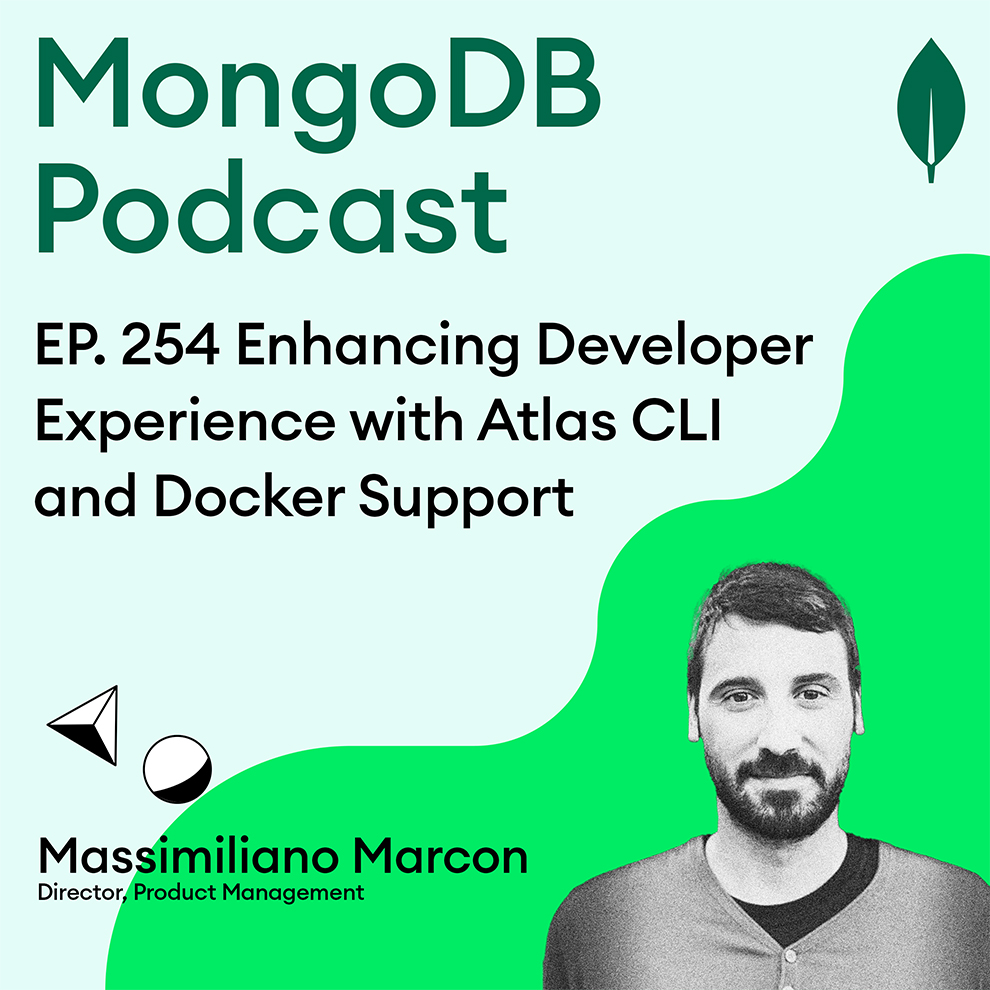
EP. 254 Enhancing Developer Experience with Atlas CLI and Docker Support
20 Dec 2024 · 11 min
Episode · The MongoDB Podcast
20 Dec 2024 · 11 min
In this episode, we explore the exciting advancements in MongoDB's Atlas CLI and Docker support with a leading expert in developer tools. Discover how these features streamline local development, enabling faster feedback loops and efficient testing environments. Learn about the integration with existing Docker tools, the benefits of running MongoDB locally, and the future enhancements on the horizon. Whether you're a developer looking to optimize your workflow or just curious about the latest in MongoDB, this episode is packed with valuable insights to elevate your development experience.
OK, hello again, everybody. If you've been watching the stream all afternoon, you may have seen me about half an hour ago interviewing Daniel Kupell and I'm back. I'm back, and this time I'm with Max Markong. Max, why don't you explain what you do, what your position is and kind of what you do on a day-to-day basis? Yeah, so I am a director of the Longwood DB. I lead developer tools. That means the other CI that you saw a lot of today, Compass, Margaret, Michelle, ID extensions, so a few other things, AI developer tools that's total making. Just a really small list.
Yeah, exactly. Excellent. And you were on the keynote this morning. I was congratulations. Was fun. I've been very well Skype. So yeah, tell us about, we're here to talk about the Atlas CLI and the kind of the the GA of OKA support. Yeah, I see. So as as Melissa mentioned Nikito this morning, this is a functionality that we announced in public video last year here in London. And in this past last year, we've been working very closely with a number of customers to see how we could support them best when they developed it.
Mongo DB locally and locally means not on the cloud, not on a server that's somewhere, but most likely on the developer's laptops. And then when it comes to testing that, put those domain on their anime in CIA in your continuous duration server anymore interactions and so on. And the, the, the primary reason for providing this new experience tool for Atlas is that we really want to give developers a very short feedback loop. So think about it. You're writing code, you put some data into the MongoDB, you run some tasks and you want the result right away. You don't want to wait for a deployment, you don't want want to wait for a cluster to speed up somewhere. You want to insert data, read data and and do that very efficiently.
And that is a fundamental, fundamental capability when you are building an application. It's even more important when you're testing an application. So suite of tasks like 1000 tests and and you want to be able to do that before I recommit. You need the environment to be fast. You need the environment to spin up. We did. So having it locally, having it locally in a docker image means that it's going to be fast and throw it away and you can create a new one. And so I.
That's fundamentally the tighter you can make keep that feedback like the faster developers. Yeah, it's. Probably the the biggest thing you can do, I think to to keep developers, but I'd say my own personal experience bringing up Atlas CLI, just kind of running a car that I'm running at this on my own machine. It's absolutely. Incredible. Yeah, yeah. And I love it personally. It's the way I used to write applications, to develop applications. We've seen a lot of success with both the offering the CLI as well as with Doctor. Customers love the idea that they have Docker already for everything else.
They use Docker Compose for their applicable stack when they build code when they write us and now we can give them the same experience for others that I think that's just amazing. So you mentioned that there like getting into the the details. So this is one of the new features in I don't know with the app of CLI is this integration with SM docker tools like components right? So if I'm already using compose, I can add configuration configuration in there to bring the. Yeah, you so the the Atlas CLI is just trigger around the experience so but but you can go and and get the docker image that I could and inserted in your docker compose file. And when you have that, you can spin it up with the rest of your services, but the CLI still knows about it. So if you want to look at what local environments are running a do Atlas deployments list, those will still track if you want to put data in those environments.
Those that you can still do where the the the normal tools that you use. If you want to create search indexes then you can still do with the auto CLI. That's very cool. And if you once I've kind of set up that all this environment locally, then when I'm moving to production, do we have anything in there that kind of helps with that? So lift and shift. And not, not right now. We've been talking to customers. We, we know that there are opportunities, for example, in the area of life cycle indexes. Think about even what we showed this morning at the kilo. You build an application, you realize that there is an index spacing, maybe your IDE calcium.
Now you go create an index locally to make sure that the the the Mountain View response in the right way when you create your queries. But then you want to eventually move that index to production. You can do it manually. Obviously you can. You can write the shell script that copies the configuration from local and applies it to production. But maybe over time it makes sense to explore this type of capability already as part of the local ethyl. Yeah, that would be pretty amazing. Given how fast we're moving on developer tooling, it wouldn't surprise me if we you see that soon. Yeah.
I mean for, for the last year, we've been incorporating feedback and feedback from customers into the product and we'll just keep doing that. So anybody who has thoughts that can care of them want to make us a voice, they can get in touch in the community forums and we'll listen to all this feedback and we also talk to customers directly obviously and all of that informs all about that. Great. So maybe maybe a controversial question, I don't know, but is there ever good?
Is there a future where people can run Atlas on their own machines? Like this becomes kind of a pathway to self hosted Atlas as opposed to self hosted. That's a good question. So I mean I I let me break it up in two parts. So one is can I the can I run Atlas services on my computer but also in AWS for production levels? The answer to that is yes in the future you saw this morning. So here talked about search and active search community community.
So like when that will be available in the same way you can run Mongo to be committed today for your hobby project or for the early season of your startup, you will be able to have search and active search too. Now the the local experience we're talking about today is a completely different offering. So we're not thinking about producting use cases. We're thinking about the best ergonomic for developers to get something up and running quickly. And then it's an experience that we control. We know what's inside, we know how you connect to it. We have a very predictable set of services that are running and that allows us to connect it with the rest of our tooling. And an example that I just gave to a customer in a in a meeting that really is right them is I control this experience. Therefore, if on your same machine you have Compass, you have PS code, those can automatically discover those local environments because I know what they look like, I know how to look for them.
So there is no copy pasting connection strings around. I open Compass and all my local environments are there and I click and I I'm already working with the data on my laptops. That's pretty amazing why I haven't actually gone through that experience yet, so I I guess I have more digging to do. So that that that's something we're still like figuring out, but it will happen that, that that's what we can do because the environment is so predictable.
Yeah, yeah. I so fundamentally this this isn't designed for scale, it's very much designed for developer. Experience exactly I have. To say, my experience with it so far has been very good. So can you give us any kind of sneak feature, sneak peek of some of the features that we're thinking about adding and feature? Yes. So something that will come very soon and and that is again, really something we are doing because customers were so vocal about it, is including in the image the Mongo DB shell, Mongo important. All that's work over dump Mongo restore and in general the ability to automatically see your local cluster with data and create indexes.
So right now you can do that with the CLI. It's pretty easy. But if we can do it as part of bootstrapping the Docker image, that makes the entire orchestration of your test suite, for example, extremely easy. Yeah. And, and the team is, is working on that almost as we speak. So you can expect that we'll be there soon. And then generally we're looking at what you said earlier, essentially what's, how can we make the experience of going from local to Atlas smoother and then also the experience of going from Atlas to local. So if I have my actual workload in Atlas, but then I want to build a new feature, can I get a subset of Atlas data into my local environment?
So the data I'm working with locally resembles that it by having production. So all of this is something that we are still figuring out and and there will be a lot of robot items going forward around it. I love this. You, you don't know this about me, but I used to work in developer tooling within a sort of a big scalable start up. Oh really? So yeah, it's like I've specifically built some of this stuff and it's hard, especially when you get into data. Like data is the hardest thing to manage within that life it. Is and and there are important aspects to keep in mind. That's why we don't do it lightly. So that is PII there.
There is a lot of stuff that is not supposed to be shared when you talk about data and so we have to be very careful with how we build this type efficient. Yeah, every time somebody talks to me about taking a copy of their production database to do development, I, I, I. Are you sure? Yeah. So we How much of a conversation do we need to have about this? So yeah, it's it's good that you're thinking about that and they're designing for the design of this tool. So there any other feedback in that way? What?
What would you say is the biggest integration that you can get now, given that this is Docker native and? People can integrate with that too. Yeah. So something we we've heard a lot from customers, well mainly two things. So one is get out actuals as part of your pipeline. For example, they can have a GitHub actuals, you can run Doffer containers there. So the integration with the the local offering is just a straight toward. And then the other thing is test containers.
So a lot of customers use them for testing and they are based on the operating versus. Therefore you can think of creating a test container for Atlas Local. Yeah. Now someone like in the community create some PRS for that. Well, we'll probably try to foster that relationship so we can make it happen. I love that. I love that. Well, I could have put you for another 20 minutes, but sadly, we've run out of time. So I'm just going to say thank you very much.
I'm really excited to see all of this. You excited about the current release? But I'm also excited to see what's coming down the line. Yeah. Thank you for having me. Hopefully we'll talk about this again on the podcast soon. Yeah, I hope so. Take care.
Transcript supplied by the publisher with the episode.

by MongoDB · English · Tech & Science
Whether you're building your first app or scaling to millions of users, The MongoDB Podcast brings you the conversations worth having. Developers, founders, and technical leaders share how they architect systems, navigate hard decisions, and build with AI.
S1 · E257 · 28 Feb 2025 · 1 hr 6 min
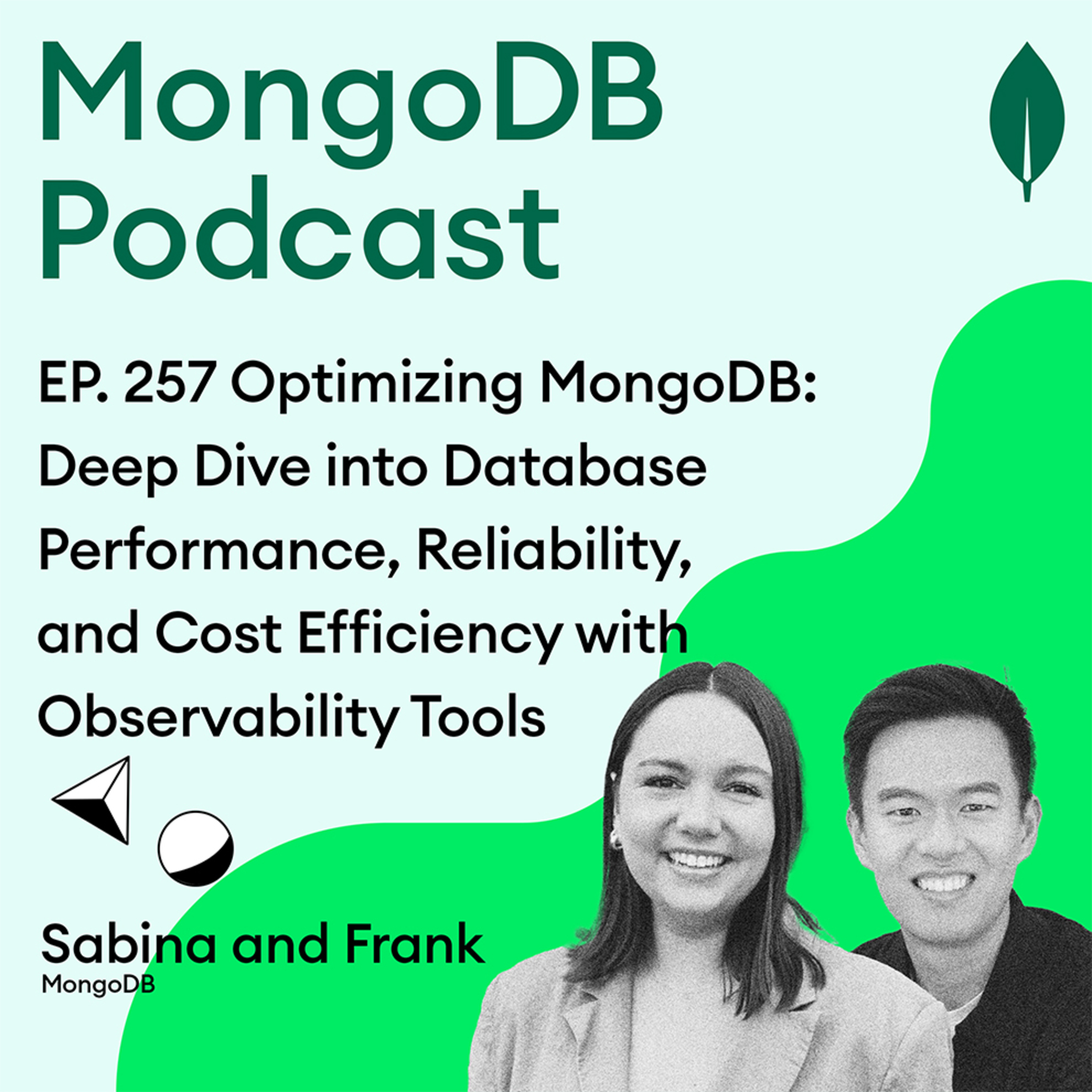
In this episode of MongoDB TV, join Shane McAllister along with MongoDB experts Sabina Friden and Frank Sun as they explore the powerful observability suite within MongoDB Atlas. Discover how these tools can help you optimize database performance, reduce costs, and ensure reliability for your applications. From customizable alerts and query insights to performance advisors and seamless integrations with enterprise tools like Datadog and Prometheus, this episode covers it all. Whether you're a developer, database administrator, or just getting started with MongoDB, learn how to leverage these…
E256 · 27 Dec 2024 · 9 min
Join us as we conclude our exciting day at Local London! In this final segment, we reflect on the highlights of the event, including key announcements, insightful discussions, and the innovative features showcased throughout the day. Our hosts share their thoughts on the importance of developer productivity, the impact of AI on various industries, and the future of MongoDB's offerings. Whether you missed the event or want to recap the key moments, this episode is packed with valuable insights and a look ahead at what's next for MongoDB.
23 Dec 2024 · 11 min
In this episode, we sit down with industry experts to discuss how MongoDB is revolutionizing the insurance sector through data modernization and AI integration. Discover how MongoDB's document model simplifies data processing, enhances developer productivity, and reduces friction in application development. Learn about the exciting advancements in vector search and unstructured data handling that are set to transform customer experiences in insurance. Whether you're in the industry or just curious about the future of data management, this episode is packed with valuable insights and…
16 Dec 2024 · 11 min
In this episode, we dive into the world of queryable encryption with our security specialist. Discover how this innovative feature protects sensitive data while allowing for secure querying without exposing any information. Learn about its applications in industries like banking, healthcare, and government, and how it ensures that even in the event of a data breach, your crown jewels remain safe. We also discuss the recent advancements, including range queries and future enhancements like full-text search. Whether you're a developer or a security professional, this episode provides valuable…
13 Dec 2024 · 12 min
Join us for an insightful discussion with a MongoDB expert as we delve into the intricacies of data modeling and design reviews. With over a decade of experience, our guest shares valuable strategies for optimizing data models, avoiding common pitfalls, and ensuring successful implementations. Learn about the importance of aligning your data structure with application needs and discover practical design patterns that can enhance your MongoDB projects. Whether you're new to MongoDB or looking to refine your skills, this episode is packed with actionable insights to elevate your data modeling…
9 Dec 2024 · 11 min
Join us in this engaging conversation with a MongoDB Community Champion as we explore the transformative capabilities of Atlas Search. With nearly a decade of experience using MongoDB at scale, our guest shares insights on managing billions of documents and achieving impressive performance benchmarks. Learn how Atlas Search simplifies data management by eliminating complex pipelines and enhancing efficiency. Whether you're a developer or a data enthusiast, this episode highlights the benefits of leveraging MongoDB's latest features for your projects. Don't miss out on these valuable insights!
S2 · E8 · 5 Jun 2026 · 56 min
Watch this episode as a video on Spotify! In this episode of the MongoDB Podcast, host Jesse Hall sits down with Karthik Kalyanamaran, Co-Founder and CTO of Langtrace AI, to discuss how engineering teams are building reliable AI products. Moving from traditional, deterministic software engineering to the non-deterministic world of Large Language Models requires an entirely new approach to debugging, testing, and monitoring. Karthik shares his journey from scaling observability infrastructure at Coinbase to creating Langtrace AI, an open-source LLM application observability platform built on…
S2 · E7 · 28 Apr 2026 · 15 min
Watch this episode in Video Format on Spotify . Are autonomous agents about to replace your traditional CRM? In this episode, Anaiya Raisinghani (Sr. Tech. Evangelist, AI Startups & Ventures at MongoDB) sits down with Ishan Mukherjee, Co-Founder and CEO of ROX. They dive under the hood of ROX, the world’s largest-scale revenue agent company that is building AI to handle the end-to-end revenue cycle autonomously.Ishan breaks down his founder journey—from Amazon Robotics to Apple's Knowledge Graph—and opens up about the technical realities of building AI agents today.What you’ll learn in this…

S2 · E6 · 21 Apr 2026 · 45 min
Watch this episode as a video on Spotify ! In this episode, Luis Pazmino, Industry Principal for Financial Services at MongoDB, sits down with Saurabh Khandelwal from Capgemini to explore how financial institutions can transform payments data into a strategic revenue engine. The conversation dives into GenPAL , Capgemini’s solution powered by MongoDB’s modern data platform, and how it enables organizations to move beyond data storage toward real-time intelligence, AI-driven insights, and data monetisation . In this episode, we discuss: • Evolving Payments Landscape: Key shifts shaping data…
S2 · E5 · 15 Apr 2026 · 47 min
Watch this episode in video format on Spotify! If you're building Python applications on MongoDB and still writing raw queries by hand, you're leaving a lot of developer productivity on the table. Beanie, the async-first ODM built on Pydantic, was created to fix exactly that — and this episode goes deep on how and why it works. You'll learn how Beanie maps Python objects to MongoDB documents without sacrificing atomicity or performance, why async-first design matters for modern Python stacks, how schema migrations actually work in a document database, and what the deprecation of Motor means…

The Melo app keeps playing with the screen off, works in the car and on your watch, wakes you to your station, and browses the whole catalogue offline. Free, no ads, no account.