
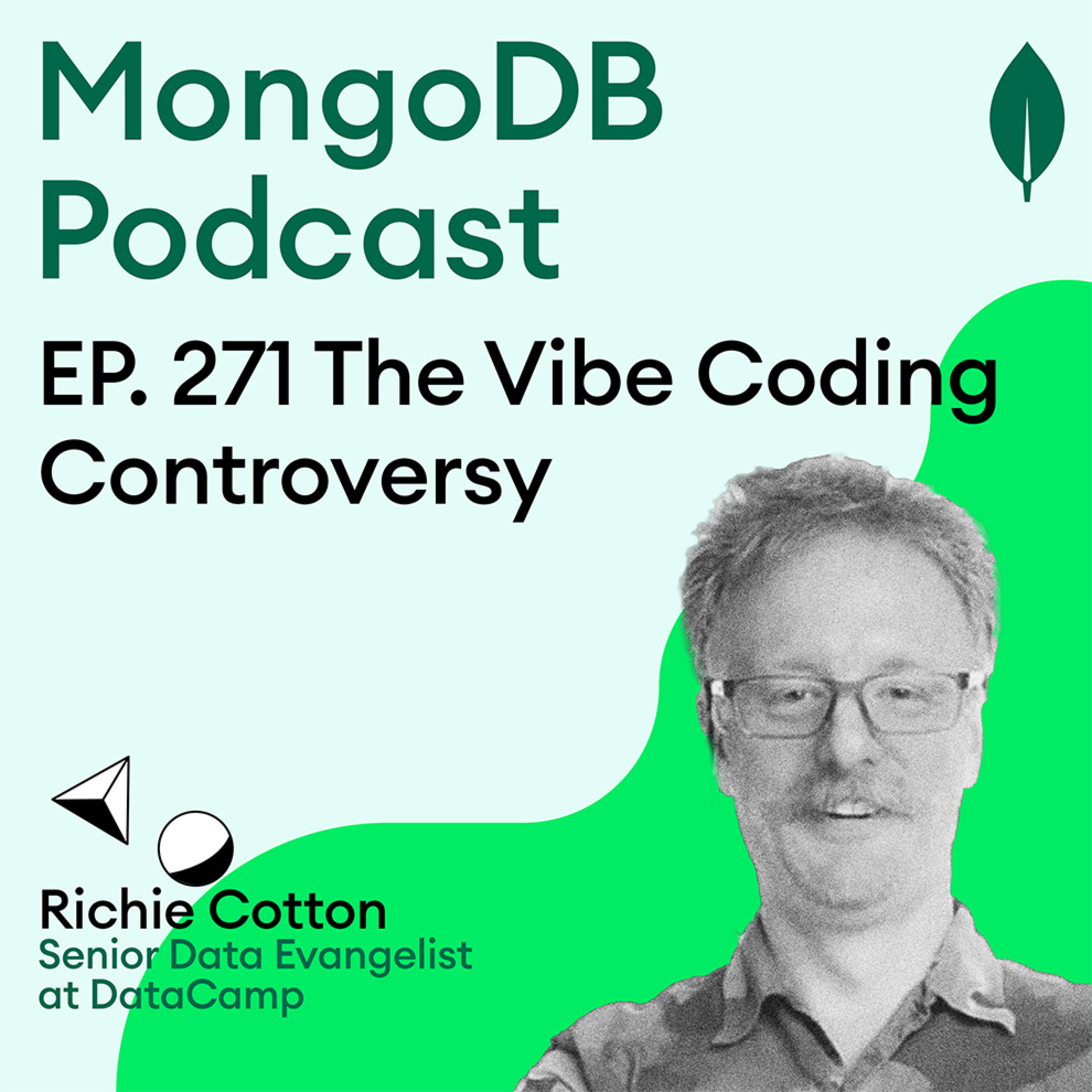
Season 1, Episode 271 · The MongoDB Podcast
EP. 271 The "Vibe Coding" Controversy: What Devs Are Getting Wrong About AI
25 Sep 2025 · 1 hr 1 min
Episode notes
Everyone's talking about AI taking over coding jobs, but what's the real story? Shane McAllister and DataCamp's Richie Cotton dive into the "vibe coding" phenomenon and expose the biggest misconceptions developers have about AI. Learn how to shift your mindset from a pure coder to a "vibe curator" and future-proof your career. Don't miss the full video discussion, available to watch now in the Spotify app.
Transcript
Read the transcript · about 11,510 words, follows along as you listen
Welcome to the Mongo DB Podcast. I'm Shane McAllister. I'm one of the leads on our developer relations team and it's great to have you join us today. So in a world when AI can write your code, well, at least some of the time, software development and data careers need rethinking. How you work and how you learn are utterly changing. Do you vibe code everything and hope for the best, as we've seen many, many articles recently? Do you spend your evenings and weekends pouring over all the latest tools and frameworks? Well, today's guest, we're going to have a great discussion and dive into the controversial area of keeping up with the vibe coders.
And today, I'm really, really happy to welcome Richie Cotton, a senior data evangelist, Pardon me, at data camp to ruminate the changing relations chip between engineering teams and data teams and modern developer workflows and everything else that we can decide to get on to on today's topic. Richie, you're very welcome to the Monetary podcast. How are you? Life is good, Shane. Really pleased to be here. I'm based in New York City. We're having a heat wave today. It's got a message from the building saying they are turning the air conditioning down in order to save energy. If I start sweating throughout the show, that's what's happening.
Hey, this is a live stream, anything can happen and I'm not usually for regular viewers, I'm not usually in my normal place. I'm in Amsterdam at the moment doing a, what we call a developer day at Mongo DB where we get some of our clients into a room for a day or two and we run through some are going to be fundamentals and also some deeper topics with them as well too. So if the Wi-Fi goes or anything else happens or somebody comes in and knocks on the door, I do apologize. So if you pass out from heat exhaustion, Richie or I get moved out of this room.
Everyone knows that this, this chat is live. I'd love to start with most guests to kind of dig back a little bit your career path to date. Richie, where did you start? What roles have you gone through all the way up to your current role as evangelists in Data camp? Absolutely, yeah. Uh, my background is in data science, so, uh, I started well before it was called data science. Really. So this is back in 2005, uh, I was working on data for chemical health and safety.
So that was the start of my career. I've also done data science in other industries. So I moved from chemical health and safety to debt collection. And then I moved from debt collection to proteomics. And there it was like it was trying to work out what's going on with like proteins. I hadn't done any biology since I was 16. I started asking stupid questions about, you know, what's that thing in a, in a cell again? But yeah, industry shifts are very difficult, but the data has been sort of persistent throughout. I joined data camp in 2016.
Since then I've been teaching things around data and more recently, AI. OK, excellent. And and you're I'm always super impressed when I get published authors on the show as well too, because I totally I see the work that's required into creating content like that. Tell us about the the two books that you put together as well. Sure. Yeah. So I wrote two books on our programmes. I suppose it was called Learning R and then I wrote Testing R code. So I really enjoyed the process of writing. Actually, that was how I kind of ended up working in education. You know, I enjoy teaching people. It's kind of sad to me that R is sort of declining as a language. I think it's a great language for working with data. Python second or everything.
I like Python as well. But yeah, 2 great books now obsolete. And these days, yeah, I, I do all my teaching via, well, as you say, evangelism. So that means I host our, the Data for the Data Camp podcast called Data framed over in our webinar program. I also organize virtual conferences. Actually the next one is on Thursday if you want to sign up for Data Camp Radar. I don't think I have a link for you, but yeah, Internet search for data on radar, that's happening on Thursday. Excellent.
So what's it like to be the guest instead of the host? So it's going to be tricky if I start asking you questions, that's usually for some habits. That's fair enough. That's fair enough. So like I was familiar with data Camp, I know Mongo DB has done stuff and has lots in the future with data Camp coming. But for our viewers who wouldn't be familiar, give us a little audit history of Data Camp and and where it's at today. Sure. Yeah. So Data Camp is an education company. So we do online courses for data and AI skills and as well as courses we also do projects.
We have certifications for testing your skills. And then we have productivity platforms. Basically, it's a hosted tube to notebook platform called Data Labs, designed to make it easy to get started and easy to collaborate with others. OK. And you've been there since 2016, as you said, obviously massive changes right in the, in those nine years or so in this space, more particularly certainly in the last, well, publicly in the last two, 2 1/2 years in the AI world.
How has that changed Datacamp's approach to, to learning? And if I could slot in a second question there longer to be redesigned its university platform about that probably about 18 months ago to make them shorter, more succinct courses. How does Data cap appeal to that as I would call them the TikTok generation Richie? Oh yeah, yeah. So things have changed widely. Like when I started data camp in 2016, there were eighteen of us. There's more than 200 now.
So obviously like it's it's a growing space, a lot of people wanting to learn about things. And I think our focus to begin with was very much on just data scientists and data analysts. And since then, everyone wants to know about data. And the last couple of years, everyone wants to know about AI. So we've created a lot more slightly less technical context or more introductory stuff for people who like, OK, maybe your background is like marketing or HR, but you need to understand things about like the basics about data and AI.
So we have a lot more basic content. And then I'll just say like the the rise of the AI, the AI engineers with the big story in the last couple of years. So we have content for that crowd as well. But yeah, you mentioned the TikTok generation. So when we started all our courses, they were they were four to five hours long. And this is like, OK, we need to go faster because before that it was like, you know, you go on courser and you've got to take an 8 week course.
No one has time for that. So we're like, OK, we can do fast content and yeah, we are getting increasing pressure for one hour courses and shorter format content. Yeah, yeah, I think so. Listen as the as the father of three kids who are teenagers and upwards, yeah, their attention spans are just non existent Richie. So those damn. Kids. I just sounded like an old curmudgeon now. But anyway, when we have people with the data science background on the podcast, there are pains to point out that AI is nothing new. Machine learning has been around for a long time. The principles behind AI, I've been there for for, you know, decades at this point in time.
But we've obviously seen this huge impact. Certainly as I said earlier, in the last two, 2 1/2 years, the impact of AI on coding practices and obviously copilot, one of the first at the gate there with we can be your peer programmer, we can sit beside you, we can help you. How has, in your view, AI changed the day-to-day work of developers? Yeah. I mean, I think this is interesting because developers tend to adopt new technology a lot faster than data scientists.
It's just a fight for life. Like all the tooling gets built for developers first because it's developers creating stuff for themselves and it's obviously a much bigger target audience than than the smaller sort of data realm. So yeah, I think things like Copilot and more recently you got like a person wins up all these kind of newfangled ID ES that are very much AI powered, so these target developers first. So I think, yeah, you hit the nail on the head. The big difference this is AI is actually getting quite good at writing your code for you.
And that means you need to think less about, well, what's the syntax and more about what do I actually want to build? And so these kind of these product skills are deserving, like what do I need to do for to solve a user problem? That's becoming increasingly important to think about also I think because it doesn't work all the time. Like you've got to spend more time just looking at like code smells like what's gone wrong with this code or what's weird.
So looking, looking at for weirdness, identifying things that might be going wrong. That's that's seems to be a great proportion of people's time compared to just trying to remember syntax. Yeah, I think and at Mongo DB we spent quite a while probably, but about two years ago we first started, uh, been concerned a little bit about coding assistance in, you know, obviously there's a different discussion about the value and the use case and is it a junior developer, should they be using it and they don't know what they're doing versus senior developer, which is reducing the mundane and the boilerplate. But we were, I suppose preoccupied in Mongo DBS, particularly in trying to understand how good these code assistants were with Mongo DB operations, making sure that they had the ground truths and the best practices, etcetera. So we did a lot of projects with many code assistant providers to make those better and to good effect. It was it opened up a different area for us as well too. But when we were preparing for the live stream, we deliberately chose the Kick Bailey title with invite. Cody.
Talk to me a little bit about where we are there now, Richie. Is it a viable strategy or incredibly risky shortcut? Yeah, I mean, a lot of it depends on what the consequences of writing bad code are. So, you know, you're developing something for like a satellite that's going into space. It's like you want every single line of code to be thoroughly checked and optimized, because if you get anything wrong, the satellite crashes, you've lost 10s of hundreds of millions of dollars. On the other hand, for if you're a data analyst, you're doing exploratory data analysis.
If the code's terrible, it's like, OK, I've drawn a plot that doesn't give me any value. You've just wasted like 2 seconds looking at a stupid plot. It's like it doesn't matter. So I think actually in data use cases, vibe coding has got a lot of value. You don't want to care so much about the code you like, particularly for exploratory stuff, you just want to generate lots of things fast. So it works really well there. Yeah. So it's all about the trade-offs of like, what happens if things go wrong?
Hmm, I think so. And I suppose that look, that's what I was trying to allude to with the the junior developers using using code assistance. Yes, they can get started super quickly in an area that they they mightn't have the skills or expertise to potentially debug further down the tracks. And and you know, I think, and I know the developers that I know using the code assistance to great effect are, yeah, it's replacing the boilerplate. It's replacing the mundane.
They're still a little skeptical on the business logic going to the coding assistance per SE, but they're using it as a canvas. In other words, they're almost like a a writer getting a draft going. I want to build this. Can you start some of it? And I'm going to tweak and shape it. How do you feel in that as well too? Have you seen that? Yeah, definitely. So I like the idea of like, coming up with ideas using AI. Like even for you, you start writing code, it's like, well, what do I want to do? What should the structure of this be like? Yeah, generative AI is great for that, but don't you point about, like, junior developers?
That's a tricky one because you're right that like, understanding your code is becoming incredibly important. But if you've only ever been using AI assistance to develop stuff, it's like, as a hiring manager, do I really want to hire someone who can generate code really well, but they can't understand it? And it's a tricky one, but it's not a clear answer. If for example, if you're a marketing analyst and you only write code like 5% of your job, it's like maybe that's fine that you can only use AI assisted tools to build something because most of it you just your marketing knowledge is the most important thing.
If you're a software developer, that's a very different proposition. Like I think I would only want to hire software developers who can write code themselves or at least understand code without having the AI explain it to them. True. I, I hear you. And I think on, on other shows I've done on similar topics, the notion of checks and balances. There's the notion of, yeah, by all means use AI to write some of your code, but go review that or get some peer review of that and, you know, put those checks and balances in place.
And we've had Red Monk who are basically, you know, consultants with regard to the developer space and, and then and on the show as well too, talking about this very topic. And they were discussing the risk of skills atrofying if you're not used to this. And if you're just relying on the code assistance over time. And the more you rely on it, the more that kind of fundamental first principle skills are going to disappear. And I suppose the more potential, as you might have said, upstream problems you could encounter if you can't debug that code.
Yeah. And so I like the idea of having backup plans. So one of my hobbies, I go backpacking and there it's like, well, it's fine to have technology until you don't have it. So for example, you can take Agps with you and then you can see like where you are at all times. And it's great till you drop your phone in a Creek. And it's like, OK, fine. Do you want a backup plan? Like it's nice to have a map, preferably washproof like a paper map. And then you need to have some map reading skills to find out where you are.
And suppose the map blows away. Well, it's actually also quite useful. Felt like a vague sense of where you are in the countryside. So having these backup plans for like when stuff fails is really useful. I think the same is true in coding. So it's like, OK, great to use AI assistants, but when they ate, the AI API goes down. Whatever you want to still be productive. Yeah, you need a backup plan for when stuff goes wrong. Yeah, I think so. I, I, I was laughing there because I wrote, I, I did electronic engineering in college, which was basically four years of maths, pure maths. And I remember giving out to our professor lecturers that, you know, I thought I'd be building electronic circuits and cool stuff.
And he goes here, we Teach First principles so that you will be able to do those, or at least know how they should work. But you're not a technician, you are the person who designs how they should work. And I suppose, you know, using any tool you need to have a fundamental knowledge of kind of the grounding in it etcetera as well too. You mentioned, you know, people playing with AI and play, you know, who wouldn't be coders etcetera as well too. Do you think we're narrowing the gap between people who wants to dabble and, you know, have an idea or have a concept or something going back to this vibe coding and being actually able to see whether that's viable or not?
Absolutely. I mean, this has sort of long been the dream that everyone can do technical things. So like, for example, in the business analytic space, the big story the last decade has been around self-service analytics. And what you really want is like all your sales team, your marketing team to be able to answer their own damn questions about data rather than to get the data team involved every time. And I think the same is true in terms of coding. It's like you, you want to build an app. It's like you shouldn't have to rely on someone technical to build something simple.
And I'm hoping, I'm really hoping that all code generation and I guess no code tools as well as as just AI just allow more people to be able to build stuff that they want to build without having to rely on the extra technical person. Yeah, and I I'm going to kind of have dig down into the change in relationship, but I see a question in from Rahm and I don't know the answer to this. I hadn't. Have you heard about the Super Bass paradox? Richie is that? Familiar to you?
Not heard of the Super Bass paradox? Do you want to give us a a bit more explanation and then then we can argue about it? Yeah, and I said at the beginning, obviously we streamed live on LinkedIn and YouTube. I've just got some DMS internally here going. It doesn't seem to be on LinkedIn at the moment. So I apologize if there's less interactivity or you're trying to get this to work on LinkedIn. It doesn't seem to be, I don't know, some connection somewhere has gone.
So I think we're solo on YouTube at the moment, Richie. So that's, that's our audience anyway. The, you mentioned there the, you know, the business intelligence and needing data teams and data engineers to get involved with the marketers and the people looking for the information. And that relationship having changed because AI is bridging that gap. Umm, how is that changing how those teams work together? How's that changing how those teams collaborate together and how does and the evolvement of, you know, how that relationship will be? Yeah, so actually, umm, this had a big effect on where data people are placed within organizations. So one thing we've been seeing is that the data analyst role itself has been kind of dying out as a job title in favour of more commercially focused alternatives. So for example, rather than just being a data person in a data team, you are now a marketing analyst or you're a sales analyst or you're a product analyst and you're embedded within one of these commercial teams. So there's been that move of like you need data skills plus some other like secondary
business skill. But on the other side of things, you get data engineers and they are becoming more centralized. So if the law, the further away from customers you are, the more likely you are to be in a central team. And the closer your work is to customers, the more likely you are to be in one of these sub commercial teams. So those job roles have been changing a bit. And I think as you maybe throw this back to you, have you seen like a difference in who's working with Mongo DB?
Are there different job titles interacting with it? I suppose there is. And I look, we obviously, uh, to use that American expression, eat our own dog food. We're using AI in some of our own tools. And we started off putting an AI chat pod in our own docs so that you couldn't, didn't have to search through the docs per SE, but you could kind of just describe what you were looking for and it would surface up the most appropriate results. And we've taken that across the board into one of the areas that we used to actually do some training on quite a lot was aggregation pipelines in, in the data context.
And now we have a natural language to aggregation pipeline generator built into Mongo DB Compass. You can tell it what you wanted to build and it will output the code for you. So we're seeing, I suppose, uh, and more recently, certainly in the last 6-7 weeks, we actually, for those who are familiar with them, MCP servers, MongoDB Atlas is now an MCP server. So in essence, you can have, you know, direct access to your data back on Mongo DB without really knowing how to query that data on Mongo DB and that's for yourself or that's through agentic systems or anything as well too. So we're seeing a big change in how people are working directly with the data.
In the past, Richie, we were obviously, you know, Mongo DB is very idiomatic it, you know, we're using drivers to directly interact with the data. Now a lot of that has been extracted away. Yes, under the hood that. What's going on in essence, but the, the requirements to really understand about, you know, collections and documents and sharding and, and you know, how we manage all of that, that's just seems to be not, not disappearing, but less of an onus as to I just need to work with this data.
And so big change on our side as well too. Definitely have to say, like, I'm sure that like the theory of sharding is very cool. It's not something I want to worry about like on a day-to-day basis because it's just not directly adding value to my role. I think for a lot of people it's like, well, you know, how does it make me more money? It's like, well, yeah, it's better if it's someone else's problem if you can't answer that immediately. But Shardim was one of those I started among going to be about 5 1/2 years ago.
And back then you had to very carefully choose your Shard key. In other words, what were you deciding where, how and where your data was split up amongst essentially your, your primaries and secondaries and all of your servers, etcetera. Now and a while ago you could change your Shard key on the fly. So this this whole, you have to think really long and hard because you're never able to change this went to you can change it on the fly to exactly what you're saying. I don't really need to worry about it. I'm going to use the tools and we've got performance monitors baked into Atlas now.
So you can go in there and say, yes, I can use, they're using AI tools themselves to show you how you might be better able to structure your data, change your scheme and where most of your queries are coming from, what part of your data collection most of those queries are hitting and therefore how you get more performance, more speed as well to Yeah. So it's it's a yeah, an ever changing space. And on that note, obviously in data camp, you're creating this content, creating these courses with that rapid changing of the ecosystem that we operate in. What are your kind of top strategies, Richie, for, you know, continuous learning data camp aside, because that's what we're going to get to, we're going to have a demo. But you know, how do you keep ahead of things as well too in this space?
Yeah, sure. I mean, there's a definite problem in that. I mean, particularly with AI, there's just so many companies, it's impossible to keep up with everything. And there's half life of the skills seems to be getting shorter and shorter. Like you learn stuff and then it goes out of date like maybe a year or two later at most. So yeah, you just have to spend more time learning in order to keep up with stuff that there's no way around. But I do think there are a lot more sources of information. So I mean, you've got sort of formal learning through courses, but you've also got, I mean, the my LinkedIn feed is full of people just blathering about the, the latest tool and there's tons of influencers like willing to tell you like what the latest cool tool is.
There are tons of reports going on. I really like the reports from McKinsey Quantum Black. That's their AI arm of McKinsey. They do some very good research, but there's there's tons of stuff around. So I mean, it really is just a case of like keep keep listening to what other people are trying to tell you. I mean, of course, podcasts and webinars are also our race on Tetra, both of us. So yeah, keep keep attending those sorts of events as well. Yeah, we had Eguazio, which is a company acquired by McKinsey and Quantum Black.
They're on the live stream there last week as well too. So we had a, we had a great conversation about that as well and, and how they are bringing AI to, you know, that's a space that they've been in a long time. And I think in the learning context then, Richie, how do identify, how do developers identify kind of the new tools and the frameworks that are worth their time? It's changing, it's moving so quickly. You don't want to bet your stack on something that might be gone in six or eight months. You know, what's your advice there? Yeah, I mean it is tricky.
So I think just checking the the financial viability of some of these AI startups is kind of worthwhile at the moment. Like there's been a lot of like cash thrown at AI companies in the last sort of couple of years. It's not clear how much longer that's going to last. So we might be looking at like sort of 2027 like big crash where half of these things disappear again. One thing you'll see like I'll. Hold you to that, Richie. I'll get you back. Absolutely.
I mean, we've seen a few big failures already, but like I think edge of the ecosystems fairly fairly cash flush still. But. In terms of getting started, I always think like just making use of some of the APIs around like work on the large language models and some of their data storage tools is a good place to start. LLM frameworks are also like a very useful thing. Other than both, there's only like 3 of them. It seems to be standardized around like Lang chain, LAMA Index, and Haystacks are one of those three seems to be useful.
And then beyond that, yeah, it's the data storage tools that are that are very important to learn. And I suppose going back to your earlier commented that it's easy to get started, it's easy to experiment. How important are, you know, is that a level of experimentation? I meet a lot of developers when we're doing Mongo DB events, et cetera, who may not be using AI in the day job, but they're doing it in their personal projects. They are experimenting, they're jumping onto platforms like Lovable to build something quickly, those sort of things.
How important are those kind of personal projects to a developer's career pathway and progression? Oh yeah. So having a portfolio is pretty essential. So thinking about this from a hiring manager's point of view, whenever I've like trying to hire people, it's like you start off, you like at the moment, like, you know, you put a job out there, you might be getting 500 applications just because, you know, things are tight in a lot of industries. So then you look at their resume or CV and you filter out, OK, well, you know, let's get rid of like 400 people who obviously don't have the qualifications is like sent in, but know what the job was.
And then you read the, the covering letter. It's like, OK, we'll weed out anyone who can't string a sentence together because they're going to be hard to communicate with the work. And that leaves you with more people than you can hire still. So then you're looking through, you want to find reasons for like, well, which people are going to get rid of. And having a portfolio is just a sanity check to make sure the person has the skills that they claim to have in their resume. So that means, yeah, if I'm hiring manager, I'm probably going to only like spend a minute or two looking at each thing in the portfolio.
But I'm just checking. Do you actually have the skills that you say you have? So really you want to have simple projects that are easy to understand in under a minute or two. It does not be something really complex, it just has to be something that demonstrates that you have the skills that are relevant to the job that you are applying for. OK, And I suppose something new that we did in Mongo DB recently as we produced skills by just going back to the TikTok generation that I was talking about. These are small, really, really bite size. Pondering our pieces of learning that you can do and get a badge that you can display on your profile on LinkedIn, for example.
Do you have something similar inside a data camp? You know the level of courses that people have taken or go through? Is that something that would add to their CV or resume? Yeah, sure. So there's sort of two alternatives here. So first of all, if you complete a course, you get a certificate. So this is just a statement of completion and this just proves that you've put in some effort into learning. We also have certifications which are basically you have to pass exams in order to say that you've got qualifications.
And so some of these certifications are with existing companies. So for example, like Microsoft, Amazon, whatever, they have the these big long standing training programs like for all the sort of cloud technologies. So you take data camp courses and then you go and pass a Microsoft certification. But for things like data science, where there's no sort of standard certification, we provide our own. OK. And for that data science certification, how long is that course pathway, Richie? How long does that take to go through? So it depends whether you've got a background or I think from scratches it's about 50 hours of learning, then you might have to do a bit of practicing as well on top of that. OK.
It's probably similar to our larger accredited Mongo DB certification then that we have it's yeah, it's a similarly decent chunk of learning in order to send over the badge or the certification that you get at the end of that as well too. Have you seen obviously the type of courses that Datacamp are pulling together and putting out their change in the last two years or so with the onset of AI and all the tools in that space? Yeah, definitely. Umm, so umm, interestingly, like from a corporate point of view, because we do subscriptions for individuals, but we also do a lot of corporate training as well. And from a corporal point of view, the most popular AI courses is all about like getting started with gender of AI.
How do I do prompt engineering? How do I do the basics understanding like what's possible with AI on saying what's not? And what we're? Finding is that there are so many people who previously never had any interest in the space whatsoever, they now suddenly realize that they need to learn this part of the job because you've got like every CEO going. We are now an AI first company. We're going to put AI everywhere. And so regardless of whether you think your job needs AI, you do need to have some AI skills because your boss or your boss's boss is going to demand interview.
So those skills are obviously augmented by, you know, whatever ID the developer is using the code assistants that can either be natively in there, that can be put through as extensions or plugins, etcetera as well too. But you still see the the need for proper pathway of learning as opposed to just as we said earlier, vibe your way through it. Yeah, definitely. I think every hiring manager wants people who do have skills, so there's definitely a need for learning. I would say please don't outsource your entire brain to AI.
It's not going to do you any good in the long term, actually. Oh, so there was an MIT paper that went viral recently. So it's all about like they did like brain scans of people writing essays, both with that with AI assistance and without AI assistance. And unsurprisingly, the people who had to like, think about what they were writing were thinking more than those who were just like typing a quick prompt and saying generate this. So kind of an obvious result.
But it was cool they had the the sort of brain scans and in general, this is a good life lesson. It's like it's cool to be more productive with AI assistants. But actually, yeah, occasionally you do want to engage your own brain. Critical thinking is going to like become like a highly commodified skill or highly valued skill. A highly valued skill such as common sense has become a highly valued skill as well too. A rare thing. A rare thing, yeah.
A rare, a rare thing. Umm, I know we've been doing some work with, with our data camp of doing some Mongo DB work and we've got more in the future as well with yourselves. Tell us a little bit about that. What's what's been done already? What's coming down the tracks? Richie, uh. Yeah. So, uh, we are currently in the middle of remaking our course, just introduction to MongoDB in Python. So this is like how to use MongoDB Python tools. Uh, this is going to be launched, uh, I think late July and then in, in August, we're of course called building AI agents with Landgraf and Mongo DB.
So that's really sort of getting cutting edge. I'm hoping they're going to be more courses. So this is just so data campaign, Mongo DB recently signed a formal partnership. So this is just the start of things. I'm hoping they're going to be a lot more courses around Mongo DB coming soon. Excellent and and am I correct in thinking we were the first non relational database data camp had a course on back in the day? Yeah. So actually this intro to Mongo DB in Python course, it's a remake of a course that was built I think back in 20/17/2018. So yeah, you would.
Mongo DB is definitely the first no sequel base course around, and I think pretty much the only one for many many years. Yeah, okay, that's great. And I suppose obviously MongoDB gets to participate in this AI space primarily through to the fact that two years ago we launched vector search on MongoDB, which has been an enabler for us. It's meant that, you know, regardless of what large language models you use, regardless of what embedding models, if you store the invectors out of those embedding models in MongoDB, the beauty is they're stored in the same document as the original data, which has a lot of advantages as well too. Are you seeing that that resonates with with when building these forces and putting together the AI agents with land graph, are you seeing that that resonates as well too, making it easier for people to have their data and the embeddings associated with that data side by side? Yeah, absolutely.
So I think one thing for people who've been in the data space for a long time, we get used to the idea data is mostly about like numbers and categorical data. But actually that's no longer true. It's like images of data now, words of data now, video is data now, audio is data now. Basically anything you think of, it's data now. And so unstructured data is just so important. And there's a lot of people who've been around in data for a long time. It's time to like retrain their thinking to be like, OK, you need to think about unstructured data.
And I think this is where Mongo DB shines. And the fact that you've got the, the sort of see traditional no sequel, I mean, it's not been around that long, but it's been what, like less than two decades? It's been getting old again. So yeah, you've got no sequel stuff and you've got voted database stuff together in one place. I think that just makes things so much nicer. It's yeah, not having to learn different systems or different tools and different things.
Is is definitely. It streamlines your workflow. Yeah, yeah. No, I couldn't have plugged Mongo DB better. Thank you for that. The other thing too is that Datacamp actually use Mongo DB underlying your product and platform as well too. Tell us a little bit about that. Sure. So I can't give you too many details on the engineering team, but recently in our Slack Wind Channels, Windows channel, they'll talk about how they've just done an upgrade on how we store experience point data. So Datacap has a gamification systems. Every time you click complete and exercise, you get some XP. All this XP data is stored using Mongo DB. There was recently an upgrade to using Mongo DB 8. The engineering team got very excited because the performance improvements from Mongo DB 8, that stuff goes faster and they're actually it was more efficient. So they actually managed to start running or storing all this on a slightly lower powered server, save some money. So basically it's going faster and saving money, which two good things.
Getting both at once is is very nice. Yeah, and that was one of the things with Mongo DB 8 at the time when we released it, it wasn't chock a block with a ton of new features, but the main messaging was around speed and performance and costs as well too. So it's great to see that in real life. It's probably prudent maybe to have a, you know, we talked about data camp a lot. Maybe if you can do a bit of a screen share, Richie, so that we can, you know, for those that aren't familiar, have a bit of a look around a bit under the hood as well to and to show us how it works.
The platform. You know that XP data as you said, that gets gathered as people complete things as well too perhaps? Sure, absolutely. Let me share my screen now. OK so this is the the home page for data camp and. So dating up is very simple from a platform point of view. It is basically Netflix for data and AI education. So basically you just choose the courses you want, you click on them, go and take them. So from a navigation point of view, very, very straightforward. So one thing I would like to show you though is our tracks. I'm just going to go to the learning. So tracks are series of courses that make sense in order. We have got 24 career tracks.
So depending on what job you want, whether you want to be data, data analyst, whatever data engineer, we've got a track for you. I'm going to click on the AI Engineering 1. So we've got two of these. So. One's a series of courses for if you have a background in data and you really want to get into AI engineering. 1 is for if you've got a background in software development, you want to get into AI engineering. So these have got, yeah, basically this one's 15 courses.
So there's about 60 hours of content and there's a certification available at the end. So if you want to prove that you have the skills, you can take that certification. There is a certification coming from the developer track sometime in Q3. So if I click through to this, you can see an example of what is going on. So this one's slightly shorter. So it takes about 26 hours to complete. And the first version of this, so it's focused on the open AIAPI. There's some hugging space stuff in there and then you learn about Pine Cone and Lang Chain.
One thing we're hoping to do with sort of future versions of this, we want you to have a choice of model. So it doesn't have to be open AI. It could be the Anthropic Cloud API, could be Google Gemini API. Same with the the the data storage. So safe. We're just starting a partnership with Mongo DB, so maybe you want to swap out Panko and have Mongo? DB in. There, of course. Maybe, of course. Of course you. Is we'll fight the Panko people. And then yeah, if you maybe don't want Lang Jane, maybe maybe you want to use Llama index, maybe you want to use Haystack. So we're going to have a bit more flexibility in those. But.
So that's the idea. You basically care about like APIs, data storage and LM development frameworks. Those are like the three most important sort of broad skills. So I want to show you an example of an exercise. So within this course you can see sort of split into smaller chapters. And within that, if you have a look at the flows, these play things, that's an example of a video. So we do short videos, like 3 or 4 minutes and then the rest of the course.
So at least 75% of the course is going to be hands on learning. So let me show you just an example of this. So we've got a short video and basically, yeah, you can see it's what it's like 4 minutes long, nice and pretty soft. You get a transcript once you do watch that. Let me just reset this. You have a coding exercise, so all the coding is done in a browser. You don't need to install anything in this case, it's just asking you to. So no external ID you needed, you can do it all straight on the platform.
Exactly. So yeah, it's basically like built in IDE. It's called complete stuff. So in this case, it's like sending a message to the open AI client. So let me just type that. So you got to create an open AI client and then you've got to create a chat completion and then submit that to see if that's right. And yeah, it's, it's, it's generated stuff. So you don't need to worry about like API tokens, you don't need to worry about setting everything up. You get a nice success message.
Actually, I can show you if you do something we've got for next exercise. I'll, I'll, I'll fill this one out wrong. So maybe we do the wrong model there. So if you do something wrong, it's going to tell you you've got like. Auto. Graded feedback. There's an error in your code. You can see what the error message is. There's an AI assistant which will explain what went wrong. That's horrible. Brilliant. So yeah, so helps you learn faster, basically. And if you get stuck, you can also take hints about what's going wrong.
And then, yeah, you can see if you get stuff right, you get XP. You've got to pay XP to. Take the hints. So all very straightforward. You lose your. XP, Yeah, Yeah, exactly. Yeah, you'll ask for the answer, but you don't get any XP there, so. You ask for the gamification, then I suppose there. Yes, I have to say, gamifications been one of the things you've been working on a lot over the last few months. So I kind of realized that I'm actually better at keeping my Duolingo streak than my data camp streak, even though data skills are more important to me than Spanish.
It's just because there's like stupid OWL giving me messages like 3 * a day saying please practice. So we're pushing a bit harder on gamification just to give you that extra motivation in order to keep learning. OK, good. So that's something coming down the tracks from Data Camp then as well too. And I put up a link there. I'll post it in the comments as well too. But for anybody interested in, you know, taking some of the Data Camp courses, you've generously given a 50% discount there.
So appreciate that, Richie. I'll make sure to copy that and get it into the comments as well. Is there some? Is there? Can they get started for free as well too? Is there trials? How does it? How does it generally work? Yeah, so you can register for free. You get to take a few exercises and there are a few costs that are entirely free. So yeah, there are things you can do without. Before you pay money, you want to kind of try the platform and learn a few bits and pieces. But yeah, if you, if you want the full experience, access to the modern 500 courses, then yeah, yeah, you've got to sign up.
Yeah, half price. So yeah, of course, one thing I find even better than buying data camp yourself, we also have corporate plans. So if you want to get your boss to pay for data camp, get them to speak to the sales team. That's certainly the best, the best way to go about it. I'm just scanning through some of the comments. As I said earlier, I think we had a breakdown in the LinkedIn connection, then I see it's picked up again. So something has fixed itself in the meantime.
So thank you for everybody who's joined us on that as well too. There was one in about seeing the boundary between the data engineers and software engineers shifting. We did touch on that a little bit earlier obviously. Do you want to maybe if if that was comment was missed by this person joining us from LinkedIn, maybe touch on that a little bit again in terms of that shrinking? Yeah. So I think there is a bit of blur between those as increasing.
So one thing I'll say is that traditionally dated teams have been bit scrappy and I think there's been increasing requirements about them becoming more professional in terms of software development. So software development like processes have been pretty well defined for decades now. Yeah. I mean, you got like the agile process around me. You've got a lot lots of kind of tools around like quality control that haven't been present as much in the data space.
I think data engineers are being treated as though they're a type of software engineer. So there's a lot of more, so a lot of professionalism around software quality there. OK. And on the other side of things, I think software engineers are requiring, are requiring more data skills. Like there's a lot more requirements around observability and just being able to understand, oh, wait, is this an anomaly And, and what's going on? Just being able to like predict what's going to happen? I think so things like time series forecasting are increasingly useful.
I think on the on the on the product side as well. AB testing has been around forever, but well, certainly in the last decade he's been incredibly popular. And maybe software engineers need to understand like what the product manager's doing with with those AB tests. So that's definitely an important skill to learn. OK. All the time when we speak about data, there's always questions generally come up around authorization, security, encryption, access.
Is there those sort of courses on data camp as well too, Richard? Yes, we have of course around data privacy, data quality, data security, data governance, all these sort of things. Most of them are conceptual courses, because it's not just technical people that need to understand these is everyone in your organization really. So yeah, all that's covered. Yeah. Yeah, I, I, I think these are kind of becoming increasingly universal skills. Like you need to at least have the basics. Like, oh, well, maybe we shouldn't put our sensitive commercial data out out into the public. Same with personally identifiable identification. It's worth understanding what those things are and how you should treat them.
And in a similar vein, I suppose when it comes to authorization and security and all of that with the rise of AI agentic systems. So AI that's due in a series of tasks on your behalf before surfacing back with the results. Two things, how does is that addressed maybe in some of the content you have there. But I suppose more secondly, more importantly for me is kind of your thoughts on that agentic space. We discussed AI. We didn't discuss the kind of AI doing its own thing until it comes back to you with a viable results.
Thoughts on that, Richie? Yeah. So AI agents, it's a very broad definition. People can disagree on exactly what constitutes an agent. So I think that there are two fields of thought. So 1 is that the AI agents you should build should just be basically business processes encoded in the software. And maybe it calls an LLM somewhere, some really, really simple agents just to make things automated and more efficient. So a good example of this, when our sales team make a call, they're supposed to write down what was said in the call according to it's called the Med Pick framework. I can't remember what the acronym is, is something sales, but it's like basically about the state of the deal and sales people hate doing this because it's really tedious and it was thinking and it's taking away time from them actually like doing something there's a it's going to help their targets. So they do it badly.
So we have a very simple agent which takes the call transcript and then it categorizes it according to this framework and then dumps the the results into sales force or wherever they're supposed to be in order to do this. So really, really simple agent really, really useful because it makes sales team happy because they don't have to do something they hate that's tedious and boring. And this is a great use case. On the other hand, you've got some companies trying to build really, really advanced employee replacement agents. So you've got some Cognition Labs has Devin it's like an AI software agent.
You've got Julius AI creating like AI data scientists. You've got called Emos trying to create like a universal AI employee, which sounds way too ambitious. I think it's mostly customer service Asians at the moment, but like trying to get real people. And I feel like the sweet spot is kind of halfway in between that. Like if you have a lot of repetitive processes, then yeah, OK, do very simple agents. But the modern sort of reasoning AIS mean you can actually do something a little bit more advanced there that and have slightly more flexible processes being dealt with using agents.
And this broach is on the usual elephant in the room topic when it comes to AI. It's AI is going to do everybody out of a job. And I think my personal take on that is, you know, from a developer perspective, yeah, who doesn't want, like, I don't want to write boilerplate code. I don't want to write the mundane code. I want to do the work that, you know, gives me a key differentiator. And I think that the types of jobs that developers will do will change the areas that get involved in a change. What's your thoughts on that?
AIS come in to take all our jobs, Richie. Yeah, I mean, it just very much depend on your job. So for example, like earlier this year there was the Duolingo CEO talking about Duolingo's going AI 1st and no more contractors is going to be a hiring freeze. Everyone has to use AI and it's going to be your performance reviews. So pretty extreme take. And if you're a Duolingo contractor, then obviously, yeah, your job is being taken by AI. But I think for developers at the moment, there is there are more development tasks to be done that there are developers in the world. There's like there's definitely a shortage of people with enough technical skills.
So I don't think we're going to see developers losing jobs rapidly. I think may there may be some hiring freezes at some companies at least in the short term. But I think like being able to build stuff is just incredibly valuable. Like there is no shortage of problems where a bit of software skills, it's not going to come in handy. Like I feel like the world has so many problems we need all the technology help we can get to solve them. Software is eating the world, Richie, right? I think from our perspective that most definitely. Software is eating the world.
AI is eating software I guess. I got a question in from Sri, which I'll answer because it's more of a Mongo DB question than a data cow question. You know, we, we have recently introduced A Django longer to be back in. So Sri go check that out. If you just search for that, you'll find our developer article around that. I think you'll find some examples as well too. We have a lot of Django developers. It's kind of we've been at the Django cons. I think we're going to the US one in another couple of months as well too. So it's a key, it's a key key area for us in terms of Django as yourselves on Datacamp.
Do you have much course in content around that? No. So Django is very much for web developers. It's slightly out of our wheelhouse at the moment, so we don't have any content on that. I did use Django briefing about 2010 with it in the last 15 years. Well, I look, we have a lot of Django proponents in here in Mongo DB. So it's something that we generally keep alive. And as I said that Mongo DB back in when public preview about 6-8 weeks ago I think. So it was something new from us and it's certainly an area you mentioned obviously or your books, the language and you're kind of go, where's that gone?
Obviously Python has has a resurgence with the AI. You've seen a lot of that yourselves as well, too. Yeah, so certainly, I mean, one thing I say like Python is sort of eating everything. Like my background I mentioned like I came for the our community, I wrote books on our and yeah, that's all gone away. So I think, yeah, it seems like the AI community is sort of settled on like Python And JavaScript being the two main languages. Yeah. So that's it's incredibly popular. I don't think the developer can we will ever settle on anything being the two main languages at all. This is this is a battle that's always going to happen. If it was, you know, there's, there's, you know, we know the Ruby on Rails, the Ross, you know, there's a whole host of languages that were the next big thing, right? Yeah, actually one thing I've still been waiting for. Like Julia was supposed to be the next big language in data has never quite happened.
Like maybe, maybe one day it will. But yeah, not just yet. Great. Well, look, this has been superb. I kind of think we're getting towards the end. Anyone got any questions in the comments, please put them there before Richie and I disappear. We touched a little bit early on how to keep up to date and data camp aside, obviously you you need to prioritize that over your Duolingo, Richie. But how else do you consume the new stuff? Is it blogs? Is it videos, podcasts?
How do you like to absorb, I suppose, your information to to keep it on top of things? All of these things actually, I have to say, if I want to learn about something new and then we find an expert and I get them to come on on the webinar podcast and I just get to interview them for an hour and that's that's how I find out about stuff. So yeah. That's something that I need to do as well too. I do get dropped in it from time to time. Totally the deep end doing these podcasts as well to go ahead.
I know nothing. I've got to do my homework before this guest joins me. So it's certainly a good way to go. That's that's what you on on age, right? You're going to say right? And I want to learn, and here's the person who's going to teach it to me. Exactly. Yeah. So I have to say, quite often I do end up like having conversations about topics I have no idea about. The hardest 1 though, is the sports analytics things because I'm, I'm not really like a huge sports fan. We did an episode of the of data framed on like how data is changing like the NBA, and I had to study so much. Just basic basketball technology just did not sound like an idiot in front of everyone.
So yeah, AI still fine. You can get away with a bit of black there because not that many people understand absolutely everything. Yeah, sports is hard to get away with. Yeah, sport. Well, at least basketball has a lot of action. I find there's sports that have lots of downtime. Baseball, American football, cricket, they are the ones that have lots of data associated with them because that's where you keep the interest up in between the downtimes of action on the pitch of the field or or wherever it might be.
I'm always amazed and I know Moneyball, you know, that is at stats.com is the company that the Moneyball guys found. It's still going very, very strong. So it's a super interesting area and most definitely. Yeah, and I have to say, just learning about the the data analytics behind things has given me a greater appreciation for the sports because, yeah, it's knowing like how people are thinking about stuff and like what actually works well with data. It's like, Oh yeah, kind of makes sense. Yeah, no, it certainly does.
It's certainly churning out a lot. And I suppose obviously we put up the code for Datacamp earlier. It's in the comments there as well too. You can grab that so people can jump across there and get started. Any final thoughts for our viewers, Richie on? You know, somebody's saying and I think we'd one of the we'd one comment come in if I can just find it is, you know, I want to learn but I have some difficulty. How can I start with app dev? You know, obviously data camp, go Start learning some stuff there, Go other frameworks and use their courses that Mongo DB has a university as well too.
But any other final thoughts for people who I think AI is one of the areas that I think people are happy to experiment in my view. In other words, it's around, you know, relatively new that there isn't, OK, People will always say they're experts, right? But there isn't anybody who's an expert in this space per SE, because it's so new. And there's a lots of experiment that you can just do and get up and running yourself. Yeah, absolutely. And so 11 tip I'll have is like it's always hard to find time to learn if you have a day job and like there's always this competing pressure. Well, I've got a deadline something else this week and I just don't have time to sit down and learn. So if you can persuade your boss to have completing some courses as part of your quarterly targets, if your boss is on time with this and it's your boss nagging you to complete the learning, that's much better than being like, you know, I've got to wait and like, try and learn on a weekend when I'm tired or whatever because I couldn't do it during the week. So yeah, get it as part of your, like, quarterly targets. Get it built into like something
official at work. Get your boss on side with you learning. That's going to make it so much easier to devote these new skills because. Yeah, it pays to have you competent and productive and knowing about all the latest technologies, it's going to pay off for your boss. So yeah, it's going to make your life easier. In that respect, I suppose you know people need that discipline certainly for self-paced learning such as Datacamp provides. Any other tips around? OK, get your boss to set aside some time and maybe actually pay for it as well too.
Any other tips in kind of, you know, how much somebody should, how often they should try, you know, is it 20 minutes a day or 40 minutes a day perhaps? Or do they set aside half a day and, and just do the rest of the work the other four days? What, what would, what do you know works best or how, how, how does it pan out? Do you hear anecdotally from your learners? Yeah. So I mean, your two options really are you set aside like a regular time each week. So it's like maybe it's like after lunch on a Friday, it's like, OK, I'm going to spend an hour learning maybe, maybe twice a week.
The other alternative is you save up and you do an intensive. It was like OK, once, once 1/4 and they do like a three day learning binge or something like that. And just like really get to grips with the new technology. So again, it's going to depend on like what the rest of your life is like for what your flow is like. But yeah, building regular habits for learning. Actually there's also a did get mobile app, so there's like practice modes if you just want to do like 5 minutes on the bus during you commute. You can also do things that way.
So yeah, you've got a choice between that like regular small amounts of learning or big binge. Like certainly a lot of companies that will run sort of like training days where it's like, OK, we're going to get everyone in a department to take the same course at the same time. So yeah, there's more than one way to learn, just as long as you find time somewhere. Yeah, and find what suits you most. The fact that it's it's on mobile too. Obviously you can use that downtime people have commuting or, you know, just hanging around to maybe kind of upskill and leverage some learning of data camp as well.
To any parting thoughts, Richie, then that did I miss any of the questions or topics you wanted to cover today? Anything to say? Oh man, no. I mean I think trick is just to get started and do stuff. So, I mean, we talked before about like, good ways of like adopting AI. And it's like, well, you know, all the experts I speak to, they're like, well, you know, first you need to like, figure out what the business problem is. And then you need to get all the data and the infrastructure in place.
And only then should you start building AI. And that's fine. But you know, you'll never ship anything. Just get started, try a project, learn some new things. And yeah, make mistakes and it's cool, you know, just just make progress, do stuff. Make progress, Yeah. And you will make mistakes, but they're all learning experiences from, you know, the you learn more from mistakes than you do from kind of anything that goes smoothly. I think is kind of one of the mantras out there as well too. Absolutely.
And you know, especially in a live situation like this, it's like make mistakes on camera. So always the fun stuff. Perfect, Willis. I certainly ascribe to that. I've been doing that for a couple of years now, making tons of mistakes from people on camera, but you get used to it as well too. Richie, listen, it's been a pleasure to have you on board. Thank you for setting aside the tie. I hope that the folks that have learned a lot drop into data camp, see what we do there.
I know we're a little early for the new courses that we have out with you from MongoDB, but as you said, uh, first one end of July or so and then onwards from there as well too. So certainly we'll keep an eye out for those. And, but for me, uh, if you want to learn a little bit more about MongoDB, we have a developer center, developer.mongodb.com where you can go. And as I said in the intro, we do these live streams. And I'm not the only one. My colleagues do these, I think every Thursday or so, which are much more hands on coding than me with the guests and and talking through some demos as well too.
But Richie, it's been superb to have you on. Thank you for sharing all the insights and agreeing to have that click Bailey title on the vibe coding. I think it worked well and let's see how that one plays out in the long term. But it's been a pleasure to have you, Richie. Thank you so much. Yeah, thank you for inviting me. And yeah, thanks to everyone in the audience for the great questions. Indeed, Yeah, thank you for all our viewers and do stay tuned and keep an eye out. Follow us on the various YouTube and LinkedIn. It's a follow or subscribe.
I can't remember which ones which, but you know what to do. Press those buttons and you'll get alerts for future shows such as this. So for me, Shane McAllister in Amsterdam and Richie over in New York, it's been a pleasure, everybody. Thank you for your time and thank you very much, Richie. Appreciate your time. Take care.
Transcript supplied by the publisher with the episode.
Podcast
The MongoDB Podcast
MongoDB · Tech & Science · English
Whether you're building your first app or scaling to millions of users, The MongoDB Podcast brings you the conversations worth having. Developers, founders, and technical leaders share how they architect systems, navigate hard decisions, and build with AI.
More from The MongoDB Podcast All episodes →
-
S2 · E5 · 15 Apr 2026 · 47 min
Why Python Devs Are Ditching Raw Drivers for Beanie
Watch this episode in video format on Spotify! If you're building Python applications on MongoDB and still writing raw queries by hand, you're leaving a lot of developer productivity on the table. Beanie, the async-first ODM built on Pydantic, was created to fix exactly that — and this episode goes deep on how and why it works. You'll learn how Beanie maps Python objects to MongoDB documents without sacrificing atomicity or performance, why async-first design matters for modern Python stacks, how schema migrations actually work in a document database, and what the deprecation of Motor means…
-
S2 · E4 · 31 Mar 2026 · 22 min
From 7 Days to 2 Minutes: Automating Workflows with Knowledge Graphs
Are you still relying on OCR for your enterprise AI? You're losing critical context. In this episode, Anaiya Raisinghani (Sr. Tech. Evangelist, AI Startups & Ventures at MongoDB) sits down with Adityavardhan Agrawal, Co-Founder and CEO of Morphik. They dive deep into how Morphik is helping developers and enterprises understand complex, unstructured data and automate high-leverage workflows. Adi breaks down the limitations of standard RAG pipelines and reveals why they turned to Vision Language Models (VLMs) to process complex documents like architectural floorplans. What you’ll learn in this…
-

S2 · E3 · 19 Mar 2026 · 31 min
From Data to Decisions: Powering gen/Agentic AI with Capgemini & MongoDB
Read more about Capgemini's Digital Cloud Platform → https://cloud.mongodb.com/ecosystem/c... In this episode of the MongoDB Podcast, Apoorva is joined by Vinay Makkaji from Capgemini and Farid Mohammad from MongoDB to discuss how enterprises are powering the next wave of Agentic AI applications. The conversation explores the shift from AI experimentation to real-world deployment, including AI agents, RAG architectures, and large-scale data modernization.They also unpack how the MongoDB–Capgemini partnership enables organizations to build scalable, production-ready AI solutions through…
-
S2 · E2 · 6 Mar 2026 · 53 min
Don't Build Your Own AI (Unless You Have To)
Are you trying to figure out if your team should build an AI model from scratch or integrate an off-the-shelf solution? You aren’t alone. In this episode of the MongoDB Podcast, Shane McAlister sits down with Akshaya Murthy, Director of AI Transformation at Zendesk, to decode the maze of building enterprise AI products. They dive into why integrating is often the winning move for speed-to-market, the hidden costs of custom models, and why bad data will break even the most perfect transformer model. What you’ll learn in this episode: The Build vs. Buy Calculus: Why lower Total Cost of…
-
S2 · E1 · 23 Feb 2026 · 35 min
How to Build Production-Ready AI Agents: MongoDB Atlas + Google Vertex AI
In this episode, Michael Lynn (MongoDB) and Yang Li (Google Cloud) break down the architectural blueprint for building intelligent, production-grade applications. Move beyond simple RAG (Retrieval-Augmented Generation) and explore the world of AI Agents. What you’ll learn: The Google Cloud AI stack: Vertex AI, Agent Space, and Model Garden. Deep-dive integration: Connecting MongoDB Atlas with BigQuery and Dataflow. Real-world Demo: Building a grocery store AI assistant using Gemini and Vector Search. Startup Perks: How to access up to $350k in Google Cloud credits and $10k in MongoDB credits.
-
S1 · E270 · 27 Aug 2025 · 1 hr
EP. 270 Cisco’s Approach to Developing and Governing AI Agents
In this live episode we’ll explore how Cisco harnesses the power of MongoDB Atlas Vector Search to enable cutting-edge AI capabilities across various projects. We’ll dive into its pivotal role in solutions like Retrieval-Augmented Generation (RAG) and the Agentic Framework, demonstrating how it serves as the backbone for efficient and scalable data retrieval. Learn how MongoDB Atlas Vector Search empowers Cisco to bridge the gap between unstructured data and intelligent AI-driven insights, fueling innovation across various use cases.
-
S1 · E269 · 12 Aug 2025 · 1 hr 4 min
EP. 269 The Secret to Trustworthy AI: "Fuzzing" Your Models with Haize Labs' Co-founder
How do you test a GenAI application that's constantly changing? In this episode, Shane talks to Leonard Tang, co-founder of Haize Labs, about why traditional testing fails for LLMs and how to adopt a new evaluation strategy. Leonard introduces "fuzzing"—a powerful technique for discovering edge cases, improving reliability, and building AI you can actually trust. He also gives a live demo of the Haize Labs platform, so be sure to watch the video version on YouTube or Spotify to see it in action.
-
S1 · E268 · 30 Jul 2025 · 58 min
EP. 268 How to turn chaos into opportunity
In this event, Shane McAllister will cover how Albert Podusenko got introduced to MongoDB and in 2016 decided to start a company using MongoDB as primary database behind their server, handling everything: From model states and real-time event generation to maintaining episodes and storing historical data.In this show we'll talk about: How to make a product out of research. Walk through it's journey that culminated with the creation of Lazy Dynamics. Show how they utilize MongoDB with demos and examples.
-

S1 · E267 · 12 Jun 2025 · 1 hr 1 min
EP. 267 Full Stack AI: Building with MongoDB, Deno, and Next.js
Is building the backend for your AI application slowing you down? In this episode of the MongoDB Podcast, host Jesse Hall sits down with Srikar and Jimmy, the creators of Daemo AI, a revolutionary tool designed to eliminate the tedious "plumbing" of backend development. Discover how Daemo AI is building upon deprecated MongoDB features like Realm App Services, creating a more powerful and flexible solution for developers. We dive deep into their tech stack, including Next.js, Deno, and Express , and explore why they chose MongoDB for its speed and flexibility in AI applications. Plus, you'll…
-

S1 · E266 · 22 May 2025 · 43 min
EP. 266 How MongoDB Scales Atlas & Reduces Cost
🔴 LIVE: How MongoDB Atlas Is Redefining Elasticity for Cost-Optimized PerformanceWelcome to this special episode where we explore the cutting-edge elasticity features in MongoDB Atlas—designed to help organizations optimize costs without sacrificing performance.Whether you're a software engineer, DevOps lead, or IT decision-maker, this conversation will show you how to scale smarter, faster, and more reliably.

Take it with you
The Melo app keeps playing with the screen off, works in the car and on your watch, wakes you to your station, and browses the whole catalogue offline. Free, no ads, no account.


