

Season 1, Episode 119 · Behavioral Science For Brands: Leveraging behavioral science in brand marketing.
Behavioral Science for Agencies: Strategy
3 Jun 2026 · 43 min
Episode notes
In this episode, MichaelAaron Flicker and Richard Shotton explore how agencies can use behavioral science to build stronger brand strategies. From the mere-exposure effect to the halo effect and goal dilution, they unpack why consistency, focus, and clear communication often outperform complexity and constant reinvention.
Transcript
Read the transcript · about 6,640 words
MichaelAaron Flicker: [00:00:00] Welcome back to Behavioral Science for Brands, a podcast where we bridge the gap between academics and practical marketing. Every week, we sit down and go deep behind the science that's powering great marketing today. I'm Michael Aaron Flicker. Richard Shotton: And I'm Richard Shotton. MichaelAaron Flicker: And today, we're continuing our miniseries, Behavioral Science for Agencies. In the past, we've looked at pitching, episode 88, copywriting, episode 92, and media planning all the way back in episode 72. And in today's episode, we're exploring how agencies can leverage behavioral science for brand strategy. Let's get into it So Richard, as we were getting ready for today's episode, I was thinking about the way to set it up for all of our listeners, and we had the pleasure of having Mark Ritson on the podcast recently, [00:01:00] episode 104. And as we were talking to him, a theme kept coming up over and over that stuck with me and so nicely connects to all the topics that we're gonna have today, and it's how m- just how much marketers overestimate how much consumers notice what it is that they're doing. That, that came up a lot in our episode, didn't it? Richard Shotton: Yeah, absolutely. I think he's spot on there. There's an amazing study, I've forgotten who it is, it might be Gilovich, called the spotlight effect, and what he does is gets like 15 people together. So sends them an invite to come for an experiment, and they're gonna have to fill maths puzzles out in this room. 14 get the correct time. One of the participants is told the wrong time. So you've got 14 people in a room. This other person arrives, and the psychologist is, says to them, "Oh, look, you're late but we'll see what we can do. As part of the [00:02:00] experiment, you need to put this new T-shirt on." Ah. And it's a picture of Barry Manilow. Now, you might not be old enough to remember Barry Manilow- ... but I can remember him from my childhood. Yeah. And even in the '80s he was very naff. By the time that this study was done by Gilovich, he was even naffer, so it's a bit embarrassing. So this student is taken down to the room where the other 14 people are doing their maths puzzles. The psychologist shows him to an empty chair. Student sits down, gets his pen out, is just about to do the first puzzle, and then the psychologist says, "Look, oh, actually, you're too late. They're miles in. I'll give you your cash, but y- you've gotta go now." takes the student back out again. And then after he's given the money, like almost as a throwaway comment, he says to them, "How how likely is it do you think those other participants noticed your T-shirt?" Now, the p- the student- Certainly not ... absolutely mortified by wearing this. Yeah exactly. They are certain everyone's noticed. [00:03:00] And let's say, I don't know, 70% of them they reckon have noticed. Psychologist then goes and speaks to the actual people doing the puzzles in the room, and it's something like 20 or 30%. Now is this... Don't know the exact numbers top of my head, but the key finding here is we think everyone is looking at us. We think we're the center of everyone's story, but of course, people have got their own stuff going on. They're the cent- they're the heroes of their own story. They don't care what everyone else is doing. Whatever behavior you do, even something like embarrassing like wearing a Barry Manilow T-shirt, most people just don't notice. And I think that is a really interesting story to tell your teenage children. Yeah. But it's also really interesting for marketers. Yeah. You put these carefully crafted campaigns out, you spend a fortune on them, but we, most people will not notice, or if they notice it, they'll forget it very quickly. And that is, I think, an absolute key point for any agency or any brand. MichaelAaron Flicker: It- we didn't use that study when we were talking to Mark Ritson, [00:04:00] but it underscores it so well. And you and I have used a different one, which many behavioral science enthusiasts may remember, which is, y- people are watching a video trying to track the basketball being bounced. I- am I right about this? And the gorilla walks in the background. Yeah. And the question is, did you notice the gorilla? A slightly different application, but the same concept that people are not paying attention to what they're not focusing on, right? We can put it in the show notes, but what was that Richard Shotton: one? Yeah, absolutely. So that, that's called intentional blindness, and it is- Yeah ... it's very similar. And it's the study was done by Chabris and I think maybe Simon, and you're absolutely right. They say to people, they give them a task. They say, "There's a team wearing black playing basketball, a team wearing white playing basketball. All we have to do is how- is count how many times the players wearing white pass the ball." Yeah. So you've got this task. You're intent on capturing, and it's a bit confusing 'cause there's players in black as well. Now, what happens halfway through the video, so people watch this video of the basketball players, halfway [00:05:00] through, a man in a gorilla suit walks through You would think would be- Hands in the air. Hands in the air, wave around. You would think unmissable. But it's something like half or maybe a third of participants do not notice the person in the gorilla suit. And it's the argument that if we have a task, we often miss information that sits outside that very specific task. So again it's highlighting that as humans, we have limited bandwidth. I think there's a general point of we're not paying attention, we don't remember stuff. But also, I think there is that variant that you mentioned, which is if you give someone a task, lots of external information about other things will be missed while they focus on the task at hand. MichaelAaron Flicker: And really the point in the introduction, we've now... We- You and I are happily off on a rabbit hole here- ... talking about, Yeah, Advertisement: we're not gonna Richard Shotton: talk about any of these. This wasn't the plan. Yeah. MichaelAaron Flicker: This wasn't the plan. Hence my- but it's critical- ... hand wave on numbers ... because it drives home- Yeah ... the concept that advertising is [00:06:00] a weak force, meaning that i- you know we are... If people are on a task, they're shopping they're walking down an aisle of a grocery store, they've got a lot of things on their mind your packaging is not necessarily going to just stop them in their tracks. Or people are watching a TV show and there's a commercial break it, you- Advertising is a weak force, and our job as behavioral science enthusiasts, as people that apply behavioral science, is to help us, help remind marketers that there's a lot else going on. And when you get to strategy it becomes Almost the pinnacle of what we try to do as communication experts is what is the psychological insight? What's the consumer pain point? What's the thing that if we say it, will unlock consideration, will unlock purchase? But it gets wrapped in a communications delivery device that j- just necessarily [00:07:00] is a weak force. And so I think we have to ask ourselves, how do we craft great strategies that could be effective amongst normal humans who are not necessarily sitting there waiting for your strategy to be delivered to them? Fair point? Richard Shotton: Yeah, absolutely fair point. And it- Yeah ... and I think the only p- thing people could criticize us is say, "Oh this is a council of despair. It's very negative. We're dismissing how influential advertising can be." but not at all. Just 'cause it's a weak force doesn't mean that you can't generate significant profits from it. But you will generate more profits if you recognize its limitations and work within those. I think that's the key point. MichaelAaron Flicker: And that's really how we set up today's episode, which is to say, when you're thinking about how you're gonna build great brand strategies, understanding the mindset of the receiver, understanding the natural [00:08:00] inclinations and mental shortcuts that people take when receiving brand strategy gives you a better chance to make sure it's effective when you develop it. So today's episode is all how... I- is designed for agencies who are getting a brief from a client or getting an assignment from a client but want to make sure that their work leverages what you and I love to say, that it's working with human nature rather than against it, that we're working with what we know about humans' natural inclinations rather than trying to overcome rather than fighting the wrong things. So one thing that we've talked a lot about in all messaging communication, especially in strategy, is just the value of consistency, be- consistently bringing your message to market. Do you wanna start there and we can start, we can start- Yeah ... diving in? Richard Shotton: So that's a great point, and I think relates to this idea that an awful lot of our messaging is missed. But even [00:09:00] once you've got someone's attention, then you still need to repeat the message again and again. So behavioral scientists argue that there's really strong value in being consistent, and I think the key experiment is one that was done by Robert Zajonc back in 1968 when he was at Stanford, and it's into this idea of the mere-exposure effect. So it's the idea- MichaelAaron Flicker: M-E-R-E. Richard Shotton: Yes. Mere, not near. Mere-exposure effect. So it's the idea that the more we see a stimulus, the warmer we become to it, even if we learn nothing new, even if we're not given any information about it. So what I mean by that will become clear if we run through his study. Now Zajonc does this three times. So we'll go through the first one in detail and then very quickly the other two. Gets a group of American students, and they are English speakers. They don't understand Turkish. And he [00:10:00] gives them this big book, and on each page there is a Turkish word. So as far as the reader's concerned, it means absolutely nothing. They have no clue what these words mean. They flick through the pages. Each page has a word on it. They get to the end, and then there is a list of all the words that they've seen, and they are-- the participants are asked to guess what the word meant. Now, the twist in the experiment is sometimes those words are shown once, sometimes they're shown twice, five, 10, 15, 25 times. And what Zajonc finds is that the goodness of the word correlates with the frequency of exposure. So the more people have seen a word, the more likely they are to think it is a positive word. If they've seen it very rarely, they might think it's a negative word. Now he repeats this experiment with Chinese symbols and with pictures of faces, and it's... he sees the same thing with [00:11:00] these other two bits of stimulus. The more often you see a face, the more handsome you think it is. So this became known as the mere exposure effect, and it's summed up very neatly by people who often say, "Familiarity breeds contentment, not contempt." MichaelAaron Flicker: It's a lovely, it's a lovely thing to jump off of because it makes you feel-- you would naturally just think that if you keep showing somebody the same thing over and over again, they might get frustrated, they might get agitated. It may feel worn out. But really, what th- what this experiment shows is the opposite, that more exposure to it increases likability and goodness. Richard Shotton: Yeah, a- absolutely. And if you think about the study from an evolutionary perspective, it makes sense that often for most of our evolutionary history, we would be [00:12:00] fearful of new things. If we have never experienced something before, that is a big risk. If we've experienced a stimulus again and again, and we've never had a negative occurrence at the same time, then we can start to relax, then we can feel a bit warmer. And I think it's always interesting when you see studies, especially that have an evolutionary ex- explanation, if you see those studies and insights working either on animals or on very young children. And Zajonc in his paper actually references a really old- This is amazing ... psychology study. Yeah. Yeah, 1928 study by Boulet. And I'm not sure about how you'd be able to do this any longer. I'm not sure it's completely ethical. But what they do is they get babies, and then they expose them to a completely new sound They've never heard it before. First time they hear it, they tend to cry with fear. Second time, they show mild [00:13:00] displeasure. Third time, they pay neutral attention. Fourth time, in the words of the psychologist, they show delectable interest. And that's the mere exposure effect happening in front of us. It seems like it's something that's hardwired in us because it has such a useful, protective evolutionary function. MichaelAaron Flicker: Always, you and I are asking how can we use these human insights to connect to what brands and marketers can do? And so we've been talking about this over a period of time. I was thinking about the GEICO episode that we did, episode 65, and the GEICO gecko has appeared in hundreds of ads, and it, his, that reinforcement has led from GEICO starting at just a 4.1% market share in 1999 to a 13.8% market share in 2023. They tripled [00:14:00] their market share sticking with the same fluent device, the same character over and over in hundreds of different iterations. It's really powerful to think how they can be associated now. You don't say GEICO in America without saying gecko, and so that pairing of a very strong fluent device, a very strong character, really helps i- the brand differentiate and be more recognizable. Richard Shotton: Yeah, and if you talk to most Ad tracking agencies, research agencies, I think they would agree with the power of consistency. More and more research companies are looking into wear-out and showing that it is very rare that actually ever happens. Now Kantar, System1, they've all published reports showing that you are-- you're more likely to get wear-in a a campaign getting a better response over time than wear-out. Now, most of these have been tested on TV ads, but I think as an industry, we are [00:15:00] chopping and changing. We're dropping ads long before our customers and viewers are bored of them. MichaelAaron Flicker: We can drop the the study from System1, where I think this is really clearly shown. System1 does a large-scale analysis of 31,000 ads run in the US, and they show this positive correlation between creative quality and campaign length, meaning the longer it's kept in market, with five- star ads running 25% longer than one-star ads, they show the longer that they're in market, the stronger the creative effectiveness is proving wear-in rather than wear-out. Richard Shotton: Yeah. And I think when I first heard about these studies, I was a bit skeptical because I thought maybe it's just the better ads are liked more by the industry, and they're run on for longer. But actually, if you see the mere exposure studies by people like Zajonc, [00:16:00] it gives you a really robust reason about why I think their finding is accurate. That this idea that if we've seen something more, we like it. Now we, we can often see that in our own behavior. All the great sitcoms or jokes that comics do you appreciate them more when you've heard them the 10th time. You look forward to the punchline. MichaelAaron Flicker: And the creativity to me spins not from only wanting, running one ad, although we would be in favor of choosing w- you know, one ad that's really killer and not believing it's gonna wear out so quickly. But it's a creative system that you create for the brand. It r- it, it's a it's a system like the GEICO gecko, or we're gonna do an episode in the future Specsavers, where they continually return to humor. It's about having an identifiable connection to your brand that you repeat over and over again. Richard Shotton: Yeah. I think you're right to split it out [00:17:00] into, to two insights. I think there's the first one, which is individual bits of copy can probably run longer. Now, of course, that depends on what people are currently doing. But as an industry, I think there's something there. But the second part, and what the best brands do, is they have a theme, a consistent theme that they constantly return to in slightly different variations, and then run that for years and years. Have a break, have a Kit Kat, in Britain has run, I think, for about 80 years. You mentioned Specsavers. Should've gone to Specsavers. That I think has run for 25 years. Each bit of creative is slightly different, but it has this very recognizable kernel of similarity. MichaelAaron Flicker: Summarizing point number one, for agencies, for brand strategists, as you start to think about how are you gonna meet this new brief, how are you going to bring meaningful effectiveness to your work, what we're sharing here is [00:18:00] you might wanna give options of more revolutionary takes for the brand, but you're probably underestimating how much value there would be in continuing what the brand has done, but in a refreshed and meaningfully in meaningfully more effective way. But that continuation of what they've been doing is can be really powerful. And of course, that fights against our desires as professionals to wanna put our own mark on it. Of course, it fights against that desire to k- we invented something brand new out of thin air that has meaningfully changed the direction of the brand. But there's a lot of data showing that if we can be consistent in market, if we can show up the same way leveraging the insights about mere exposure, there's a lot of chance that you're already building on the shoulders of the work that's come before you. And maybe that could give you some insight when you're working with your client to stay the course, but do it in a refreshed and even better way, rather than doing something truly revolutionary a- [00:19:00] in your brand strategies. Richard Shotton: Agree. Agree. MichaelAaron Flicker: So let's go to the second- Yes ... bias of how we can apply behavioral science to strategy. Richard Shotton: Yeah. And I think there's a, there's probably an overlap here again, which is know your limits, as it were. And it's a series of experiments called the gold dilution effect. So in "Hacking the Human Mind," we wrote about this in the introduction, the five guys chapter. And essentially it's the idea that each time you tell a potential customer that you do more things- You undermine the belief in your capability for doing your core activity. So again, I'll run through the experiment. It'll probably make it a bit clearer. So the original experiment was done in 2007 by Zhang and Fishbach, so both at the University of Chicago. And what they do is they-- And they run this again three [00:20:00] times. But so the first study, they recruit a group of people, and they tell them about how eating tomatoes is good for health. So some people are told eating tomatoes helps prevent cancer, and there's a paragraph explaining why, and they are asked to say how effective tomatoes are at preventing cancer. The second group of people see exactly, and this is the important bit, it's exactly the same paragraph on cancer prevention. But then also on top of this, they see a passage on tomatoes being good for reducing the chance of a degenerative eye disease. They are then asked, the second group are then asked to rate how good are cancers at prevent-- how good are tomatoes at preventing cancers? And even though they've had the same information about cancer, the same information about those biological benefits of tomatoes, they rate tomato consumption as 12% worse than the first group. So [00:21:00] that is a very long-winded way of saying, if you give people additional reasons to believe why a product or a vegetable in this case is good, it undermines belief in the core reason to believe. So you wanna be very careful as a brand about adding on extra reasons to purchase. MichaelAaron Flicker: Yeah, and there's an old saying, "A jack of all trades is a master of none." And I think that insight that comes from people to say How could a product be great at all things in all cases?" So that just natural doubt that it really could be claiming all of these good things in our experiment it'd be good at curing cancer and at reducing degenerative eye disease. It just starts to smack at how could all of these things be true? And what is that the data shows that really if you stay focused [00:22:00] on just one thing, it's gonna be more believable. Richard Shotton: A- absolutely. And often with these biases, they start from a place of truth. Yeah. As you say, generally in life, people aren't good at everything. If I was to say, "Oh, I'm great at behavioral science, and I'm amazing at karate, and I'm brilliant at painting, and I'm an amazing hairdresser," after a while you're gonna think, "Really? Can that even be possible?" So generally in life, people who specialize tend to be better than people who generalize. The interesting thing about the bias is that even though it's often right, people are essentially pattern-making machines, and they begin to apply that rule of thumb even when it's inappropriate. So in this situation from Zang and Fishbach, where everyone has the same information about warding off cancer, adding in this extra piece about degenerative eye disease is actually waters it [00:23:00] down, actually minimizes that, that believability. So I think it's sometimes a sensible rule of thumb that maybe gets applied too often. That's at the root of many of these rules of thumb or heuristics, as psychologists call them. MichaelAaron Flicker: And as a brand strategist, you're given a brief with lots of RTPs on it. You're given a brief with lots of things the brand wants you to deliver. So it takes not just courage, but it takes a little bit of scientific backing to say, "To be the most effective we can be, we have to be more single-minded in our communications. We have to be more single-minded in what we're trying to get people to really take away." And I think that can be hard when a brand is driving for effectiveness. They're looking for, whether it's growth or new customers they're really they're really asking us as strategy partners to [00:24:00] help them get to that outcome, and it can take a little bit of courage to say, " we ought to only focus on one thing." Richard Shotton: I I think you're right. But agencies should push through because if it's hard for them to broach the subject, it is much harder for the brand itself to realize this point. Because if you've spent five years I don't know, making your washing powder smell nicer, you want to mention that as well as the fact that it gets your clothes, MichaelAaron Flicker: Yeah. Maybe final comment on this is, even if you assume the best intent of that large group of [00:27:00] decision-makers trying to help, great communication is clearly More single-minded in nature. And i-i- the, you can only ask the asset that you're putting in market to do so much, whether that's a billboard, everyone can agree it can only say one thing, or a TV spot or a web experience. At some point you have to have a bet on what's gonna be the most effective thing to say in market. You and I, long time ago, did an interview. I'm only testing us to see if we together can come up with it. There was a guest we had on the show that said, "You must choose if you want the ad to make someone think something, feel something, do something." I can't remember who it was. Maybe it was Gareth Harvey. I'm not sure who came. Somebody came, and they were m-making that argument on the show. W-we'll see if we drop it in the show notes. Richard's face is showing me we might not find it. Yeah. [00:28:00] I... Don't, I feel really bad now. But there was somebody who was making that... Yeah. Yeah. Somebody was making that argument, and I think it's a great argument, which is choose one thing you want your ad to accomplish, be single-minded, and avoid the gold dilution effect while you do that, and that can make for much better communications. Richard Shotton: Agree. Agree. MichaelAaron Flicker: Okay. So let's go to our third bias that we're trying to convince our strategy partners- Richard Shotton: Yeah ... to MichaelAaron Flicker: consider when they're making their strategies. Richard Shotton: Okay. Yeah, bear with me on this one. I think maybe one of the most important and under-discussed ideas comes from the halo effect. So the original s- research goes back to the 1930s various work by Thorndike. But the classic study was done in 1977 by Nisbett and Wilson, and what they do is they recruit a colleague, and this colleague is Belgian, and they get the colleague to [00:29:00] give a lecture, which they record. Now, they record two versions. Sometimes the Belgian lecturer comes across as warm and friendly, other times cold and austere. They get a group of people to watch the videos, and each participant only watches one. So they're randomized into one of two groups. They either watch the friendly lecturer or the unfriendly lecturer. After the participants have watched that lecture, they're then asked a series of questions by Nisbett and Wilson. For example, they're asked, "How friendly do you think, how likable do you think the lecturer was?" And just as you'd expect, when he was behaving in a kind and friendly manner, he's rated very highly. But the participants who saw the lecturer behave in an unfriendly manner rate him as cold and dislikeable. So far, so obvious. But then the next questions that the researchers pose [00:30:00] to the participants are all about completely unrelated metrics. So remember, the lecturer has just been likable or dislikable. But now what the researchers ask about is, was the lecturer good-looking? Was his mannerisms interesting? What-- Did he come across as intelligent? All stuff that is completely unrelated to likability. But what they find is that all of the metrics shift in lockstep. So what I mean by that is if someone thought the lecturer was likable, they were much more likely to think that he was good-looking. They were much more likely to think his accent was pleasant. They were much more likely to think he was intelligent What is happening here is what's known as the halo effect. So logically, when we are weighing up the characteristics of another person or a brand, we should judge each of their characteristics independently. But that would be [00:31:00] time-consuming, and humans, our cognitive biases, we're always looking for shortcuts. So the shortcut when we're judging people is to identify one standout metric, and once we've noticed that standout metric, we then use it as a guide to all the other metrics, whether they're related or not. So if someone comes across as funny, we'll think they're better looking. If someone comes across as likable, we'll think they are more intelligent and better looking. One standout metric influences all the others. MichaelAaron Flicker: Yeah. It's a, It's hard to believe until you start to think about how you make decisions in the marketplace, until you start thinking about how much effort do you put into any one product that you are deciding. Maybe, and I'm gonna keep going to the grocery shelf in this e-episode, I'm not sure why. Maybe you'll flip over and look at the ingredients. Maybe you'll look at the... But after a while, how many, how much digging will you [00:32:00] do? And so y- making an easier decision and assuming everything else goes up with it is really a calorie, a brain calorie-saving maneuver to let you focus on other, more important thoughts. Richard Shotton: A-absolutely. If you weighed up every product on each of its attributes, you wouldn't get out of the supermarket. You'd g- have to get there at 6:00 in the morning. You'd be leaving at midnight that day. That would be a crazy way of living your life. So what people do instead is they pick up a bottle of wine. They notice it's really expensive, so they think it must be high quality. They pick up a bottle of sparkling water. They know it's beautifully designed, so they assume it must be tasty. We aren't desiccated calculating machines which weigh up every single attribute independently. Instead, we look for these shortcuts. MichaelAaron Flicker: And in some ways, without oversimplifying it- If the bottle of water can afford the fancy [00:33:00] packaging and can afford the heavier glass, or the wine is priced and moving at a higher price, the wine retailers are going to stand by that price. To some... You assume the market almost corrects for the h- for the shortcuts that people make to a degree. I don't wanna oversimplify it, but you in at least Western capitalist societies, you say, " there must be a reason it is commanding this price. There must be a reason it's being sold for this." Now maybe that's too much of a shortcut to take, but you feel like the system does correct for that a little bit. Richard Shotton: Yeah. I'm gonna go back to what we talked about with the gold dilution effect. Generally, these rules are sensible. But I think with the halo effect, it probably pushes it to the extremes. Now generally, specialists are better than generalists. So that, yeah, I probably shouldn't have started that sentence with generally, but specialists [00:34:00] tend to be better than generalists. But when it comes to beautiful people, they're probably not more intelligent. When it comes to likable people, they're not necessarily more trustworthy. So I think this is one of those biases where it probably occurs again and again because it's such an amazing time saver. And actually, even if it leads to sometimes inaccurate decisions, people would just rather have the speed of decision-making 'cause we need speed in a complex world. MichaelAaron Flicker: So let's apply it to the brands. Richard Shotton: Yes. MichaelAaron Flicker: A, a brand should not try to persuade on every plausible and possible dimension. Rather, our recommendation would be that they should find the attribute that does the hardest work, the heaviest and most important decision for the buyer. Focused on one standout characteristic, whether [00:35:00] that's co- co- whether that's competence or trustworthiness or quality, and that means that the other unrelated areas will also be ameliorated. They'll also get lifted up with that. Richard Shotton: Yeah. Now, someone could say, "Okay, isn't this the same as the gold dilution effect?" You're saying pick just one area and then other things will follow. But I think it's slightly different in that the halo effect liberates you so that you don't have to pick the attribute that you think is most important in determining sales. Let's say you think the most important thing is conveying trustworthiness, or the most important thing is about conveying quality. What I think the halo effect suggests, and this is why it's so interesting for strategy, is that you should focus instead on what you can more effectively communicate within the restrictions of an ad. And here, I think it comes down to what can [00:36:00] you demonstrate in an ad versus what you can claim? You talked about Geico Gecko or Specsavers. You can be funny, you can be likable, you can be beautifully designed. These things are something that can be tangibly demonstrated, indisputably demonstrated. You can't be, I don't think, trustworthy. You can't be I don't know, quality maybe in-- certainly in, in terms of your product. So I think you find the attributes you can powerfully communicate in an ad, and then you let the halo effect work to benefit all the other attributes that, that people might pick you up on. So here is why I think being likable and funny are such important tools for an advertiser MichaelAaron Flicker: You and I spoke about in the in the Aviation Gin episode 58, how Aviation Gin has really driven [00:37:00] their success on the back of humor. But I remember when we were doing that episode, you and I leaned back and said, "Look at the history of advertising and how common humor used to be, and how we've walked away from it." And the point we're making here is that humor is demonstratable in an ad. It's something that you can feel and see in an ad, whereas quality is hard to demonstrate. And I think you raised Apple, and I think that's such a great one. Apple is a design company. Design you can see. You can see the beauty of a s- of the MacBook Air or of a, or of an iPhone. But innovation, that's hard to communicate in a, in an ad, so to me that's a it, it's a very insightful point that you're driving Richard Shotton: at. Yeah. And there it also gives a nod to why it's so important to get a good designer and a good copywriter. It's hard to convey the quality of your product, [00:38:00] but what you can display is the quality of the writing about your product or the you can demonstrate the quality of the imagery of your product in an ad. A- and they're slightly different things, the product itself and then the representation of the product. But making that representation as beautiful and well-crafted as possible will create the perception that other areas of the business are high quality a- and premium. So these aren't, these creative flourishes aren't just nice-to-haves, they are absolutely fundamental. MichaelAaron Flicker: And it's about choosing, if you're a brand strategist, if you're writing the strategy, what is the highest use of each part of the campaign? TV can communicate sight, sound, and motion, so how do we bring it to life? Product packaging or s- or retail sales materials can help do objection killing at the point of purchase.[00:39:00] So b- use it for something different. And I think the point we're making here is w- if we can use each channel to the best of its abilities, we have a chance to really make make the decision easier, even if we're not communicating the most important product attribute that will get to a sale. We're trying to use each channel for what it's best at in the world. Richard Shotton: Yeah. I think y- the argument here would be you can get your goals a bit more obliquely than a logical narrow-minded view would suggest. Just because one attribute is the most important thing to communicate, it doesn't mean that's what you should lead with. MichaelAaron Flicker: Lovely. So as we come to a close today, Richard, do we wanna think back over the episode and pull the biggest things we chatted about together? Richard Shotton: Yeah. So we've had three broad themes. We talked about the mere-exposure effect, the Zajonc experiment with the Turkish words and the Chinese symbols. That's [00:40:00] essentially the idea that the more often we see a stimulus, the warmer we feel towards it. So key watch-out here for brands is be very careful about radical changes of brand strategy. If you start to communicate in a fundamentally different way, you've lost a lot of that familiarity, that goodwill. You've got to do a huge amount to, to counterbalance it. So be very careful about change. The second thing we talked about was the gold dilution effect. So that was the slightly complicated Tavassos and degenerative eye disease study. And the argument there from Zang and Fishbach was if you tell people that you do lots or you give lots of benefits you have lots of strengths as a product, what you subtly do each time is undermine belief in your core benefit. So- Key point here, as you said people don't believe that you can [00:41:00] be a master of all trades. As you said, the phrase is, "Jack of all trades, master of none." So we have a suspicion about brands that claim to be all things to all people. That they can do lots of different things very well. And then the final bit we talked about was the halo effect. Essentially, this argument from Nisbett back in the 1977, that we don't judge people or products on all their attributes independently. We normally grasp for one standout attribute, and then if that's positive, we'll assume the person or product will have positive attributes i- across the whole range, even if those characteristics are unrelated. So the idea here is identify what is easy and can be effectively communicated, which attributes can be effectively communicated within the restrictions of a channel or a brand, and focus on those, and the halo effect will mean that your audience will [00:42:00] think you're far better on lots of other attributes too. MichaelAaron Flicker: Thank you for summarizing that all for us. And with that, we've reached the end of our episode. Thanks for joining us on Behavioral Science for Brands today. If you found today's conversation interesting and engaging, please share it with others h- so we can reach them and they can learn more as well. And it's always helpful if you can like or comment and follow our page. It helps us reach more followers just like you. Until next time, I'm Michael Aaron Flicker. Richard Shotton: And I'm Richard Shotton. MichaelAaron Flicker: Thanks for listening. Advertisement: Behavioral Science for Brands is brought to you by Method1, recognized as one of the fastest-growing companies in America for the third year in a row, featured on Inc.'s 5000 list. Method1 is a proudly independent creative and media agency grounded in behavioral [00:43:00] science. They exist to make brands irresistible, helping people discover products, services, and experiences that bring moments of joy to their lives. As behavior change experts, Method1 creates emotional connections that drive true brand value for their clients, focusing primarily with indulgence brands in the CPG space. Find out more at method1.com.
Transcript supplied by the publisher with the episode.
Podcast
Behavioral Science For Brands: Leveraging behavioral science in brand marketing.
Consumer Behavior Lab · Business · English
The Consumer Behavior Lab is dedicated to teaching marketersacross the United States how behavioral science principles can beapplied to help their brands. By decoding the underlying motivationsof how consumers make decisions, the CBL seeks to make a betterindustry - where both brands and agencies pu
More from Behavioral Science For Brands: Leveraging behavioral science in brand marketing. All episodes →
-

S1 · E124 · 8 Jul 2026 · 41 min
How behavioral science reveals what traditional market research misses
In this episode, MichaelAaron and Richard challenge some of marketing’s biggest assumptions about consumer research. They explore why people often can’t explain their own decisions, why A/B tests outperform surveys, and how observing real behavior leads to stronger insights and better marketing decisions.
-
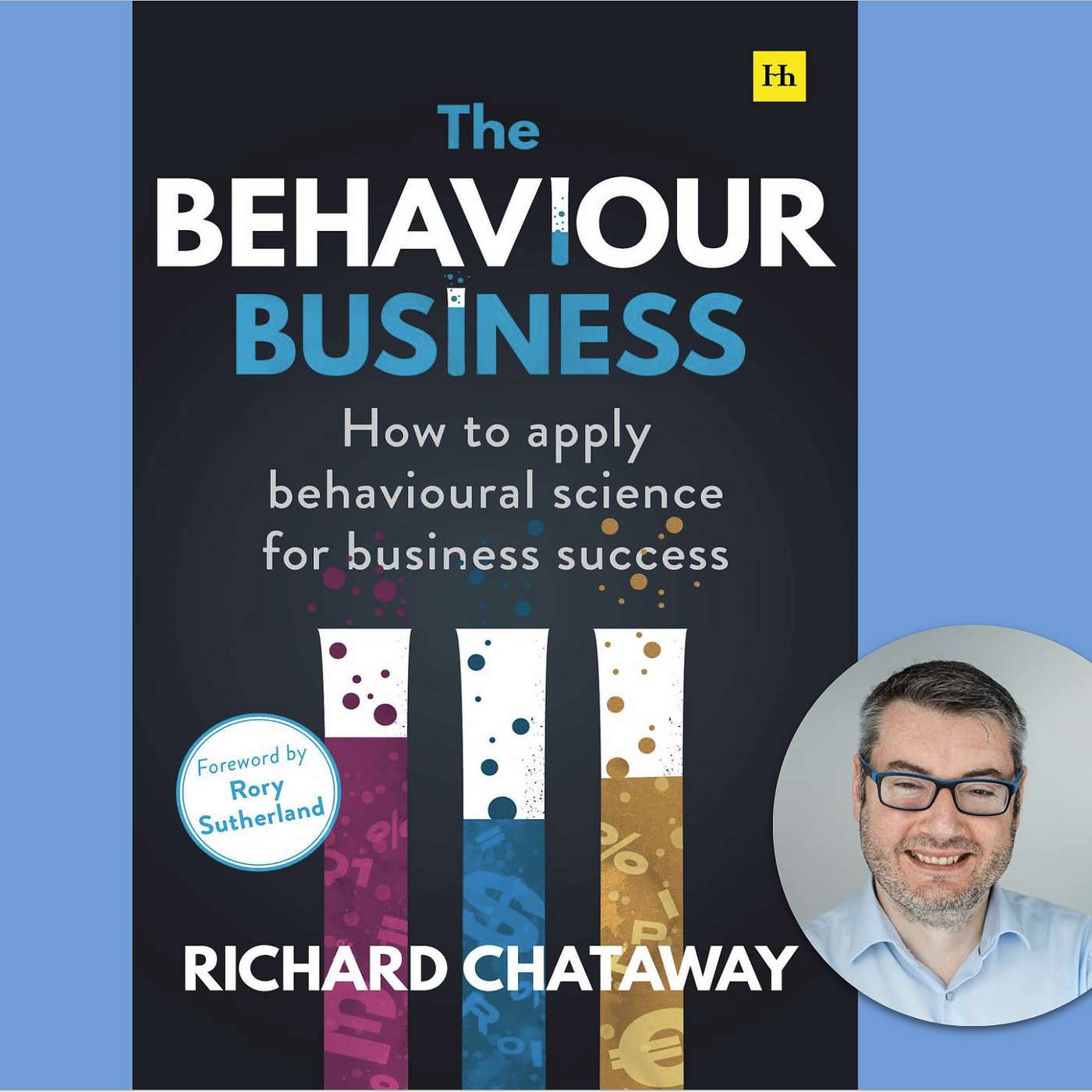
S1 · E123 · 1 Jul 2026 · 59 min
Interview: Richard Chataway, author of The Behavior Business, on why every business is in the business of behavior
In this episode, we speak with Richard Chataway, founder of Communication Science Group and author of The Behaviour Business. Richard reveals how he used behavioral science to help people quit smoking, why diversity has both a moral and commercial justification, and how interacting with AI changes our behavior.
-

S1 · E122 · 24 Jun 2026 · 49 min
How AI is influencing marketing and why human judgment still matters
In this episode, MichaelAaron and Richard explore the intersection of artificial intelligence and behavioral science. They discuss why AI amplifies good and bad thinking alike, how overreliance can weaken judgment, why creativity risks becoming more uniform, and how understanding human behavior remains a critical advantage in the age of AI.
-

S1 · E121 · 17 Jun 2026 · 39 min
How e-commerce brands use behavioral science to increase perceived value
In this episode, MichaelAaron and Richard explore how behavioral science can improve e-commerce performance. From why perfect reviews reduce trust to how scarcity boosts value perception, they unpack practical ways brands can increase conversion, reduce friction, and shape buying decisions online.
-

S1 · E120 · 10 Jun 2026 · 47 min
Interview: Michael Hallsworth, creator of the EAST framework, on what really changes behavior
In this episode, MichaelAaron and Richard sit down with behavioral scientist Michael Hallsworth, co-creator of the EAST framework and author of The Hypocrisy Trap. They explore behavior change, social influence, hypocrisy, and why relatable messengers, simple interventions, and context matter more than most marketers realize.
-

S1 · E118 · 28 May 2026 · 34 min
The 4 P's of Marketing: Place
In this episode, the fourth and final installment in a miniseries on the 4 Ps of Marketing, MichaelAaron Flicker and Richard Shotton explore how behavioral science shapes “place.” From making products easier to access to using scarcity and premium environments to influence perception, they unpack why distribution is far more powerful than most marketers realize.
-

S1 · E117 · 20 May 2026 · 1 hr 2 min
Interview: Robert West, creator of the COM-B model, on the three forces behind every human behavior
In this episode, MichaelAaron and Richard sit down with behavioral scientist Robert West, creator of the COM-B model, to explore the three forces behind every human behavior: capability, opportunity, and motivation. They discuss why behavior change so often fails, how environments shape decisions more than we realize, and how businesses and governments can design more effective interventions.
-

S1 · E116 · 14 May 2026 · 46 min
The 4 P's of Marketing: Product
In this episode, part three of a miniseries on the 4 Ps of Marketing, MichaelAaron and Richard explore how behavioral science shapes product design. From optimal newness to visible social proof and sensory cues, they show how small design choices can dramatically influence perception, appeal, and willingness to pay.
-
S1 · E115 · 6 May 2026 · 39 min
Awarded Campaigns: How Specsavers used humor and consistency to become one of the UK’s most effective brands
In this episode, MichaelAaron and Richard unpack how Specsavers turned a simple joke into one of the UK’s most effective campaigns. By combining humor, consistency, and behavioral science, they show how the brand captured attention, avoided fear-based messaging, and built lasting trust and growth.
-

S1 · E114 · 29 Apr 2026 · 46 min
The 4 P's of Marketing: Pricing
In part two of our miniseries on the 4 Ps of Marketing, MichaelAaron and Richard explore how behavioral science can improve pricing decisions. They discuss how price signals quality, why delaying costs boosts uptake, how fairness shapes willingness to pay, and how framing upgrades as small differentials can increase conversion.

Take it with you
The Melo app keeps playing with the screen off, works in the car and on your watch, wakes you to your station, and browses the whole catalogue offline. Free, no ads, no account.


