

Season 5 · EHA Unplugged
Accelerating Clinical Trials with AI (with Dr Jan Moritz Middeke)
13 Jan 2026 · 16 min
Episode notes
[This is a Rerelease. Episode first published on April 11, 2025.] Listen to Dr. Jan Moritz Middeke from University Hospital in Dresden as he discusses the future of clinical trials in hematology and the role artificial intelligence (AI) may play in that field. Dr. Middeke explains how synthetic data is generated and what are the potential benefits and limitations of its use in clinical trials. He also points out the open questions and hurdles that need to be addressed before AI-generated synthetic patients can be included in clinical trial design. Tune in to hear how Dr. Middeke envisages…
Transcript
Read the transcript · about 2,160 words, follows along as you listen
Greetings and welcome to EHA Unplug, the official podcast channel of the European Hematology Association EHA. Hello, I am Isabella Rivera, a medical writer for EHA. Today we're thrilled to have Doctor Jan Moritz Medeka, a distinguished hematologist and AI specialist. We're going to be talking today about AI to accelerate clinical trials. Welcome, Doctor. Medeka, can you please introduce yourself? Hi, yeah, thanks for having me. I'm, I'm Moritz Malika from the University Hospital in Dresden. I'm working there as a hematologist and have a. Research Group.
On AI in hematology. So we want to understand how you can accelerate clinical trials by generating data with AI. Can you please explain first what is synthetic data? Synthetic data is as the name says. Data which is. Made-up and. The idea is that we face a. Big problem with clinical trials in general, but especially in hematology. Where a lot of the diseases are rare diseases for. Example acute myeloid leukemia is a rare. Disease per seat. And we already know that.
There are several subgroups with targeted therapies, so the. Number of patients we can include in clinical trials are even lower and therefore we need to think about new ways how we can. Accelerate how we. Perform clinical trials in order to get sufficient data to get the knowledge about novel. Therapies. So what types of synthetic data are you generating that could be used for clinical trials? So the idea. Is that you have synthetic? Data which is.
Reassembling the original cohort in a A. Most perfect way. But without being able. To get back. To the original data. So you're generating images. This can be used. Used both for. Images. But also for tabular. Data and what we did in recent study and also other groups have shown is that you can reassemble real clinical trial data in terms of baseline data, but also in terms of outcome results based on cohorts of of. Real. Patients and the synthetic data is reassembling all the information about the original patient which is like. Age.
Sex. But also molecular changes and then the outcome after a given intervention. And how do you generate the synthetic data? So for this. We used guns, Generative Adversarial Networks, which is a known form of AI. Which has been. Used for image generation. Quite successful. Already. But can also. Be used for tabular data and in our specific work we use two types of these, so. Nflow and C Top Gun. So these are types of deep learning and it's generative modelling.
You have described 4 scenarios in which synthetic data generation can be useful and I would like to walk through this for the audience. So first, AI generated data could help to prevent privacy concerns about clinical trial date data of the patients. Exactly so. The generated synthetic data can be shared without any. Privacy issues, so we checked that. There was no single patient in the synthetic cohort. Which was exactly. Matching the original patient.
So there's no way that you can go back to the original patient which. Of course is the case if you. Just have an anonymized data, so this makes. It really easy. You can just upload these data and make them available. Also for other research. Group and see public. So how does this compare to the de identification or anonymisation of patient data? So anonymisation of these data isn't 100% sure, and with the synthetic data it's 100% sure. So there's no way that you can go back to the original patient. Because see, there's.
No original data coming from one single patient. So it's basically 100% sure that you can't go back to the. Characteristics of. One single patient. So this is a big step forward for this kind of data. Also, you would create new patients and this would lead to either cohort augmentation, so some synthetic patients among patients that are real or completely a substitution and you have a complete new cohort. How robust is this process? So for the. Generation it's.
Very robust. We showed and also other groups. Matteo de la Porta did this for MD's. Showed that it's. Reassembling the whole. Crestrix of the. Patients for a given disease. So it's not only age and sex in terms of the distribution, but it also comes down to the molecular changes, which is very important because we know that there are certain relationships between certain mutations. So for example, if you have an NPM 1 mutation, you're more likely to also have inflat 3 mutation. And these correlations are preserved in the synthetic. Data set.
And this. Holds also true. For correlation between age and certain cytogenetic abnormalities like complex. Karyotypes with with. Higher age and so on so. Biologically. Important correlations are. Preserved. Within this data and even more important, this also. Holds true for the. Correlation to the outcome data, so known factors for. Poor or good? Prognosis are also preserved in the synthetic. Data so if. You have a patient with some complex karyotype. He.
Also has a worse prognosis in the. Synthetic group of patients, and this is super important because if we want to use him as a real control group, we have to make sure that. This is also. Like in the. Real world. So there's also A use for exploratory analysis. So synthetically enlarged data sets, what is the interest? Of this, we know that there are several important subgroups when we stay in the case of acute myeloid leukemia, certain molecular subgroups which are recurrent.
But are rare. And. So for these group. Of patients, it's of course very important to know. How they fare with a certain. Therapy and. With a synthetic. Generation of data you can. Substitute or. Enlarge. These rare subgroups. How reliable is this process? We have all heard about hallucinations in AI. Can this generative AI generate misleading data? Well. Of course, you always have to show it. For a given group, but for the examples I mentioned. This is very robust, so. There are some small differences, but in general. This is.
Very robust in terms of how the baseline distribution of. Characteristics is but also. For the outcome data, however, especially when the outcome events get lower in the training group. This leads to a lower. Robustness of the model. So there is still open question where we have to work on. And the last case you mentioned where this kind of synthetic data can be used is in model training or benchmarking. Can you explain this further? So the. Idea is that.
We also have to generate. Data for rare subgroups. And for that we can use synthetic data to enlarge the group of. Patients, basically. For in clinical trials this generated patients are called now synthetic patients. Can you summarize what the advantages to use this kind of synthetic patients? We have to point out that. So far synthetic. Patients have not been used within clinical trials and. I believe that there's still a lot of work to do, also from a regulatory. Aspect to.
Show that this is really feasible. On the other hand, we know that the generation works and the. Problem is so big that. We have to think of new ways how we can accelerate clinical testing. So for this example we used. Only intensively treated acute myeloid leukemia patients almost with. Our targeted therapy, so this has to. Be shown with. Targeted therapies this has. To be shown with. Real life data. And with certain intervention and there's a lot of.
Work to do. Before we can really. Say OK. So we one group of patients within a clinical trial for in the end leading to an approval or identification of certain efficacy of a of a given drug. So really is work in progress, how closely does these cohorts match real world cohorts? OK. That's a difficult question because. It hasn't been shown yet. So for the moment you don't know really how well and it's being tested. We know how well it matches. For.
A given group of patients we studied. Or other groups. Studied and there it is working well. However, we have to. Yeah. Prove this for real world cohorts. And and certain interventions. So the idea would be to use these cohorts mostly in the control group in a clinical trial at the beginning at least. Yes, I, I. I think this is the most realistic and and closest scenario that we use this as a control group, an enlarged control group. Yes. With a certain intervention.
Which would be interesting because then you don't have to assign patients to a control group. So you mentioned the regulatory considerations. We have some tools at the moment, like GDPR or HIPAA. Are they enough to address the potential issues that this kind of synthetic patients would bring? Well, I think this. Requires. Complete new thinking about the approval process and the. The way we look at. Clinical trials. We need a. Way to prove that this is.
Really working and and I envision this in the 1st. Place to go. Alongside clinical. Trials and this is also. What we are currently doing, so we're going back to clinical. Trials we already. Did and we are going to see how many patients we can substitute by synthetic patients. To get the results, we. Already know, so for me this is an important step. To show how. We can incorporate A synthetic patients in real clinical trials and I think this step has to be done in close contact. With the authorities.
That we together define criteria. Where we say OK this is. Working and we can move on further. So if you had a crystal ball and could see what the future holds in five years time, do you think it's going to be used a lot? Yeah, what 5? Years is close in in clinical testing, but I I know. That the way we. Did clinical trials in rare disease like acute myeloid leukemia in the. Past is over. So there won't be clinical. Trials with like. 1000 patient randomized with a certain drug because in the meanwhile other drugs are coming up we we gain further knowledge. So this is getting harder and harder to perform these large trials.
So we have to. Adopt new methods and I think synthetic data is 1 very promising way. But there are several steps. Before we can really say, OK, that this is working and enhancing our clinical testing. Are there other uses of this data that you are now developing for prognostic capabilities in hematological malignancies? So coming back to images, there's another interesting field where we can enhance the amount of images. For rare subgroups. Of patients, so basically doing the same thing for small subgroups within clinical.
Trials. We can also do this for. Images of of bone marrow smears, for example. This is already, it's been used. Well, I wouldn't say it's been used, but it's like we and others have shown that this is working and that you can generate synthetic images based on real bone marrow smears and that you can't really tell which is a synthetic or. A real bone marrow smear picture. And these have been used to train. Well, it hasn't been used, but that's. The idea.
So the idea. Is that you can generate more data and then increase model development. So in the future you think that you will go beyond the control group, so you would use the synthetic data also in the test group. The improvement of the techniques is so fast that we can really, like simulate what is going on within a single cancer. Cell with a. Certain intervention and with that I believe that in I don't know how many years, but in the future. We will be able to.
Also simulate what will happen to a certain group of patients when we. Give the drug X. Yes, I'm I'm a biologist by training and I find difficult to imagine that you will be able to reproduce this complex system in its totality, but I look forward to it. It would be fantastic. Yeah. Agree on that but like. Five years back, you probably would. Have said that in predicting protein structure which is now working almost. Perfectly. So yeah. I think it's really promising and I really hope this works because it would help enormously in accelerating clinical trials and treating the other patients. So thank you very much, Doctor Mideke, for sharing your insights and your experience with us. Thank you to everybody for listening. And if you like this episode, don't forget to like it and share it with your colleagues.
And stay tuned for our next episode. Thank you. Thank you.
Transcript supplied by the publisher with the episode.
Podcast
EHA Unplugged
European Hematology Association · Tech & Science · English
In these EHA-produced podcasts, experts share with you their hematology knowledge and stories. With "EHA Unplugged" we would like to give you the opportunity to unplug from your computer screen, while still learning, by listening to interviews, clinical cases, monologues, and more.
More from EHA Unplugged All episodes →
-
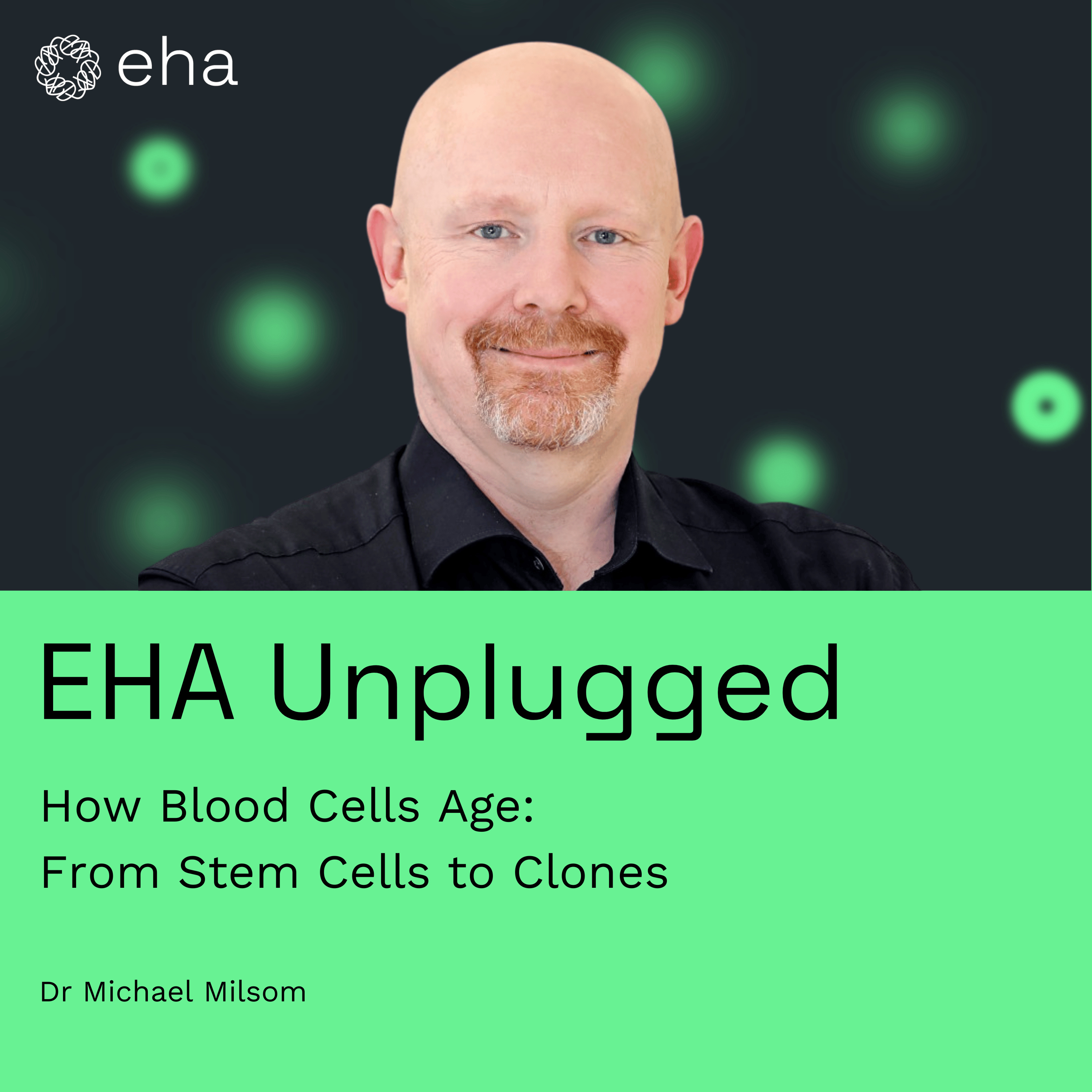
S6 · E2 · 27 Feb 2026 · 27 min
How Blood Cells Age: From Stem Cells to Clones (with Dr Michael Milsom)
In this episode, Dr Michael Milsom discusses how thehematopoietic system aging is a complex process with multiple causes. Dr Milsom proposes a more holistic view of the driving mechanisms of hematopoietic andimmune aging that does not focus solely on HSCs. He describes how inflammation‑driven stem cell activation and proliferation cause functional attrition and clonalselection of HSCs, contributing to clonal hematopoiesis. Learn about the mechanisms of blood cells aging andpotential interventions to slow down the process. Guest: Dr Michael Milsom Head of the Division of Experimental…
-
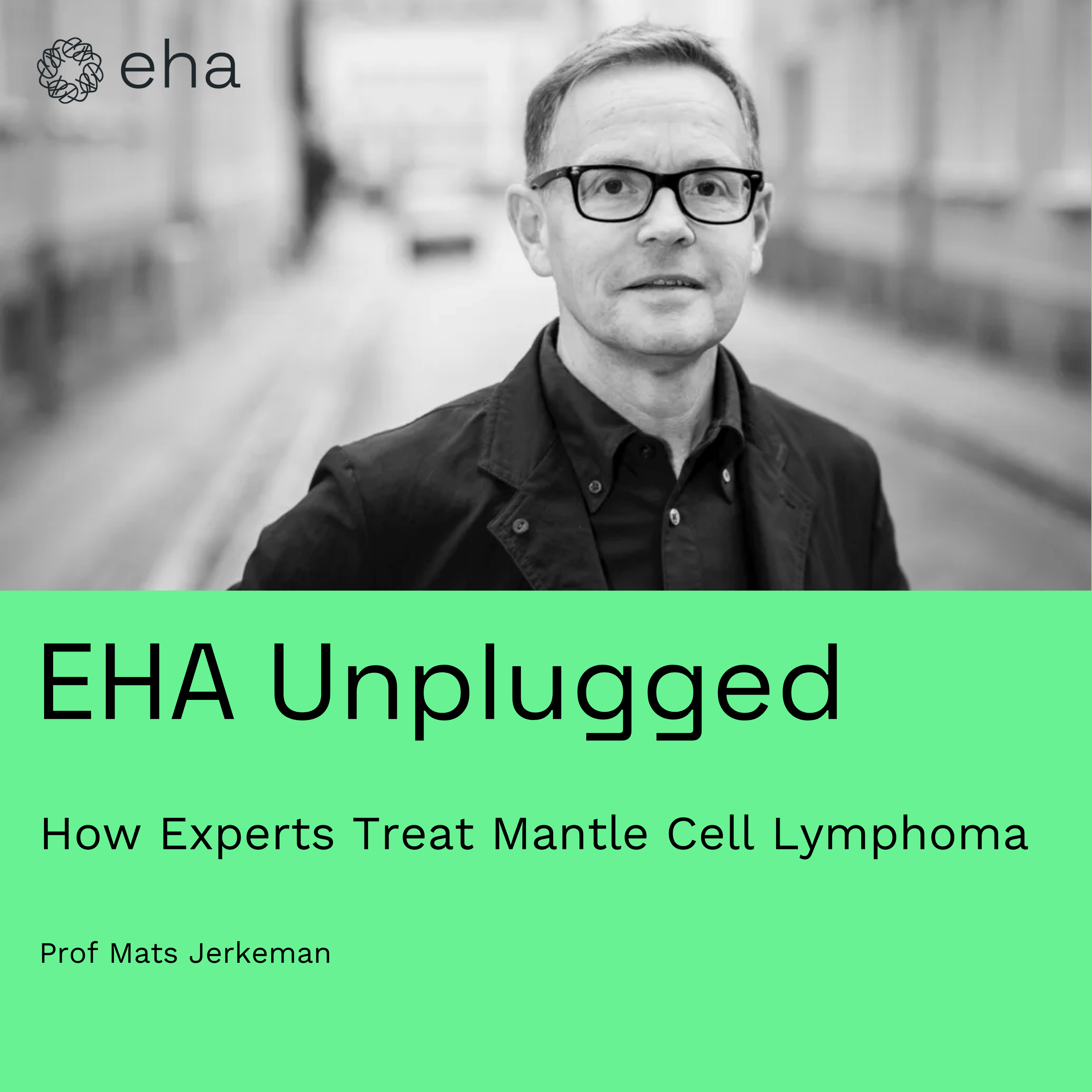
S6 · E1 · 6 Feb 2026 · 16 min
How Experts Treat Mantle Cell Lymphoma (with Prof Mats Jerkeman)
Get up to date with the latest EHA-EU guideline for Mantle Cell Lymphoma ( EHA–EU MCL network guidelines for diagnosis and treatment of mantle cell lymphoma - Jerkeman - 2025 - HemaSphere - Wiley Online Library ) with Prof Mats Jerkeman (Lund University, Sweden). In this episode, he explains how biological risk factors, particularly TP53 mutations and proliferation rate, inform patient stratification. He reviews evolving treatment sequencing, including the expanding role of BTK inhibitors (such as ibrutinib) in first-line regimens. He further discusses the management relapsed/refractory MCL,…
-

S4 · 30 Jan 2026 · 12 min
Life After CAR T-cell Therapy: Jonathan Clark’s Journey with Mantle Cell Lymphoma and the Future of Patient Advocacy
[This is a Rerelease. Episode first published on July 19, 2024.]Join us for a conversation with Jonathan Clark, a patient advocate who has been in remission for over five years after receiving CAR T-cell therapy for Mantle Cell Lymphoma. Jonathan shares his journey from relapse to recovery, detailing the challenges and triumphs of this cutting-edge treatment from a patient’s perspective. With host Dr. Sarah de Vlieger, they discuss his motivation for sharing his story and the profound physical and psychological impacts of long-term remission. Jonathan also talks about managing long-term side…
-

S4 · 23 Jan 2026 · 16 min
The Role of Artificial Intelligence in Hematology (featuring Dr Gregor Hormann)
[This is a Rerelease. Episode first published on November 22, 2024.]Join us in this podcast episode to get a glimpse of what the future holds in the big field of innovation in hematology. With the help of our host, Dr Gregor Hormann (MLL Munich Leukemia Laboratory, Germany), you will be taken on a journey toward a future that is already here. Dr Hormann will discuss the many potentials of AI in hematology and oncology, including the automated integrated diagnostic tools, from morphology to chromosomal banding analysis in a few minutes, new classification algorithms, and innovative large…
-

S4 · 16 Jan 2026 · 13 min
How Does Climate Change Affect Hematology Practice? (with Dr Stephen Hibbs)
[This is a Rerelease. Episode first published on November 1, 2024.] Join us for an engaging episode with Dr. Stephen Hibbs from Queen Mary University of London as he discusses the environmental impacts of hematology. Alongside our host Dr. Sarah de Vlieger, they explore how climate change is already affecting hematology, emphasizing that these effects are being felt now rather than in the future. The conversation highlights how climate change alters aspects of hematology practice, such as the risk of transfusion-transmitted infections due to evolving disease vectors. Dr. Hibbs describes also…
-

S5 · E42 · 12 Dec 2025 · 19 min
EHA Junior Research Grant: Dr Ana Río-Machín’s Journey in AML Research and Collaborative Science
Join us for this interview with Dr Río-Machín from Autonomous University of Madrid in Spain as she discusses her research on rare subtypes of acute myeloid leukemia (AML), which she conducted thanks to the EHA Junior Research Grant. Her discovery of transcriptional activator of key leukemia drivers in one of these subtypes may pave way to new therapeutic approaches. Tune in to hear dr. Río-Machín‘s call for more collaborative research to achieve impactful results for patients in the future. Host: Isabel Olivera-Martinez, PhD, Medical Writer Guest: Dr Ana Río-Machín Learn More What did you…
-

S5 · E41 · 8 Dec 2025 · 27 min
Hematologists’ Role in the Management of Gaucher Disease (Prof Argiris Symeonidis and Prof Sam Salek)
Join us for this discussion between Prof Argiris Symeonidis from University of Patras in Greece and Prof Sam Salek from University of Hertfordshire in UK who focus on the role of the hematologist in the diagnosis and management of patients with Gaucher disease. Prof Symeonidis and Prof Salek are both experts in recognizing and treating this rare lysosomal storage disorder and share their recommendations for hematologists to ensure earlier detection of this disease. Host: Prof. Sam Salek, University of Hertfordshire, UK Guest: Prof. Argiris Symeonidis, University of Patras, Rion, Greece Learn…
-

S5 · E40 · 28 Nov 2025 · 19 min
Navigating the Toughest Challenges in Hematology Nursing: Insights from HNHCP Leaders
Join us for this inspiring interview with Erik Aerts from University Hospital Zurich in Switzerland and Mairéad Ní Chonghaile from St. James’s Hospital in Ireland who discuss their extensive work within the Hematology Nurses & Healthcare Professionals Group (HNHCP). Erik, the President, and Mairéad, the Vice-President of HNHCP, describe their unwavering commitment to providing hematology education to nurses and other healthcare professionals to ensure the best possible care for their patients. Tune in to hear what their thoughts are on the future of nursing in hematology and how they…
-
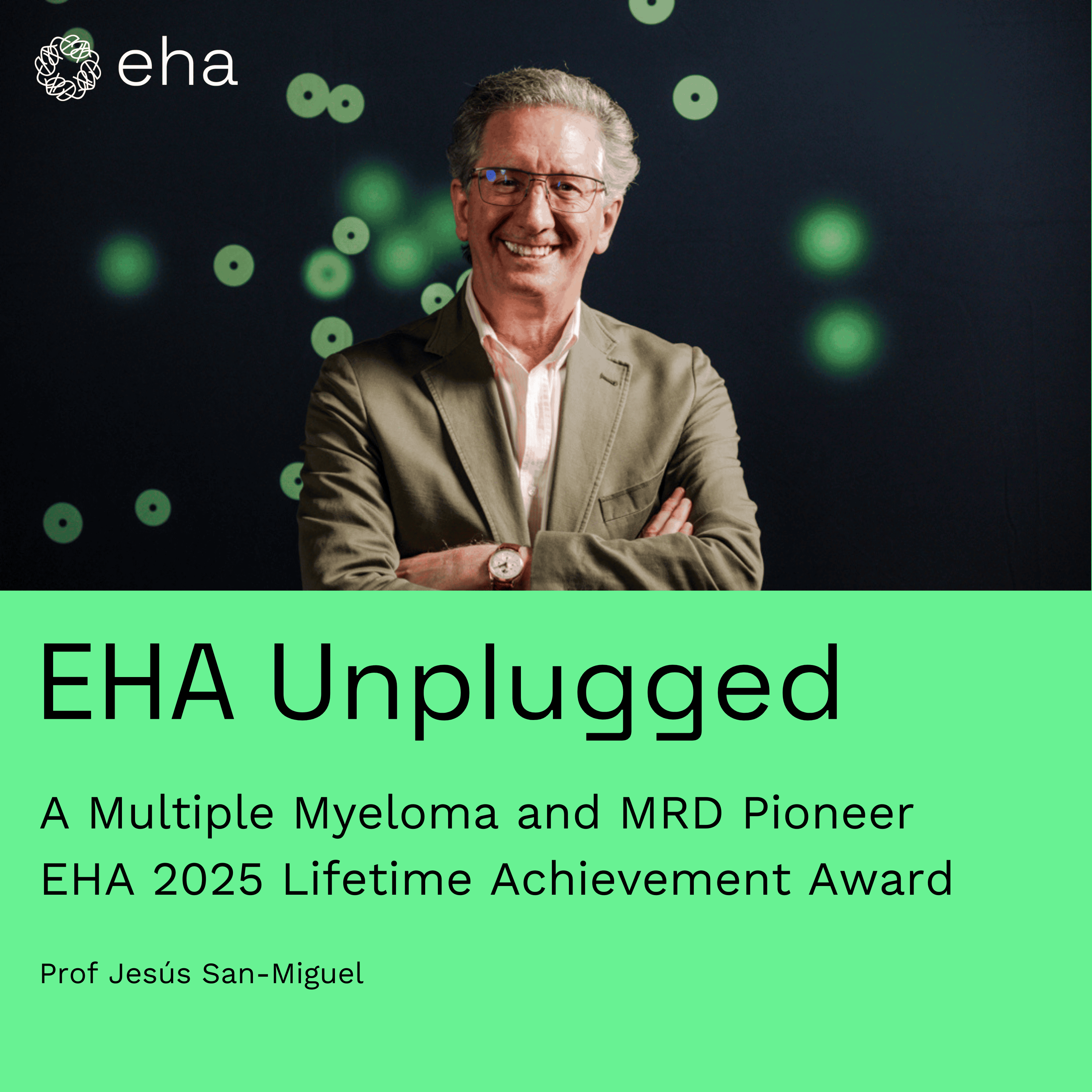
S5 · E39 · 21 Nov 2025 · 27 min
A Multiple Myeloma and MRD Pioneer: EHA 2025 Lifetime Achievement Award (Prof Jesús San-Miguel)
Join us for this inspiring interview with prof. Jesús San-Miguel from Clínica Universidad de Navarra in Spain who discusses his extensive work to improve care for patients with multiple myeloma. Prof San-Miguel’s research and clinical contributions have shaped the current treatment landscape for multiple myeloma. For his contributions, he has received the 2025 EHA Lifetime Achievement Award. Tune in to hear his thoughts about the future of multiple myeloma management and the crucial role that collaborative research will play in it. Host: Isabel Olivera-Martinez, PhD, Medical Writer Guest:…
-

S5 · E38 · 14 Nov 2025 · 22 min
Young Hematologists in the Spotlight: EHA2025 Young EHA Award (Dr Mandy Lauw)
Join us for this interview with Dr Mandy Lauw from Erasmus Medical Center in Rotterdam, Netherlands who describes her work to increase the visibility and voice of young hematologists within the EHA. For her unwavering efforts to improve the support and opportunities for young hematologists at the beginning of their career, Dr Lauw has been awarded the Young EHA Award. Tune in to hear about the many educational and mentoring programs EHA has available for young hematologists. Host: Isabel Olivera-Martinez, PhD, Medical Writer Guest: Dr Mandy Lauw Learn More What did you think of this podcast?…

Take it with you
The Melo app keeps playing with the screen off, works in the car and on your watch, wakes you to your station, and browses the whole catalogue offline. Free, no ads, no account.


