

Season 4 · EHA Unplugged
How Does Climate Change Affect Hematology Practice? (with Dr Stephen Hibbs)
16 Jan 2026 · 12 min
Episode notes
[This is a Rerelease. Episode first published on November 1, 2024.] Join us for an engaging episode with Dr. Stephen Hibbs from Queen Mary University of London as he discusses the environmental impacts of hematology. Alongside our host Dr. Sarah de Vlieger, they explore how climate change is already affecting hematology, emphasizing that these effects are being felt now rather than in the future. The conversation highlights how climate change alters aspects of hematology practice, such as the risk of transfusion-transmitted infections due to evolving disease vectors. Dr. Hibbs describes also…
Transcript
Read the transcript · about 2,470 words, follows along as you listen
Greetings and welcome to EHA Unplugged, the official podcast channel of the European Hematology Association EHA. I'm Sarah Deflecker and I'm here today in London with Steven Hibbs. Steven, would you please introduce yourself? Yeah, sure. So I'm up the road in London, in East London. I'm a hematology registrar and a clinical research fellow, mostly researching sickle cell disease care, but here to talk about something different. Yeah. So we're here to talk really about the environmental impacts of hematology. But before we get into that, how do you see that climate change is impacting hematology already?
Yeah. So I think there's probably often a conversation about climate change that thinks this is something that's going to happen in the future and it can be sort of end of the world scenarios. And those are real, you know, those are real. But I think what's often missed is that climate change is happening now and the effects of it are now. Probably one really important thing to say before I answer that directly is that the the worst effects of climate change are felt by those who've contributed least to emissions and who are least equipped to to deal with those consequences because they're in parts of the world that have already been impoverished by the way the global financial system works.
So that's really important just to say to start with. And so many of our colleagues who listen to this in countries like the Maldives or Bangladesh or around the Sahara will know far better than any of us do that climate change is real and it's happening now. But I think for those of us who perhaps have felt less of the impact of that so far, we're going to start seeing it in these big ways. But perhaps it's just worth pointing out a few ways in which this is affecting specific parts of hematology practice.
So I'll give a couple of examples. When we think about blood transfusion, one key part is to ensure blood safety, thinking about transfusion transmitted infections. But something that we're seeing is that as climate changes, the vectors that spread particular diseases that can be transmitted in infections change. So West Nile virus is a good is a good example of that. That's already changing and we'll see more of this in the years to come. That's perhaps more of an obvious consequences of things as well, like disruption to logistical lines or some mass casualty events from severe weather events. Those are the sort of obvious things, but I think there's going to be an awful lot of things that are less predictable as well.
So one really good example of this paper published earlier this year in Lancet Planetary Health, showed that mothers who exposed to extreme heat in the first trimester pregnancy, their children were significantly more likely to go on to develop acute lymphoblastic leukaemia. Now, I could not have predicted about that, but that is not, to me, a an obvious link. And I still don't think anyone fully understands what that is. But I think it's a good example of how because systems are so interconnected, all of the planetary health of humans, but also animals, plants, every part of the planet is deeply interconnected. And we're going to see many, many ways in the coming decades in which hematology practices that we take for granted are going to be affected and disrupted by climate change. And you've been doing some research into the impact of hematology on climate change.
Can you maybe sort of tell our audience what you've been looking into? Yeah. So just take a bit of brief background. Healthcare related activities contribute 5% of global emissions. So of all CO2 emissions from anything in the world, 5% of it is related to healthcare. It's quite a big amount and there's a method called life cycle assessment which is looking at cradle to grade assessments of a particular practice or a particular item. So it's originally developed in construction, but it can be applied to healthcare activities.
So if I start with what kind of inspired the work and then I'll move on to transfusion. And there's been some really practice changing work looking at things like anaesthetic gases and inhalers that showed that you could take an anaesthetic gas that does exactly the same thing. So there's one called desflorine does exactly the same thing as something called Seba fluorine, but the first has 26 times the environmental impact of the 2nd. And so the first has now been outlawed, reduced from practice, removed altogether and Seba fluorine is used instead. And the same with moving from one type of inhaler to another type.
So we wanted to ask the question, well, what about in hematology practices? And specifically we were looking at transfusions. Was there a sort of smoking gun that we could identify to say there's something about the way in which we're collecting or processing or giving blood transfusions that could quickly be changed and lead to a reduction in its impact? So we wanted to ask the questions, what is the impact of a blood transfusion on the environment in terms of its carbon emissions?
And secondly, we wanted to ask the question where along the cycle are those emissions generated and what can we do about it? So it's a cut. Long story short, a lot of work went into it. We collaborated with some environmental engineers based in in America, lots of people throughout NHS blood and transport plant in the UK measured many machines, many chemicals, many tests, looked at transport surveys, even metered fridges and how much electricity they were used to come up with an overall figure. And So what I can tell you is that one unit of red blood cells in England generates about 7 1/2 kilograms of CO2 equivalent, and most of that is transportation, refrigeration and the plastic blood bags themselves.
And you said that this is in England. Do you think that this is, you know, can we extrapolate from this to other geographies as well? So I think there's a few factors that are going to change things in different places. So one is what's the electricity generation mixes in that country? So the UK has actually moved a lot to things like wind energy, renewable energy. And so actually the amount of carbon that's generate that's that's used to generate electricity in the UK is quite small compared to a lot of other countries where it could be two or three times bigger.
So that's one factor we've got to think about. Another is the distance is involved. So if you're in a blood system, so your blood provider who's providing over a huge kind of rural area or area where there's just big distances, then it's going to go up there and NHS blood and transplant the UK or sorry, the England's blood provider, they've already done quite a lot of work to do things like move to an electrified transport, transport fleet. And so I think all of those things mean that I expect the other, the other blood providers might find that their red blood cells generate even more carbon. I guess another question here is, well, what is 7 1/2 kilograms of CO2 equivalent, right? Because we're not used to dealing with this particular unit.
And I find it really hard to answer that question because depending on the answer I give you, it really sounds more or less significant. So I could tell you that it's about the equivalent of 100 COVID tests. Sounds quite a lot, You know, you think, well, that's, that's, that's a decent amount. I could also tell you that it's an 8 oz beef steak in a higher welfare cow or that you'd for one person going to an international hematology conference. So flying out to ASH or AABB or whatever. The amount of emissions generated by that trip is the same as 150 red blood cell transfusions. So what do you say?
It's significant, but modest compared to some other things. I read somewhere that it's equivalent to about driving 40 kilometers in a, you know, in a petrol car. So what would you say to people who say, well, you know, what's the harm in that? It's it, you know, it's a life saving procedure in many cases, yeah. Yeah. I mean, in no way is anything we're trying to say we should use less blood on the basis of its environmental impact. I guess it's more saying are there are there clear ways in which we can reduce the we can reduce now the impact that it does generate?
I think when we, when we think about the scale of one blood transfusion, it's not very much. But when we, when we sort of scaled it up to 1.3 million units transfused each year, it really does start to become a significant amount. And so any saving that can be made across that is significant. I think that some of the things actually might be quite practical, like modernizing fridges or consolidating things into one larger fridge rather than several smaller fridges is 1 quite practical thing that can be done.
Now we need to look at some of the plastic that's used in the blood bags that could improve things as well. But I think that the other thing here is that actually what this method shows us is that there's many other practices in hematology, transfusion and elsewhere where we might also apply such a method. Is there any indication on, you know where that might lie within hematology at this point? So it's not been done very much so far. A colleague of mine in in Harvard, Andrew Hantel, has looked a bit at doing remote or local consultations for cancer follow up rather than bringing people into centres some of the far away from their homes. There's a little bit of work looking at things like for blood counts and basic other hematology tests, but I think there's some really important work to be done looking at things like anticoagulation strategies. There really might be quite significant carbon footprint there that we've not seen.
I think when we think about transfusion, some of the frozen products we use, So if you put plasma in a freezer for two years, there's a huge amount of electricity generation and also refrigerant leakage there. Where now we've got possibilities of things like freeze dried products that don't need to be kept in a freezer that whole time. There really might be a significant saving there to make. So I think quoting Antonio Guterres, who's the UN secretary general, he says when we think about the climate, when we think about climate change, it needs to be Everything, Everywhere, all at once.
So are there any things that like an individual hematologist can do in order to reduce their impact? I think probably some of the stuff that makes sense already in when we think about economic and just patient care, things like challenging tests that don't make sense. I think reducing waste is going to be a big one. I think probably thinking about some of our professional practices as well. I mentioned things like international conferences and meetings.
I think there's, there's been some good suggestions about maybe using hub and spoke models rather than bringing everyone in the world to 1 central place. Could we have a few smaller local gatherings that then link in in different ways that that could be big? I think also just looking up at some of the things like our organisations we work for, I can say because I've already spoken to people on the E Hard board that E Hard does not have any investments in fossil fuels, but actually a lot of organisations might.
And so looking at the organisations that you're part of to see the impact they have. So I think the final thing I'd say is that if it's if there's someone who's listening to this and who is interested in the research aspect of this, there is a huge amount of work to be done to understand what our footprint even is and to look for some strategies how we might reduce that. You're obviously very passionate about this. Why should other hematologists get passionate about this? For those who haven't looked at the sort of wider conversation on climate change, it might seem quite a niche issue. I think for those who have looked at the sort of wide issues about climate change, it can be overwhelming. We're really looking at, you know, possibilities of millions of people dying within the next couple of decades of man made climate change.
And for me, I can often feel a bit overwhelmed by that and feel a bit paralyzed. Just it's too big, it's happening. What what can we do? I think what's not talked about enough are some of the good news stories and a question that I really like that one of my favorite podcasts about climate change often says is what would it look like for this to go right? What if, what if this goes right? And I think leading on from that question, if we look at some of the good news, like I think last week, the last ever coal power generation in the UK was shut down after 142 years of coal power. That's happened.
If we look at the last three years in the UK, we've gone from 15% of electricity as wind power to 35%. I mean, there's incredible upscale and there's incredible good news stories around the world. I mentioned about anesthetic gases, I mentioned about inhalers. I think that it is possible it might not happen. We might fail, we might face human extinction in the next decade, in the next century. That that is a possibility. But I think part of the reason about being about really trying to think about what we can do with as hematologists is both about feeling like we've got some agency, some power in this, but also about as, as Antonio Gutierrez says, being part of that, Everything Everywhere all at once. OK, thank you very much.
This is a very interesting conversation and I implore our listeners to have a look into this in their own time and look up some of the research and the position papers that have already been published on this. Thank you, Steven for being here with us today and TuneIn for the next episode of EHA Unplugged.
Transcript supplied by the publisher with the episode.
Podcast
EHA Unplugged
European Hematology Association · Tech & Science · English
In these EHA-produced podcasts, experts share with you their hematology knowledge and stories. With "EHA Unplugged" we would like to give you the opportunity to unplug from your computer screen, while still learning, by listening to interviews, clinical cases, monologues, and more.
More from EHA Unplugged All episodes →
-
S6 · E3 · 16 Mar 2026 · 17 min
Hematology Portraits: Prof Konstanze Döhner
Join EHA President Prof Konstanze Döhner from University Hospital Ulm in Germany as she discusses her deep interest in hematology, both in research and in the clinics. Listen as Prof. Döhner shares why she decided to focus on Acute Myeloid Leukemia (AML) and myeloproliferative neoplasms (MPNs) in her career as a medical doctor, a researcher and a educator. Tune in to hear Prof. Döhner describe her journey to becoming the EHA president and her reflections on the current challenges in the hematology field and the solutions she proposes to address those. Guest: Prof Konstanze Döhner, University…
-
S6 · E2 · 27 Feb 2026 · 27 min
How Blood Cells Age: From Stem Cells to Clones (with Dr Michael Milsom)
In this episode, Dr Michael Milsom discusses how thehematopoietic system aging is a complex process with multiple causes. Dr Milsom proposes a more holistic view of the driving mechanisms of hematopoietic andimmune aging that does not focus solely on HSCs. He describes how inflammation‑driven stem cell activation and proliferation cause functional attrition and clonalselection of HSCs, contributing to clonal hematopoiesis. Learn about the mechanisms of blood cells aging andpotential interventions to slow down the process. Guest: Dr Michael Milsom Head of the Division of Experimental…
-
S6 · E1 · 6 Feb 2026 · 16 min
How Experts Treat Mantle Cell Lymphoma (with Prof Mats Jerkeman)
Get up to date with the latest EHA-EU guideline for Mantle Cell Lymphoma ( EHA–EU MCL network guidelines for diagnosis and treatment of mantle cell lymphoma - Jerkeman - 2025 - HemaSphere - Wiley Online Library ) with Prof Mats Jerkeman (Lund University, Sweden). In this episode, he explains how biological risk factors, particularly TP53 mutations and proliferation rate, inform patient stratification. He reviews evolving treatment sequencing, including the expanding role of BTK inhibitors (such as ibrutinib) in first-line regimens. He further discusses the management relapsed/refractory MCL,…
-
S4 · 30 Jan 2026 · 12 min
Life After CAR T-cell Therapy: Jonathan Clark’s Journey with Mantle Cell Lymphoma and the Future of Patient Advocacy
[This is a Rerelease. Episode first published on July 19, 2024.]Join us for a conversation with Jonathan Clark, a patient advocate who has been in remission for over five years after receiving CAR T-cell therapy for Mantle Cell Lymphoma. Jonathan shares his journey from relapse to recovery, detailing the challenges and triumphs of this cutting-edge treatment from a patient’s perspective. With host Dr. Sarah de Vlieger, they discuss his motivation for sharing his story and the profound physical and psychological impacts of long-term remission. Jonathan also talks about managing long-term side…
-

S4 · 23 Jan 2026 · 16 min
The Role of Artificial Intelligence in Hematology (featuring Dr Gregor Hormann)
[This is a Rerelease. Episode first published on November 22, 2024.]Join us in this podcast episode to get a glimpse of what the future holds in the big field of innovation in hematology. With the help of our host, Dr Gregor Hormann (MLL Munich Leukemia Laboratory, Germany), you will be taken on a journey toward a future that is already here. Dr Hormann will discuss the many potentials of AI in hematology and oncology, including the automated integrated diagnostic tools, from morphology to chromosomal banding analysis in a few minutes, new classification algorithms, and innovative large…
-

S5 · 13 Jan 2026 · 17 min
Accelerating Clinical Trials with AI (with Dr Jan Moritz Middeke)
[This is a Rerelease. Episode first published on April 11, 2025.] Listen to Dr. Jan Moritz Middeke from University Hospital in Dresden as he discusses the future of clinical trials in hematology and the role artificial intelligence (AI) may play in that field. Dr. Middeke explains how synthetic data is generated and what are the potential benefits and limitations of its use in clinical trials. He also points out the open questions and hurdles that need to be addressed before AI-generated synthetic patients can be included in clinical trial design. Tune in to hear how Dr. Middeke envisages…
-

S5 · E42 · 12 Dec 2025 · 19 min
EHA Junior Research Grant: Dr Ana Río-Machín’s Journey in AML Research and Collaborative Science
Join us for this interview with Dr Río-Machín from Autonomous University of Madrid in Spain as she discusses her research on rare subtypes of acute myeloid leukemia (AML), which she conducted thanks to the EHA Junior Research Grant. Her discovery of transcriptional activator of key leukemia drivers in one of these subtypes may pave way to new therapeutic approaches. Tune in to hear dr. Río-Machín‘s call for more collaborative research to achieve impactful results for patients in the future. Host: Isabel Olivera-Martinez, PhD, Medical Writer Guest: Dr Ana Río-Machín Learn More What did you…
-

S5 · E41 · 8 Dec 2025 · 27 min
Hematologists’ Role in the Management of Gaucher Disease (Prof Argiris Symeonidis and Prof Sam Salek)
Join us for this discussion between Prof Argiris Symeonidis from University of Patras in Greece and Prof Sam Salek from University of Hertfordshire in UK who focus on the role of the hematologist in the diagnosis and management of patients with Gaucher disease. Prof Symeonidis and Prof Salek are both experts in recognizing and treating this rare lysosomal storage disorder and share their recommendations for hematologists to ensure earlier detection of this disease. Host: Prof. Sam Salek, University of Hertfordshire, UK Guest: Prof. Argiris Symeonidis, University of Patras, Rion, Greece Learn…
-

S5 · E40 · 28 Nov 2025 · 19 min
Navigating the Toughest Challenges in Hematology Nursing: Insights from HNHCP Leaders
Join us for this inspiring interview with Erik Aerts from University Hospital Zurich in Switzerland and Mairéad Ní Chonghaile from St. James’s Hospital in Ireland who discuss their extensive work within the Hematology Nurses & Healthcare Professionals Group (HNHCP). Erik, the President, and Mairéad, the Vice-President of HNHCP, describe their unwavering commitment to providing hematology education to nurses and other healthcare professionals to ensure the best possible care for their patients. Tune in to hear what their thoughts are on the future of nursing in hematology and how they…
-
S5 · E39 · 21 Nov 2025 · 27 min
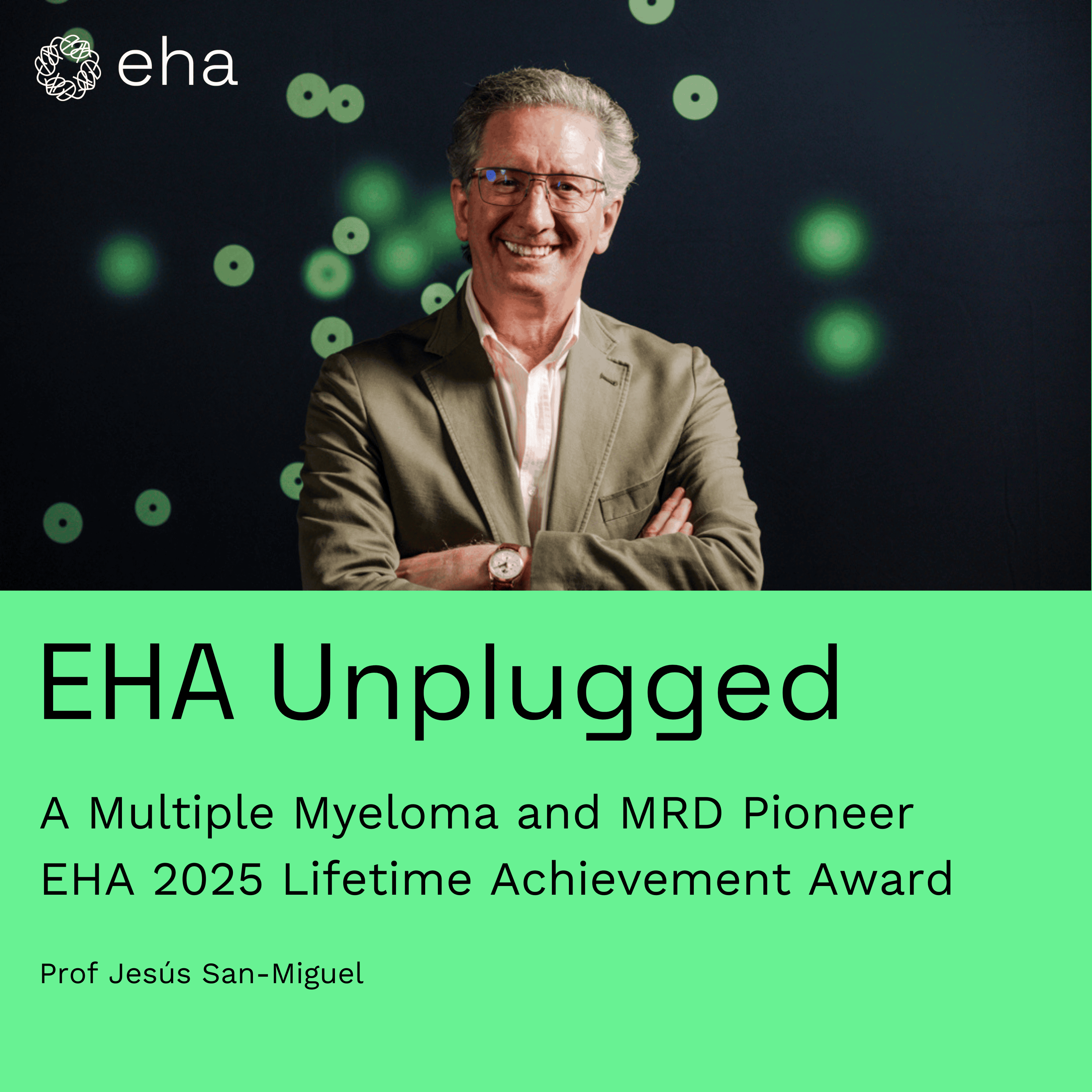
A Multiple Myeloma and MRD Pioneer: EHA 2025 Lifetime Achievement Award (Prof Jesús San-Miguel)
Join us for this inspiring interview with prof. Jesús San-Miguel from Clínica Universidad de Navarra in Spain who discusses his extensive work to improve care for patients with multiple myeloma. Prof San-Miguel’s research and clinical contributions have shaped the current treatment landscape for multiple myeloma. For his contributions, he has received the 2025 EHA Lifetime Achievement Award. Tune in to hear his thoughts about the future of multiple myeloma management and the crucial role that collaborative research will play in it. Host: Isabel Olivera-Martinez, PhD, Medical Writer Guest:…

Take it with you
The Melo app keeps playing with the screen off, works in the car and on your watch, wakes you to your station, and browses the whole catalogue offline. Free, no ads, no account.


