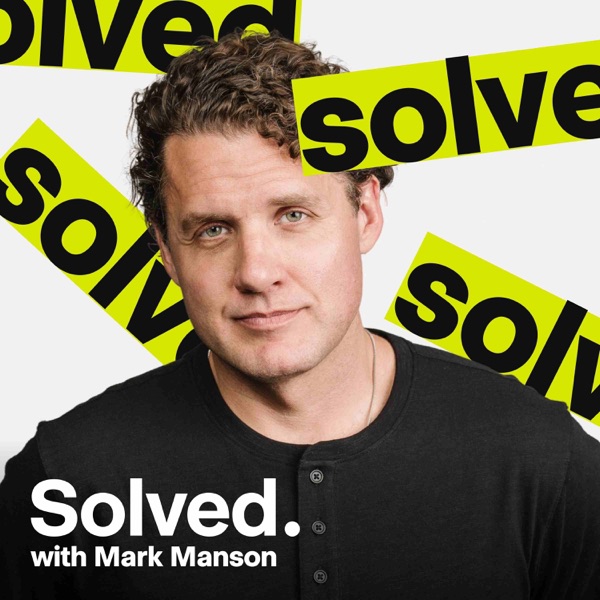
Solved Clips brings you the standout moments, key insights, and sharpest segments from SOLVED, the show where 3x #1 New York Times bestselling author Mark Manson answers life's biggest questions with research-backed, practical frameworks.
Watch the full Change episode on the Solved podcast: https://mrk.mn/change Most "personal growth" is perfectly designed to feel like progress while producing none of it. In this clip, Drew opens up in real time about being avoidant in relationships, and how he changed the behavior, catching himself, responding instead of shutting down, while the belief underneath it never actually moved. The realization lands live on the mic: he's no more securely attached than he was, he just got better at performing it. I get into my own version of this, including years of sabotaging relationships and…
Watch the full Confidence episode on the Solved podcast: https://mrk.mn/confidence What happens when confidence loses all connection to reality? Mark and Drew tell the story of Florence Foster Jenkins, the worst singer in history who still sold out Carnegie Hall, and the bank robber who wore lemon juice to hide from cameras, to explain the Dunning-Kruger effect and the real danger of overconfidence. Chapters Chapters 00:00:00 Florence Foster Jenkins: The Delusional Singer Who Sold Out Carnegie Hall 00:00:19 From Child Prodigy to Broke Single Mother 00:01:03 Inheriting Wealth and Pursuing an…
Watch the full Commitment episode on the Solved podcast: https://mrk.mn/tc7phn0t. The people who make it aren't the most talented or the most confident. They're the ones who can't imagine doing anything else. I went to music school with a dropout rate near ninety percent, and the ones who made it were never the students joking about becoming a pizza guy. Drew and I get into real faith versus blind faith, why Elon says he'd give aspiring entrepreneurs no encouragement at all, and the moment I told my co-founder I planned to die in this industry. Your calling doesn't ask your permission.…
Watch the full Commitment episode on the Solved podcast: https://mrk.mn/tc7phn0t. People don't regret the decisions they made. They regret the ones they never got around to making. I've made plenty of bad calls, lost money, embarrassed myself, and the only things I truly regret are the times I hurt someone I love. Drew and I get into the research on regret, Annie Duke's point that we all quit too late, and why a bias toward action beats a bias toward waiting almost every time. You're taking too long to decide, and it's costing you more than a wrong decision ever would. Chapters Chapters…
Watch the full Change episode on the Solved podcast: https://mrk.mn/change You've heard about the marshmallow test: the kids who waited for a second marshmallow grew up to ace the SATs and out-earn everyone, so willpower is destiny. There's one problem. The researcher who ran it, Walter Mischel, didn't believe that conclusion himself. In this clip, Drew and I get into what the famous study actually shows once you look past the headline. When Mischel ran it in Trinidad, the thing that predicted who could wait wasn't discipline, it was whether a kid had a reliable father at home. Later…
Watch the full Commitment episode on the Solved podcast: https://mrk.mn/tc7phn0t. Here's the uncomfortable truth about happiness: the decisions you can't undo are the ones that make you happiest. Harvard's Dan Gilbert calls it the psychological immune system, and it kicks in hardest when a door is truly closed behind you. Drew and I get into the one-sentence prenup that's a masterclass in incentives, why Gilbert proposed to his girlfriend the second he understood his own research, and why keeping every door open is a recipe for staying stuck. Constraints don't trap you. They free you.…
Watch the full Commitment episode on the Solved podcast: https://mrk.mn/tc7phn0t. Your brain was built for a world of scarcity, and it has no idea what to do with dating apps, endless scrolling, and infinite choice. Drew walks through the study where men rated their own relationships lower after seeing ten attractive faces for a few seconds, which is roughly thirty seconds online. We also get into additive bias, the reason your first move when you're unhappy is to add something new when what you actually need is to subtract. More options are quietly making you worse off. Chapters Chapters…
Watch the full Confidence episode on the Solved podcast: https://mrk.mn/confidence Performance builds confidence far more than confidence builds performance. Mark shares the four sources of self-efficacy, the power of starting with the smallest possible action, and stories from his years as a dating coach, when clients paid thousands only to learn that all they needed to do was say hello. Chapters Chapters 00:00:00 The Self-Esteem Movement Backfire 00:00:36 The Four Sources of Self-Efficacy 00:00:55 Mastery Experiences: The Foundation of Confidence 00:01:29 Learning from Others: The…
Watch the full Commitment episode on the Solved podcast: https://mrk.mn/tc7phn0t. I spent years traveling the world, dating whoever I wanted, working from a laptop anywhere on earth. It slowly made me miserable, and I want to tell you exactly why. In this one I get honest about the ADHD, the avoidant attachment, and the diminishing returns of chasing novelty on every front at once. The thing that pulled me out wasn't another adventure. It was noticing I'd rather drink beers with my old friends than raft through Indonesia. Narrowing down saved me. Chapters Chapters 00:00:00 Introduction: The…
Watch the full Commitment episode on the Solved podcast: https://mrk.mn/tc7phn0t. Your anxiety might not be fear. It might be freedom. Kierkegaard popularized the word anxiety, and his definition still hits harder than anything in a modern self help book: the dizziness of too much freedom. Every option you leave open is one you feel guilty for not taking. Drew and I unpack why standing at the edge feels worse than jumping, and why committing to something is a lot like diving into a cold pool. The dread is all before the leap. Chapters Chapters 00:00:00 Introduction: Kierkegaard's…
Watch the full Luck episode on the Solved podcast: go.markmanson.net/h0g98i67 If you want the entire luck framework in one place, this is the clip. I tie it all together: the three types of luck, the two traps that keep people stuck (thinking it's all luck, or thinking you earned every bit of it), and why the longer you live, the more your decisions outweigh whatever you were born into. Heaven luck, earth luck, human luck, all of it, clean and practical. Chapters Chapters 00:00:00 Introduction: Why We Avoid Thinking About Luck 00:00:48 The Legibility Problem: How Much Control Do We Really…
Watch the full Luck episode on the Solved podcast: go.markmanson.net/h0g98i67 If you want the entire luck framework in one place, this is the clip. I tie it all together: the three types of luck, the two traps that keep people stuck (thinking it's all luck, or thinking you earned every bit of it), and why the longer you live, the more your decisions outweigh whatever you were born into. Heaven luck, earth luck, human luck, all of it, clean and practical. Chapters Chapters 00:00:00 Introduction: Why We Ignore Luck 00:00:48 The Legibility Problem: How Much Control Do We Really Have? 00:01:21…
Watch the full Commitment episode on the Solved podcast: https://mrk.mn/tc7phn0t. A philosopher in 1846 predicted your Instagram feed. After a tabloid roasted him for months, Kierkegaard wrote some of the sharpest criticism of media ever put on paper. He named the thing that happens when everyone is connected to everyone: leveling, the quiet pressure to never stand out. Drew and I get into why the 19th century looked more like today than the 20th did, and why young people now barely dance, drink, or ask each other out. He called his shot 180 years early. Chapters Chapters 00:00:00…
Watch the full Commitment episode on the Solved podcast: https://mrk.mn/tc7phn0t. Why does nobody feel like a real adult anymore? For most of history, cultures had rites of passage that moved you from one identity into the next. We deleted the ritual but kept the awkward in-between phase, and now people get stuck there into their thirties. Drew and I walk through liminality, emerging adulthood, and Zygmunt Bauman's idea that commitment itself became an economic liability. By the end you'll understand why "30 is the new 20" is less of a joke than it sounds. Chapters Chapters 00:00:00…
Watch the full Commitment episode on the Solved podcast: https://mrk.mn/tc7phn0t. Most people think they're keeping their options open. What they're actually doing is running from a decision. In this one, Drew and I break down Kierkegaard's three stages of life and a brilliant follow-up from Walter Kaufmann, who mapped the ten sneaky ways we avoid commitment. He called it decidophobia. Drew shares the "practical" career choice that was really avoidance in disguise, and we get into why every escape hatch you build is a version of what Sartre called living in bad faith. Chapters Chapters…
Watch the full Luck episode on the Solved podcast: go.markmanson.net/h0g98i67 After a decade of research, Richard Wiseman found that lucky people share four specific habits. None of them are mystical, and every one of them can be learned. In this clip Drew and I walk through all four, and I get honest about which ones I actually live and which one took me years to figure out. Plus the true story of the networking dinner nobody wanted to go to that ended up changing our whole team. Chapters Chapters 00:00:00 Introduction: The Four Principles of Earth Luck 00:00:13 Principle 1: Maximizing…
Watch the full Luck episode on the Solved podcast: go.markmanson.net/h0g98i67 Napoleon was the poorest, smallest, most bullied kid at his academy, and he became maybe the most statistically improbable commander in history. I read the whole biography this year and could not stop thinking about him. In this one I get into how he manufactured his own luck: obsessing over high-leverage skills before anyone else did, crossing the Alps when every strategist said it was impossible, and eating dinner with his foot soldiers. It looks like luck from the outside. It wasn't. Chapters Chapters 00:00:00…
Watch the full Confidence episode on the Solved podcast: https://mrk.mn/confidence Confidence is built, not felt. Mark and Drew unpack Bandura's famous snake-phobia experiment, how "guided mastery" cured lifelong fears in a single afternoon, and why that same principle proves confidence is domain-specific and built from real evidence. Chapters Chapters 00:00:00 The Classic Snake Phobia Experiment 00:00:47 The Severity of Real Phobias 00:01:27 Guided Mastery: The Simple Intervention 00:02:30 The Birth of Exposure Therapy 00:02:51 The Unexpected Confidence Transfer 00:03:45 Act First, Believe…
Watch the full Luck episode on the Solved podcast: go.markmanson.net/h0g98i67 Some games are rigged in your favor before you play a single hand. A lucky dentist is barely better off than an unlucky one. A lucky musician is a millionaire. In this clip Drew and I break down power laws and why the game you choose, the industry, the career, the city, matters more than how hard you grind inside it. I use my own book as the case study, because the numbers there genuinely messed with my head. Chapters Chapters 00:00:00 Introduction: Earth Luck and the Poker Table Analogy 00:00:54 Power Laws: Why…
Watch the full Luck episode on the Solved podcast: go.markmanson.net/h0g98i67 Drew grew up in a small town in the middle of nowhere and spent years convincedheI got dealt a bad hand. He was wrong, and it took him a long time to see it. In this one we get into why the internet quietly makes almost everyone feel less fortunate than they are, how gratitude is really about widening your frame of reference, and the mental traps that keep you from reading your own luck straight. Including the guy who was born on third base and thinks he hit a triple. Chapters Chapters 00:00:00 Introduction: The…
Watch the full Luck episode on the Solved podcast: go.markmanson.net/h0g98i67 People burn a lot of energy fighting over whether success is luck or skill. Wrong fight. In this one I break down the framework that reorganized how I think about all of it: San Sai, an ancient Chinese model that splits luck into three kinds. The luck you're born with, the environment you put yourself in, and the way you play your hand. Two of the three you can actually work on. If life is poker, this is the difference between the cards, the table, and how you play them. Chapters Chapters 00:00:00 Luck Is…
Watch the full Luck episode on the Solved podcast: go.markmanson.net/h0g98i67 Two babies are born on the same day, one in Norway, one in Sierra Leone, and one of them will live 21 years longer. Neither picked a thing. This is the luck everyone fixates on, and it's also the luck you're worst at interpreting. In this clip I run the actual numbers, get into the philosopher's thought experiment that reframes the whole thing (the veil of ignorance), and tell the story of a pastor in Sierra Leone who stumbled onto a $10 million diamond. Because luck is always relative. Lucky compared to what? Good…
Watch the full Luck episode on the Solved podcast: go.markmanson.net/h0g98i67 Why do two people walk into the same coffee shop and one spots the cash on the floor while the other walks right past it? Richard Wiseman ran the studies, and the results are wild. Lucky people literally see more of what's in front of them. In this clip Drew and I get into how luck behaves like a skill you can train, and why we get so squirmy the second someone suggests our success came down to luck instead of genius. Chapters Chapters 00:00:00 Introduction: Why the West Struggles with Luck 00:01:06 Ancient Greece…
Watch the full Change episode on the Solved podcast: https://mrk.mn/change You've probably taken the Myers-Briggs test, put your type in a LinkedIn bio, or had a boss organize your team around it. In this clip, Drew and I get into why that four-letter label is closer to a horoscope than a science. I tell the real story of where MBTI came from: not a lab, but a mother-daughter pair working from a dining room table during World War II, building on Jung's ideas even though Jung himself warned against boxing people into types. We get into the numbers that should give you pause, like the fact…
Watch the full Confidence episode on the Solved podcast: https://mrk.mn/confidence Do affirmations actually work? Mark and Drew go through the research on affirmations, vision boards, and power posing, why most of it failed to replicate, and how affirmations can actually make people with low self-esteem feel worse. Plus the WOOP method that makes visualization genuinely useful. Chapters ⇨ Sign up for my newsletter, Your Next Breakthrough. It will help make you a less awful person: https://go.markmanson.net/msub25ez ⇨ Get clarity on what actually matters. Try Purpose, Mark's AI mentor app…
Watch the full Confidence episode on the Solved podcast:https://mrk.mn/confidence Nearly every piece of confidence advice we have inherited traces back to one anxious 1940s preacher, Norman Vincent Peale, and his book The Power of Positive Thinking. Mark and Drew break down the "feel fallacy," the mistaken belief that you have to feel confident before you can perform, and the surprising fact that the term "con man" comes from "confidence man." Chapters Chapters 00:00:00 The Origins of Modern Confidence Advice 00:00:45 The Birth of Positive Thinking 00:01:42 From Personal Hack to Global…
Watch the full Change episode on the Solved podcast: https://mrk.mn/change Most people who try to change themselves are working on the wrong layer, and that's why they keep failing. In this clip, Drew and I lay out the framework that runs through the entire Change episode: the self operates on three layers at once. Your personality traits are the base, your natural set point, and they barely move. On top of that sit your adaptations, the identities and habits you build to work with your traits and your environment. And at the surface is your behavior, which you can change tomorrow. The…
Watch the full Change episode on the Solved podcast: https://mrk.mn/change Everyone's taken a Big Five personality test at some point, but almost nobody knows what the results actually mean, or whether they're stuck with them for life. In this clip, Drew and I break down the single most replicated finding in all of psychology: the Big Five (OCEAN) traits, what each one actually predicts about your health, relationships, and career, and why not one of them is "good" or "bad," with a single exception. Then we get into the question that actually matters: can you change your personality, or are…
What happens when technology turns the entire planet into your tribe? Social media has essentially scaled shame to infinity — transforming our ancient survival instincts into a 24/7 shame machine. From cancel culture mobs to shameless trolls, the internet has distorted the way we relate to one another, fueling anxiety, outrage, and paranoia. Watch the full episode here: https://youtu.be/0M9b8bi6ApQ?feature=shared
About Solved Clips
Solved Clips brings you the standout moments, key insights, and sharpest segments from SOLVED, the show where 3x #1 New York Times bestselling author Mark Manson answers life's biggest questions with research-backed, practical frameworks.
Solved Clips is a English learning podcast from Mark Manson. Melo plays each episode straight from the publisher's own feed — no ads added, no account needed — and remembers where you stopped, in this browser only.
The Melo app keeps playing with the screen off, works in the car and on your watch, wakes you to your station, and browses the whole catalogue offline. Free, no ads, no account.