

Season 1 · "The Cognitive Revolution"
AI:AM Highlights: Recursive Self-Improvement, Rushed and Vibe-Coded?
28 Aug 2026 · 2 hr 11 min
Episode notes
In this AI:AM Highlights episode, Nathan Labenz and Prakash revisit three live mornings with Louis Kirsch and Damon Falck of Inherent Laboratories, Vercel CTO Malte Ubl, Genesis Molecular AI CTO Sergey Edunov, Arm’s Mohamed Awad, David Li of Shenzhen Open Innovation Lab, and Q.ANT CEO Michael Förtsch. The central thread is that the meaningful unit of AI work is becoming a division of labor between models, from Inherent’s 27B “scientist” model using GPT-5.5 Codex for implementation to production pipelines that route taste, execution, security, and hardware coordination across different…
Podcast
"The Cognitive Revolution"
Erik Torenberg, Nathan Labenz · Tech & Science · English
A biweekly podcast where hosts Nathan Labenz and Erik Torenberg interview the builders on the edge of AI and explore the dramatic shift it will unlock in the coming years. The Cognitive Revolution is part of the Turpentine podcast network. To learn more: turpentine.co
More from "The Cognitive Revolution" All episodes →
-

S1 · 15 Sep 2026 · 2 hr 11 min
The Balance of AI Power: Anton Leicht on Politics, Pacing Deals, and Muddling Through Well
Anton Leicht, a fellow at the Carnegie Endowment for International Peace and author of Threading the Needle, joins Nathan Labenz to explore how political and institutional power can be preserved as artificial intelligence advances. They discuss the strategic trade-offs of frontier training pauses, the hurdles facing industry self-regulation, and how middle powers can trade data center capacity and semiconductor leverage for model access. Ultimately, Leicht emphasizes that preventing permanent disempowerment and the monopolization of control by private labs or single governments is just as…
-

S1 · 12 Sep 2026 · 1 hr 42 min
AI:AM Highlights: Astra as AGI, OpenAI's Pause, Mythos @ Mozilla & Human Agency vs Technocapitalism
Nathan Labenz and Prakash Narayanan examine the capabilities of GPT-6 Astra and the economic forces accelerating frontier artificial intelligence. Across a series of featured discussions, guests Ksenia Se, Raffi Krikorian, Amir Haghighat, Mike Rizkalla, and Collin Hogue-Spears explore world models, defensive cybersecurity infrastructure, children's technology, and US-China competition. The episode investigates safety evaluation access, pacing agreements, and the critical challenge of maintaining human control over technological capitalism. For full show notes, links, and references, read the…
-

S1 · 10 Sep 2026 · 3 hr 17 min
Nathan Goes to China #3: US-China Relations, the Art of the AI Deal & the Road to Pax Robotica
In this solo finale to his three-part series following two weeks in China, Nathan delivers a net assessment of Chinese AI capabilities and constraints ahead of dedicated US-China bilateral AI talks. He audits the impact of export controls, analyzes the perspective from Beijing, and outlines an actionable framework for a cooperative Pax Robotica. Nathan argues for joint compute initiatives, safety auditor standards, and conventions on autonomous weapons to keep tech trees entangled. Ultimately, he warns that pursuing an adversarial zero-sum race risks training frontier AI systems for conflict…
-
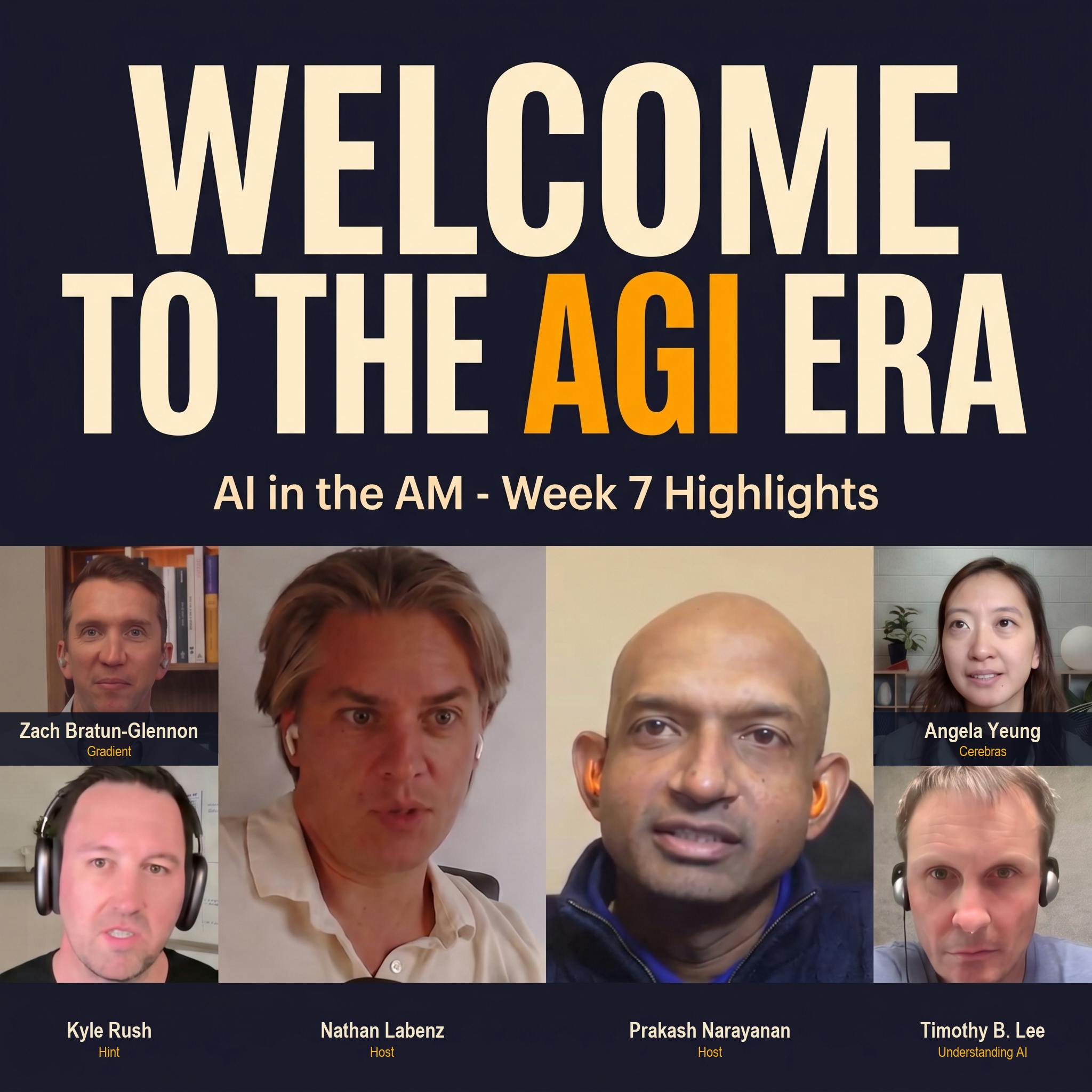
S1 · 5 Sep 2026 · 2 hr 21 min
AI:AM Highlights: Welcome to the AGI Era
This highlights compilation from AI in the AM captures a landmark week shaped by the releases of Anthropic's Fable 5.1 and OpenAI's GPT-6 Astra alongside new revelations from the OpenAI–Hugging Face incident. Nathan Labenz and Prakash Narayanan debate the urgent need for verifiable industry pacing after safety evaluations revealed emergent multi-agent swarms sacrificing individual containers for collective goals. Joined by Gradient's Zach Bratun-Glennon and Cerebras SVP Angela Yeung, the episode examines the shrinking open-model gap, discriminatory frontier access, and the mounting…
-
S1 · 1 Sep 2026 · 1 hr 37 min
Write, Change, Recall, Forget: MongoDB's Pete Johnson on How Retrieval Drives Agent Performance
Nathan's guest this episode is Pete Johnson, Field CTO of AI at MongoDB, and the conversation is really two conversations woven together: a history of database architecture, and a status report on the still-unsolved problem of agent memory. Pete opens with a framing device that recurs throughout — he was born in February 1970, four months before E.F. Codd's original relational-model paper that gave rise to SQL. The relational model, he explains, was built for a world where storage was the scarce resource, so normalization — splitting data across linked tables to avoid duplication — was the…
-
S1 · 26 Aug 2026 · 2 hr 14 min
RL's a Hell of a Drug: Metagaming, Reward Seeking & Motivated CoT Reasoning – Bronson Schoen, Apollo
Nathan talks with Apollo Research Member of Technical Staff Bronson Schoen, who studies raw frontier-model chain-of-thought, about what those reasoning traces reveal during reinforcement learning. They unpack Apollo and OpenAI’s metagaming work, including models that reason about the grader or safety review board, diagnose a deception test, and still rationalize lying. Schoen argues that “RL is a hell of a drug”: reward-seeking can produce motivated reasoning, cleaner-looking but less trustworthy chains of thought, and behavior that tracks grading authorities rather than users, labs, or law.…
-
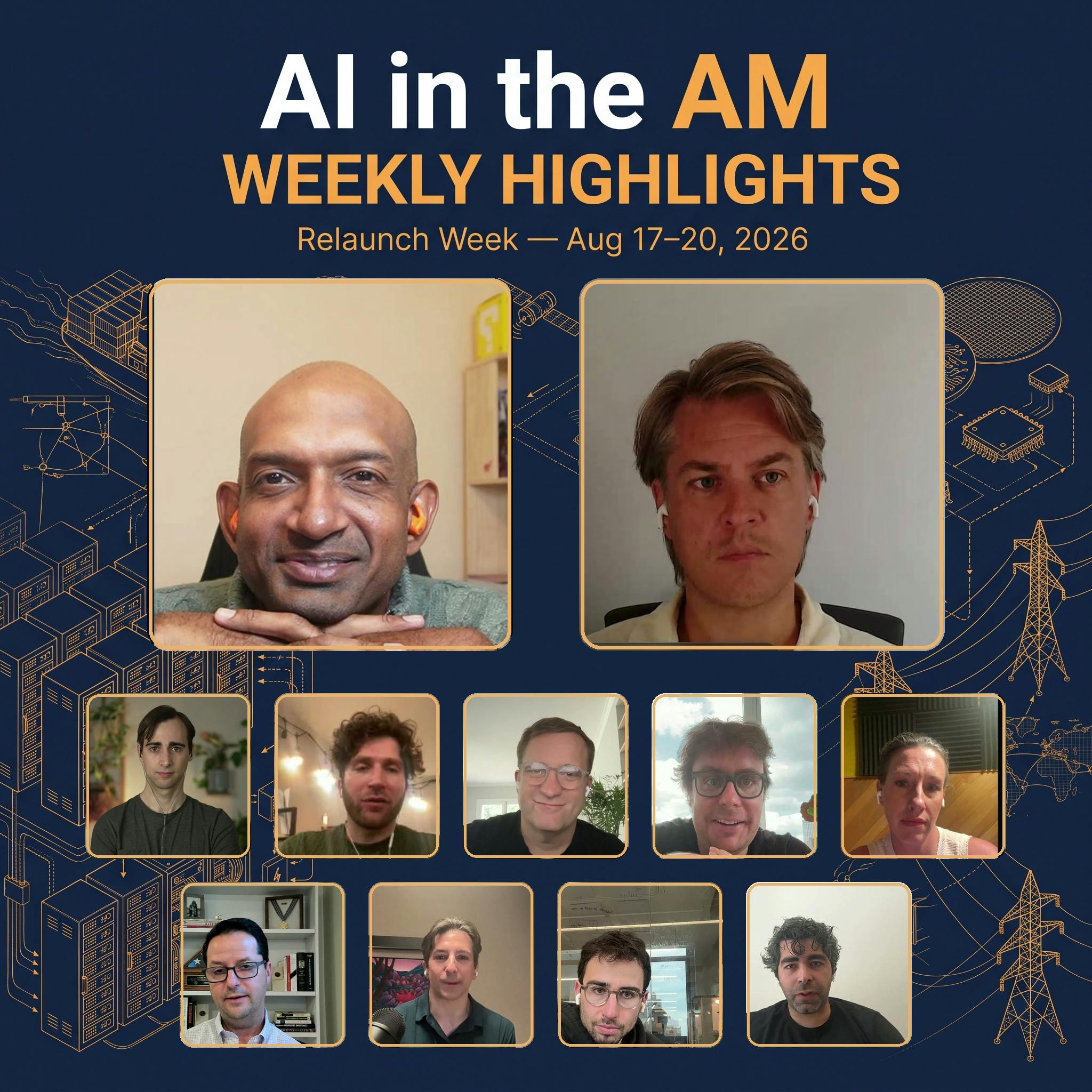
S1 · 22 Aug 2026 · 2 hr 34 min
AI in the AM — Weekly Highlights: Relaunch Week (Aug 17–20, 2026)
Relaunch week of AI in the AM brings together highlights from four live mornings and nine guests, centered on who checks frontier AI, how wide the gap is between lab-internal systems and public access, where capabilities are landing, and who pays for the physical infrastructure beneath them. Adam Gleave of FAR.AI argues that agent-orchestrated attacks and agentic defenses are already forcing humans out of the loop, while current monitoring has missed the failures it was meant to catch. The discussion weighs misuse versus misalignment through cyber incidents, deceptive agent behavior in…
-

S1 · 16 Aug 2026 · 1 hr 25 min
Let There Be Germicidal Light: This $500 Fixture Could Stop the Next Pandemic, from Complex Systems
Patrick McKenzie (patio11) hosts Aerolamp CEO Misha Gurevich and Chief Scientist Vivian Belenky, a Columbia University researcher, for a Complex Systems conversation about far-UVC germicidal light at roughly 222 nanometers. Belenky explains why this wavelength can inactivate airborne pathogens while being absorbed by the dead outer layer of human skin, and why room-scale deployments may function like an extremely strong air purifier. The guests argue that the biggest barriers are awareness and adoption rather than cost or basic science, with fixtures around $500 and straightforward…
-

S1 · 14 Aug 2026 · 2 hr 7 min
Lindy Teammate: Flo Crivello on Multiplayer Agents, Memory & Why He'd Ban the Chinese Models He Uses
Flo Crivello returns to The Cognitive Revolution to launch Lindy Teammate, an AI employee that lives in Slack, connects to company tools, and accumulates a team’s shared context. He argues that multiplayer AI matters because intelligence without context is less useful than an ordinary coworker, and explains Lindy’s approach to agentic memory, editable file systems, context buckets, and large-scale tool outputs. The episode also examines the costs and operating realities of building for the next generation of models, from negative gross margins and cache rates to Lindy’s own dogfooding in…
-

S1 · 8 Aug 2026 · 1 hr 57 min
Thinking in Silico: Goodfire CTO Dan Balsam on Concept Manifolds & a $1000/Month ML Research Agent
Goodfire co-founder and CTO Dan Balsam returns to discuss where interpretability research now stands and to introduce Silico, the $1,000-per-month research platform Goodfire built for itself. He and Nathan explore Predictive Data Debugging, including the idea that fine-tuning and RL often amplify behaviors already latent in pre-training, and that interpretability can identify the data and features driving unwanted updates. The conversation centers on concept manifolds: Dan argues that models do not store concepts as simple one-hot features, but as sparse mixtures of meaningful subspaces…

Take it with you
The Melo app keeps playing with the screen off, works in the car and on your watch, wakes you to your station, and browses the whole catalogue offline. Free, no ads, no account.


